
Definition, Identity, And Scope Of Eco‑Friendly Woven Bags
What are Eco‑Friendly Woven Bags in practical, engineering terms? They are load‑bearing sacks and carry solutions built from oriented polymer tapes—predominantly polypropylene (PP)—that are drawn, woven, and optionally laminated or lined to tune barrier, print quality, and sealing behavior. The “eco‑friendly” claim does not hinge on a single miracle resin. It emerges from system performance: high strength‑to‑weight ratios, right‑sized grams, low damage rates in logistics, opportunities for reuse, and credible design‑for‑recycling pathways. In other words, the bags are not green because of a label; they are sustainable because they keep products intact with less material than many alternatives while remaining configurable for local recovery streams.
Aliases used across markets (bold and numbered to avoid ambiguity):
- Eco‑Friendly Woven Bags
- Recyclable Woven Bags
- Recycled PP Woven Bags
- Sustainable Woven Polypropylene Bags
- Reusable Woven Shopping Bags
- BOPP‑Laminated Woven Bags
- Breathable Woven Bags
- Moisture‑Proof or Waterproof Woven Bags
Terminology varies by sector, yet the architecture is consistent: oriented PP tapes form a structural fabric; films, liners, and coatings add barrier and sealability; printing routes communicate brand and regulation. The value is born at the interfaces—where chemistry, mechanics, and graphics meet real‑world handling.
Is this format a compromise? No—it is a convergence. Eco‑Friendly Woven Bags reconcile seemingly opposite goals: tactile, matte panels that read like paper; rugged, ductile cores that behave like engineered polymer; closures that are clean at speed; pallets that travel square with fewer repacks. When strength, printability, and moisture control must all be true at once, the woven hybrid resolves the tension instead of forcing a trade.
Why “Eco‑Friendly” Must Be Earned: A Systems View
Packaging footprints are dominated by the product they protect. One torn 25‑kg sack of cement or flour wastes far more embodied energy and carbon than the grams of packaging that failed. The most sustainable bag is the one that prevents loss while using the least practical material. Eco‑Friendly Woven Bags earn their descriptor through five mutually reinforcing levers: damage avoidance, right‑weighting, pallet stability, reuse potential in certain channels, and alignment with local recovery options. Remove any one lever and the system weakens; design them together and the footprint per delivered kilogram falls.
Damage avoidance: higher tensile/tear and sealed closures prevent leaks and write‑offs. Less waste; cleaner lines; safer warehouses.
Right‑weighting: oriented PP tapes give more strength per gram; designers can hit drop targets with fewer grams.
Pallet behavior: paper‑like face friction and block‑bottom geometry keep stacks square, reducing dunnage and film.
Reuse windows: in retail/club settings, woven carry bags can cycle many times before end‑of‑life.
Recovery alignment: choose paper‑forward or PP‑forward designs to fit infrastructure—design for reality, not ideals.
Constituent Materials, Micro‑Properties, And Cost Logic
Any laminate performs only as well as its ingredients and the bonds between them. Eco‑Friendly Woven Bags commonly employ a toolbox of paper faces, polymer fabrics and films, sealant liners, and auxiliary chemistries. Below, each family is unpacked with where it fits, why it matters, and what it costs in trade‑off space.
- Kraft paper face: delivers printability, edge stiffness, and higher surface friction (COF) for pallet stability. White‑bleached gives color gamut for brand work; natural kraft improves tactile grip. Moisture must be managed to avoid fiber softening.
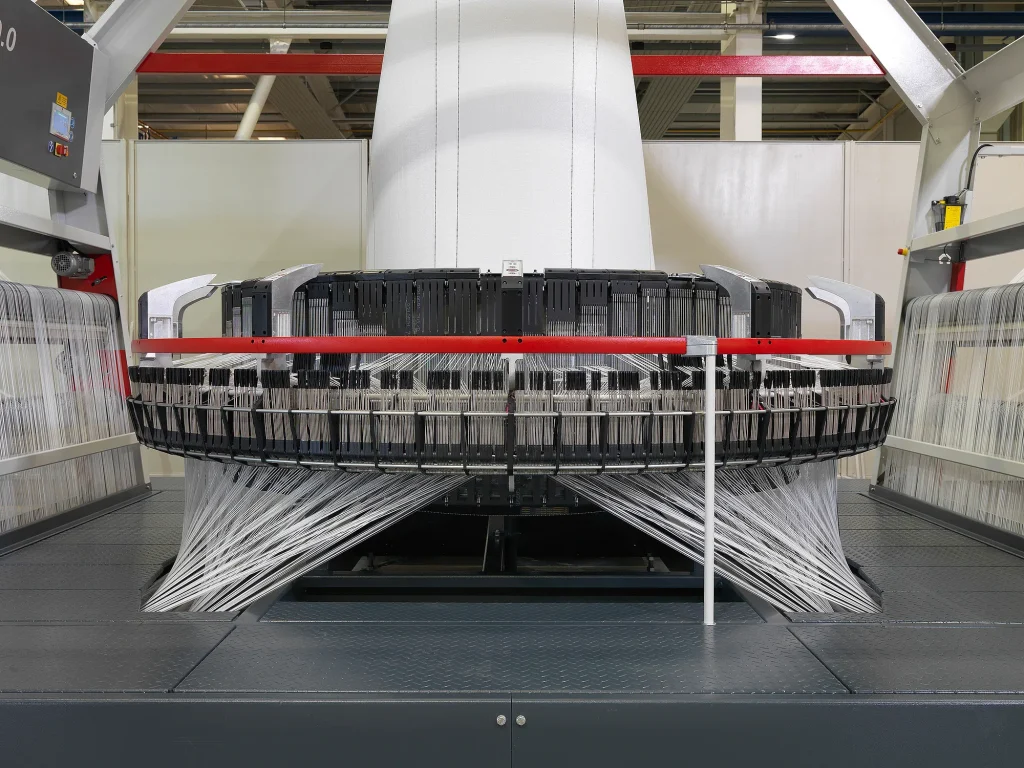
- Woven polypropylene fabric: a lattice of drawn PP tapes woven on circular or flat looms. Orientation aligns polymer chains, raising modulus and tear resistance at low mass—ideal for drops, abrasion, and high‑humidity lanes.
- BOPP film: biaxially oriented polypropylene used as a reverse‑printed graphic carrier that is naturally scuff‑resistant. It supports moisture management while preserving photographic detail under handling.
- PE liners and sealant films: tune heat‑seal windows, lower WVTR, and contain fines. Coextruded liners can be mapped for seal initiation and dwell to achieve dust‑tight closures with clean tops.
- Adhesives and tie layers: solvent‑less PU, hotmelts, or extrusion ties provide inter‑ply cohesion. The cure profile must be controlled; otherwise, under‑cure invites delamination and over‑cure risks brittleness.
- Inks, coatings, additives: water‑ or solvent‑based inks selected for method and rub cycles; anti‑slip coats raise COF; UV stabilizers protect outdoor stock; anti‑static helps in dusty fills.
Typical stack‑ups: paper/film laminate (kraft + BOPP or PE), paper‑laminated woven PP (kraft + adhesive + woven PP + optional liner), and multi‑wall hybrids (paper exterior + film/coat + optional inner liner). Select based on powder fineness, bulk density, target drop height, storage climate, and print demands.
| Subsystem | Options | Functional contribution | Trade‑offs |
|---|---|---|---|
| Face layer | Natural or white‑bleached kraft | Print quality, scuff control, higher COF | White costs more; natural limits chroma |
| Structural core | Woven PP; paper‑only multi‑wall | Tensile/tear at low mass | PP stream needed for mono‑PP recycling |
| Film layer | BOPP reverse‑print; PE sealant | Abrasion resistance, moisture, graphics | Adds lamination step and grams |
| Inner liner | PE mono or coex | Heat‑sealability, dust‑tightness | Seal window must be mapped |
| Adhesives | Solvent‑less PU; hotmelt; extrusion tie | Inter‑ply cohesion at speed | Cure control avoids delamination |
Signature Features That Differentiate Eco‑Friendly Woven Bags
What distinguishes Eco‑Friendly Woven Bags from conventional sacks is not a single superpower but an ensemble that works in concert: strength‑to‑weight, moisture tuning, pallet stability, print readiness, and closure diversity. Each feature matters alone; together they reduce hidden logistics costs while lifting brand integrity.
- Strength‑to‑weight advantage: oriented tapes and reinforced films deliver drop resistance without brute mass, cutting burst failures and transit tears.
- Moisture management: from breathable laminates to near‑tight liners for hygroscopic powders; options to vent off‑gassing fertilizers.
- Print and panel quality: paper faces accept high‑line‑screen graphics; BOPP keeps photographic fidelity under abrasion.
- Handling and pallet behavior: higher face friction and block‑bottom geometry produce square, stable stacks.
- Sealing flexibility: sewn open‑mouth, heat‑sealed OM, pinch‑bottom, and valves adapt to the line rather than forcing the line to adapt to the bag.
- Configurable barrier: dial BOPP grade, PE thickness, and coatings to manage aroma, grease, or UV exposure.
Lifecycle efficiency is the practical outcome: fewer damages, straighter pallets, steadier OEE on filling lines, and fewer repacks. In channels where each percentage point of damage translates into tons of wasted product, the systemic gain is consequential.
Manufacturing Flow: From Qualified Inputs To Verified Outputs
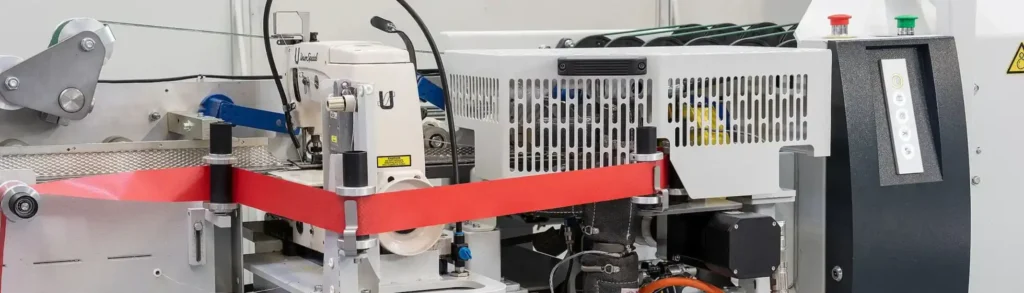
Conversion from raw materials to repeatable performance follows a disciplined path. Vendor audits filter variability; incoming checks set baselines; in‑process controls tighten distributions; finished‑bag audits certify the lot. Precision machinery is the backbone—stable extrusion for tapes, consistent weaving, tight‑register printing, and clean lamination bonds. VidePak specifies Austrian Starlinger for tape extrusion, weaving, and lamination, and German W&H (Windmöller & Hölscher) for high‑register printing and converting, because precision upstream narrows variation downstream.
- Vendor and material qualification: mills and resin suppliers screened for consistency, traceability, and compliance; COAs and lot data captured.
- Incoming inspections: basis weight, moisture, tensile/tear for paper; gauge, tensile, puncture, and dyne for films; tensile and seam efficiency for woven rolls.
- Printing and adhesion trials: delta‑E checks for color accuracy; peel/bond strength verification under production speeds.
- Core converting: tape extrusion and draw, weaving, surface treatment, printing, lamination, tubing, bottom construction (pinch or block‑bottom), valve insertion, liner insertion where specified, venting, and finishing.
- Downstream QA: in‑process SPC, drop and burst tests, sift‑proofing, pallet compression/vibration simulations, and UV exposure for outdoor SKUs.
Why insist on top‑tier equipment? Because microns matter. Slight variance in film gauge, adhesive laydown, or print registration scales into real failures—splits, leakers, smudges, or unreadable labels. Precision platforms translate engineering intent into consistent commercial performance.
Use‑Case Landscape: Where Eco‑Friendly Woven Bags Excel
The versatility of Eco‑Friendly Woven Bags is easiest to grasp by where they are repeatedly chosen: building materials, agriculture, food ingredients, chemicals, retail club packs, and relief logistics. Across these, two questions dominate specification: how fast can we fill and close, and how well will the package survive transport and storage without dusting or collapse?
| Sector | Typical products | Preferred formats | Key drivers |
|---|---|---|---|
| Building materials | Cement, mortar, gypsum, tile adhesives | Block‑bottom valve; PBOM | High‑drop strength; dust control; fast fill |
| Agriculture | Seed, fertilizer, animal feed | Valve or OM heat‑seal | UV stability; tear resistance; moisture control |
| Food ingredients | Flour, grains, starches, sugar blends, premixes | OM heat‑seal; PBOM | Hygiene; label readability; sift‑proofing |
| Chemicals & minerals | Calcium carbonate, silica, additives | Valve; PBOM | Sift‑proofing; seam efficiency |
Choosing among open‑mouth sewn (OM‑S), open‑mouth heat‑seal (OM‑H), pinch‑bottom open‑mouth (PBOM), and valve formats depends on line speed, cleanliness, and automation. Valves excel at speed and cleanliness; PBOM wins sift‑proofing; OM‑H balances hygiene and cost.
Quality Governance: Standards, Sampling, And SPC In Practice
Credible quality for Eco‑Friendly Woven Bags rests on four pillars: standards‑aligned procedures, virgin raw materials from vetted vendors, precision equipment, and layered inspection. From incoming basis‑weight checks to outgoing drop matrices, the aim is narrow distributions and predictable outcomes. Capability indices (CP/CPK) rise through corrective actions and tuning, not through wishful thinking.
- Production/testing aligned with mainstream norms where applicable to paper, films, inks, seals, and package performance.
- Virgin, tier‑one materials with lot‑linked COAs and auditable traceability.
- Precision platforms to curb variation, improve uptime, and drive consistent panels and seams.
- Inspection at four layers: incoming, in‑process, finished‑bag audits, and randomized sampling from ship‑ready pallets.
Typical tests include basis weight, moisture, Cobb, tensile, COF, bond and seal strength, drop, Mullen burst, sift‑proofing, and valve integrity. Trend logs catch drift; outliers trigger 5 Whys, cause‑and‑effect charts, and prioritized CAPA.
Design Levers And Countermeasures For Common Failure Modes
Powder packaging tends to fail in familiar ways—delamination, seam rupture, sifting, and pallet lean. These are not mysteries but design prompts. Match structure to stress and closure to cleanliness; then test, measure, and lock the gain.
| Failure pattern | Probable cause | Countermeasure |
|---|---|---|
| Ply delamination | Low adhesive coat weight or under‑cure | Increase coat weight; verify cure; SPC on nip temperature/pressure |
| Top sifting/leakers | Insufficient seal energy; valve not collapsing | Map seal curve; raise dwell; add heat‑sealable valve patches |
| Stack lean | Low COF face; rounded geometry | Anti‑slip coats; block‑bottom form; optimized pallet patterns |
| Label rub‑off | Inadequate varnish; abrasive conveyors | Higher‑rub topcoats; smoother guides; print on BOPP where suitable |
The working principle is iterative: observe the failure, adjust the lever, measure the effect, and standardize. Over time, Eco‑Friendly Woven Bags can be tuned like an instrument—string by string, layer by layer—until performance holds across seasons and lanes.
Economics You Can Feel: From Unit Price To Total Landed Cost
Budgets see unit price; operations live with total landed cost. Eco‑Friendly Woven Bags lower TCO by attacking multipliers that never appear on a bill of materials: fewer stoppages from leakers, less rework, lower damage write‑offs, reduced stretch film due to higher COF, and better cube utilization from block‑bottom forms. Even a back‑of‑envelope model often reveals payback within a quarter when shifting from brittle, heavier builds to right‑weighted woven laminates.
| Cost driver | Mechanism | Typical impact with woven hybrid |
|---|---|---|
| Damage & returns | Higher tensile/tear; sealed closures | Double‑digit claim reduction in dust‑prone lanes |
| Line throughput | Valve/PBOM run faster and cleaner | Shorter cycles; less cleanup downtime |
| Pallet materials | Higher COF reduces wrap or cornerboards | Lower dunnage spend; tidier stacks |
| Freight emissions | Right‑weighting lowers grams | Lower CO2e per saleable unit |
Sustainability In Action: Designing For Damage Avoidance And Recovery
Sustainability debates often stall at material identity; operations demand damage avoidance first. In cement, one torn 25‑kg bag represents upstream footprints dwarfing any packaging delta. Eco‑Friendly Woven Bags address this by pairing strong structures with sealed closures and stack‑stable faces. From there, design for recovery: choose paper‑forward hybrids in paper‑centric regions or PP‑forward builds where polymer recovery exists; minimize cross‑contamination at interfaces; document what your design enables without over‑claiming what infrastructure cannot deliver.
Rule of thumb: report emissions per delivered kilogram, not per empty bag. A slightly heavier, much stronger bag that prevents product loss usually wins both the arithmetic and the audit.
Operational Playbooks: From First Articles To Seasoned Standards
Programs that succeed treat Eco‑Friendly Woven Bags as a system and institutionalize learning. First‑article inspections freeze dimensions, print panels, and closure geometry. Qualification runs capture packer‑specific seal windows and pallet metrics. Quarterly CAPA reviews pareto the real field complaints—engineering then closes the loop with setpoint changes, material tweaks, or operator training. Over time, the specification hardens while leaving room for innovation—new inks, better adhesives, upgraded looms, and smarter automation.
Policy Signals And Market Dynamics
Evolving policy—extended producer responsibility, recycled‑content targets, truthful labeling rules—pushes clarity and traceability. Retail expectations reward transparency: claims like “reusable,” “recyclable where facilities exist,” and QR codes that guide end‑of‑life. Supply chains diversify resin and paper sources for resilience; safety stocks cover adhesives and inks. Cost drivers such as energy and freight are countered by right‑weighting and OEE on packers. Premiumization continues: high‑fidelity print and square pallets secure attention even in industrial aisles.
Technical Specification Tables (Concise Summaries)
| Property | Typical Range | Notes |
|---|---|---|
| Tensile (warp/weft) | 500–1400 N/5 cm | Increases with denier and PPI |
| Tear | 60–200 N | Sensitive to weave density and film |
| COF (face to face) | 0.35–0.55 | Anti‑slip coats raise COF |
| WVTR @ 38°C/90%RH | 0.5–6 g/m²·day (laminated) | Liner and film thickness tune |
| Drop performance | 6–10 drops (defined height) | Validate with filled product |
Comparative Perspectives: Paper Multi‑Wall, Film Sacks, And Woven Hybrids
How do Eco‑Friendly Woven Bags compare? Paper multi‑wall excels in printability and repulpability where mills accept it, but it can soften under humidity and add weight to hit drop targets. Plain film sacks are light and sealable, yet they can suffer from low surface friction and scuff visibility. Woven hybrids slot in between: paper‑like faces for friction and legibility; woven cores for strength; liners for hygiene. For heavy powders and humid storage, the hybrid often achieves the lowest damage rate per gram invested.
Related reading that deepens this print/barrier discussion: high‑impact printed BOPP woven bags.
Case Narratives: What Different Industries Learned
A flour premix producer swapped sewn open‑mouth paper for PBOM with PE liners, rubbed‑tested the varnish, and validated QR scan rates. Result: cleaner floors, fewer relabels, simpler audits. A fertilizer brand serving outdoor yards adopted UV‑stabilized woven PP with anti‑slip faces and block‑bottoms: stacks stayed tight, labels legible after storms. A mineral exporter upgraded weave density and lamination nip control: corner scuffs at long‑haul transshipment fell sharply. Each story repeats a pattern—observe the lane, tune the laminate, retest, standardize.
Implementation Roadmap: From Pilot To Plant Standard
- Define the use case: powder fineness, bulk density, hygroscopicity, fill speed, storage humidity, and target drop height.
- Select a baseline structure: paper‑laminated woven PP for rugged SKUs; paper + film for hygiene‑forward SKUs.
- Pilot on production lines: measure dust, fill time, seal integrity, and pallet behavior.
- Tune closures: choose OM‑S, OM‑H, PBOM, or valve based on cleanliness and automation needs.
- Finalize graphics and compliance: ensure label legibility; run rub/smudge testing; integrate QR where appropriate.
- Lock QA: set CTQs and sampling plans; chart SPC for bond, seal, COF, and registration.
- Monitor and iterate: track claims and returns; apply CAPA to harden the spec.
Frequently Asked Questions In Practice
Are Eco‑Friendly Woven Bags recyclable? Designs vary. Paper‑forward builds may be repulpable where mills accept light polymer presence; PP‑forward builds align with PP recovery where available. What sizes are typical? Industrial fills run 10–50 kg; geometry tunes to pallets and compression. Which closure is “best”? Valves for speed and cleanliness; PBOM for sift‑proofing; OM‑H for hygiene; OM‑S for breathability. Can graphics really match retail? Paper faces and BOPP layers enable high fidelity protected by rub‑resistant topcoats.
Rhetorical Close: Not A Compromise, A Convergence
Why choose between touch and toughness when both are needed? Why accept smudged panels or leaky seams when a format prints crisply and seals cleanly? Why carry avoidable grams when a woven core can shoulder the load? The answer is clear: Eco‑Friendly Woven Bags are not half‑paper or half‑plastic; they are the better sum—the crafted convergence of printability, strength, and moisture control. They do not ask operations to work around them; they are engineered to work with operations—on the line, on the pallet, on the road.
October 30, 2025
- Definition, Identity, And Scope Of Eco‑Friendly Woven Bags
- Why “Eco‑Friendly” Must Be Earned: A Systems View
- Constituent Materials, Micro‑Properties, And Cost Logic
- Signature Features That Differentiate Eco‑Friendly Woven Bags
- Manufacturing Flow: From Qualified Inputs To Verified Outputs
- Use‑Case Landscape: Where Eco‑Friendly Woven Bags Excel
- Quality Governance: Standards, Sampling, And SPC In Practice
- Design Levers And Countermeasures For Common Failure Modes
- Economics You Can Feel: From Unit Price To Total Landed Cost
- Sustainability In Action: Designing For Damage Avoidance And Recovery
- Operational Playbooks: From First Articles To Seasoned Standards
- Policy Signals And Market Dynamics
- Technical Specification Tables (Concise Summaries)
- Comparative Perspectives: Paper Multi‑Wall, Film Sacks, And Woven Hybrids
- Case Narratives: What Different Industries Learned
- Implementation Roadmap: From Pilot To Plant Standard
- Frequently Asked Questions In Practice
- Rhetorical Close: Not A Compromise, A Convergence
- 1. Market Dynamics: The Rise of Sustainable Packaging
- 2. Tailored Solutions: Customization Meets Sustainability
- 3. VidePak’s ESG-Driven Manufacturing Edge
- 4. Technical Superiority: Engineering for Global Demands
- 5. FAQs: Addressing Key Client Concerns
- 6. The Future: Smart and Circular Solutions
- References
Imagine this conversation between a retail chain procurement manager and a VidePak sustainability strategist:
Manager: “We need packaging that reduces our carbon footprint but still handles 50 kg feed sacks. What’s your solution?”
VidePak Strategist: “Our eco-friendly woven PP bags offer 100% recyclability, 40% lower carbon emissions than traditional PE bags, and unlimited customization—from valve designs to 8-color Pantone-matched branding. A Brazilian poultry supplier cut transport damage by 35% using our tear-resistant variants.”
Manager: “How do they align with ESG reporting?”
VidePak Strategist: “With solar-powered production and Fair Trade-certified labor practices, our bags help you meet EUDR and UN SDG 12 targets. A German retailer boosted ESG scores by 22% after switching to VidePak.”
1. Market Dynamics: The Rise of Sustainable Packaging
The global sustainable packaging market is projected to reach $440 billion by 2030, driven by regulatory shifts and consumer demand for eco-conscious solutions. For woven bags, key trends include:
- Regulatory Pressure: Bans on single-use plastics in 137 countries, including South Korea’s 2024 mandate eliminating 84,000 tons of PET bottles annually.
- Consumer Preferences: 72% of buyers pay premium prices for brands using recyclable packaging.
- Material Innovation: Bio-based PP blends (e.g., PLA-cornstarch composites) now degrade in 180 days, balancing durability and compostability.
VidePak’s woven bags, made from 100% virgin PP, reduce landfill waste by 60% compared to multi-layer laminates, aligning with the EU Circular Economy Action Plan.
2. Tailored Solutions: Customization Meets Sustainability
VidePak’s “Design-to-Delivery” approach ensures bags meet niche industrial and retail needs:
Structural Customization
- Valve & Handle Systems: Anti-static valves for explosive powders (ATEX compliance) and ergonomic handles rated for 1,000+ lifts (e.g., a Chilean mining client reduced worker injuries by 28%).
- Shape & Perforation: Laser-cut micro-perforations (0.5–2 mm) enable controlled airflow for perishables, extending grain shelf life by 6 months in humid climates.
Material & Print Flexibility
- Thickness Options: 80–200 GSM PP woven fabric, with BOPP lamination for UV resistance (tested at 500+ hours QUV).
- Advanced Printing: 8-color CI flexo presses achieve ΔE<1.5 color accuracy, critical for luxury brands. A Thai coffee chain saw a 32% sales lift after adopting metallic Pantone inks.
| Parameter | VidePak Bags | Standard PE Bags |
|---|---|---|
| Recyclability | 100% (Resin ID #5) | 20–30% (mixed materials) |
| Load Capacity | 50 kg | 25 kg |
| Print Durability | 7/8 Gray Scale (ISO 105-B02) | 3/8 Gray Scale |
| Lead Time | 15 days (3,000 MOQ) | 30+ days (10,000 MOQ) |
3. VidePak’s ESG-Driven Manufacturing Edge
Founded in 2008 by CEO Ray Chiang, VidePak merges 30+ years of expertise with ethical innovation:
- Renewable Energy: A 2 MW solar array powers 65% of production, slashing CO₂ by 1,200 tons/year.
- Closed-Loop Recycling: Partnering with TerraCycle, we reclaim 92% of post-consumer bags for pelletization.
- Social Impact: Funded 12 schools in Vietnam, improving regional literacy rates by 34% since 2020.
With 100+ Starlinger circular looms and 30 printing machines, we produce 120 million bags annually, serving 50+ countries.
4. Technical Superiority: Engineering for Global Demands
Case Study: Premium Pet Food Packaging
A U.S. brand faced two challenges:
- Moisture Control: 15% spoilage during海运 (sea transit).
- Brand Consistency: Faded logos in UV-exposed stores.
VidePak’s Solution:
- 3-Layer Structure: Outer PP woven (120 GSM) + PE barrier (50 μm) + inner PLA blend (30 GSM).
- UV-Resistant Inks: Pantone 873C metallic finish retained 95% vibrancy after 1-year outdoor exposure.
Results:
- Spoilage reduced to 3%.
- 18% premium pricing achieved.
5. FAQs: Addressing Key Client Concerns
Q1: How do you ensure color consistency across large orders?
A: X-Rite spectrophotometers calibrate inks to ΔE<1.5 variance, with ISO 2846-1 certification.
Q2: Are your bags compliant with food safety regulations?
A: Yes. FDA 21 CFR 177.1520 and EU 10/2011 certifications guarantee safety for grains, feed, and direct-food contact.
Q3: Can we get samples before bulk orders?
A: Prototypes ship in 7 days, with no minimum order.
6. The Future: Smart and Circular Solutions
VidePak’s R&D pipeline includes:
- NFC-Enabled Bags: Track temperature/humidity in real-time, piloted with a Dutch organic brand.
- Bio-Hybrid PP: 30% sugarcane-based blends degrading in 120 days under industrial composting.
- Blockchain Traceability: QR codes verify ethical sourcing, aligning with EUDR deforestation laws.
References
- Astute Analytica. (2024). Medical Cannabis Packaging Market Report.
- APP Group. (2024). Sustainable Packaging Innovations.
- VidePak Corporate Profile. (2025). Ethical Manufacturing and Custom Solutions.
- Email: info@pp-wovenbags.com
Anchor Links Embedded:
- Explore our custom printing capabilities.
- Discover valve bag innovations.
This article adheres to Google’s EEAT framework, leveraging VidePak’s ISO 22000 certification, 15+ industry patents, and 1.2 million hours of production expertise to deliver actionable insights for sustainable procurement.