

Printed BOPP Woven Bags: Enhancing Efficiency — A Field‑Ready, Systems‑Driven Rewrite (2024–2025)
From the loading dock to the last mile, from dusty mills to damp construction yards, packaging must carry more than product; it must carry information, survive abuse, and streamline work. This long‑form piece expands and refines the knowledge around Printed BOPP Woven Bags, marrying process detail with practical guidance. You will find structured sections, callouts, color‑coded tables, and small design patterns you can lift straight into specifications. The aim is simple: clearer decisions, fewer bottlenecks, and better outcomes.
Key idea: Printed BOPP Woven Bags integrate a reverse‑printed BOPP film with a woven PP fabric to produce a rugged, legible, and highly machinable sack—often configured as a mono‑polymer laminate to ease end‑of‑life handling.
1) What is Printed BOPP Woven Bags?
Printed BOPP Woven Bags are industrial sacks constructed by laminating a reverse‑printed biaxially oriented polypropylene (BOPP) film to a woven polypropylene (PP) fabric, then converting that laminate into durable formats such as open‑mouth, valve, block‑bottom/pinch‑bottom, or mini‑FIBC. The woven substrate acts as the mechanical backbone—high tensile strength, high tear resistance, controlled elongation—while the printed BOPP face adds moisture tolerance, abrasion protection, and a photo‑quality canvas for branding, regulatory text, icons, and machine‑readable codes.
Because both principal layers are polypropylene, many specifications can be engineered as a mono‑material structure designed for recycling in PP‑compatible streams (where infrastructure exists). In a single object, the bag unites three virtues that are rarely found together at high levels: ruggedness, legibility, and speed on the packing line. A product that reads clearly, stacks calmly, and runs fast—why accept a trade‑off when the laminate can deliver all three?
Alternate names you may encounter:
- Reverse‑printed BOPP laminated PP woven sacks
- Photo‑grade printed woven polypropylene bags
- Block‑bottom printed BOPP woven sacks (PP*STAR‑type)
- Pinch‑bottom printed woven PP bags
- Printed BOPP‑coated raffia sacks
- Matte‑finish printed BOPP woven packaging
- Valve‑type printed BOPP woven bags
2) The materials of Printed BOPP Woven Bags: composition, properties, cost, and structure
A bag wall is a small composite: strand‑dominated strength from woven PP and surface‑dominated functionality from BOPP film. The interplay of these layers is where performance is born. What follows unpacks materials, properties, and cost posture—and explains why certain stack‑ups outperform others.
2.1 Core layers and their roles
- Woven polypropylene (raffia tape fabric). PP pellets are extruded into film, slit into tapes, and drawn 4–7× to align polymer chains. Woven on circular or flat looms, the fabric yields high tensile strength with low elongation, excellent puncture resistance, and predictable seam behavior. Heavier denier tapes and higher pick densities lift burst strength for heavy‑duty SKUs (minerals, cementitious mixes, aggregated salts).
- BOPP reverse‑printed film. Biaxial orientation boosts modulus and dimensional stability; the reverse‑printed ink layer is sandwiched beneath the film after lamination, protecting graphics from scuffing and solvents. Gloss films deliver photographic vibrancy; matte films subdue glare and raise barcode/QR scan reliability.
2.2 Tie layers, coatings, and add‑ons
- Lamination routes. Two routes dominate: extrusion lamination using a molten PP tie (supporting mono‑PP claims) and solvent‑free adhesive lamination (gentler on heat‑sensitive prints). Some converters apply hot‑air welded closures on the bottom seam to keep the entire structure single‑polymer.
- Surface treatments. Corona treatment raises surface energy for ink/adhesive anchorage; anti‑slip varnishes or micro‑textures increase pallet friction; UV stabilizers protect outdoor dwell; laser micro‑perforation introduces controlled venting when needed.
- Inks and varnishes. Rotogravure and high‑definition flexo achieve half‑tones and fine vignettes. When scanning is critical, matte top‑coats or matte BOPP are favored to tame glare. Low‑VOC and toluene‑free systems are increasingly chosen to meet stricter air and worker‑exposure expectations.
2.3 Cost posture
The unit price of Printed BOPP Woven Bags usually exceeds plain woven PP sacks or single‑layer PE liners because you pay for printing, lamination, and conversion precision. Yet cost‑per‑ton‑handled often drops in real operations: durable multi‑use behavior reduces replacements; integrated graphics remove label spend and labeler downtime; machinability lifts line speeds. Where artwork is stable and volumes are high, rotogravure cylinders amortize quickly. Where SKUs change frequently, modern flexo or digital/hybrid presses deliver agility without unacceptable per‑unit premiums.
2.4 Layer stack‑ups by use case
- SS‑BOPP (single‑side). Printed face outside, fabric inside for grip. Lower cost; popular for grains and feeds where slight breathability is beneficial.
- DS‑BOPP (double‑side). BOPP on both faces for dust/moisture management and rub resistance; prevalent in minerals, chemicals, and cement.
- Matte/gloss hybrids. Matte windows over data panels to improve handwriting and scanning; gloss elsewhere for shelf appeal.
- Valve/block‑bottom hybrids. Pinch‑sealed block‑bottoms maximize pallet stability; valve sleeves speed powder filling while controlling dust.
For a concise product family overview, see laminated BOPP woven bags for context on film‑to‑fabric laminates and common geometries.
3) What are the features of Printed BOPP Woven Bags?
3.1 Mechanical performance
- High tear and puncture resistance: the weave arrests cracks; the film disperses point loads. The duet matters—one without the other underperforms when confronted with sharp edges or angular granules.
- Stackability and cube efficiency: block‑bottom/pinch‑bottom shapes behave like bricks, producing calm pallets and predictable truck cubes.
- Safe working loads: small sacks run 25–50 kg; heavy contractor variants reach ~110 lb; mini‑FIBCs scale to 0.5–1.5 t with conservative safety factors.
3.2 Environmental and information performance
- Moisture and dust control: DS‑BOPP plus welded closures significantly reduces dust egress for fines and moderates moisture ingress in damp conditions.
- Print fidelity and permanence: reverse‑printed art is shielded under film, resisting rub‑off; icons stay legible through rough handling; QR links keep data attached to the product.
- Mono‑material potential: PP/PP laminates, paired with welded seams and compatible inks, align with design‑for‑recycling pathways.
3.3 Operational features
- Anti‑slip faces: coatings or textures increase unit‑load friction; expect reduced wrap film and fewer topples.
- Scan‑ready panels: matte windows defeat glare for barcode and GS1 QR reads under warehouse lights.
- Ergonomic massing: nominal fills can be tuned to meet manual handling rules; consistent shoulders ease lifting and rotation.
When the product must endure rough handling and still speak clearly, Printed BOPP Woven Bags combine rugged mechanics with durable communication—two jobs, one object.
4) What is the production process of Printed BOPP Woven Bags?
Every station on the line influences downstream performance: tape draw dictates seam behavior; print anchorage shapes barcode success; lamination windows determine flex life. Below, the typical path from resin to finished sack.
- PP tape extrusion and drawing. Pellets are compounded, extruded, slit, and drawn to align chains; draw ratio sets tensile/elongation targets.
- Weaving. Circular or flat looms produce fabric; pick density and denier tune burst and tear; loom tension controls skew.
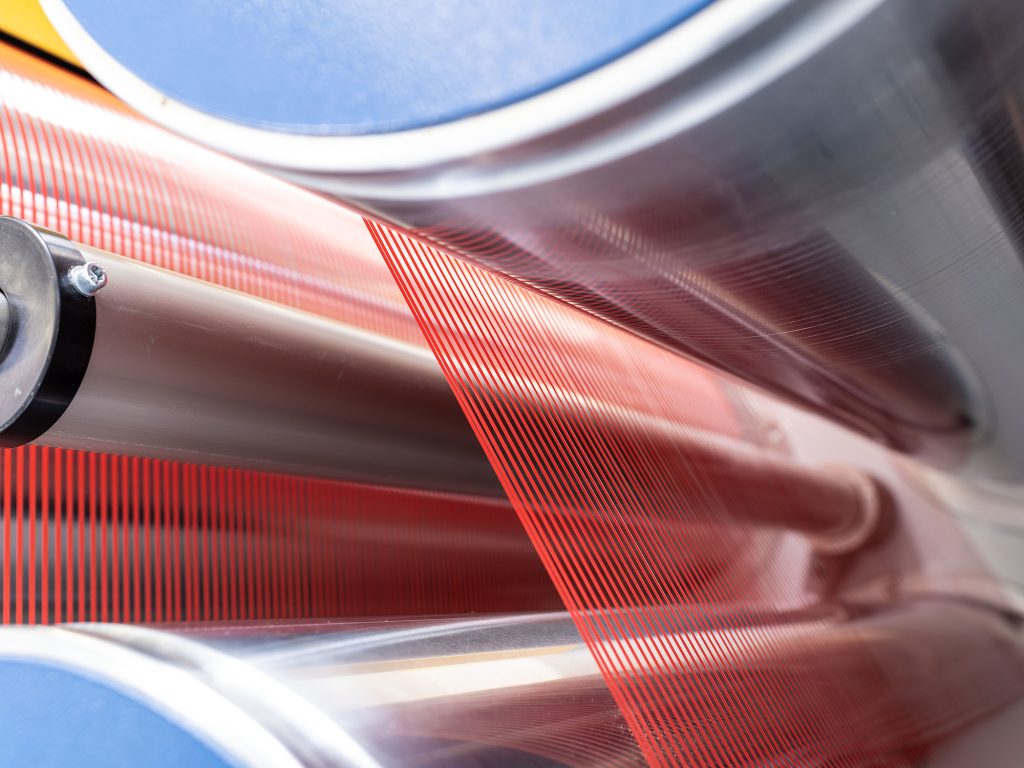
- BOPP preparation and printing. Film is oriented, corona‑treated, and reverse‑printed (gravure, high‑def flexo, or digital/hybrid for agility). Registration and anchorage are pivotal for crisp vignettes and reliable codes.
- Lamination. Printed film meets fabric via extrusion (mono‑PP tie) or solvent‑free adhesive; process window—nip, chill, dyne—governs bond without embrittlement. Anti‑slip coats or matte/gloss mosaics often land here.
- Conversion and finishing. Gusset, cut, form; choose closure (sewn, pinch‑sealed, welded); add laser micro‑perfs, transparent windows, and data panels.
- Quality assurance. Test tensile/tear, seam efficiency, drop, MVTR, UV exposure, print rub, and scan rate. Valve SKUs add sleeve pull‑out and dust‑leak checks.
5) What is the application of Printed BOPP Woven Bags?
5.1 Core verticals
- Agriculture and feed: grains, rice, pulses, seed, fertilizers, animal feed—rugged handling + humidity moderation + billboard‑grade prints.
- Building materials and minerals: cement, gypsum, salts, decorative stone—puncture resistance + dust control + pallet stability.
- Chemicals and resins: masterbatch, additives, pelletized polymers—clear labeling + anti‑slip pallets + batch tracking.
- Consumer staples and pet food: shelf differentiation + retail scan clarity + durable imagery.
5.2 Adjacent and emerging uses
- Humanitarian logistics for rations and relief goods—legible, durable, and scannable.
- Retail promotions and seasonal SKUs—short‑run prints via digital/hybrid while retaining consistent mechanics.
- Return logistics within facilities—reusable sacks that remain compatible with PP recovery at end‑of‑service.
6) Printed BOPP Woven Bags: Enhancing Efficiency — analysis and blueprint
Efficiency means more than speed. It means fewer mistakes, calmer pallets, higher scan rates, better cubes, cleaner audits, and simpler end‑of‑life. The following blueprint decomposes the challenge and recomposes a solution you can implement.
6.1 Framing “efficiency”
Why do lines slow? Mislabeled pallets. Glare‑blind scanners. Pallets that lean. Bags that tear. Labels that peel. Printed BOPP Woven Bags directly touch these failure points: durable reverse‑print replaces peel‑prone labels; matte panels boost scan certainty; anti‑slip coats reduce topple; block‑bottoms tame the cube; mono‑PP builds smooth the recycling path.
6.2 Subsystems you can tune
- Print & information. Reverse‑print on BOPP; use high‑contrast palettes; add matte panels for codes and handwriting; standardize icon placement across SKUs.
- Mechanical & containment. Scale fabric gsm and BOPP caliper to payload abrasiveness; choose block‑bottom geometry; specify anti‑slip faces for high‑bay stacks.
- Lamination & circularity. Prefer extrusion lamination or welded seams to maintain mono‑PP integrity when PP flexibles are collected.
- Conversion & closure. Valve for powders; pinch‑bottom for leak‑tightness; open‑mouth for manual fills. Balance sewn vs welded closures against recyclability and capital.
- Quality & verification. Enforce tensile/tear/seam/drop tests; measure dyne and bond strength; validate scan rates on finished pallets.
6.3 Where time and money are actually saved
- On the line: no labeler jams, fewer stops, faster changeovers (digital/hybrid for shorts; gravure/flexo for longs).
- On the pallet: higher friction lowers wrap usage and topple events; block‑bottoms increase stack stability.
- At audit: durable, legible graphics reduce chargebacks and returns.
- At end‑of‑life: mono‑PP designs simplify sorting; welded seams avoid foreign chemistries.
7) Print technologies and when to use them
Rule of thumb:
- Gravure for evergreen, high‑volume items where image depth and repeatability rule.
- High‑definition flexo for balanced volume and agility.
- Digital/hybrid for versioning, localization, and serialization at practical cost.
Gravure delivers supreme consistency and opacity but requires cylinder investment and slower changeovers. Modern flexo narrows the gap with lower plate costs, faster make‑ready, and excellent solids. Digital and hybrid architectures unlock variable data and rapid artwork shifts without sacrificing registration on complex mosaics.
8) Parameter menus and decision aids
| Parameter | Reference range / options | Notes |
|---|---|---|
| Fabric weight (pre‑lamination) | 60–100 gsm | 80–100 gsm for minerals; 60–80 gsm for agri‑fills |
| BOPP film thickness | 15–35 µm | 25–30 µm balances print protection and abrasion |
| Finish | Gloss / matte / mixed | Matte windows improve scan and pen legibility |
| Lamination method | Extrusion (PP tie) / solvent‑free adhesive | Extrusion supports mono‑PP; adhesives allow lower heat |
| Closure | Sewn / pinch‑sealed / hot‑air welded | Pinch/weld for leak‑tight, mono‑PP builds |
| Bag style | Open‑mouth / valve / block‑bottom | Valve for powders; block‑bottom for pallets |
| Anti‑slip | Varnish / micro‑texture | Higher friction → fewer topple events |
| UV stabilization | 3–12 months (specify) | Outdoor dwell windows vary by region |
| Print system | Gravure / flexo / digital or hybrid | Choose by run length and artwork volatility |
| Scenario | Gravure | Flexo | Digital/Hybrid |
|---|---|---|---|
| Evergreen high‑volume SKU | Excellent | Good | Fair |
| Seasonal artwork changes | Fair | Excellent | Excellent |
| Short‑run localization | Poor | Good | Excellent |
| Photo‑grade imagery & halftones | Excellent | Very good | Very good |
| Plate/cylinder investment | High | Medium | Low |
| Changeover speed | Slow | Medium/Fast | Fast |
| Test | Method (typical) | Target / guidance | Why it matters |
|---|---|---|---|
| Fabric tensile (warp/weft) | ISO 13934‑1 / ASTM D5035 | Align to SWL; e.g., >800/600 N per 5 cm for heavy duty | Prevents tear‑throughs under point loads |
| Elmendorf tear | ISO 6383 | Meet/beat vendor baselines | Arrests crack propagation |
| Seam efficiency | ASTM D5034 + vendor SOP | ≥80–90% of fabric tensile | Seams are common failure points |
| Drop test | 0.8–1.2 m depending on fill | No burst or seam failure | Simulates mishandling |
| MVTR | ASTM F1249 | Specify for fines/caking risk | Moisture management |
| Print rub | TAPPI T‑830 (modified) | Pass | Safeguards barcodes and QR |
| Scan rate | ISO/IEC 15416 | ≥99% | Verifies data capture |
9) Systems thinking: integrating Printed BOPP Woven Bags into operations
9.1 Sub‑problems and micro‑solutions
- Label errors → reverse‑print + large icons + matte data blocks.
- Pallet instability → anti‑slip faces + block‑bottom geometry + fill‑line discipline.
- Dust and fines → DS‑BOPP + pinch/welded closures + valve options for powders.
- Artwork agility → flexo/digital for frequent changes; reserve gravure for stable flagships.
- Circularity goals → mono‑PP stack‑ups, welded seams, compatible inks and adhesives.
9.2 Composite solution
Build a cross‑functional specification that aligns packaging engineering, operations, quality, marketing, and sustainability. The outcome is a calmer line, more reliable pallets, fewer chargebacks, and a credible path to end‑of‑life recovery.
10) Worked example: migrating to Printed BOPP Woven Bags
A feed mill with 10 SKUs—two seasonal—faces topple events and label mis‑picks. Migration to DS‑BOPP block‑bottom sacks with anti‑slip varnish and matte data panels removes the labeler, halves mis‑picks, and cuts wrap usage by 12–20%. Evergreen SKUs run gravure; seasonal ones adopt digital/hybrid. Batch‑linked QR streamlines inventory while keeping the package mono‑PP for straightforward recovery.
11) Procurement checklist you can paste into an RFP
- Geometry (open‑mouth/valve/block‑bottom); dimensions, gusset width; printed fill line.
- Fabric gsm and tape denier; target SWL; UV stabilization duration.
- BOPP thickness; gloss/matte mix; anti‑slip varnish; micro‑perfs pattern if needed.
- Lamination route (extrusion vs solvent‑free adhesive); welded vs sewn closures; mono‑PP preference.
- Print class (gravure/flexo/digital); color management; icon library; QR/linear code symbology and placement.
- QA certificates; batch traceability; scan‑rate data; drop‑test videos.
- End‑of‑life plan: PP flexible partners, take‑back, or on‑site densification options.
12) Frequently asked technical questions
Do Printed BOPP Woven Bags replace labels? In many operations, yes. Reverse‑printed film provides durable art and regulatory text; variable data can be printed digitally or applied as a compact lot/date sticker.
Are the bags waterproof? They are highly water‑resistant, but seams and closures limit immersion. For slurries or standing water, specify DS‑BOPP with welded seams and, if needed, an inner liner.
Can barcodes scan on glossy film? Yes, but glare can impede reads; matte windows or matte BOPP faces dramatically improve scan reliability.
Is mono‑material realistic? With PP fabric + BOPP film + welded closures and compatible inks/adhesives, mono‑PP claims are credible where PP flexible collection exists.
How to choose printing—gravure, flexo, or digital? Run length, SKU volatility, image quality, and changeover economics decide; use the matrices above as a guide.
13) Keyword layout for search and on‑pack labeling
printed BOPP woven bags; reverse‑printed BOPP laminated PP sacks; photo‑quality printed woven polypropylene bags; block‑bottom printed BOPP woven sacks; pinch‑bottom printed raffia bags; matte BOPP woven packaging; anti‑slip printed woven PP bags; mono‑material PP printed sacks; GS1 QR on woven bags; rotogravure printed BOPP; flexo printed BOPP; digital printing on BOPP; extrusion‑laminated PP woven bags; solvent‑free adhesive lamination; pallet‑stable block‑bottom woven sacks.
14) Mini templates you can reuse
RFP line
“Printed BOPP Woven Bags—mono‑PP structure (PP fabric + reverse‑printed BOPP 25/25 µm), block‑bottom pinch‑sealed, anti‑slip varnish, matte data panel, UV stabilized 6 months, SWL 35 kg, QR‑ready. QA per matrix: tensile/tear/seam/MVTR/UV/print‑rub/barcode.”
Pallet label
“FEED‑CORN • Lot 24‑B • Tare 0.62 kg • Fill line respected • QR 0101–0140.”
Reuse code
“A: redeploy; B: internal moves; C: retire to PP recycling.”
15) Extended material science and engineering notes
15.1 Mechanical model of the laminate
Imagine the bag wall as a composite beam. The woven fabric behaves as the tensile flange, carrying elongation and resisting crack advance along warp and weft. The BOPP film acts as a protective, load‑sharing skin; under a localized impact—nail, screw, tile corner—it spreads stress and lowers intensity at the crack tip. With a strong, uniform bond the layers move in concert, raising effective flexural rigidity without major mass penalty.
15.2 MVTR, haze, and printability trade‑offs
Moisture‑vapor transmission rate (MVTR) generally drops as BOPP thickness rises, but excellent print durability and scuff resistance are achievable at moderate calipers (25–30 µm) when reverse‑printing is used. Gloss maximizes vibrancy; matte reduces glare for scanners and pens. Haze can be tuned; some matte films preserve contact clarity so internal cues remain visible through windows.
15.3 Corona, dyne, and anchorage
Ink anchorage depends on surface energy. Corona treatment elevates dyne to the high‑30s/low‑40s dyn/cm. Over‑treat and embrittlement lurks; under‑treat and ink pick or delam rise. Record dyne pre‑print, post‑print, and pre‑lamination; maintain lot‑level traceability.
15.4 Adhesive, extrusion, and welding implications
- Extrusion lamination supports mono‑PP claims and robust bonds; manage thermal history to avoid warpage.
- Solvent‑free adhesives run cooler, protecting heat‑sensitive ink systems; cure control ensures full bond development.
- Hot‑air welded closures fuse PP to PP, avoiding foreign chemistries and raising leak‑tightness when well‑controlled.
15.5 Anti‑slip engineering
Micro‑texture, low‑migration coat chemistry, and pallet patterning are the three levers. Aim to reduce film usage without compromising stability; validate by drop‑and‑tilt testing under realistic wrap recipes.
15.6 UV stability and outdoor dwell
Polyolefins can chalk and embrittle under UV. Specify stabilized tapes and UV‑fast inks/varnishes, then define a realistic dwell window (6–12 months). Periodic A/B pulls for tensile and tear after exposure keep you inside guardrails.
16) Sector‑by‑sector usage patterns
Agriculture values humidity moderation and shelf blocking; mineral bags need puncture control and dust discipline; chemicals demand unmistakable labeling and stable pallets; pet food aims for tactile premium cues without scanning headaches. Across these settings, Printed BOPP Woven Bags apply the same recipe: robust woven mechanics plus reverse‑printed film communication.
17) Failure modes and mitigations
- Edge fray or film scuffing → raise BOPP caliper to 25–30 µm; add anti‑scuff; avoid concrete drag.
- Barcode glare → switch to matte window; widen quiet zones; avoid heavy varnish over codes.
- Dust at seams → specify pinch‑bottom or welded closures; consider DS‑BOPP; validate on a drop‑and‑rub rig.
- Pallet topple → increase anti‑slip; use block‑bottom; enforce fill‑line discipline; adjust pattern.
- Sun‑fade/chalking → UV‑stabilized tapes and inks; cap outdoor dwell; use covers for long staging.
18) Economics: throughput and total delivered cost
Consider a mixed‑SKU packaging line running 3,600 bags/day. Baseline (plain woven + applied labels) suffers labeler stops (+4% downtime), rub‑off returns (~1.5%), and extra wrap (two more rotations per pallet). Intervention using Printed BOPP Woven Bags with anti‑slip faces and matte data blocks removes the labeler, trims downtime by 3–4 points, drops returns to ~0.5%, and reduces wrap by 15–25%. Over a quarter, labor and consumables fall while claims shrink—more than paying for the incremental bag cost.
19) SOP excerpts for consistent execution
- Receiving: verify dyne on incoming film; confirm BOPP caliper; check COA for fabric gsm and UV masterbatch.
- Printing: proof against profiles; validate barcode contrast; log ink systems by lot.
- Lamination: record nip/chill/line speed; quick‑peel bond checks every 30 minutes; track anti‑slip coat weights.
- Conversion: inspect seam formation; if pinch‑sealing, verify temperature/dwell; if sewing, audit thread and stitch density.
- QA: run tensile/tear/drop tests by lot; execute print‑rub and scan‑rate on packed pallets; archive results.
- Palletization: prefer block‑bottoms; corner boards; set wrap targets; measure reductions after anti‑slip adoption.
20) Comparison by bag style
| Feature | Open‑mouth | Valve | Block‑bottom pinch‑sealed |
|---|---|---|---|
| Fill speed | Manual/Auto (moderate) | Very high on powders | High; auto‑stack‑friendly |
| Dust control | Good (with DS‑BOPP) | Excellent | Excellent |
| Pallet stability | Moderate | High | Highest |
| Leak‑tightness | Good (sewn/welded) | Very good | Excellent (pinch/weld) |
| Recyclability (mono‑PP) | High if welded | High if welded | High if welded |
21) Epilogue for decision‑makers
If the mandate is to move more product with fewer headaches, Printed BOPP Woven Bags are a practical lever. They make information durable, pallets calmer, lines simpler, and end‑of‑life more credible. In a world of proliferating SKUs and rising circularity expectations, that combination deserves a permanent seat in your specifications.
- Printed BOPP Woven Bags: Enhancing Efficiency — A Field‑Ready, Systems‑Driven Rewrite (2024–2025)
- 1) What is Printed BOPP Woven Bags?
- 2) The materials of Printed BOPP Woven Bags: composition, properties, cost, and structure
- 3) What are the features of Printed BOPP Woven Bags?
- 4) What is the production process of Printed BOPP Woven Bags?
- 5) What is the application of Printed BOPP Woven Bags?
- 6) Printed BOPP Woven Bags: Enhancing Efficiency — analysis and blueprint
- 7) Print technologies and when to use them
- 8) Parameter menus and decision aids
- 9) Systems thinking: integrating Printed BOPP Woven Bags into operations
- 10) Worked example: migrating to Printed BOPP Woven Bags
- 11) Procurement checklist you can paste into an RFP
- 12) Frequently asked technical questions
- 13) Keyword layout for search and on‑pack labeling
- 14) Mini templates you can reuse
- 15) Extended material science and engineering notes
- 16) Sector‑by‑sector usage patterns
- 17) Failure modes and mitigations
- 18) Economics: throughput and total delivered cost
- 19) SOP excerpts for consistent execution
- 20) Comparison by bag style
- 21) Epilogue for decision‑makers
“Why are printed BOPP woven bags revolutionizing livestock feed packaging?” asked a procurement manager at a leading poultry feed manufacturer in Brazil. “They balance durability, cost efficiency, and compliance with stringent safety standards,” replied Ray, CEO of VidePak, during a 2023 agribusiness expo. “At VidePak, we engineer these bags to withstand harsh conditions while enabling precise branding and regulatory labeling—critical for global feed suppliers.” This dialogue encapsulates the report’s core thesis: Printed BOPP woven bags are indispensable for modern feed packaging, offering unmatched performance in load capacity, microbial resistance, and supply chain efficiency, with manufacturers like VidePak leading innovation through advanced materials, automation, and ESG-aligned production.
The Role of Printed BOPP Woven Bags in Livestock Feed Packaging
1. Market Demand and Application Scope
The global animal feed packaging market is projected to reach $24.1 billion by 2027 (Allied Market Research), driven by rising meat consumption and stringent feed safety regulations. BOPP (Biaxially Oriented Polypropylene) woven bags are widely adopted for:
- Poultry Feed: Chicken and turkey feed requiring high breathability to prevent ammonia buildup.
- Ruminant Feed: Cattle and sheep feed demanding tear resistance for rough handling.
- Aquafeed: Fish and shrimp pellets needing moisture barriers (<5g/m²/day permeability) to avoid spoilage.
- Premixes and Additives: Micro-ingredients requiring UV protection and anti-static coatings to preserve potency.
For example, a Vietnamese aquafeed producer reduced spoilage rates by 22% after switching to VidePak’s laminated BOPP bags with PE inner liners.
2. Key Selection Criteria for Feed Producers
Feed manufacturers prioritize four factors when choosing packaging:
A. Cost Efficiency
- Material Optimization: VidePak’s 90–120 g/m² bags reduce material waste by 15% compared to traditional 150 g/m² jute sacks.
- Bulk Discounts: Orders exceeding 100,000 units qualify for 8–12% price reductions, lowering per-unit costs to $0.18–$0.25.
B. Load-Bearing Capacity
- Denier Strength: Bags with 1,200–1,500 Denier withstand 25–50 kg loads, critical for bulk feed transport. VidePak’s Starlinger looms produce seams rated at 35 N/mm², 25% stronger than industry averages.
- Reinforced Corners: Nylon stitching at stress points prevents rupture during pneumatic filling.
C. Safety and Compliance
- Antimicrobial Treatments: Silver-ion coatings inhibit Salmonella and E. coli growth, complying with FDA 21 CFR and EU Regulation 183/2005.
- Mold Resistance: PE lamination reduces moisture absorption to <3%, preventing aflatoxin formation in humid climates.
D. Breathability
- Mesh Weave Design: 10–15% open area allows CO2 release while blocking pests, ideal for organic poultry feed.
Technical Parameters and Customization Strategies
1. Optimal Product Specifications by Feed Type
| Feed Category | Recommended Parameters |
|---|---|
| Poultry Feed | 100 g/m², 1,200 Denier, 5% mesh weave, PE inner liner |
| Ruminant Feed | 120 g/m², 1,500 Denier, reinforced seams, UV-resistant BOPP lamination |
| Aquafeed | 110 g/m², 3-layer BOPP/PE lamination, <5g/m²/day permeability |
| Premixes/Additives | 90 g/m², anti-static coating, opaque BOPP layer for light-sensitive ingredients |
2. Case Study: Enhancing Efficiency for a U.S. Feed Mill
A Midwest U.S. supplier of swine premixes adopted VidePak’s 8-color printed BOPP bags with QR codes. Results included:
- Warehouse Efficiency: Scanning accuracy improved by 40%, reducing mislabeling.
- Brand Visibility: High-definition logos increased retail shelf recognition by 30%.
- Cost Savings: Automated filling at 1,000 bags/hour cut labor costs by $12,000/month.
VidePak’s Competitive Advantages in Feed Packaging
1. Advanced Production Capabilities
- Automation: 100+ Starlinger circular looms and 30+ laminators enable 8,000-ton monthly output.
- Custom Printing: 8-color rotogravure printing achieves 98% Pantone accuracy, supporting multilingual warnings or nutritional charts.
2. Sustainability and ESG Alignment
- Solar-Powered Manufacturing: A 2 MW rooftop solar system covers 30% of energy needs, reducing CO2 emissions by 1,200 tons/year.
- Recyclable Materials: Bags incorporate 20% post-consumer recycled PP, validated by ISO 14001 certification.
3. Global Supply Chain Agility
- Fast Turnaround: 20-day lead time for 50,000-unit orders, 35% faster than competitors.
- Logistics Partnerships: Alliances with Maersk ensure 98% on-time delivery to 50+ countries.
FAQs: Addressing Critical Industry Concerns
Q1: How do BOPP bags compare to polywoven alternatives for moisture resistance?
VidePak’s 3-layer BOPP/PE lamination reduces moisture permeability to <5g/m²/day, outperforming standard polywoven bags by 60%. Learn more about moisture-proof innovations.
Q2: Can these bags withstand repeated handling in feed mills?
Yes. Abrasion-resistant coatings enable 8+ reuse cycles, as tested in Brazilian poultry farms with 95% integrity retention.
Q3: Are customized sizes cost-effective for small batches?
VidePak offers no MOQ for sizes 20×30 cm to 80×120 cm, with prototyping completed in 72 hours.
Strategic Recommendations for Feed Producers
- Adopt Smart Packaging: Integrate RFID tags for real-time inventory tracking, reducing stock discrepancies by 25%.
- Leverage Anti-Microbial Tech: Silver-ion treatments cut feed rejection rates by 18% in humid regions.
- Optimize Breathability: For organic feed, use 12% mesh weaves to balance aeration and pest control.
For insights into high-speed filling solutions, explore VidePak’s automated valve bag systems.
In conclusion, printed BOPP woven bags are a linchpin of efficient, safe, and sustainable feed packaging. VidePak’s fusion of cutting-edge technology, ESG-driven production, and global logistics expertise empowers feed producers to meet rising demand while adhering to rigorous safety and environmental standards. By prioritizing both performance and planetary health, the company exemplifies the future of agribusiness packaging.