
Understanding Anti-Bulge FIBC Bags In Modern Bulk Logistics
In contemporary bulk logistics, Anti-Bulge FIBC Bags have moved from being a niche engineering curiosity to a core platform for safe and efficient material handling. They are part of the larger family of Flexible Intermediate Bulk Containers, yet they behave very differently from conventional bulk bags. Where a standard sack tends to swell outward and lose its geometry, a form-stable Anti-Bulge FIBC Bag holds its shape, respects pallet edges, and behaves more like a lightweight box than a deformable sack.
At their essence, Anti-Bulge FIBC Bags are large, woven polypropylene containers designed with internal baffles and carefully controlled fabric tension so that lateral expansion is restricted when the bag is filled. Granules, powders, pellets, or flakes can be loaded into the bag, yet the side walls stay almost vertical and the footprint remains close to nominal. This stable footprint is not a cosmetic detail; it is the foundation for safer stacking, cleaner aisles, and better use of expensive warehouse or container space.
When logistics managers talk about anti bulging FIBC containers, they often use a family of related names that reflect different perspectives on the same technology. In practice, the market recognizes multiple aliases such as baffle FIBC bags, form-stable bulk bags, cubic jumbo bags, anti-bulging ton bags, and space-saving FIBC containers. Each label highlights one aspect: the internal baffles, the stable cube, the tonnage, or the space efficiency. Yet behind these names lies one common promise: a high-capacity woven poly container that transforms loose bulk into a predictable cubic load.
Key idea: Whenever warehouses struggle with leaning stacks, damaged stretch-wrap, or pallets that mysteriously grow wider after filling, Anti-Bulge FIBC Bags offer a structural cure rather than a temporary bandage.
From a systems point of view, Anti-Bulge FIBC Bags sit at the intersection of packaging and handling equipment. They interface with filling machines, conveyors, forklifts, cranes, racking, and shipping containers. This means their geometry, strength, and surface properties affect not only the safety of a single lift but the throughput of entire plants. A bag that holds its shape is easier to fill, easier to grip, easier to store, and easier to unload. Conversely, a bag that bulges unpredictably forces operators to work around it, introducing inefficiencies and hidden risks at every step.
Names, Aliases, And Functional Personas Of Anti-Bulge FIBC Bags
Why do so many labels exist for what appears to be one product family? Because different industries view these containers through different lenses. A chemical engineer might focus on form stability and call them form-stable FIBC bulk bags. A warehouse planner might care most about floor utilization and talk about space-saving cubic jumbo bags. A purchasing manager might use the generic phrase baffle bulk bags because the internal baffles distinguish them from simpler sacks.
Common working names for Anti-Bulge FIBC Bags
- Anti-Bulge FIBC Bags – emphasizing resistance to lateral expansion.
- Baffle FIBC bags – highlighting the internal fabric baffles that keep the cube.
- Form-stable bulk bags – pointing to the controlled deformation under load.
- Cubic jumbo bags – underlining their near-box geometry and high volume.
- Anti-bulging ton bags – connecting ton-level capacity with shape control.
- Space-saving FIBC containers – focused on stacking density and container filling.
The multiplicity of names can be confusing at first glance, but it actually reflects the versatility of Anti-Bulge FIBC Bags. All these terms describe the same underlying engineering principle: the use of internal constraints to prevent uncontrolled bulging and to convert a flexible sack into a largely cubic, space disciplined container. In that sense, these long-tail descriptors are different windows into a single design philosophy.
It is also useful to contrast Anti-Bulge FIBC Bags with other large packaging forms. Steel drums are rigid but heavy and space-inefficient. Corrugated IBC cartons offer better cube than drums, yet they are vulnerable to moisture and cannot match the load factor of a ton bag. Conventional jumbo bags without baffles are light and economical, but they bulge at the sides, reducing stacking safety and wasting cubic meters. By combining the light weight of flexible packaging with the shape stability of a box, anti bulging FIBC containers occupy a unique middle ground.
Material Foundations Of Anti-Bulge FIBC Bags
The performance of Anti-Bulge FIBC Bags begins with their raw materials. At the core lies woven polypropylene, often abbreviated as PP, a thermoplastic that has become the backbone of industrial sacks and bulk containers across the world. PP is chosen because it is light in density, strong in tension, resistant to many chemicals, and tolerant of flexing and fatigue. These traits are not accidental; they emerge from its semi-crystalline molecular structure and the way tapes are drawn during production.
To form the main body of a form-stable Anti-Bulge FIBC Bag, virgin polypropylene pellets are dried and melted, then extruded into a thin film. This film is slit into narrow ribbons called tapes and drawn under heat so that the polymer chains align along the tape axis. As the draw ratio increases, tensile strength climbs and elongation drops, creating high modulus tapes that can take substantial loads with limited stretch. Woven together on looms, these tapes become a fabric with a high strength-to-weight ratio and relatively low creep under sustained stress.
The anti-bulge function depends not only on the body fabric but also on the internal baffles. These baffles are usually made from lighter woven PP fabrics or from specialized coated materials with engineered cut-outs. The apertures in each baffle are crucial: they allow product to flow through during filling so that all corners of the bag are utilized, while still providing enough restraint to prevent the side walls from ballooning. If the openings are too small, filling is slow and voids may occur; if they are too large, the bag loses form stability. Engineers therefore tune baffle fabric weight, weave density, and aperture pattern in response to product flow properties.
Design note: For free-flowing powders, engineers often select slightly tighter baffle apertures to control surge and maintain a stable cube. For coarse granules or pellets, larger cut-outs are acceptable because the risk of segregation and void formation is lower.
Beyond base fabrics, coatings and liners add further layers of performance. A thin coating of PP or PE on one or both sides of the woven fabric reduces the risk of sifting, where fine particles escape through the microscopic gaps between tapes. Coatings also enhance moisture resistance, which matters when Anti-Bulge FIBC Bags are used outdoors, in humid climates, or for hygroscopic materials. For even higher barrier requirements, such as when handling sensitive food ingredients or moisture-critical chemicals, additional liners are introduced. These may be loose liners, tabbed liners, or precisely shaped form-fit liners that mirror the internal cube and baffle layout.
Liners are typically made from LDPE, LLDPE, or multilayer specialty films. Their thickness and structure are selected based on barrier requirements, mechanical stress, and compatibility with filling and discharging systems. A form-fit liner inside a baffle FIBC bag must not fight against the baffles; instead, it must cooperate, expanding into corners without pulling the side walls outward. To achieve this, designers use welded gussets at the corners and appropriate slack in the liner geometry so that the liner follows the bag rather than trying to reshape it.
The lifting elements of Anti-Bulge FIBC Bags are made from high-tenacity woven webbing, usually polypropylene or polyester. Loop strength must exceed the safe working load by a wide margin, taking into account both static and dynamic forces during handling. End users may choose four-loop designs, cross-corner loops, tunnel-lift solutions, or even two-loop designs for specialized filling frames. In each case, webbing is sewn into the body so that forces are transmitted through reinforced seams and patches, minimizing stress concentrations.
A quiet but important class of raw materials is additives. UV stabilizers, often based on hindered amine light stabilizers, slow down the degradation of PP in sunlight so that outdoor storage does not rapidly erode fabric strength. Color masterbatches are used to brand different product lines, highlight safety information, or color-code hazard levels. Antistatic agents, whether in the fabric, coating, or liner, are added to help anti-bulging FIBC bags meet modern electrostatic risk classifications for powder handling. When properly specified, these additives let the same basic material platform meet both food-contact requirements and hazardous goods regulations.
Material roles inside an Anti-Bulge FIBC Bag
| Component | Typical Material | Primary Function |
|---|---|---|
| Body fabric | Woven PP tapes | Carry load, resist creep, define overall dimensions |
| Internal baffles | Light woven PP or coated PP | Control bulging, guide product into corners |
| Coating layer | Thin PP or PE coating | Reduce dusting and moisture ingress |
| Liner | LDPE, LLDPE, multilayer film | Provide barrier, hygiene, or chemical compatibility |
| Lifting loops | High-tenacity PP or polyester webbing | Transfer load to handling equipment |
| Additives | UV stabilizers, colors, antistatics | Extend life, enable branding, manage electrostatic risk |
Seen as a whole, the material architecture of Anti-Bulge FIBC Bags is a carefully tuned composite system. Each layer and component has a distinct job, but they work together to create a container that is light, strong, shape-stable, and compliant with demanding regulations.
Structural Features And Performance Characteristics
The most visible characteristic of Anti-Bulge FIBC Bags is their cubic or near-cubic profile after filling. When a conventional bulk bag is filled, the internal pressure from the product pushes side panels outward, creating a barrel-like shape that can overhang the pallet and destabilize stacks. Internal baffles in baffle FIBC bags interrupt this tendency. Stitched between opposing panels, they act as internal ribs. Product flows through holes in the baffles so that all corners are filled, but the fabric restraints keep walls from moving too far from their original positions.
This structural principle yields a series of advantages that reverberate through the warehouse. A cubic bag makes better contact with the pallet surface, reducing point loads and improving friction. Pallets can be placed closer together, since overhang is minimized, and racks can be designed or adjusted to a more predictable footprint. Forklifts and pallet jacks can operate with consistent clearances, which supports faster and safer maneuvers. It becomes easier to design standardized stacking patterns because each form-stable bulk bag behaves like its neighbors.
Question to consider: If each stack in a warehouse is only slightly more stable, only marginally more cubic, and only a little easier to wrap, how large is the cumulative effect over tens of thousands of bags moved per year?
Another defining feature of Anti-Bulge FIBC Bags is their high strength-to-weight ratio. Because the body fabric is made from oriented PP tapes, and because seams are reinforced at critical points, these bags can carry from several hundred kilograms up to multiple tons while the bag itself remains relatively light. Safety factors of five to one for single-trip designs and six to one for multi-trip designs are common, and documented testing is used to validate these ratings. Dynamic top-lift tests, cyclic loading tests, and drop tests help prove that a cubic jumbo bag can endure typical handling shocks without failure.
Versatility in filling and discharging is also central to their appeal. On the filling side, Anti-Bulge FIBC Bags support open tops, duffle tops, and spouted tops that can interface with dust collection or closed conveying systems. On the discharge side, options range from simple flat bottoms to various spouts, conical bottoms, or full-open bottoms for rapid emptying. The challenge for designers is to integrate these inlets and outlets without compromising the anti-bulge function. That is why baffle layout, reinforcement patches, and sewing patterns are mapped carefully around these functional openings.
Handling ergonomics benefit from well-designed loops and lift points. Cross-corner loops that stand upright make it easier for forklift drivers to capture bags without leaving the cab. Corner-sewn loops create a compact profile that fits container doors or rack openings. Tunnel-lift designs allow forks to slide into sleeves along the sides, particularly useful on high-speed bagging lines. In each case, Anti-Bulge FIBC Bags are engineered not only to survive lifting but to make the act of lifting simpler, faster, and safer.
From a safety perspective, a bag that retains its shape is a bag that behaves predictably. When stacks are built from space-saving FIBC containers, the risk of a bag leaning out of line, rolling away from the pallet, or sliding into an aisle is reduced. This, in turn, lowers the probability of accidents involving falling loads or sudden obstructions. Such events may be rare in absolute terms, but each incident can be costly in injuries, equipment damage, or product loss. By improving stack geometry and stability, Anti-Bulge FIBC Bags help shrink that risk envelope.
There is also a sustainability dimension. A cube-like bag enables better use of available volume in sea containers, railcars, and warehouses. If each unit load carries more product within roughly the same footprint, fewer loads are needed to move a given tonnage. That can translate into lower fuel consumption and reduced emissions across the supply chain. When specified for multiple trips in closed loops, anti bulging ton bags further offset the environmental footprint of single-use packaging.
From Resin To Finished Bag: Production Of Anti-Bulge FIBC Bags
The production of Anti-Bulge FIBC Bags follows a multi-stage workflow that transforms raw resin into a sophisticated, load-bearing container. Each stage presents its own technical challenges, and each contributes to the final performance of the bag. VidePak treats this workflow as an integrated chain where quality must be guarded at every link.
The journey begins with raw material procurement and verification. Virgin PP resin is sourced from reputable producers with robust quality systems. Alongside resin, additives, liner resins, webbing yarns, and sewing threads are also procured. Each batch is checked against internal specifications: melt flow index, moisture content, color, contamination, and mechanical properties. Only material that passes these gatekeeping tests is admitted into the production stream. This insistence on clean, consistent inputs is essential for fabric and webbing that will be asked to carry tons of material safely.
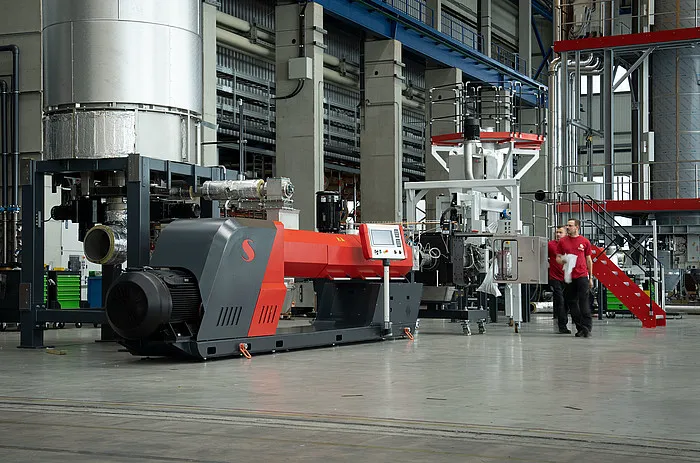
Extrusion and tape drawing form the first major processing step. PP resin is dried to remove excess moisture, melted in an extruder, and extruded as a thin sheet. This sheet is slit into narrow tapes, which are then drawn at controlled temperatures. The draw ratio determines the balance between strength and elongation; too little drawing yields weak tapes, too much can make them brittle. VidePak uses advanced extrusion and drawing lines from Austrian Starlinger and German W and H, equipment known for tight process control, stable temperature profiles, and consistent haul-off speeds. These features help maintain tape denier within tight tolerances, which is vital for uniform fabric.
Production stages at a glance
| Stage | Key Focus | Impact On Anti-Bulge Performance |
|---|---|---|
| Raw material inspection | Resin purity, additive accuracy, webbing strength | Ensures baseline strength and reliability |
| Tape extrusion and drawing | Tape denier, draw ratio, crystallinity | Defines tensile properties of body fabric |
| Weaving | Weave pattern, pick density, fabric width | Controls strength and dimensional consistency |
| Coating or lamination | Coat weight, adhesion, pinhole rate | Improves moisture barrier and dust containment |
| Cutting and printing | Panel dimensions, marking accuracy | Ensures baffles and panels align for cubic shape |
| Sewing and assembly | Seam type, stitch density, loop attachment | Transfers loads and maintains internal bracing |
| Inspection and testing | Dimensional checks, load tests, visual inspection | Confirms that finished Anti-Bulge FIBC Bags match design intent |
After tape production, weaving turns tapes into fabric. High-speed circular or flat looms, again often from Starlinger or W and H, interlace tapes into a robust matrix. Loom settings such as pick density, warp tension, and loom speed are tuned so that fabric weight, width, and tensile properties stay within specification. For Anti-Bulge FIBC Bags, consistency in width is particularly important; if panels vary too much, baffles will not match perfectly and the bag may lean or twist when filled.
Coating or lamination lines may follow. Here, the woven fabric passes through an extruder-coater that deposits a thin film of PP or PE onto its surface. Line operators aim for a uniform coat weight with minimal pinholes. This step is critical when anti bulging FIBC containers are used for dusty or moisture-sensitive products. In parallel, blown film extrusion lines produce liners, which are later cut and welded into form-fit shapes if required.
Once fabrics and liners are ready, they are cut to size. Automated cutting tables with hot knives or ultrasonic cutters can shape panels, baffles, tops, bottoms, and reinforcement patches with high dimensional accuracy. At this phase, traceability codes, logos, safety pictograms, and product information can be printed or applied. Baffle panels receive their flow openings, positioned so that material can move efficiently while the baffle still ties opposing walls together.
Sewing and assembly then bring the structural logic of Anti-Bulge FIBC Bags to life. Skilled operators or semi-automatic stations sew body panels, attach baffles, integrate the base and top constructions, and fix loops in place. Different seam types are used depending on load paths: flat seams, safety seams, and chain lock seams, sometimes combined with binding tapes. Critical seams around loops and baffles are often sewn multiple times or with reinforced patches to avoid stress concentrations.
Downstream, VidePak performs staged inspection: measuring dimensions, checking seam quality, validating printing, and sampling finished bags for mechanical tests. Top-lift tests simulate actual handling, cyclic loading tests assess fatigue behavior, and sometimes drop tests emulate accidental impacts. For bags intended for hazardous materials, additional tests and documentation may be required to meet international transport rules.
Quality Management And VidePak's Control Philosophy
To understand why Anti-Bulge FIBC Bags from VidePak behave consistently in the field, it is useful to look at the company's quality philosophy. Quality is not treated as a final gate, but as a thread woven through every design and production decision. Instead of asking only whether a bag passes a specific test, VidePak asks how every parameter influences the real-world context in which the bag will be used.
First, designs are created in alignment with widely recognized standards such as ISO, ASTM, EN, and related norms governing bulk packaging. These frameworks define test methods for safe working load, safety factor, top-lift strength, stacking performance, and drop behavior. By designing Anti-Bulge FIBC Bags so that they meet or exceed these benchmarks, VidePak ensures that its products integrate smoothly into global supply chains where compliance is not optional.
Second, raw material strategy is intentionally conservative. By prioritizing virgin PP and high-grade webbing, liners, and threads from large, established suppliers, VidePak reduces variability at the source. Every incoming batch is sampled, tested, and recorded. If customers request recycled content to support sustainability programs, this is handled through controlled formulations and additional checks so that the mechanical integrity of anti bulging ton bags is not compromised.
Quality reminder: For a one-ton Anti-Bulge FIBC Bag, a small hidden defect in webbing or a poorly controlled seam can separate safe performance from catastrophic failure. That is why VidePak treats quality as a continuous process rather than a final stamp.
Third, VidePak relies on advanced machinery from Starlinger and W and H at the core of its extrusion, weaving, and conversion operations. These platforms offer precise control of temperature, speed, and tension, as well as built-in monitoring and alarms. Stable equipment performance translates directly into uniform tape properties, consistent fabric GSM, and predictable panel dimensions. For space-saving FIBC containers, where panel alignment and baffle symmetry are crucial, this consistency is a decisive advantage.
Fourth, an integrated inspection regime covers the entire production chain. Incoming material inspection is followed by in-process checks on extrusion and weaving lines, including tape denier tests, fabric tensile tests, and visual inspection for defects. Later, finished bags undergo dimensional verification, load tests on sample units, and visual inspection under controlled lighting. Traceability systems link each production batch to material lots and test records, enabling root-cause analysis if issues arise in the field.
Taken together, these layers of control make VidePak's Anti-Bulge FIBC Bags not only strong on paper but reliable in real operations. Quality is treated as a set of overlapping safety nets rather than a single checkpoint: if a deviation slips past one net, another is likely to catch it before bags reach customers.
Applications Across Industries And Process Environments
The true value of Anti-Bulge FIBC Bags becomes obvious when viewed across the variety of industries that depend on them. Chemical producers, mineral processors, food ingredient manufacturers, agricultural cooperatives, construction firms, and recycling facilities all face similar logistical questions: how to move large amounts of dry, flowable material safely, efficiently, and with traceability. The precise answers differ, but baffle FIBC bags repeatedly emerge as a practical, scalable solution.
In the chemical and mineral sectors, these containers are used for dense powders and granules such as titanium dioxide, calcium carbonate, engineered plastics, industrial minerals, pigments, and specialized additives. These products often have high bulk density and may be abrasive. Stacking conventional bags filled with such products can be risky, because overhanging barrels of powder exert uneven pressure on pallets and racks. By contrast, form-stable bulk bags resist bulging, allowing higher yet stable stacks and reducing the likelihood of damage to pallets, racks, and packaging film.
Food and feed industries rely heavily on Anti-Bulge FIBC Bags for ingredients such as sugar, flour, starch, grains, premixes, and animal feed. Hygiene, allergen control, and traceability are major concerns. Here, form stability supports a different type of efficiency: cold storage capacity. In chilled or frozen warehouses, every cubic meter is expensive to operate. When space-saving FIBC containers stack uniformly, air flow becomes more predictable and refrigeration systems can operate closer to their optimal design conditions. Meanwhile, liners and food-contact-approved fabrics protect ingredients from contamination.
In agriculture and forestry, anti bulging FIBC containers carry seeds, fertilizers, pesticides, wood pellets, and biomass. Storage patterns often combine outdoor and indoor areas, exposing bags to UV, humidity, and mechanical stress from handling equipment. UV-stabilized fabrics and robust loop designs become critical. The cube-like form of cubic jumbo bags helps farmers and biomass operators organize stock into clear modular blocks, simplifying inventory control across seasons.
Construction and infrastructure projects present yet another demanding environment. Cement, sand, aggregates, specialty grouts, and admixtures all pass through job sites where space is restricted, ground may be uneven, and loading conditions are unpredictable. Being able to hoist a form-stable Anti-Bulge FIBC Bag by crane, place it near a mixer, and discharge it through a spout without the bag leaning dangerously or snagging on nearby structures is a significant advantage. When bags must be temporarily stored in stacks on tight sites, form stability again reduces the risk of collapse.
Waste management and recycling operations use Anti-Bulge FIBC Bags for sorted recyclables, shredded plastics, metal scrap, and refuse-derived fuels. These materials can be irregular, sharp-edged, or dusty. Here, coatings and liners are particularly important to contain dust and fragments, while rugged fabrics protect against puncture. Stable stacks in yards or transfer stations help keep access routes clear and minimize the risk of bags sliding or toppling when wind or weather conditions change.
Observation: Across these very different sectors, the same pattern repeats. Whenever bulk materials must be stacked high, stored densely, and moved frequently, Anti-Bulge FIBC Bags provide a way to turn volatile piles of powder or granules into orderly, manageable units of inventory.
Engineering Parameters And Design Trade-Offs
Designing Anti-Bulge FIBC Bags is not merely a matter of picking a size and adding baffles. It is a multi-variable optimization problem where safe working load, safety factor, fabric weight, baffle geometry, liner configuration, and loop design all interplay. Change one variable, and several others may need adjustment. The original article on enhancing safety and efficiency with anti-bulge designs hints at these trade-offs; a closer look shows how they work in practice.
A typical anti-bulge design starts with a target safe working load, say 1,000 kg, and a required safety factor, for instance 5:1 or 6:1. From these parameters, engineers determine fabric strength, seam geometry, and loop properties. Bulk density of the product then informs bag height: higher bulk density means more mass for the same volume, so bag height may be moderated to keep loads within limits. Conversely, low-density products might use taller bags to maximize container utilization.
Typical specification ranges for Anti-Bulge FIBC Bags
| Parameter | Typical Range | Design Comment |
|---|---|---|
| Safe Working Load | 500 to 2,000 kg | Higher loads require stronger fabrics, seams, and loops |
| Safety factor | 5:1 or 6:1 | 6:1 for multi-trip or critical routes |
| Footprint | 90 x 90 to 110 x 110 cm | Matched to pallet and container dimensions |
| Height | 90 to 150 cm | Influenced by product density and stacking requirements |
| Body fabric weight | 160 to 230 g per square meter | Heavier GSM for abrasive or high-stress applications |
| Baffle fabric weight | 90 to 120 g per square meter | Lighter fabric is sufficient but must resist tearing |
| Coating weight | 18 to 30 g per square meter | A balance between barrier performance and flexibility |
| Liner thickness | 50 to 120 micrometers | Thicker liners for sharp products or high barriers |
What makes these parameters interesting is not the numbers themselves but their interactions. Increase fabric weight to handle a more abrasive product, and stitching patterns may need adjustment to avoid thick seam build-ups that run poorly on sewing machines. Select a heavier liner to meet aggressive barrier targets, and the filling behavior of the bag might change, requiring a different baffle aperture pattern to prevent trapped air. Raise the height of the bag to improve container utilization, and stacking rules must be re-evaluated to ensure safety margins remain acceptable.
This web of interdependencies explains why Anti-Bulge FIBC Bags are best designed collaboratively, with input from production engineers, logistics planners, and sometimes even external partners. In some cases, insights from broader woven packaging experience, such as that captured in a detailed guide to heavy duty woven bags, can be repurposed to refine anti-bulge designs. After all, load paths, fabric behavior, and coating dynamics follow similar physical laws across different bag formats.
Operational Scenarios And Before–After Transformations
Real-world stories often make the value of Anti-Bulge FIBC Bags more tangible than spreadsheets or test reports. Consider three contrasting scenarios: a fine chemical producer, a food ingredient manufacturer, and a recycling yard. Each starts with different challenges, but in each case, the introduction of baffle FIBC bags reshapes daily operations.
A fine chemical producer handles powders that tend to aerate during filling and then settle over time. Conventional bulk bags balloon outward on the pallet, causing overhang that forces conservative stacking patterns. Warehouse teams adopt pyramid stacks only two or three bags high, far below what the building could safely accommodate. After switching to Anti-Bulge FIBC Bags with optimized baffle geometry and coated fabric, the same warehouse can support higher stacks with straight sides. The footprint of each stack shrinks, aisles widen, and forklift operators report fewer near-misses when maneuvering.
A food ingredient manufacturer faces a different problem: cold storage pressure. Sugar and starch blends must be kept cool, but existing packaging comprises a mix of smaller sacks and conventional jumbo bags. Heights vary, aisles are inconsistent, and cold air does not circulate uniformly. When the manufacturer standardizes on space-saving FIBC containers with food-grade liners, pallet loads become modular, each with known dimensions and weights. Airflow becomes more predictable, temperature gradients narrow, and the cold store operates closer to design efficiency. At the same time, traceability improves as each form-stable bulk bag carries a unique identification code linked to batch records.
A recycling facility processes mixed plastics and metal scrap. Loads are irregular and often sharp-edged. Conventional jumbo bags tear at seams and bulge into aisles, making it hard to keep yards organized. Introducing robust Anti-Bulge FIBC Bags with reinforced corners, heavier body fabric, and carefully chosen baffle layouts changes the landscape. Stacks stand straighter. Wind gusts have less leverage on cubic loads than on barrel-shaped ones. Trucks can be loaded more densely because pallets fit neatly in containers. Operators spend less time re-stacking and more time processing material.
Pattern behind these stories: Different inputs, similar outcome. Whether the concern is limited space, difficult climate control, or unruly scrap, the shift from conventional bulk bags to Anti-Bulge FIBC Bags tends to convert chaos into order, and hidden risk into more predictable routines.
Risk, Cost, And System-Level Thinking
When procurement teams evaluate packaging options, the temptation is to focus on unit price and nominal specifications. How much does a bag cost? What is its rated load? Yet Anti-Bulge FIBC Bags reward a broader lens that considers risk and cost at the system level. The question becomes not only how much a bag costs to purchase, but how it shapes safety, throughput, and total logistics cost once it enters daily operations.
On the cost side, Anti-Bulge FIBC Bags can reduce transport and storage expenses by improving space utilization. If more product fits into each container or onto each warehouse pallet position, fewer shipments are needed for the same volume. Higher stacking in safe configurations can defer the need for warehouse expansion or rental of additional storage space. Reduced product damage and less rework also matter: when stacks are stable and bags remain intact, fewer loads must be repacked, written off, or investigated.
On the risk side, form stability and robust construction help limit safety and reputational hazards. A bag that holds its shape and resists tearing reduces the probability of falling loads, dust emissions, or spilled product. For hazardous or high-value materials, even a single incident can have large implications. Anti-Bulge FIBC Bags contribute to risk mitigation by reducing the number of uncontrolled variables: geometry is consistent, lifting behavior is predictable, and performance is verified against recognized standards.
Seen through this systems lens, the apparent premium for an anti bulging FIBC container often becomes a rational investment rather than an extra cost. When total cost of ownership includes storage density, freight utilization, safety incidents, housekeeping effort, compliance exposure, and customer satisfaction, the equation tends to tilt in favor of higher-performing packaging.
Looking Ahead: Evolving Anti-Bulge FIBC Bag Design
The story of Anti-Bulge FIBC Bags is still unfolding. As logistics networks grow more complex, environmental expectations rise, and digital tools spread through factories and warehouses, new requirements and new opportunities are emerging. Packaging is being asked to perform not only as a container, but as a data carrier, a sustainability lever, and a platform for innovation.
On the material front, advances in PP formulations and process technology are enabling lighter fabrics with equal or greater strength. This could allow future form-stable bulk bags to carry the same loads with less material, reducing both cost and environmental footprint. In parallel, better ways of incorporating responsibly managed recycled content are being explored, so that circularity can be increased without sacrificing critical safety factors.
Digitally, tags, barcodes, and optional RFID transponders can turn each Anti-Bulge FIBC Bag into a node in the data network. Bags can be tracked as they move, linked to batch and test records, and associated with specific routes or customers. In multi-trip systems, this data can reveal how many cycles a particular bag has completed, when it should be inspected more closely, or when it should be retired. Predictive maintenance, once reserved for machines, can extend to reusable packaging fleets.
In terms of structural design, simulation and testing tools are becoming more sophisticated. Finite element models of baffle FIBC bags can predict how fabrics stretch, how seams share loads, and how internal pressures distribute during filling and transport. Physical test rigs allow accelerated life testing under combined stresses: vibration, stacking, and cyclic lifting. Insights from these tools feed back into refined baffle geometries, novel seam architectures, and new liner concepts that push the balance between cube stability, cost, and handling behavior.
Ultimately, the question for engineers, buyers, and logistics planners is not whether Anti-Bulge FIBC Bags can carry a load. That part is already well established. The more interesting question is how these containers can be integrated into broader strategies for operational excellence, worker safety, and environmental responsibility. When those conversations happen, anti-bulge designs cease to be a narrow technical option and become instead an enabling technology for the whole supply chain.
2025-11-14
- Understanding Anti-Bulge FIBC Bags In Modern Bulk Logistics
- Names, Aliases, And Functional Personas Of Anti-Bulge FIBC Bags
- Material Foundations Of Anti-Bulge FIBC Bags
- Structural Features And Performance Characteristics
- From Resin To Finished Bag: Production Of Anti-Bulge FIBC Bags
- Quality Management And VidePak's Control Philosophy
- Applications Across Industries And Process Environments
- Engineering Parameters And Design Trade-Offs
- Operational Scenarios And Before–After Transformations
- Risk, Cost, And System-Level Thinking
- Looking Ahead: Evolving Anti-Bulge FIBC Bag Design
- 1. Design Innovations: Structural Integrity Meets Functional Precision
- 2. Comprehensive Quality Assurance: 12-Point Inspection Protocols
- 3. Operational Benefits: Cost Savings and Risk Mitigation
- 4. VidePak’s Competitive Edge: Scale, Customization, and Compliance
- FAQs: Addressing Procurement Priorities
- References
Anti-bulge FIBC (Flexible Intermediate Bulk Container) bags are revolutionizing industrial packaging by mitigating risks of load instability, material spillage, and workplace accidents. At VidePak, a global leader in woven packaging since 2008, we combine 30+ years of industry expertise, 100+ Starlinger circular looms, and 16 extrusion lines to produce FIBC bags that exceed ISO 21898 standards, with ≥1,200 N/5 cm tensile strength and ≤0.5% thickness tolerance. This article explores how our anti-bulge FIBC designs enhance safety, streamline logistics, and reduce operational costs, supported by 12-point quality inspections and data-driven material innovations.
1. Design Innovations: Structural Integrity Meets Functional Precision
1.1 Reinforced Base and Side Panels
VidePak’s anti-bulge FIBC bags feature triple-layered corner reinforcements and cross-stitched side panels to counteract lateral stress during filling, transport, and stacking. For example, our 1,000 kg capacity bags maintain ≤2% deformation under dynamic loads, tested per ASTM D5276 standards. The 2.3 mm fine-yarn weaving technology ensures uniform fabric density (14×14 strands/inch), reducing puncture risks by 40% compared to conventional designs.
1.2 Advanced Material Blends
Our FIBC bags integrate UV-stabilized polypropylene (PP) and anti-static additives to ensure durability in harsh environments:
- UV Resistance: Maintains 95% tensile strength after 1,000 hours of accelerated UV exposure (per ISO 4892-3).
- Anti-Static Properties: Surface resistivity ≤10^9 Ω/sq, critical for flammable powder storage.
2. Comprehensive Quality Assurance: 12-Point Inspection Protocols
VidePak’s ISO 9001-certified labs conduct rigorous tests to guarantee compliance with global safety benchmarks:
| Test Parameter | Standard | VidePak Performance |
|---|---|---|
| Tensile Strength | ASTM D5034 | ≥1,200 N/5 cm |
| Tear Resistance | ASTM D2261 | ≥300 N (Elmendorf tear) |
| Heat Seal Strength | ASTM F88 | ≥25 N/cm |
| UV Aging Resistance | ISO 4892-3 | ≤5% strength loss after 1k hrs |
| Thickness Tolerance | ISO 4593 | ±0.05 mm |
| Color Consistency | ASTM D2244 | ΔE ≤1.5 (CIELAB scale) |
Additionally, we perform edge smoothness checks (≤0.1 mm burr tolerance) and grammage verification (85–100 g/m²) to eliminate defects.
3. Operational Benefits: Cost Savings and Risk Mitigation
3.1 Enhanced Load Stability
By integrating internal baffles and load-bearing liners, our FIBC bags reduce product shift during transit. For instance, a Brazilian fertilizer client reported a 30% reduction in spillage-related losses after switching to VidePak’s anti-bulge designs.
3.2 Ergonomic and Logistical Efficiency
- Four-loop lifting system: Distributes weight evenly, minimizing worker strain.
- Custom printing: High-definition 8-color flexography ensures legible handling instructions, reducing misloading incidents by 25%.
4. VidePak’s Competitive Edge: Scale, Customization, and Compliance
With 568 employees and $80 million annual revenue, VidePak delivers:
- Fast turnaround: 15–20 days for 20,000+ units.
- Global certifications: BRCGS, FDA, and EU REACH compliance.
- Custom solutions: Anti-microbial coatings, moisture barriers, and RFID tracking tags.
FAQs: Addressing Procurement Priorities
| Question | Answer |
|---|---|
| What is the maximum load capacity? | 500–2,000 kg, depending on fabric GSM and stitching design. |
| Are your bags recyclable? | Yes, 100% PP material complies with EPRO recycling standards. |
| Can you handle urgent orders? | Yes, our 100+ looms enable 10,000-unit emergency orders in 10 days. |
References
- VidePak Official Website: www.pp-wovenbags.com
- Email: info@pp-wovenbags.com
- Industry Standards: ASTM D5034, ISO 21898, BRCGS Packaging Materials (2024)
For insights into FIBC bulk bag manufacturing processes, explore our technical guide on Understanding the Production of Jumbo Bags. To learn about safety protocols, visit Ensuring Quality and Safety in FIBC Bulk Handling.
Final Note: The anti-bulge FIBC market is projected to grow at 6.2% CAGR through 2030, driven by automation and sustainability demands. VidePak’s fusion of Austrian engineering precision, China’s cost efficiency, and ESG-aligned production positions us as the partner of choice for bulk handlers prioritizing safety and ROI. With a 98% client retention rate, we invite you to experience innovation engineered for reliability.