
What are Poly‑BOPP Bags? Definitions, everyday aliases, and the value they bring
At their core, Poly‑BOPP Bags are multilayer packaging sacks that combine a biaxially oriented polypropylene film—commonly abbreviated as BOPP—with a woven polypropylene fabric substrate. The woven layer contributes tensile strength, puncture toughness, and dimensional stability, while the film layer contributes print quality, surface cleanliness, and improved resistance to moisture ingress. When these layers are laminated correctly, the whole becomes more than the sum of its parts: the bags remain strong in warehouses, legible on retail shelves, and dependable across rough logistics chains. Because they reconcile industrial durability with consumer‑facing appearance, Poly‑BOPP Bags operate equally well in fertilizer depots, seed and grain stores, construction sites, animal feed mills, and modern grocery channels.
Terminology varies across markets, and the same structure may be referenced using parallel names. The most common equivalents include: BOPP‑laminated woven polypropylene bags, BOPP woven sacks, polywoven laminated bags, laminated PP woven bags, and BOPP coated polypropylene sacks. Whether a spec sheet says windowed film, matte film, reverse‑printed film, or micro‑perforated film, the engineering intent is similar: pair a film skin with a woven backbone and tailor each parameter to the product physics, the filling line, and the shipping environment.
Quick clarity: throughout this article the terms Poly‑BOPP Bags, BOPP‑laminated woven PP bags, and polywoven laminated sacks are used interchangeably to refer to the same functional architecture: BOPP film laminated onto woven polypropylene fabric, optionally with functional coatings, micro‑perforations, anti‑slip texturing, specific closures, or valve assemblies.
What is the material system behind Poly‑BOPP Bags? From resin to film to seams
Understanding the materials that constitute Poly‑BOPP Bags clarifies why they are rugged in motion yet refined in presentation. The woven base is made from polypropylene tapes—sometimes called raffia tapes—extruded, slit, stretched, and woven into fabric. Polypropylene is chosen for its high strength‑to‑weight ratio, low moisture absorption, chemical resistance, and recyclability within mono‑polyolefin streams. The orientation imparted during tape drawing improves tenacity and limits elongation creep under stacking loads. Fabric basis weights often range from 70 to 160 gsm for most applications, with heavier fabrics used where drop heights are high or pallets are stacked deep.
The outer film is biaxially oriented polypropylene. By drawing the film in both the machine direction and the transverse direction, the polymer chains align, producing stiffness, clarity, gloss, abrasion resistance, and lower water vapor transmission compared to unoriented films. BOPP can be supplied in clear gloss, matte, or specialty textures. When reverse printed—ink protected under the film—graphics remain scuff‑resistant through long supply chains. When surface printed, the film can be tuned for high ink adhesion and outdoor durability. Film thickness commonly falls between 15 and 35 microns, with the exact thickness chosen to balance print fidelity, barrier behavior, and hand feel.
Between film and fabric sits a bonding medium—either a molten polyolefin extrusion coating or an adhesive layer formulated to stick strongly to both BOPP and PP tape fabric. To maintain recyclability, many designs prefer PP‑ or PE‑based tie layers, including anhydride‑grafted polyolefins that achieve excellent interfacial bonding without introducing incompatible chemistries. Around the edges of the bag, the conversion step creates seams and closures. Some bags are sewn open‑mouth (SOM) with high‑tenacity polyester or PP threads; others are heat‑sealed using a peelable inner layer; still others are produced as valve sacks for high‑speed filling with controlled de‑aeration.
Material card
Woven PP fabric: structural layer that sets tensile and tear thresholds; its pick density and denier distribution define seam retention and drop performance.
Material card
BOPP film: printable, abrasion‑resistant skin that reduces soiling and optimizes shelf impact; supplied as gloss, matte, soft‑touch, or windowed variants.
Material card
Tie layers & coatings: PP/PE‑based adhesives and functional layers (anti‑slip, sealable, antistatic) that deliver bond strength, machinability, and pallet stability.
| Sub‑layer | Typical options | Function in Poly‑BOPP Bags | Notes |
|---|---|---|---|
| BOPP skin | 15–35 μm, gloss/matte, reverse or surface printed | Barrier moderation, visual branding, abrasion resistance | Reverse print protects inks under film; windows possible |
| Tie/adhesive | PP/PE‑based, anhydride‑grafted polyolefins | Secure lamination bond without contaminating recyclate streams | Tune line speed, nip pressure, and web tension for high bonds |
| Woven PP fabric | 70–160 gsm; 600–1200 denier tapes; 10–14 picks/in | Structural backbone controlling tensile, tear, seam slippage | Circular or flat looms; pick density linked to air retention |
| Inner seal/coating | PE coex seal layer; anti‑slip lattice; antistatic | Heat‑sealability, pallet grip, dust control | COF tuning to avoid conveyor jams or pallet slide |
| Closure | Sewn open‑mouth, heat‑sealed, or valve | Filling speed, hermeticity, and cleanliness | Valve sleeves sized to product flow and deaeration needs |
What are the hallmark features of Poly‑BOPP Bags? From shelf appeal to warehouse resilience
Why do buyers specify Poly‑BOPP Bags again and again? Because the design addresses two competing demands at once. On the one hand: the warehouse—forklifts, stacked pallets, long journeys, abrasive contact. On the other hand: the shelf—clean graphics, legible warnings, brand‑consistent colors. Film over fabric fuses these worlds. The exterior resists scuffs; the interior carries the load. And unlike paper multiwall, the woven structure retains strength when ambient humidity surges.
Key features include impressive drop resistance at low basis weight; improved moisture moderation that helps powders avoid caking; exceptional print fidelity through reverse printing; optional micro‑perforations to evacuate trapped air at the filler; and COF control across film and film‑to‑pallet interfaces that reduces shifting during transport. For outdoor storage, UV‑stabilized options maintain bag integrity in sunlight. For electrostatic powders, antistatic packages reduce nuisance shocks and dust attraction.
Callout — The retail advantage: Reverse‑printed BOPP keeps inks protected under the film, so the visual signal a brand sends at the point of sale is the same signal seen at the factory—glossy or matte, crisp or soft‑touch, with windows precisely where the product tells its story.
What is the production process of Poly‑BOPP Bags? A stepwise path from resin audits to final inspection
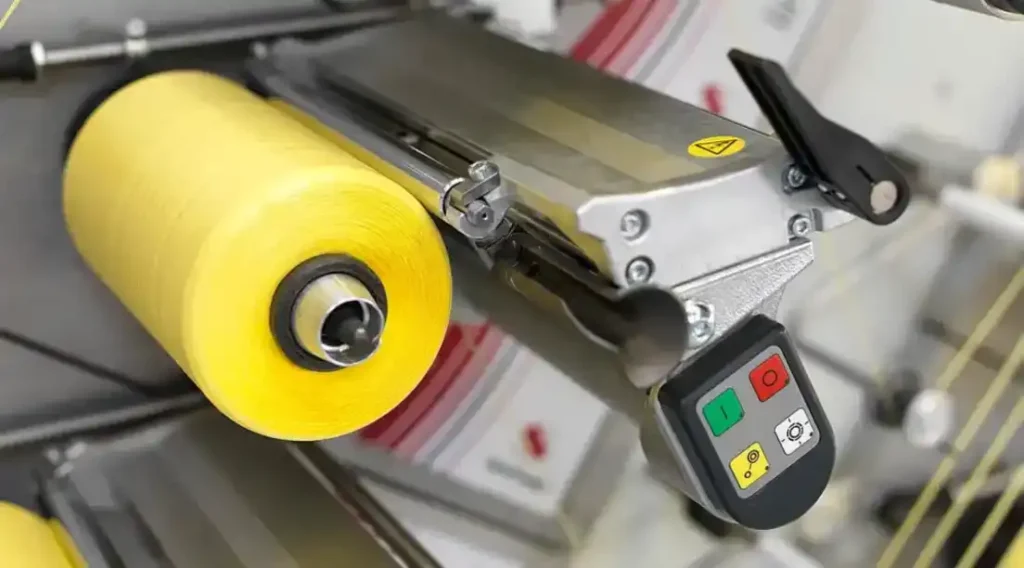
A reliable bag does not appear by accident; it is the output of a disciplined process that translates specifications into parts and parts into performance. The manufacturing of Poly‑BOPP Bags moves through three linked arcs: front‑end raw‑material qualification, middle‑stage forming and lamination, and back‑end conversion and testing. VidePak emphasizes that each arc runs on best‑in‑class equipment sourced from Austria and Germany: tape lines and looms from Starlinger, coating and printing from W&H (Windmöller & Hölscher), automated conversion with integrated inspection. Tight control of web tension, nip pressure, draw ratios, and registration contributes directly to uniform bond strength, clean seams, and stable dimensions.
Front‑end: material selection & testing
- Approved raw materials: virgin PP raffia grades for stable melt flow; optical‑quality BOPP films with tight thickness tolerance.
- Incoming checks: melt flow index, ash content, pellet color and size uniformity, film haze and gloss, film gauge profile.
- Compliance files where needed: food‑contact declarations, migration data, and RoHS/REACH statements.
Mid‑process: forming & lamination
- Tape extrusion and orientation on Starlinger lines to target denier, tenacity, and elongation limits.
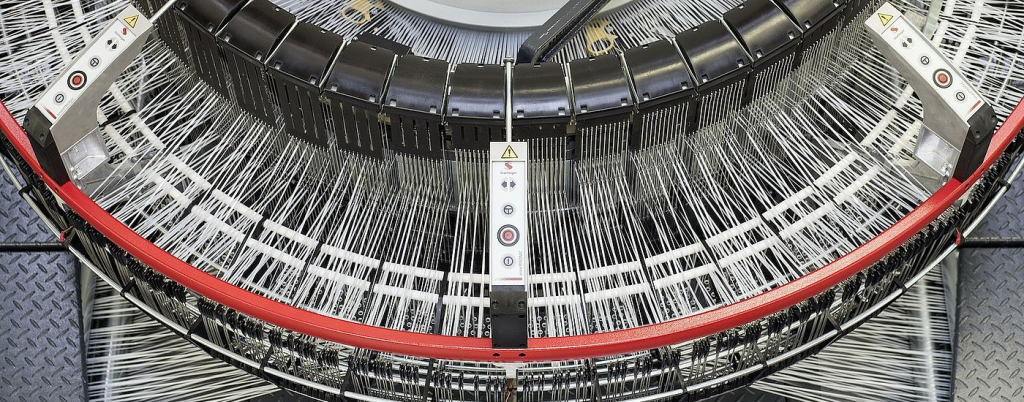
- Weaving on circular or flat looms with real‑time pick‑density monitoring and tape‑break detection.
- Extrusion coating or adhesive lamination to couple BOPP to fabric; reverse or surface printing on W&H presses.
Back‑end: conversion & quality control
- Cutting, gusseting, valve installation or sewing, heat sealing if specified; edge trimming for clean seams.
- Mechanical tests (tensile, tear, seam slippage), barrier checks (WVTR spot tests), coefficient of friction, drop tests.
- Visual inspection for registration, color tolerance, surface defects; statistical sampling per standard AQL plans.
Process conviction: better machines constrain variation. Starlinger and W&H platforms stabilize the variables that matter—temperature profiles, web tension, nip pressure, registration accuracy—so each lot of Poly‑BOPP Bags behaves like the next when it meets your filling line.
Where do Poly‑BOPP Bags excel? A tour of applications and selection heuristics
Applications span agriculture, construction, chemicals, retail dry goods, and humanitarian logistics. For fertilizers and soil amendments, the balance of moisture moderation and abrasion resistance is pivotal: caking declines and labels remain readable. For cement, gypsum, lime, and dry mortar, woven strength plus film control of COF improves stack safety. For seeds and grains, windows display product while printing unlocks competitive shelf presence. In pet care, litter and feed benefit from strong seams and optional odor‑modulating inner layers. Across these categories, a few variables govern the final spec: bulk density, particle shape, sensitivity to humidity, filling method, and palletization regime.
| Market | Typical configuration | Why Poly‑BOPP Bags fit |
|---|---|---|
| Fertilizers | 110 gsm fabric; 25 μm matte film; micro‑perfs; anti‑slip | Moisture moderation, pallet stability, abrasion‑proof graphics |
| Seeds & grains | 80–100 gsm; 20 μm gloss film with window; heat‑seal top | Retail presentation without sacrificing handling strength |
| Construction powders | 100–140 gsm; high‑COF film; valve closure | Higher drop resistance, faster filling, lower dust |
| Chemicals & polymers | Antistatic options; matte film; long valve sleeve | Safer dispensing, cleaner pallets, improved readability |
How does VidePak guarantee quality? Four pillars that close the loop
Quality is not a slogan; it is a system. VidePak embeds quality across sourcing, production, and test regimes so that the performance of Poly‑BOPP Bags is demonstrably consistent. The first pillar is adherence to mainstream standards. Whether the customer references ISO, ASTM, EN, or JIS methods, processes are mapped to specific work instructions, critical control limits, and inspection templates. The second pillar is the use of 100% virgin raw materials from major producers; recycled feedstock is kept out of critical structural layers to preserve melt flow stability, bonding behavior, and long‑term mechanicals. The third pillar is the machinery choice—Starlinger for extrusion and weaving; W&H for coating and printing—because superior equipment narrows variation and raises uptime. The fourth pillar is a layered inspection plan covering incoming materials, in‑process checkpoints, and finished‑goods AQL sampling with retention samples and traceback.
Pillar 1
Build and verify against recognized standards with documented SOPs and control charts.
Pillar 2
Use 100% virgin PP and high‑uniformity BOPP from large, audited producers.
Pillar 3
Run premium equipment from Austria’s Starlinger and Germany’s W&H for tighter tolerances.
Pillar 4
Execute layered inspection: incoming → in‑process → finished goods, with AQL sampling.
System thinking for Poly‑BOPP Bags: decoupling complexity and recombining it into a clear spec
Great packaging is a system solution. To specify Poly‑BOPP Bags well, treat the decision space as four interlocking subsystems: product physics, filling line dynamics, logistics and storage, and branding/regulatory constraints. Decompose each into measurable inputs; choose film, fabric, and features accordingly; then integrate the choices into one coherent specification. Ask: What particle size distribution and bulk density are we dealing with? What is the target bags‑per‑minute and what filling technology is used—gravity, auger, air, or impeller? Will pallets face tropical humidity or high‑altitude cold? What label laws or retail shelf tests apply? A bag that is perfect for mineral additives in a dry inland climate may be overbuilt or underbuilt for rice stored near a humid port. The right answer is specific.
Design heuristic: translate inputs into levers. Bulk density maps to fabric gsm; abrasiveness maps to film thickness and varnish choices; humidity maps to WVTR targets and inner seal layers; pallet geometry maps to COF windows; fill method maps to valve geometry and deaeration pathways.
Engineering parameters and decision ranges: a reference for spec writers
The numbers that define Poly‑BOPP Bags are not abstract; they are actionable. While actual targets vary by application, the following ranges and checkpoints offer a practical starting point for engineers and buyers drafting a first specification or benchmarking an incumbent design.
| Parameter | Typical range | Why it matters | Tuning tips |
|---|---|---|---|
| Fabric basis weight | 70–160 gsm | Controls tensile and stacking safety at minimum mass | Increase gsm for higher drop heights; decrease for retail lightweights |
| Tape denier | 600–1200 D | Affects tear propagation and seam retention | Use higher denier for abrasive products |
| Pick density | 10–14 ppi | Influences air retention, stiffness, and seam bite | Coordinate with valve design to manage deaeration |
| BOPP thickness | 15–35 μm | Sets print fidelity and scuff resistance | Thicker films for outdoor or abrasive logistics |
| WVTR | 3–8 g/m²/day | Moderates caking and humidity uptake | Use spot tests at 38 °C/90% RH for moisture‑critical SKUs |
| COF (film/film) | 0.3–0.6 | Pallet stability without jamming conveyors | Tune via anti‑slip coatings or lattice textures |
Comparing alternatives: when to choose Poly‑BOPP over paper multiwall or PE mono‑film
Decision‑makers often weigh Poly‑BOPP Bags against paper multiwall sacks and mono‑film polyethylene bags. Paper wins on perceived naturalness and printability but loses strength as humidity rises. Mono‑film PE can heat‑seal beautifully yet struggles with drop performance at higher weights and may scuff under abrasive handling. Laminated PP woven constructions split the difference: mechanical robustness approaches heavy‑duty sacks, while the BOPP skin captures the marketing value once reserved for paper. Question what the product requires: ruggedness or romance? If both are needed, a woven‑plus‑film laminate answers yes to durability without saying no to design.
Paper multiwall
Strong initially, but humidity softens fibers; graphics look great yet scuff; recyclability straightforward but moisture remains the nemesis.
PE mono‑film
Excellent sealability and clarity; may lack puncture resistance for dense powders; graphics risk abrasion.
Poly‑BOPP
Hybrid strength and print; designed for pallets and shelves; tunable for valve filling, windows, anti‑slip, and WVTR targets.
Filling line integration: from bag mouth geometry to dust control
An ideal bag is easy to pick, easy to open, easy to fill, and easy to seal. Poly‑BOPP Bags can be produced with crisp mouth rigidity for automatic placement on filling nozzles; valve versions can be paired with specific sleeve diameters and lengths to optimize product flow. Micro‑perfs act as escape vents for entrained air, and antistatic packages prevent powders from clinging to the film surface. On high‑speed lines, reverse‑printed film preserves graphics despite friction at guides and conveyors. When heat‑sealing is used, inner coex layers tuned for seal initiation temperature and hot tack ensure hermeticity without warping the laminate.
For readers who also need a deeper dive into lamination families closely related to Poly‑BOPP Bags, see this guide on advanced laminated PP woven bags. It elaborates on laminate options and how they interplay with performance on the line.
Moisture, barrier, and cleanliness: the hygiene logic behind film‑over‑fabric
Water vapor transmission is only part of the moisture story. Powders cake when vapor condenses, when ambient humidity saturates the pore structure, or when temperature swings drive cycles of absorption and release. The oriented film in Poly‑BOPP Bags lowers vapor ingress compared with unlaminated fabrics, while the smooth exterior resists dust pickup and is easy to wipe down. For highly hygroscopic materials, a sealable inner layer raises hermeticity; for less sensitive goods, micro‑perfs balance air evacuation with moderated barrier. In clean rooms and food‑grade zones, the non‑fibrous film surface reduces the risk of shedding and supports legible, sanitary labelling.
Branding and graphics: why reverse printing under BOPP changes the math
There is a reason many brands shift to Poly‑BOPP Bags when the package must carry identity as well as inventory. Reverse printing protects the ink layer beneath the film, guarding against abrasion at conveyors, in trucks, and on pallets. Color management can be tightened to ΔE tolerances that keep product lines visually coherent across time and vendors. Matte varnish softens glare for premium goods, while gloss amplifies saturation for high‑impact categories. Windows tell product stories: the translucence of rice, the granularity of mineral salt, the nuanced palette of pet food kibbles. As a result, marketing teams get a larger, cleaner, more durable canvas than paper alone can support in humid or abrasive settings.
Palletization and transport: stability, stack safety, and the role of COF
Stack a pallet too high, accelerate too hard, or brake too suddenly, and pallets shift. Film that is too slick glides; film that is too tacky jams. Tuning the coefficient of friction on Poly‑BOPP Bags allows logisticians to run the Goldilocks zone where layers neither slide nor seize. Anti‑slip lattices raise friction; smooth matte films lower it. Pallet patterns, interlayers, and stretch‑wrap regimes interact with COF to produce a stability envelope. The extraordinary thing is that the same film that carries beautiful artwork is the film that provides tuned friction: function and form are not at odds here; they cooperate.
Risk management: failure modes, root causes, and corrective actions
Any packaging system can fail when variables drift. The solution is not finger‑pointing but structured troubleshooting. If lamination bubbles appear, suspect residual moisture in fabric or film, or inadequate nip pressure during coating; pre‑dry or raise nip. If print adhesion seems poor on surface‑printed designs, check surface energy, ink/solvent compatibility, and oven/cure conditions; corona treatment or ink system revision may be required. If seams slip, revisit stitch density, overlap geometry, and seam reinforcement; the answer may be a subtle rebalancing rather than a complete redesign. By moving symptom → cause → action, teams reclaim control of outcomes.
| Symptom | Likely root cause | Corrective action |
|---|---|---|
| Lamination bubbles | Residual moisture; low nip pressure | Pre‑dry; increase nip; adjust line speed and web tension |
| Poor print adhesion | Low surface energy; ink mismatch; under‑cure | Corona treatment; update ink; raise cure temp/time |
| Seam slippage | Insufficient bite; wrong geometry | Increase stitches; adjust overlap; reinforce seam |
| Pallet shifting | COF too low; smooth film | High‑COF film; anti‑slip coat; revise pallet pattern |
Sustainability: mono‑material clarity and downstream recyclability
Sustainability discussions gain coherence when designs are honest about chemistry. Poly‑BOPP Bags are fundamentally polyolefin structures: BOPP film over PP fabric. By keeping tie layers in the same family, and by avoiding incompatible inserts, the bag remains eligible for mono‑polyolefin mechanical recycling. In factories, clean trim can be reprocessed into noncritical components. In markets with extended producer responsibility regimes, mono‑material claims are easier to substantiate when the laminate avoids foreign species. None of this is accidental; it is the result of specification discipline.
Regulatory and hygiene: food‑contact, migration, and clean manufacturing
When Poly‑BOPP Bags are destined for food, feed, or seed applications, compliance becomes existential. Films, inks, and adhesives should be paired with declarations of compliance; migration testing may be run per market. Line hygiene rules—tool cleaning, lot segregation, foreign‑matter controls—protect the package from becoming the problem it was meant to solve. The film skin helps here too; it is low‑lint and easy to wipe, and reverse printing keeps ink encapsulated away from hands and incidental contact.
Procurement and total cost: price, performance, and risk as one equation
Price is vital, but price is not the whole story. The total cost of a bag includes line speed, reject rates, logistics losses, brand damage from scuffed labels, and the labor cost of rework or returns. By maintaining drop performance at lower basis weights and guarding graphics under film, Poly‑BOPP Bags often recover their unit‑price delta through fewer failures and better shelf outcomes. On the supplier side, the stability provided by Starlinger and W&H equipment enhances uptime and reduces line scrap—benefits that accrues to the buyer as predictability rather than as visible line items. The cheapest bag rarely remains the cheapest outcome when the calendar advances and the data accumulates.
Case patterns: translating requirements into repeatable specifications
Consider a hygroscopic fertilizer bagged at 25 or 50 kilograms. The spec may call for 110 gsm fabric, a 25 μm matte BOPP layer with reverse printing, micro‑perforations for deaeration, an anti‑slip surface, a UV package for yard storage, and a valve closure with PE sleeve. Quality control would include WVTR spot checks, ΔE color management, seam slippage within tight limits, and a drop test protocol at a defined height and cycle count. Now consider premium rice at 5 or 10 kilograms. The geometry may shift to heat‑seal tops, a gloss film with a clear window, and tighter print registration for retail alignment. Speak a third language for mineral additives on auger fillers: antistatic packages, long valve sleeves, high‑COF surfaces for pallet stability. Different stories; a common grammar.
From pilot to scale: qualification, AQL, and continuous improvement
New specifications begin with discovery, advance through short pilot runs, and harden during scale‑up. Each stage should capture data: fill rate, spillage, weight accuracy, dust emissions, pallet stability, and returns. Acceptable Quality Level plans balance risk and throughput, and retention samples anchor root‑cause analysis when deviations appear later. Once a spec is frozen, periodic audits—of raw materials, of process capability, of finished goods—keep the truth current. If the market or climate changes, the bag can evolve without abandoning the core platform. In other words, the specification is a living document, and Poly‑BOPP Bags are the living solution it describes.
Frequently asked questions: packaging engineers and buyers want to know
Are Poly‑BOPP Bags suitable for food? Yes, provided components are selected with food‑contact compliance and run on hygiene‑controlled lines, with proper documentation and migration testing. How do laminated sacks manage trapped air? Micro‑perforations plus valve geometry address deaeration without sacrificing barrier where it matters. Can these bags be fully recyclable? Mono‑polyolefin builds keep the chemistry compatible with mechanical recycling streams, especially when metal or non‑polyolefin inserts are avoided. When should anti‑slip films be specified? When pallet patterns, height, or transit acceleration demand extra friction; COF 0.5–0.6 is a common target window.
Tip for spec writers: anchor the drawing with four numeric anchors—fabric gsm, film thickness, COF target, and seam slippage limit—then articulate optional features like windows, varnishes, anti‑static, and UV packages. This lets vendors offer apples‑to‑apples quotes for Poly‑BOPP Bags.
Putting it all to work: a one‑page specification template you can adapt
Product: Poly‑BOPP Bags for [material]
Fill weight: [e.g., 25 kg]
Fabric: [e.g., 100 gsm PP woven, 12 ppi]
Film: [e.g., 25 μm matte BOPP, reverse printed]
Features: [micro‑perfs, anti‑slip, antistatic, UV]
Closure: [valve/heat‑seal/SOM]
Color control: ΔE ≤ [1.5] vs Pantone [ ]
QC checkpoints: WVTR ≤ [ ], seam slippage < [ ] mm, drop ≥ [ ] cycles at [ ] m; visual: registration within ±0.2 mm; COF [0.5–0.6].
Why the name matters: keywords, synonyms, and how buyers actually search
Real buyers do not search in perfect synonyms; they search in phrases, in near‑misses, in product plus problem. That is why the language around Poly‑BOPP Bags should naturally include variants like BOPP laminated woven polypropylene bags, laminated PP woven sacks, polywoven laminated packaging, moisture‑resistant woven bags, reverse‑printed BOPP sacks, UV‑stabilized woven bags, heat‑seal woven bags, micro‑perforated BOPP sacks, and valve bags for dry powders. The point is not to stuff a glossary; the point is to speak the dialect of practical concerns: “25‑kg BOPP valve bag,” “50‑kg laminated woven bag,” “anti‑slip COF 0.55,” “ΔE color tolerance,” “matte film window.” When documentation includes these living terms, engineers and purchasers find what they need faster and with fewer misunderstandings.
Closing conviction: a practical synthesis for teams that build and move real products
When a package has to be strong enough for the warehouse and clear enough for the shopper, when it must run on automated lines and withstand damp yards, when it must carry color‑accurate branding and also stack five high on a truck, the engineering choice gravitates toward Poly‑BOPP Bags. They are neither an indulgence nor a compromise. They are a pragmatic reconciliation of durability, moisture management, and visual communication—one you can specify in numbers, verify in tests, and improve in cycles. The technology is mature; the design space is rich; the outcomes are repeatable. That is why these bags have become the common language between operations and marketing, between today’s constraints and tomorrow’s opportunities.
2025-10-25
- What are Poly‑BOPP Bags? Definitions, everyday aliases, and the value they bring
- What is the material system behind Poly‑BOPP Bags? From resin to film to seams
- What are the hallmark features of Poly‑BOPP Bags? From shelf appeal to warehouse resilience
- What is the production process of Poly‑BOPP Bags? A stepwise path from resin audits to final inspection
- Where do Poly‑BOPP Bags excel? A tour of applications and selection heuristics
- How does VidePak guarantee quality? Four pillars that close the loop
- System thinking for Poly‑BOPP Bags: decoupling complexity and recombining it into a clear spec
- Engineering parameters and decision ranges: a reference for spec writers
- Comparing alternatives: when to choose Poly‑BOPP over paper multiwall or PE mono‑film
- Filling line integration: from bag mouth geometry to dust control
- Moisture, barrier, and cleanliness: the hygiene logic behind film‑over‑fabric
- Branding and graphics: why reverse printing under BOPP changes the math
- Palletization and transport: stability, stack safety, and the role of COF
- Risk management: failure modes, root causes, and corrective actions
- Sustainability: mono‑material clarity and downstream recyclability
- Regulatory and hygiene: food‑contact, migration, and clean manufacturing
- Procurement and total cost: price, performance, and risk as one equation
- Case patterns: translating requirements into repeatable specifications
- From pilot to scale: qualification, AQL, and continuous improvement
- Frequently asked questions: packaging engineers and buyers want to know
- Putting it all to work: a one‑page specification template you can adapt
- Why the name matters: keywords, synonyms, and how buyers actually search
- Closing conviction: a practical synthesis for teams that build and move real products
“What separates a premium packaging solution from a mediocre one?”
The answer lies in rigorous quality control of raw materials and precision engineering. At VidePak, our Poly-BOPP (Biaxially Oriented Polypropylene) woven bags are not merely products—they are the culmination of scientific material selection, advanced manufacturing, and uncompromising adherence to global standards. For industries ranging from agrochemicals to construction, our bags deliver 30% higher tensile strength and 50% longer lifespan than conventional alternatives, ensuring your goods remain secure from production to end-user.
1. The Foundation of Excellence: Raw Material Quality Control
Poly-BOPP bags derive their durability from the integrity of their raw materials. VidePak’s four-tier quality assurance system ensures every gram of PP resin meets exacting specifications.
1.1 Supplier Vetting: Beyond ISO Certificates
We audit suppliers against a 12-point checklist, including:
- Technical capability: Production capacity, R&D investment, and innovation track record.
- Market reputation: Third-party reviews and client testimonials (e.g., BASF holds a 4.8/5 rating on Chemical Industry Digest).
- Compliance: Alignment with ASTM D4101 (PP resin standards) and EN 13432 (compostability).
In 2023, we rejected 15% of potential suppliers due to inadequate melt flow index (MFI) consistency, a critical factor for extrusion stability.
1.2 Strategic Partnerships with Industry Leaders
VidePak sources PP granules exclusively from BASF, Sinopec, and Yangzi Petrochemical, leveraging long-term contracts to secure:
- Price stability: 10–15% cost savings versus spot market purchases.
- Material consistency: MFI variance <5% across batches, ensuring uniform fabric density (80–200 GSM).
1.3 Incoming Inspection: Science Over Guesswork
Every shipment undergoes:
- Melt Flow Index (MFI) Testing: Measures resin viscosity at 230°C/2.16 kg (target: 2–4 g/10 min for optimal extrusion).
- Tensile Strength Analysis: Samples tested on Instron 5967 machines (ASTM D638 compliance).
- Visual Inspection: Granule color and size uniformity (defect tolerance: <0.1%).
Data is logged into our SAP-QMS system, enabling traceability from raw material lot to finished bag.
2. Engineering Durability: How VidePak’s Technology Delivers
With 30+ years of industry expertise and Austrian Starlinger machinery, we transform premium PP into robust packaging solutions.
2.1 Circular Looms and Extrusion Mastery
- 100+ Starlinger Circular Looms: Weave fabric with <1% elongation variance, critical for load-bearing FIBC bags.
- 16 Extrusion Lines: Produce UV-stabilized PP tapes (width: 2–5 mm) with anti-fungal additives for tropical climates.
Case Study: A Chilean copper concentrate producer reduced bag rupture rates from 3% to 0.2% after switching to VidePak’s Poly-BOPP bags, saving $1.2 million annually in product loss.
2.2 Lamination and Printing Precision
- 30 Lamination Machines: Apply BOPP films (15–30 microns) for moisture resistance (WVTR <5 g/m²/day).
- 8-Color Flexographic Printing: Achieve Pantone-matched branding with abrasion-resistant inks (tested per ISO 2836).
3. Certifications and Compliance: Trust Built on Data
| Parameter | VidePak Standard | Industry Average |
|---|---|---|
| Tensile Strength | 35–45 N/mm² (MD), 30–40 N/mm² (CD) | 25–35 N/mm² (MD/CD) |
| Seam Slippage | <3 mm (ISO 13935-2) | 5–8 mm |
| UV Resistance | 1,500 hours (ASTM G154) | 800–1,000 hours |
| Recyclability | 100% PP content (EU Circular Economy compliant) | 70–80% PP content |
4. FAQs: Addressing Client Concerns
Q: How does VidePak ensure color consistency in custom printing?
A: Our spectrophotometer-controlled system calibrates inks to ΔE <1.5, ensuring brand colors match across batches.
Q: What measures prevent contamination in food-grade bags?
A: We adhere to FDA 21 CFR 177.1520, with dedicated production lines cleaned to ISO Class 7 cleanliness standards.
Q: Can bags withstand -20°C storage?
A: Yes. Our cold-crack resistance formulation (tested per ASTM D746) ensures flexibility at -25°C.
5. The Economic Impact of Quality
A 2024 McKinsey report found that 67% of packaging-related supply chain costs stem from premature bag failures. VidePak’s Poly-BOPP bags mitigate this through:
- Reduced Replacement Costs: 50-kg fertilizer bags achieve 20+ reuse cycles (vs. 5–8 for standard PP).
- Lower Insurance Premiums: FM Global-certified fire resistance (ASTM E84 Class A) cuts risk ratings.
Conclusion: Where Quality Meets Global Scale
With $80 million annual revenue and a 526-member team, VidePak delivers Poly-BOPP bags that redefine durability. As CEO Ray Chiang emphasizes: “Our bags protect more than products—they protect reputations.”
References
- ASTM International (2023). Standard Specification for Polypropylene Injection and Extrusion Materials (D4101).
- McKinsey & Company (2024). Packaging Efficiency in Global Supply Chains.
- ISO 2859-1:1999. Sampling Procedures for Inspection by Attributes.
- VidePak Internal Quality Metrics (2024).
- BASF Technical Datasheet: Polypropylene Resins for Woven Applications.
External Links
- Explore our BOPP lamination technology for moisture-sensitive products.
- Learn how our quality assurance protocols exceed industry benchmarks.
Authored by VidePak’s Technical Excellence Team | Updated: March 8, 2025