
What are Block Bottom Valve Bags?
Block Bottom Valve Bags are engineered industrial sacks that combine a squared, self‑standing base (the block or square bottom) with a compact filling sleeve (the valve) tucked into a top corner. During filling—on impeller, screw, or air‑packer systems—the product flows through the valve; once the target weight is reached, product head pressure and/or a short heat‑seal cycle closes the sleeve. The result behaves like a carton in the warehouse yet fills like a performance sack on the line: flat tops, tidy faces, consistent stack geometry, and lower rewrap rates across long routes. To help sourcing and technical teams align vocabulary, below are industry aliases that typically refer to the same geometry and purpose. While phrasing varies by region and supplier catalog, the underlying architecture is consistent—woven or laminated shell, block bottom, and a fast, low‑dust valve interface. 1. Block‑bottom PP valve sacks 2. Square‑bottom polypropylene valve bags 3. AD‑style woven valve bags (PP) 4. BOPP‑laminated block‑bottom valve sacks 5. Paper–poly block‑bottom valve bags 6. PP valve sacks with PE liners 7. Open‑top block‑bottom sacks (same base geometry, no valve)The materials of Block Bottom Valve Bags
A high‑performing sack is an ecosystem of layers. Each layer does a job; each job has a measurable success criterion. The composition below ties material choices to the outcomes that matter: fill speed, sift control, drop survival, stack stability, moisture defense, print legibility, and end‑of‑life positioning. ### 1) Structural shell — woven polyolefin The shell of most Block Bottom Valve Bags is woven polypropylene (PP) raffia: slit tapes drawn from an extruded PP film, then interlaced on circular or flat looms. Denier typically ranges from 600–1200 D, paired with weave densities around 10×10 or 12×12 picks per square inch. Before any coating/lamination, basis weight (GSM) for 10–50 kg formats usually lands between ~60–110 g/m². • What it contributes. Tensile strength, tear resistance, puncture tolerance, and shape retention under clamp‑trucks and tight wrap. • How to tune. Raise denier and tighten weave for sharper granulates and harder drop environments; right‑weight only after seam efficiency is proven so you don’t chase fabric mass to fix a seam problem. • Alternates. HDPE raffia increases stiffness for edges that must stay square, while PP typically wins on flex‑fatigue and seam friendliness. Choose by duty cycle, not by habit. ### 2) Face finish — uncoated, coated, or laminated The outside face can be left breathable (uncoated), extrusion‑coated with a thin polyolefin for smoother printing and modest barrier, or laminated with BOPP for photographic graphics and scuff resistance. Coating/lamination weight commonly spans ~12–40 g/m². • Trade‑off. As face porosity drops (via coating/laminate), you gain print fidelity and scuff resistance but lose natural venting at the filler. Compensate with micro‑perforation patterns or internal vent paths. • Scan reliability. Target dyne levels ≥38 dyn/cm on coated faces to hold inks and preserve barcode grade after wrap. ### 3) Inner barrier — liners (PE/PP), optional but decisive Liners add moisture and dust control for hygroscopic or dusty grades. LDPE and LLDPE offer toughness and heat‑sealability; HDPE reduces water‑vapor transmission at equal gauge. Typical gauges for 10–50 kg fills: ~60–120 μm. Integration choices: • Loose insert. Best for separability and take‑back programs; slightly slower to load. • Tacked at the mouth. Speeds loading and prevents liner “swallowing.” • Continuous sleeve (valve builds). Enables very fast fills with clean de‑aeration and post‑fill heat‑seals. ### 4) Valve sleeve and corner reinforcement The valve is a short film sleeve matched to the filler spout’s OD/ID and surface energy. Options include self‑closing geometries, heat‑sealable films for high sift‑proofing, and internal baffles or micro‑perfs that vent entrained air without expelling product. Reinforcement tapes distribute stress at the corner so edges remain crisp. ### 5) Additives and functional finishes • UV stabilizers (HALS + UVA) for pallets stored outdoors. • Slip/antiblock to control bag‑to‑bag friction during palletizing and depalletizing. • Antiskid weaves or coatings to raise friction angle and prevent stack creep. • Antistatic pathways for cold, dry fills where dust and operator shocks appear. ### 6) Graphics, inks, and codes Use water‑based or solvent flexographic inks compatible with coated/BOPP faces; verify abrasion resistance and barcode grade after stretch‑wrap and a cold‑soak simulation. Wide, flat faces on Block Bottom Valve Bags make compliant labeling and route coding readable at height—only if inks and substrates are tuned together.What are the features of Block Bottom Valve Bags?
Block Bottom Valve Bags matter because they move needles on the line, on the pallet, and on the route. Not talking points—outcomes. • Fast, low‑dust filling. Valve architecture pairs with impeller/air packers for high throughput. Tuned micro‑perfs let air escape while keeping product inside. Less blow‑back, fewer mis‑weights, more uptime. • Stable, cubic stacks. The block bottom forms self‑standing prisms. Tops are flat; faces are readable; pallets are happier. Stable stacks cut film use and clamp‑truck rework. • Moisture defense + sift control. Coatings and liners reduce humidity gain and particle leakage—essential for hygroscopic powders and fines. • Strength without mass. Drawn PP tapes deliver tensile and tear resistance at modest GSM, so you ship product, not packaging. • Readable, scuff‑resistant faces. Coated or BOPP‑laminated faces hold color and code through conveyors and long routes, preserving scan speed and brand presentation. • System‑aware material logic. A PP/PE family keeps recovery conversations simpler than multi‑family mixes, enabling honest labeling and practical take‑back where available.What is the production process of Block Bottom Valve Bags?
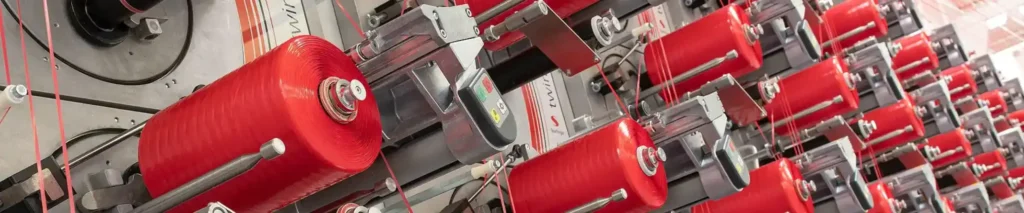
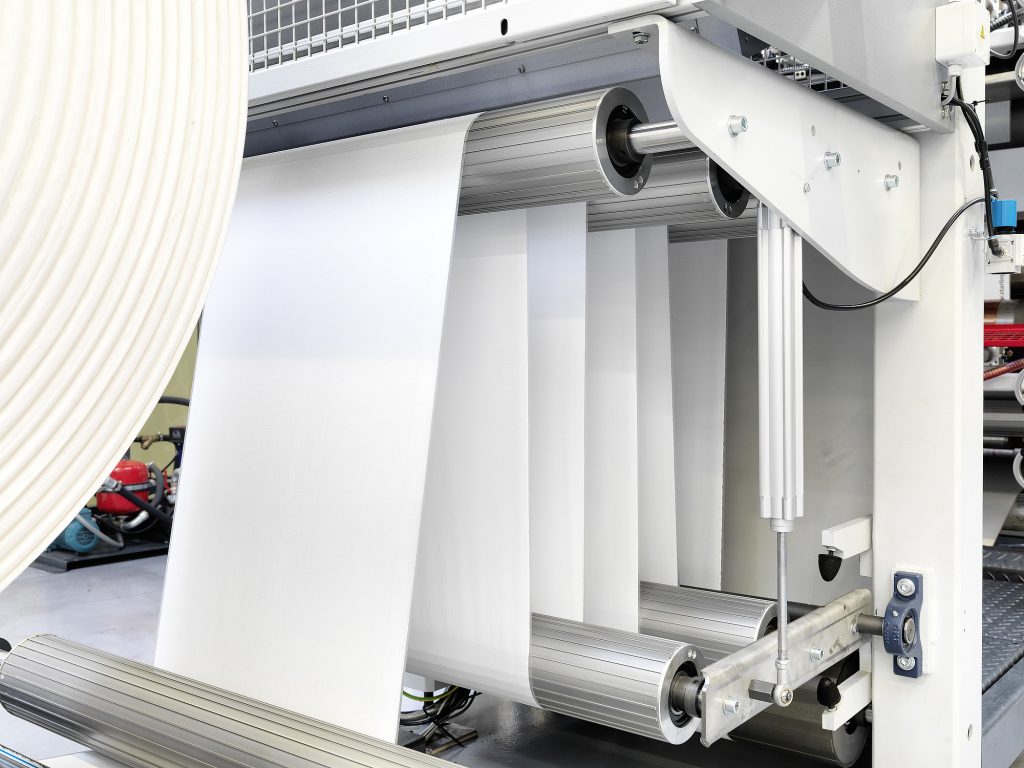
From pellets to pallets, quality is a chain. A draw‑ratio drift today is a seam tear tomorrow; a crushed paper edge at lamination is a delam blister in the field. The map below highlights the steps and the variables that matter. 1. Tape extrusion & slitting. PP is extruded into a thin film and slit into tapes. Film gauge uniformity governs denier spread downstream; die and chill settings lock in crystallinity. 2. Drawing (orientation). Tapes are drawn at elevated temperature to align chains. Draw ratio trades tensile for elongation: too high embrittles folds; too low yields limp fabric and poor seam efficiency. 3. Weaving. Circular looms produce tubular fabric; flat looms produce sheets later back‑seamed. Pick density and loom tension are charted by shift; tension drift is the quiet thief of quality. 4. Coating or lamination (optional). Apply an extrusion coat for print smoothness and sift control or laminate BOPP for scuff‑resistant graphics. Integrate micro‑perfs to restore venting when face porosity drops. 5. Conversion to a block bottom. Precision folding and thermal welding turn the tube into a square‑bottom sleeve. Fixtures and in‑line cameras keep geometry true; this step governs base integrity and pallet behavior. 6. Valve formation. Sleeve dimensions match the packer spout; friction fit and de‑aeration behavior are validated with a go/no‑go gauge and timed fill trials. Options include self‑closing designs and heat‑sealable films. 7. Liner insertion & sealing (if specified). Liners are introduced as loose tubes, tacked at the mouth, or continuous sleeves. Seal windows—temperature, pressure, dwell—govern peel strength and pinhole incidence. 8. Printing & coding. Flexographic plates, inks, and corona levels are tuned for rub resistance and scan grade after wrap and cold‑soak. 9. Quality release. Routine checks: GSM/denier, tensile/tear, seam efficiency, conditioned drop tests, valve leak checks, moisture ingress trials for coated/liner builds, barcode grade after wrap, pallet tilt/compression.What is the application of Block Bottom Valve Bags?
The format excels wherever free‑flowing powders and granules must be filled quickly, stacked neatly, shipped far, and opened without drama. Representative clusters include: • Food staples & powders. Flour, starches, sugar, salt, pulses, rice. Hygiene via liners, readability via coated faces, and cube via block bottoms. • Chemicals & minerals. Pigments, silica and carbonate powders, gypsum, lime, cementitious blends. Valve filling manages dust; coatings/liners fight moisture and abrasion. • Fertilizers & agriculture. Urea, NPK blends, seeds. Moisture defense matters; square stacks reduce damage in crowded sheds. • Pet food & animal nutrition. Abrasive kibbles and grain blends depend on scuff‑resistant faces and stable stacks. • Retail‑ready heavy packs. BOPP‑laminated Block Bottom Valve Bags deliver shelf‑strong visuals while preserving industrial toughness. For readers comparing related architectures, this overview of valve bags is a useful reference; most principles map one‑to‑one to the block‑bottom geometry.Types of Block Bottom Valve Bags (structure & duty)
When performance, aesthetics, or compliance goals differ, the stack changes. Below is a practical typology you can bring to supplier calls without losing nuance. 1. Uncoated PP shell + valve (no liner). Highest breathability; lowest cost; minimal moisture defense; suitable for dry climates and non‑hygroscopic products. 2. Single‑side coated PP + valve. Smoother print face and modest barrier without sacrificing breathability; a well‑balanced general‑purpose choice. 3. BOPP‑laminated PP + valve. Premium graphics and scuff resistance; plan micro‑perfs or vent paths to restore de‑aeration. 4. PP shell + internal PE liner (loose or sleeve). Strong moisture/dust barrier; liner becomes food‑contact surface; choose gauge to resist pinholes. 5. Paper–poly (kraft‑laminated) block‑bottom valve. Natural paper aesthetic plus woven strength; common in building materials and staple food SKUs. 6. Anti‑static / conductive variants. Additive systems and grounding paths mitigate static in dry powder fills (follow plant EHS guidance). 7. High‑sift‑proof builds. Heat‑sealable valves, tighter weaves, and seal patches for pigments, silica, and cement fines.Quality Control Measures (end‑to‑end)
Quality systems that prevent complaints mirror how bags actually fail. The plan below connects incoming verification, in‑process control, and field‑realistic tests. ### A) Incoming materials control • Resin & film confirmation (PP for tapes; PE/PP for liners), including additive packages (UV, slip, antistatic) per spec. • Paper/BOPP rolls: verify kraft moisture, coated/BOPP dyne levels, and surface defects prior to lamination. • Valve film and reinforcement tapes: sleeve dimensions, heat‑seal compatibility, corner strength. • Documentation: declarations for food‑contact components where applicable; lot traceability. ### B) In‑process controls • Extrusion/drawing: hold draw ratio and tape width; monitor film gauge for slit‑tape stability. • Weaving: track pick density and loom tension by shift with SPC; tension drift predicts weak corners and seam complaints. • Coating/lamination: audit coat weight and nip temperature/pressure; run peel coupons by roll to prevent hidden delam. • Conversion: gauge cut length and bottom geometry; use in‑line cameras and fixtures to keep squares square. • Valve & liner fit: go/no‑go gauges for sleeve fit; record seal windows (temp/pressure/dwell) for valves and liners. ### C) Functional (bag‑level) testing • Conditioned drop tests (flat & corner) at defined heights; log seam locations for any failures. • Valve leak & sift tests with vibration simulation; inspect powder traces around sleeve/corners. • Stack tilt/compression over 24–72 hours; verify friction angle (antiskid effectiveness). • Barcode grade after wrap (ANSI/ISO) under dust and glare. ### D) Component‑level validation • Dart impact on liner film to catch brittle gauges and sealing hotspots. • Seal peel strength windows for valves/liners; too low opens, too high tears adjacent film. ### E) Feedback & improvement • Defect Pareto by machine/shift; SPC on critical dimensions. • Golden‑set trials to lock best‑known spout/valve fits, micro‑perfs, and seal profiles; audit adherence.Engineering tables (paste‑ready for RFQs)
| Layer / feature | Typical options | Primary purpose | Notes |
|---|---|---|---|
| Shell (woven) | PP raffia 600–1200 D; 10×10–12×12 weave | Tensile/tear; puncture tolerance | Right‑weight after seam & drop tests |
| Face finish | Uncoated; single‑side coated; BOPP‑laminated | Printability; scuff control; sift reduction | Add micro‑perfs if face porosity drops |
| Valve sleeve | PE or coated PP film; friction‑fit to spout | Fast fill; controlled de‑aeration | Heat‑sealable variants for high sift‑proofing |
| Liner (optional) | LDPE/LLDPE 60–120 μm; HDPE for lower WVTR | Moisture/dust barrier; hygiene | Loose, tacked, or sleeve; validate seals |
| Bottom geometry | Block/square bottom; welded or sewn | Stack stability; carton‑like cube | Fixtures & cameras keep corners tight |
| Step | Control variable | Typical check |
|---|---|---|
| Tape extrusion | Film gauge; slit edge quality | Hourly mic checks; edge inspection |
| Drawing | Draw ratio; tape width | SPC charting; tensile spot checks |
| Weaving | Pick density; loom tension | In‑process gauges; shift audits |
| Coating/lamination | Coat weight; nip settings; dyne | Gravimetric checks; peel coupons; dyne ≥ 38 |
| Conversion (bottom) | Geometry; cut length | Template fixtures; in‑line cameras |
| Valve/liner | Sleeve OD/ID; seal window | Go/no‑go gauges; peel & pinhole tests |
| Printing | Barcode grade; color ΔE | In‑line verifiers; spectro checks |
| Performance question | Method | Example target |
|---|---|---|
| Will filled bags resist drops? | Conditioned flat & corner drops at defined height | 5/5 passes at 1.2 m for 25 kg fills; no seam tears |
| Will the valve stay clean & tight? | Transit vibration + powder trace inspection | No visible sifting at sleeve/corners |
| Is the liner robust? | Dart impact on film; seal peel | Dart above plant floor; peel in window; zero pinholes |
| Will stacks remain safe? | Pallet tilt/compression; friction angle | No lean at target tilt; friction angle ≥ spec |
| Are codes readable after wrap? | Post‑wrap scan study (ANSI/ISO grading) | Grade ≥ C on all faces |
From the title to the thinking: aligning scope and logic
The phrase Exploring Block Bottom Valve Bags: Types and Quality Control Measures suggests a journey that is practical rather than poetic: define the artifact, enumerate the main structural types, and anchor the whole program in verifiable QC. A sensible reasoning path looks like this: 1. Identify the core geometry and mechanics that make Block Bottom Valve Bags behave like cartons in the warehouse but like high‑throughput sacks at the filler. 2. Classify types by face finish and barrier needs—uncoated, coated, BOPP‑laminated, and lined—so budget and performance trade‑offs are explicit. 3. Map a QC plan that mirrors real failure modes: seam tears at corners, sifting at valves, pinholes in liners, and leaning pallets from soft corners or overfill. 4. Recompose this logic into a one‑page, testable specification you can carry into supplier negotiations without ambiguity.Procurement & deployment workflow (duty → delivery)
Risk register — common defects and durable fixes
• Bottom corner splits. Root cause: off‑square conversion or poor weld geometry. Fix: re‑center fold lines; verify heat profile; raise bottom inspection frequency. • Seam tears at drop. Root cause: low stitch density or insufficient denier. Fix: double‑fold seams; higher denier; re‑validate seam efficiency. • Liner pinholes. Root cause: sealing hotspots or sharp granules. Fix: optimize seal window; increase liner gauge; smooth transitions at the valve. • Sifting at valve. Root cause: sleeve mismatch or poor de‑aeration. Fix: resize sleeve; add baffles/micro‑perfs; tune dwell and heat‑seal time. • Bulging/leaning stacks. Root cause: overfill and low‑friction faces. Fix: enforce fill‑height targets; specify antiskid; adjust pallet pattern and wrap tension. • Graphics scuffing / unreadable codes. Root cause: under‑treated faces or ink mismatch. Fix: raise dyne; use compatible inks or over‑varnish; require post‑wrap scan checks.Keywords & long‑tail cluster (for clarity and discoverability)
Block Bottom Valve Bags; block‑bottom polypropylene valve sacks; square‑bottom valve PP bags; AD‑style PP valve bags; BOPP‑laminated block‑bottom valve sacks; PP valve bags with PE liner; sift‑proof polypropylene valve sacks; micro‑perforated valve bags for fast de‑aeration; heat‑sealable valve sleeve woven PP bags; 25 kg block‑bottom valve sacks; antiskid square‑bottom valve bags; barcode‑ready BOPP valve sacks; moisture‑resistant PP valve bags; paper–poly block‑bottom valve bags; coated PP valve sacks for powders.- What are Block Bottom Valve Bags?
- The materials of Block Bottom Valve Bags
- What are the features of Block Bottom Valve Bags?
- What is the production process of Block Bottom Valve Bags?
- What is the application of Block Bottom Valve Bags?
- Types of Block Bottom Valve Bags (structure & duty)
- Quality Control Measures (end‑to‑end)
- Engineering tables (paste‑ready for RFQs)
- From the title to the thinking: aligning scope and logic
- Procurement & deployment workflow (duty → delivery)
- Risk register — common defects and durable fixes
- Keywords & long‑tail cluster (for clarity and discoverability)
Ray, CEO of VidePak, gestures toward a prototype during a client demo:
“Block bottom valve bags are not just containers—they’re engineered ecosystems. Their square base design and precision valve systems ensure 30% faster stacking efficiency and 99.5% dust containment for sensitive products like seeds and coffee beans. At VidePak, we achieve this through Starlinger’s ultrasonic welding and ISO 9001-certified quality controls, tailored for industries from agriculture to specialty foods.”
1. Introduction
Block bottom valve bags, characterized by their flat bases and controlled dispensing valves, have become indispensable in bulk packaging for hygroscopic and perishable goods. VidePak, a global leader with $80 million annual revenue and 526 employees, exemplifies innovation in this niche. Leveraging 100+ Starlinger circular looms and 30 lamination machines, the company produces over 15 million bags annually, serving clients like Cargill and Olam International. This report analyzes design variations, material engineering, and application-specific quality controls that define modern block bottom valve bag solutions.
2. Types of Block Bottom Valve Bags
VidePak’s product portfolio caters to diverse industries through three primary designs:
| Type | Structure | Applications | Key Features |
|---|---|---|---|
| Laminated PP Bags | 3-layer PP + LDPE coating | Coffee beans, spices | Moisture barrier (<0.5% WVTR*) |
| Breathable Mesh Bags | Micro-perforated PP fabric | Seeds, grains | 12% air permeability |
| Multi-Wall FIBCs | PP + Kraft paper layers | Rice, wheat | Stack strength >1.5 tons |
*Water Vapor Transmission Rate (ASTM E96)
Case Study: A 2024 trial with a Brazilian coffee exporter showed VidePak’s laminated bags reduced moisture absorption by 40% during maritime transport compared to traditional woven sacks.
3. Application-Specific Requirements
3.1 Seeds and Grains
- Breathability: Micro-perforated PP fabric (0.1–0.3 mm pores) maintains seed germination rates >95% by allowing 8–10 L/m²·h oxygen exchange.
- UV Resistance: BASF’s Tinuvin® additives prevent polymer degradation under sunlight, extending outdoor storage life to 18 months.
3.2 Nuts and Coffee Beans
- Moisture Control: 50 μm LDPE coatings achieve a hydrostatic head of 15,000 mm, critical for maintaining <8% moisture content in almonds.
- Anti-Static Properties: Carbon-black-infused PP reduces dust adhesion by 70%, complying with FDA 21 CFR 177.1520.
3.3 Starch and Powders
- Valve Precision: Laser-cut valve sleeves with ±0.2 mm tolerances prevent leakage of particles <50 μm.
- Anti-Caking: Inner PE liners with silica gel pockets absorb residual moisture, reducing clumping by 60%.
4. Quality Control Measures
VidePak’s four-tier quality framework ensures compliance with global standards:
4.1 Raw Material Testing
- PP Resin MFI: Maintained at 8–12 g/10 min (ISO 1133) to balance extrudability and tensile strength (35–40 MPa).
- Lamination Adhesion: Peel resistance >200 N/cm (ASTM D882) for multi-layer bags.
4.2 Production Process Controls
- Starlinger Extrusion: Temperature zones controlled to ±1°C, minimizing MFI variance to ±0.5%.
- Ultrasonic Welding: Seam strength uniformity CV <2%, validated via ISO 2859 statistical sampling.
4.3 Post-Production Validation
| Test | Standard | Acceptance Criteria |
|---|---|---|
| Stack Compression | ISO 2233 | >1,500 kg without deformation |
| Valve Flow Rate | ASTM D4919 | 25–30 kg/min for granulars |
| Accelerated Aging | ASTM F1980 | <5% tensile loss after 90 days |
5. Parameter Selection Guide
Optimizing bag specifications requires balancing functional and economic factors:
| Product | Thickness (μm) | GSM | Inner Liner | UV Protection |
|---|---|---|---|---|
| Seeds | 80–100 | 90–110 | Perforated PE | Required |
| Coffee Beans | 120–150 | 130–160 | LDPE + Al foil | Optional |
| Rice | 180–220 | 200–240 | None | Not required |
Note: Higher GSM (grams per square meter) correlates with puncture resistance but increases costs by $0.02–0.05 per bag.
6. Sustainability and Market Trends
- Circular Economy: VidePak’s bags achieve 98% PP recovery via pyrolysis, aligning with EU 2030 targets.
- Market Growth: The global FIBC market will expand at 6.7% CAGR through 2030, driven by Asian agricultural demand (Grand View Research, 2024).
7. FAQs: Addressing Industry Concerns
Q1: How to prevent insect infestation in grain bags?
A: Integrate insect-repellent masterbatch (e.g., permethrin-infused PP) during extrusion, achieving 99% mortality in Sitophilus species.
Q2: Can block bottom bags withstand -20°C storage?
A: Yes. PP retains 85% elongation at break at -20°C when blended with 5% EVA copolymer.
Q3: What certifications ensure food safety?
A: FDA 21 CFR 177.1520, EU 10/2011, and ISO 22000 for allergen control.
8. Conclusion
Block bottom valve bags epitomize the synergy of engineering precision and ecological responsibility. By combining Starlinger’s manufacturing rigor with adaptive design intelligence, VidePak delivers solutions that protect both products and planetary health. As Ray summarizes, “In packaging, every seam is a promise—of quality today and sustainability tomorrow.”
Explore our innovations in agricultural packaging solutions and sustainable material engineering.