

What are FIBC Bags? Definition, scope, and the names farmers, millers, and shippers actually use
Across fields and silos, on docks and in mills, FIBC Bags move mountains of value a ton at a time. The term refers to large, flexible industrial containers whose structure, geometry, and surfaces are engineered for lifting, stacking, and transporting bulk agricultural materials like seeds, grains, pulses, sugar, salts, fertilizers, and feed. The promise is simple to say and demanding to deliver: high payload with low tare; clean fills and clean floors; pallets that behave even when the road does not. When FIBC Bags perform, they convert seasonal chaos into predictable flow. When they fail, the day fails with them.
Different sites speak different dialects. To avoid confusion and to make contracts readable from farm to port, it helps to gather the aliases under one roof. The labels vary; the fundamentals do not.
- Bulk Bags
- Big Bags
- Jumbo Bags
- Super Sacks
- Ton Bags
- PP Woven FIBC
- Woven Polypropylene Bulk Containers
Whichever label your RFQ prefers, the architecture stays familiar: a woven polypropylene shell for strength, lifting loops to transmit load, optional coatings to manage dust and friction, optional liners for hygiene and barrier, and inlet/outlet systems that cooperate with your filler and your mixer. The quiet power of FIBC Bags is not that they are strong in the abstract, but that they are configurable in the concrete: built to the physics of your product, your line, your climate, and your route.
Callout — Working definition you can forward to procurement: FIBC Bags are liftable, stackable, flexible containers made primarily from woven polypropylene, optionally coated and/or lined, designed to carry bulk commodities safely at a specified Safe Working Load and Safety Factor while maintaining cleanliness, traceability, and pallet stability through transport and storage.
What is the material system of FIBC Bags? From resin to web to loop to liner
An FIBC Bag is not a single slab of plastic; it is a deliberate stack of sublayers. Each sublayer has a job and a budget. Each interface either transmits force or blocks a pathway for contamination. Below is the anatomy that turns polymer into reliability.
Woven polypropylene (PP) fabric
Virgin PP raffia tapes are extruded, slit, and drawn to higher tenacity, then woven on circular or flat looms. For agricultural FIBC Bags carrying one‑ton payloads, basis weights commonly range from 160 to 260 gsm, with tape denier around 700–1200 D. The weave pattern (U‑panel, 4‑panel, or circular) sets seam count and bulge behavior; pick density governs stiffness, air retention, and seam bite. Fabric mass is the dominant cost driver, which is exactly why it should be optimized, not guessed.
Lifting loops & webbing
High‑tenacity webbing (PP or PE multifilament, 50–100 mm wide) translates the bag’s mass into the forklift, sling, or crane. Loop geometry—cross‑corner, side‑seam, hood‑lift sleeves—controls tilt, sway, and operator feel. Stitch patterns and seam bite turn loops from decoration into a bond of trust.
Coatings & laminations
Thin PP/PE coatings—typically 20–40 μm—reduce dust release, moderate moisture ingress, and tune the coefficient of friction (COF). Matte exteriors lower glare for scanners; lattice anti‑slip patterns raise pallet grip only where needed. Laminated film skins add wipeability and improve print abrasion resistance.
Liners (LDPE/LLDPE/EVOH‑coex)
Liners deliver hygiene, moisture and oxygen control, and a generous hot‑seal window. Loose inserts are simple; tab‑fixed liners resist slumping; true form‑fit liners marry the bag’s internal geometry and spouts, reducing folds, dust traps, and product hang‑ups during discharge. Typical thickness runs 60–120 μm; barrier coex is reserved for oxygen‑sensitive or odorous commodities.
Electrostatic safety (Types A/B/C/D)
Dusts and dry climates create sparks. Type A provides no specialty control; Type B limits brush discharges; Type C uses conductive threads and must be grounded; Type D dissipates charge without external grounds when used correctly. Match the ESD package to your powder class and zone; never rely on luck where ignition is possible.
| Sublayer | Typical options | Role within FIBC Bags | Cost/performance lens |
|---|---|---|---|
| Woven PP fabric | 160–260 gsm; 700–1200 D tapes; U‑panel/4‑panel/circular weaves | Carries tensile load; sets bulge and seam retention | Largest contributor to mass and price; optimize gsm to pass tests |
| Loops & webbing | 50–100 mm cross‑corner/side‑seam; hood‑lift sleeves | Transfers load safely to forklift/crane; controls tilt | Small fraction of mass; huge safety leverage |
| Coatings/laminations | PP/PE 20–40 μm per side; matte; lattice anti‑slip | Dust control; moisture moderation; COF tuning; print protection | Light mass; outsized stability and cleanliness gains |
| Liners | LDPE/LLDPE 60–120 μm; EVOH coex for barrier | Hygiene; barrier; broadened heat‑seal window; clean discharge | Protects shipment value; model MVTR/OTR vs climate |
| ESD package | A/B/C/D fabrics; conductive yarns; antistatic masterbatch | Ignition risk management for powders; operator safety | Choose to zone and dust class; training required |
What is the features of FIBC Bags? Converting materials into outcomes that matter on the farm and at the port
Ask ten operators how they define a good day and you’ll hear ten variations on a theme: no spills, no surprises, no delays. Strength alone cannot buy that day; system behavior can. The value of FIBC Bags lives in the way they behave under mixed realities—humidity swings, erratic forklifts, rush orders, and audits that arrive when the shift is tired.
- High Safe Working Load (SWL) with low tare: tonnage without the weight tax of rigid totes.
- Stack stability and bulge control via baffle/Q‑bag options; safer three‑high stacks in windy yards.
- Hygiene and barrier: coatings and liners keep dust in and moisture out, while film skins wipe clean.
- Static safety through Type B/C/D fabric systems matched to dust class and zoning.
- Filling and discharge flexibility: spouts, duffles, and petals tuned to gravity, auger, or pneumatic systems.
- Logistics friendliness: collapsible empties; COF tuned for conveyors versus pallets; durable, scanner‑legible prints.
- Sustainability levers: mono‑polyolefin builds for recyclability; less tare per ton lowers freight emissions intensity; reuse feasible under controlled programs.
Tip — Invert the wishlist: instead of asking “what features should we buy,” ask “which failures will we refuse to tolerate?” Scuffed hazard symbols, caked fertilizer, pallets that wander? Specify coating thickness, COF, liner grade, and baffles to extinguish those risks at the source. FIBC Bags give you levers; your route tells you which to pull.
What is the production process of FIBC Bags? Front‑end selection → core manufacturing → back‑end QA (with Starlinger & W&H)
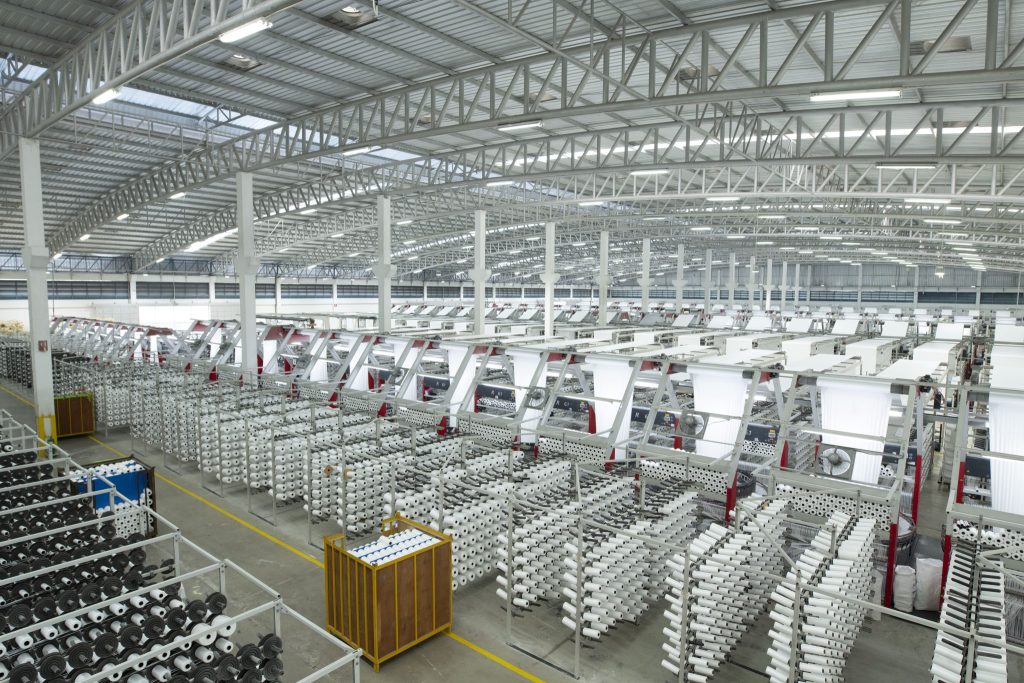
Reliability is not granted by hope; it is earned by process. VidePak’s production model places premium equipment where variability begins: Starlinger lines in Austria for tape extrusion and weaving; W&H (Windmöller & Hölscher) systems in Germany for coating and printing. Better machines narrow the river of randomness, and a narrower river means fewer boats capsize.
Front‑end: raw materials & incoming tests
- Virgin PP raffia with Melt Flow Index windows that support stable draw and seam performance; no uncontrolled recyclate in structural layers.
- Masterbatches for UV stability, antistatic function, and slip; dispersion verified by micrographs; let‑down calibrated.
- Liner resins (LDPE/LLDPE/EVOH) with barrier data; incoming films measured for thickness profile and seal integrity.
- Coating films with tight gauge, haze/gloss, and surface energy; ink adhesion screenings before press runs.
- Incoming QC: MFI, ash content, pellet uniformity, moisture; film dyne checks; quick ESD screens for C/D fabric builds.
Core: extrusion, weaving, coating, printing
- Tape extrusion & draw (Starlinger): denier and tenacity held by draw ratio controls; heat‑setting locks dimensions; SPC charts catch drift before product does.
- Weaving (Starlinger circular/flat looms): pick‑density feedback, tape‑break detection, auto‑doffing; patterns chosen for bulge control and seam efficiency.
- Coating/lamination (W&H): extrusion coatings to meet dust and COF specs; laminations to protect prints and add wipeability.
- Printing (W&H flexo): registration, ΔE color targets, varnish overlays for scuff‑heavy routes; document pouches applied with dimensional control.
Conversion & QC: cutting, sewing, assembly, inspection
- Cutting with controlled tolerances; ultrasonic/laser edges where hygiene demands sealed fibers.
- Loop insertion with reinforcement tapes; stitch density and seam bite validated to slippage limits.
- Baffles integrated and vented to avoid discharge hang‑ups; inlets/outlets fabricated to filler/mixer geometry.
- Liner insertion—loose, tab‑fixed, or form‑fit—with leak and seal checks; spout‑to‑spout fit confirmed.
- Finished‑goods validation: top‑lift, drop, stacking, seam slippage; MVTR (with liners); ESD testing for Type B/C/D; visual audits for print registration and scuff.
Process conviction — Starlinger and W&H systems do not exist to be name‑dropped; they exist to squeeze variance. Web tension, nip pressure, heater maps, registration: when these wander, bags burst. When they stay home, FIBC Bags behave.
What is the application of FIBC Bags? A field‑tested catalog of agricultural use cases
Agriculture is plural. The physics of sesame is not the physics of urea; the life of sugar is not the life of wheat. The same family of FIBC Bags can serve them all—by tuning the stack to the commodity and the route. Below is a compact catalog of use cases with practical heuristics.
| Commodity | Typical configuration | Why FIBC Bags fit | Key risks & tunings |
|---|---|---|---|
| Seeds & grains | Baffle/Q‑bag; form‑fit LLDPE liner 80–100 μm; high‑COF pallet faces; document pouch | Dryness, gentle handling, traceability, clean floors | MVTR targets; label protection; discharge diameter for mixers |
| Pulses & specialty crops | Smooth interior; medium gsm; clean discharge spout; QR/RFID | Less breakage, fewer fines, auditable chain of custody | Minimize folds; protect prints; avoid liner snags |
| Sugar & sweeteners | Barrier liner as needed; laminated exterior; high‑COF outer | Moisture discipline; wipe‑down hygiene; pallet stability | Monitor MVTR; prevent caking; protect label contrast |
| Fertilizers & soil amendments | Coated outer; baffles; optional liners; robust base | Survive humidity, yard handling, long dwell times | Caking prevention; UV stabilization; drop corners |
| Animal feed & premix | Hygienic film skin; liner; large discharge spout | Clean discharge; fewer residues; readable warnings | Hot‑tack checks; varnish over critical icons |
| Salts & minerals | Higher denier tapes; base reinforcement; ESD package as needed | Abrasion tolerance; predictable discharge | Fork impact mitigation; matte exterior to reduce guide scuff |
How does VidePak control and guarantee the quality? Four pillars with measurable discipline
Quality that survives the season is not accidental. VidePak treats it like any other engineered outcome: specify, measure, control, and improve. Four pillars hold up the roof.
Standards scaffold
Build to ISO/ASTM/EN/JIS methods—tensile, tear, seam slippage, top‑lift, stacking, drop, color ΔE, and COF—backed by written instructions and acceptance criteria. Apply AQL sampling and keep retention samples by lot for traceability and dispute resolution.
Virgin inputs
Use 100% new raw materials from major producers for structural layers; stable MFI for extrusion; qualified liner resins with barrier data; masterbatches with proven dispersion. No uncontrolled recyclate in the load path.
Equipment advantage
Starlinger for tape extrusion and weaving; W&H for coating and printing. Precision platforms reduce variance at the source; reduced variance translates into fewer weak spots and calmer audits.
Layered inspection
Incoming → in‑process → finished goods. MFI/ash/moisture; denier/pick/coat weight/ΔE; top‑lift/stack/drop/seal/MVTR/ESD. Deviations trigger root‑cause and preventive actions, not just rework.
Versatility in agricultural packaging: a system map and the levers that make it real
Versatility is not vagueness; it is specificity reused. The same platform of FIBC Bags adapts to seeds today, sugar tomorrow, fertilizer next week—because we change the levers, not the chassis. System thinking breaks the job into subsystems and then recombines the answers into one specification that behaves across seasons.
| Subsystem | Inputs | Decisions | Metrics |
|---|---|---|---|
| Product physics | Bulk density, particle size/shape, hygroscopicity, abrasiveness, dust class | Fabric gsm & denier; liner thickness/barrier; ESD type; baffle need | MVTR/OTR; residue %; seam slippage; decay time |
| Process dynamics | Fill method & rate; headspace; de‑aeration; seal window; drop heights | Spout geometry; skirt/iris; micro‑perfs; bottom seams; mouth rigidity | Hot‑tack; leak; stoppages/hour; drop damage rate |
| Logistics & storage | Pallet pattern; stack height; climate; UV; transport mode | Baffles; COF tuning; UV package; wrap recipe; protectors | Shift index; creep (mm/week); scuff counts; scan success |
| Regulatory & brand | Food contact; labeling; import certifications | Liner grade; varnish; document pouch; QR/RFID | Migration pass/fail; ΔE; scan rate; error rate |
Helpful resource — For a deeper orientation to design trade‑offs, see this overview on engineering and applications of FIBC in practice. It complements the agriculture‑specific guidance collected here.
Engineering parameters and starting ranges for agricultural FIBC
Numbers are not the whole story, but they let the story be audited. Use these as starting ranges, not commandments; tune them to your material, your climate, and your tolerance for risk.
| Parameter | Typical range | Why it matters | Practical tuning |
|---|---|---|---|
| SWL | 500–1,500 kg | Defines payload and loop/seam targets | Align with forklift and crane limits; specify safety factor |
| Safety factor | 5:1 single‑use; 6:1 multi‑trip | Design margin against dynamic loads | Inspect prior to reuse; define retirement triggers |
| Fabric basis weight | 160–260 gsm | Controls tear and seam retention; affects bulge | Raise for angular particles or long outdoor storage |
| Baffle choice | Sewn internal panels | Reduces bulge; improves cube utilization | Use for export stacks and container loads |
| Coating thickness | 20–40 μm | Dust control; COF; print protection | Apply lattice only where pallets touch |
| Liner thickness | 60–120 μm (LLDPE) | Hygiene and MVTR/OTR control | Form‑fit to avoid folds and dust traps |
| COF (external) | 0.35–0.60 | Balance between conveyor glide and pallet hold | Matte for guides; high‑COF lattice for pallets |
Procurement, RFQ hygiene, and a one‑page working specification
Buying containers without buying outcomes is how budgets leak. The antidote is a clear, testable specification folded directly into the RFQ. Copy, adapt, and enforce.
Product: FIBC Bags for [commodity]
SWL/SF: [1000 kg, 5:1 single‑use or 6:1 multi‑trip]
Pattern: [Baffle/Q‑bag] + [U‑panel/4‑panel/circular]
Fabric: [e.g., 220 gsm PP; pick density X]
Loops: [80 mm cross‑corner; high‑tenacity webbing]
Coating: [PP/PE 25 μm; matte outside; lattice on pallet faces]
Liner: [LLDPE 90 μm; form‑fit; barrier coex if required]
Inlet/Outlet: [450 mm spout + iris] / [350 mm discharge + petal safety]
ESD: [Type C grounded] or [Type D dissipative]
Print: [flexo; ΔE ≤ 2.0; varnished warnings; document pouch]
QC: incoming MFI/ash/moisture; in‑process denier/pick/coat/ΔE; finished goods top‑lift/stack/drop/seal/MVTR/ESD; AQL per ISO; retention samples for 24 months.
Troubleshooting and prevention: a matrix of symptoms, causes, and fixes
Even well‑designed FIBC Bags can misbehave when reality shifts. A practical way to recover is to look for patterns: symptom → likely cause → corrective action. The aim is not to blame; the aim is to stabilize.
| Symptom | Likely cause | Corrective action |
|---|---|---|
| Caking at destination | Insufficient liner barrier; high MVTR | Thicker liner; barrier coex; pallet covers; yard SOPs |
| Pallet shift in drayage | COF too low; weak wrap | High‑COF lattice; stronger wrap; edge protectors |
| Loop tear during lift | Low seam bite; thread selection | Increase overlap; reinforce zones; upgrade thread |
| Bulge in container stacks | No baffles; low gsm | Add baffles; raise gsm; reduce stack height |
| Dust clouds at discharge | Poor skirt/iris; liner folds | Add dust skirt; form‑fit liner; revise spout geometry |
Case files from the field: five scenarios you can adapt
Real farms, real mills, real docks. The numbers below are illustrative but the logic is reproducible. Copy the patterns, change the inputs, test, and own the outcome.
Case A — Monsoon fertilizer export
230 gsm baffle body; outer coat 25 μm with high‑COF pallet faces; form‑fit LLDPE liner 100 μm; inlet spout + iris; discharge with safety petal. Result: caking incidents down >80%; container cube up ~12%; claims near zero.
Case B — Seed export with audits
200 gsm with laminated film skin; form‑fit liner 90 μm; document pouch; QR traceability; varnished warnings. Result: audit findings eliminated; label legibility sustained after long voyages; complaint rate <0.2%.
Case C — Mineral salt inland
240 gsm; base reinforcements; matte exterior to reduce guide scuff; loop seam bite increased. Result: bottom‑corner ruptures down ~90%; housekeeping time reclaimed for production.
Case D — Feed premix, dust sensitive
Antistatic Type C with verified grounding; long sleeve spout; skirt + iris; liner vents; varnished hazard icons. Result: fewer fogs; faster discharge; safer operators.
Case E — Sugar to retailer’s blending
Barrier coex liner; laminated exterior; high‑COF lattice on pallet faces; tight ΔE targets. Result: clean inspections; zero returns for contamination; pallet stability improved.
Sustainability, recycling pathways, and reuse programs for FIBC in agriculture
Sustainability is not separate from performance; it is one of the outcomes a good specification delivers. FIBC Bags make this practical because they are largely polyolefin structures. That supports mechanical recycling and, in some regions, chemical routes that turn polymers back into feedstock. Reuse is feasible for non‑food commodities under controlled inspection and cleaning, especially where run‑to‑run cross‑contamination is not a hazard. The levers are familiar: mono‑material choices, liner compatibility, minimal inks and varnishes, and high payload per tare kilogram. Fewer units per ton, fewer labels per shipment, fewer lifts per order—that is what efficiency looks like and why it aligns with sustainability.
Frequently asked questions from farm managers and packaging engineers
Are FIBC Bags food‑grade? They can be—when constructed with compliant films, inks, and adhesives; made on hygiene‑controlled lines; and supported by documentation. Can they be reused? Yes for non‑food commodities under 6:1 safety factor and inspected programs; many food and feed items remain single‑use to minimize risk. Which ESD type should we choose? Type A for non‑flammable environments; Type B to limit brush discharges; Type C when reliable grounding is available; Type D when intrinsic dissipation is preferred and the use instructions are followed. Do baffles actually pay back? Repeatedly—in cube utilization, stack safety, and downstream calm. Are they recyclable? As mono‑polyolefin builds, yes—subject to local infrastructure.
2025-10-26
- What are FIBC Bags? Definition, scope, and the names farmers, millers, and shippers actually use
- What is the material system of FIBC Bags? From resin to web to loop to liner
- What is the features of FIBC Bags? Converting materials into outcomes that matter on the farm and at the port
- What is the production process of FIBC Bags? Front‑end selection → core manufacturing → back‑end QA (with Starlinger & W&H)
- What is the application of FIBC Bags? A field‑tested catalog of agricultural use cases
- How does VidePak control and guarantee the quality? Four pillars with measurable discipline
- Versatility in agricultural packaging: a system map and the levers that make it real
- Engineering parameters and starting ranges for agricultural FIBC
- Procurement, RFQ hygiene, and a one‑page working specification
- Troubleshooting and prevention: a matrix of symptoms, causes, and fixes
- Case files from the field: five scenarios you can adapt
- Sustainability, recycling pathways, and reuse programs for FIBC in agriculture
- Frequently asked questions from farm managers and packaging engineers
- 1. Global Market Dynamics: Regional Preferences and Producer Profiles
- 2. Competitive Landscape: China’s Manufacturing Edge
- 3. Case Study: FIBC Bags in Action
- 4. Technical Specifications: Tailored for Agriculture
- 5. FAQs: Addressing Client Concerns
- 6. The Future of FIBC Bags: Sustainability Meets Smart Tech
- Conclusion: Partnering for Global Success
“How can a single packaging solution address the diverse challenges of global agriculture?”
The answer lies in Flexible Intermediate Bulk Containers (FIBC bags)—a powerhouse of durability, cost-efficiency, and adaptability. At VidePak, we engineer FIBC bags that not only withstand the rigors of agricultural logistics but also align with regional market demands, from the rice fields of Asia to the grain silos of North America. Customizable designs, rapid global delivery, and competitive pricing position FIBC bags as the cornerstone of modern agricultural packaging—reducing waste by 30% and logistics costs by 25%, according to 2024 industry benchmarks.
1. Global Market Dynamics: Regional Preferences and Producer Profiles
The FIBC bag market is shaped by regional agricultural practices, regulatory frameworks, and economic priorities. Below is a breakdown of key markets and their unique characteristics:
1.1 Asia-Pacific: Scale Meets Innovation
- Market Size: APAC dominates 47% of the global agricultural packaging market, driven by agrarian economies in China, India, and Southeast Asia.
- Local Producers: Chinese manufacturers like EBIC International leverage 20,000-unit monthly production capacities and cost-effective labor to offer FIBC bags at $7.80–$12 per unit.
- Demand Drivers: High-volume exports of rice, fertilizers, and grains necessitate UV-resistant and moisture-proof FIBC solutions.
1.2 Europe: Sustainability and Compliance
- Regulatory Focus: EU mandates like the Circular Economy Action Plan push for 50% recycled content in packaging by 2030.
- Producer Strategies: Companies like Mondi Group prioritize biodegradable PP blends and blockchain-enabled recycling systems to meet ESG goals.
1.3 North America: Precision and Efficiency
- Technological Edge: U.S. firms integrate IoT sensors into FIBC bags for real-time tracking of perishables like fruits and vegetables.
- Logistics Optimization: Lightweight designs (5–7 kg empty weight) reduce transportation costs by 15% compared to metal alternatives.
2. Competitive Landscape: China’s Manufacturing Edge
Chinese FIBC producers dominate global supply chains through a combination of advanced infrastructure and strategic pricing. Here’s how they outperform competitors:
2.1 Quality Control and Technology
- Starlinger Machinery: VidePak’s 100+ circular looms and 30 lamination machines ensure fabric tensile strength of 35–45 N/mm², exceeding ASTM D638 standards.
- ISO 9001-Certified Production: Hourly quality checks and SAP-QMS systems reduce defect rates to <0.1%.
2.2 Cost and Speed
- Economies of Scale: Bulk PP procurement from Sinopec and Yangzi Petrochemical cuts material costs by 12%.
- Rapid Turnaround: MOQs as low as 10,000 units with 15–20 day lead times, supported by 24/7 production lines.
2.3 Global Supply Chain Integration
- Export Networks: 70% of VidePak’s $80 million revenue comes from exports to Europe, North America, and the Middle East.
- Customization: Multi-language labeling and region-specific certifications (e.g., EU REACH, FDA) streamline cross-border compliance.
3. Case Study: FIBC Bags in Action
A Vietnamese rice exporter reduced post-harvest losses by 22% using VidePak’s UV-stabilized FIBC bags with anti-fungal coatings. Key outcomes included:
- 40% faster loading via forklift-friendly loops.
- 8 reuse cycles per bag, slashing annual packaging costs by $18,000.
4. Technical Specifications: Tailored for Agriculture
| Parameter | VidePak FIBC Bags | Industry Average |
|---|---|---|
| Load Capacity | 500–2,000 kg | 300–1,500 kg |
| Fabric GSM | 220–240 (UV-treated) | 180–200 |
| Seam Strength | 2,300 N (ISO 13935-2) | 1,800 N |
| Moisture Resistance | WVTR <5 g/m²/day (PE-lined options) | WVTR 10–15 g/m²/day |
| Recyclability | 95% PP content (closed-loop program) | 70–80% PP content |
5. FAQs: Addressing Client Concerns
Q: How do FIBC bags handle volatile agrochemicals?
A: Our anti-static liners and double-stitched seams prevent combustion risks, compliant with UN Certified Dangerous Goods standards.
Q: Can bags be branded for regional markets?
A: Yes. VidePak’s 8-color flexographic printing supports Pantone-matched logos and multilingual safety instructions.
Q: What’s the environmental impact of disposal?
A: We reclaim 95% of retired bags through our global recycling network, aligning with EU Circular Economy targets.
6. The Future of FIBC Bags: Sustainability Meets Smart Tech
The 2024 Global Agricultural Packaging Report highlights two transformative trends:
- Biodegradable Additives: PLA-blended FIBC bags decompose within 180 days in industrial composts.
- IoT Integration: RFID tags enable real-time monitoring of grain moisture levels, reducing spoilage by 18%.
Conclusion: Partnering for Global Success
With 526 employees and 30+ years of expertise, VidePak delivers FIBC solutions that bridge regional demands and global standards. As CEO Ray Chiang states: “Our bags don’t just carry crops—they carry the future of sustainable agriculture.”
References
- IndustryARC, Agricultural Packaging Market Report (2024).
- EBIC International Co., UN Certified FIBC Bags Product Specifications (2024).
- Smithers Pira, The Future of Sustainable Packaging (2024).
- ASTM International, Standard Test Methods for PP Woven Fabrics (2023).
- Aditya Timpack Pvt Ltd, FIBC Manufacturing Processes (2025).
External Links
- Explore our FIBC manufacturing expertise.
- Learn how sustainable practices align with global ESG standards.
Authored by VidePak’s Global Solutions Team | Updated: March 8, 2025