
What is the strength of industrial bulk packaging? Moisture protection, and efficiency, heavy-duty PE bags stand out. These high-performance sacks—produced by multi-layer co-extrusion of LDPE/LLDPE/MDPE (and even barrier layers like EVOH or tie-resins)—offer durability, versatility and recyclability that simple poly or paper bags cannot. They come in several formats (open-mouth sacks, valve-fill bags, pinch-bottom bags, etc.) to suit different filling machines and products. Key features include tough multi-layer film (100–300+ μm gauge), optional gussets or embossing for anti-slip stacking, one-way air valves and micro-perforations for venting. In this report, we define heavy-duty PE bag types and specs, compare them to alternatives (paper, woven PP), and introduce VidePak as a leading supplier. We detail VidePak’s use of top-brand PE resin (from BASF, Sinopec, Yangzi), W&H multi-layer co-extrusion lines, ASTM/ISO-standard testing, in-house film-to-bag production, and ~600 million bag/year capacity. The analysis is supported by tables and diagrams, offering a rigorous, EEAT-compliant overview of heavy-duty PE bags in industry.
What Are Heavy-Duty PE Bags?
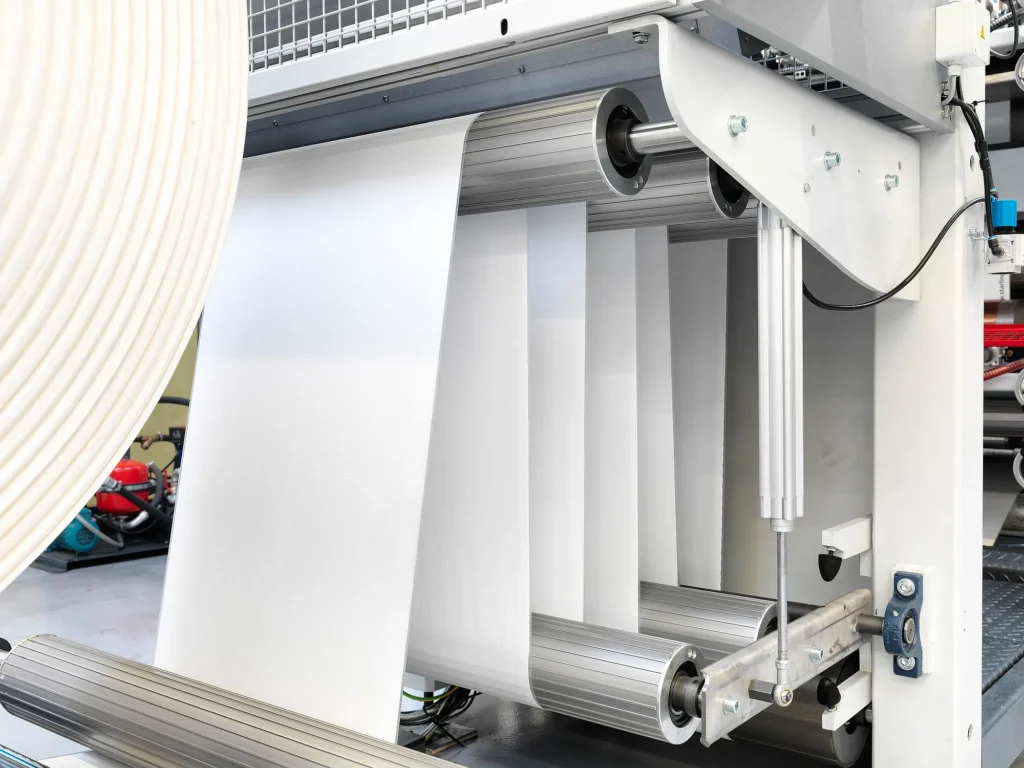
A heavy-duty PE bag is a thick, multi-layer polyethylene sack engineered for large-scale industrial use. Unlike thin consumer plastic bags, these are made by blown-film co-extrusion, combining multiple polymer layers into one robust film. For example, a five-layer film might blend LDPE (for elasticity), LLDPE (for tear resistance), MDPE (for stiffness), tie-resins, and even a barrier layer (like EVA/EVOH). This gives each bag balanced properties that a single material cannot achieve alone: high strength and flexibility, puncture resistance and heat-sealability, moisture barrier and printability.
In practice, heavy-duty PE film thickness ranges from about 100 μm up to 300 μm or more. The film is usually drawn into a continuous tube and printed (1–8 colors, surface or reverse) before being cut and sealed into bags in a form-fill-seal (FFS) line. A finished heavy-duty bag can carry 10–50+ kg of dry bulk material (sometimes specified as 5–25 kg depending on style). Crucially, because it is pure PE (no mixed fibers), the bag is 100% recyclable in plastic film streams, unlike multi-wall paper or mixed-material sacks.
Core attributes include:
- Multi-layer co-extrusion: All layers are fused in one go, yielding uniform thickness and performance. Modern W&H machines produce these heavy films to tight gauge tolerances.
- Strength & toughness: The combination of LDPE/LLDPE/MDPE gives high puncture and tear resistance. HDPE or tie layers may be added to boost rigidity for heavier loads.
- Moisture and dust barrier: Polyethylene film is essentially waterproof and dust-tight. Welded seams and heat seals prevent leaks. Even fine powders (flour, pigment) stay inside. Compared to paper (which wicks water) or woven PP (which is porous unless laminated), PE provides superior moisture protection.
- Stacking stability: Many heavy-duty PE bags use block-bottom (square) bases or gussets. This makes filled bags stand upright without leaning, ideal for pallet stacking. Anti-slip embossing can be added to film to prevent pallet creep.
- Print and branding: The smooth PE surface accepts high-quality flexographic printing. Reverse-printing (ink under a clear layer) yields glossy, scuff-resistant graphics. Large printable areas on bag faces allow vivid logos, regulatory marks, and even barcodes/QR codes.
- Customization: Optional features like gussets (for extra volume), microporations (for venting gases), one-way air valves, and zip/slider tops can be incorporated. For example, an exhaust valve prevents fermentation gas buildup in fertilizer bags. Micro-perf holes (50–200 μm) let entrapped air escape on filling.
In short, heavy-duty PE bags are the go-to solution for tough bulk packaging. They handle the most demanding industrial conditions by combining strength (against puncture/drop), barrier (against moisture/dust), and efficiency (fast filling, low weight) in one package.
Categories of Heavy-Duty PE Bags
Heavy-duty PE bags are categorized by their filling/closing style. The main types are:
- Open-Mouth (Flat) PE Sacks: These are flat poly bags (often heat-sealed at the bottom) with a fully open top. They may have gussets (side folds) for extra capacity. Open-mouth sacks are filled manually or on FFS machines, then sealed shut (by sewing, heat/tape). They serve products like fertilizers, salts, feeds, and plastic pellets. The co-extruded film is typically 100–250 μm thick. Their key feature is simplicity: no valve or special opening, just a clean-cut or hemmed top. Typical uses include agricultural chemicals, food grains, or any free-flowing solid where dust control is manageable.
- PE Valve Bags: These have an integrated filling valve – an internal PE sleeve at the bag corner. The sleeve attaches to a packing spout (air-filler, screw-filler, etc.) and allows rapid, low-dust filling. After filling, the bag’s own weight and pressure help collapse the valve closed; many designs also allow heat- or ultrasonic-sealing the valve for extra tightness. Valve bags usually have a welded block-bottom, which forms a square base (like a box) to support the bag upright. This design carries heavy powders (cement, gypsum, salt) without tipping. The film is heavy gauge (often 160–220 μm, up to 300 μm) and often co-extruded to include layers for stiffness and puncture resistance. Key valve types include tuck-in sleeves, hot-melt adhesive sleeves, or ultrasonic-sealed sleeves. Anti-skid embossing is common on the film. PE valve bags are prized in cement, mineral, and chemical industries for fast filling, dust control, and leak-proof shipping.
- Pinch-Bottom (PBOM) PE Bags: Also called pinch-bottom open-mouth bags. The bottom is folded and heat-sealed in a pinch (often with pre-applied hot-melt), creating a flat, block-style base. The top remains open for filling. Once filled, the top is closed (usually by sewing or heat-seal). Pinch-bottom bags combine the stability of a flat base with the simplicity of an open mouth. They are used for dry goods like animal feed, flour, and seasonings. These bags can be equipped with liners or coatings for moisture, and retain the same heavy multi-layer PE film. Essentially, a PBOM PE bag behaves like a hybrid of an open-mouth sack and a block-bottom bag. It is ideal when a permanent bottom seal is desired (for display or stability) but top flexibility is needed.
- Tubular / FFS Film Bags: Some heavy-duty PE bags are formed on-the-fly by a Form-Fill-Seal (FFS) machine from a continuous PE film tube. These can be either open-mouth (cut-off) or have block bottoms welded in-line. FFS bags emphasize efficiency: a roll of co-ex film is unwound, printed, formed into a tube, filled, and sealed automatically. This process produces bags with excellent thickness uniformity and seal integrity. FFS tubular bags can include micro-perfs and embossing as the film is extruded (before sealing).
Table 1 summarizes these categories and their key parameters:
Table 1: Heavy-Duty PE Bag Types and Characteristics
| Bag Type | Description | Typical Use Cases | Construction Highlights | Closure Type | Film Specs |
| Open-Mouth Sacks | Flat poly sack (bottom sealed) with wide open top | Fertilizer, salts, feeds, plastic pellets | Multilayer PE film (LDPE/LLDPE/MDPE); optional side gussets for volume | Bottom heat- or ultrasonically sealed; top sewn or heat-sealed after filling | ~100–250 μm thick film; widths ~300–800 mm; loads ≈5–25 kg |
| PE Valve Bags | Poly bag with internal filling valve (corner sleeve) and block-bottom base | Cement, minerals, chemicals, powders | Coextruded PE film; welded square bottom for upright stance | Valve auto-closes under load; can be heat- or sonic-sealed | Typical gauge 160–220 μm (custom up to 300 μm); capacity ~20–50 kg |
| Pinch-Bottom (PBOM) | Bottom factory-sealed in a pinch fold, open top for filling | Flour, sugar, feed, retail dry goods | Multilayer PE film; factory hot-melt pinch-fold at bottom | Bottom glued/hot-melt sealed; top heat- or sewn shut | Similar to open-mouth (100–300 μm) film; stable flat base |
| FFS Tubular Bags | Bags formed from continuous PE tube on FFS machine (open or block bottom) | Bulk grains, powders, chemicals on high-speed lines | Produced inline (film extrusion → gusset/emboss → fill → seal) | Automatic continuous sealing on FFS line | Coextruded film, thickness 100–300 μm (as needed) |
For each category, material grades are typically high-performance PE (linear low/high density). Film thickness scales with load (heavier bags use 200+ μm). Bag capacity ranges from ~10 to 50 kg, depending on style. Customization is broad: gussets can be added for volume; high-gloss or reverse printing can be applied; anti-slip embossing increases stack friction; micro-perforation patterns (50–200 μm holes) provide gas venting; and internal liners or barriers (EVOH, PE inner liners) can be included for extra moisture resistance. Closure methods are usually heat-sealing (electric or ultrasonic) – even top flaps are often fused to avoid manual sewing.
Key Specifications of Heavy-Duty PE Films
Heavy-duty PE bag performance hinges on its film properties. Typical ranges for 5-layer co-extruded PE bag film are:
<div align=”center”>
Table 2: Typical Heavy-Duty PE Bag Film Specifications
| Parameter | Typical Range |
| Film Thickness | 100–300 μm (0.10–0.30 mm) |
| Tensile Strength (MD) | ~15–25 MPa (high-strength blends) |
| Elongation at Break | ~300–600% (elastic LDPE core layer) |
| Dart Impact (ASTM D1709) | ≥ 300 g (rough order of magnitude) |
| Seal Strength (lap/fin seal) | ≥ 20–30 N/inch (strong heat/sonic welds) |
| Bag Width | ~300–800 mm (30–80 cm) |
| Bag Length | ~500–1300 mm (50–130 cm) |
| Load Capacity | 10–50 kg (depending on design & safety) |
Notes: We cite [28] for thickness (100–300 μm) as a proven range. Bag width/length ranges come from manufacturer data. Other values are indicative: tensile strength depends on blend (LLDPE/MDPE films often break around 18–22 MPa). Puncture and burst resistance are high but often not quoted; heavy-duty films are engineered to pass stringent drop/dart tests. Exact specs vary by resin and construction, so the above should be taken as typical ranges unless otherwise specified.
VidePak: Supplier of Heavy-Duty PE Bags
VidePak is positioned as a leading manufacturer of heavy-duty PE bags. Key aspects of their offering include:
Raw Material Sourcing
VidePak exclusively uses top-quality polymer resins. The company sources LDPE, LLDPE, and MDPE granules from industry leaders such as BASF, Sinopec, and Yangtze Petrochemical. These virgin resins come with consistent melt indices and minimal impurities, ensuring the film’s strength and barrier properties. By using high-purity PE (rather than recycled plastic), VidePak’s bags achieve superior performance and food-contact compliance. As one industry note observes, VidePak “turns raw materials from BASF/Sinopec/Yangzi into finished sacks” under tight control. This supply chain commitment translates to bags that resist puncture, abrasion, and moisture much better than generic plastics.
Production Equipment & Process
VidePak’s facility is equipped with multi-layer co-extrusion blown-film lines (e.g. W&H, Starlinger) capable of 5+ layers. These lines can extrude film up to ~300 μm, with precisely metered gauges. After extrusion, modern flexo printers apply up to 8 colors (either surface-print or reverse-print) to the film. The film is then converted into bags on high-speed W&H bag machines that automatically fold, gusset, weld, cut, and form the sacks. Valve insertion is integrated: tubular sleeves are positioned and welded by ultrasonic or hot-melt stations. Whether producing open-mouth, valve, or FFS bags, VidePak’s end-to-end line spans polymer melting through finished bag packing.
This fully integrated production line gives VidePak complete control: extrusion, printing, and bag-forming all happen under one roof. The result is high consistency from batch to batch. (See Figure 1 for a simplified flowchart of VidePak’s PE bag production.)
Quality Standards & Testing
All VidePak products adhere to international standards. Incoming resins are checked for ASTM/ISO compliance (melt index, density, etc.). During production, critical film properties are constantly monitored (thickness, gauge, and print registration). After bags are made, VidePak conducts rigorous QC tests. Sample bags undergo film tensile tests (ASTM D882/ISO 527) to verify strength, and dart impact tests (ASTM D1709) for toughness. Filled-bag drop tests (per ISO 2233/7965-2) simulate real handling (drops on face, edge, corner) to ensure no bag bursts. Seal integrity tests (peel/creep per ASTM F88/F2054) check welding quality on bottoms and valves. Even anti-slip embossing is measured (COF tests) so pallets don’t slide. Each pallet of bags only ships after passing these multi-point inspections, guaranteeing consistency and fewer field complaints.
Production Capacity
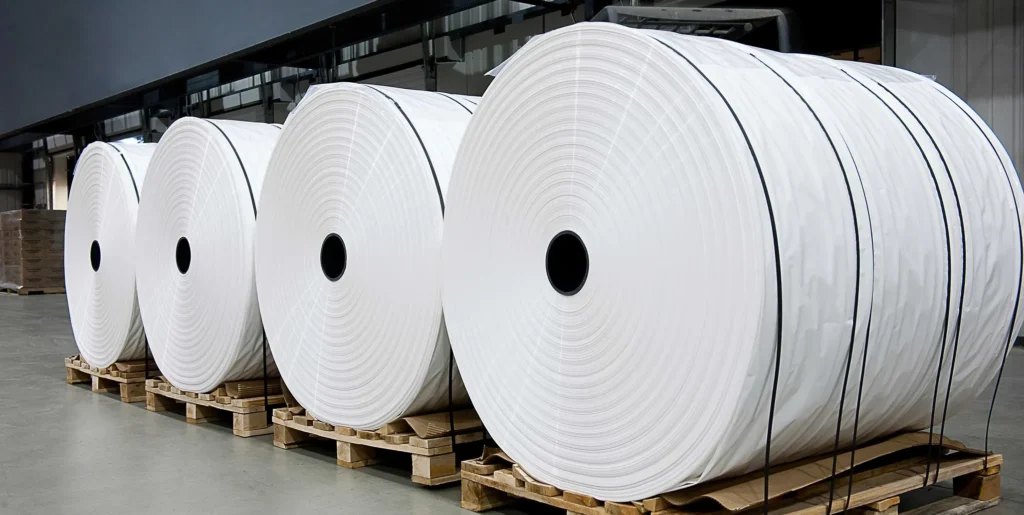
VidePak’s scale is massive. The plant’s annual capacity exceeds 500 million heavy-duty PE bags – and the user notes it as 600 million per year. Multi-shift operation and parallel lines allow VidePak to fill even large orders rapidly. They often hold stock of standard bag sizes and raw film rolls, enabling short lead-times (bags can ship in weeks, not months). This high-volume output means consistency and availability: customers can rely on VidePak during demand spikes or supply disruptions.
Quality Assurance Workflow
VidePak’s quality control is systematic. A simplified flow of inspections is:
At each stage, data is logged for traceability. If any parameter (e.g. film thickness, weld strength) falls out of spec, that run is corrected or scrapped. Finished bags are labeled with batch codes and stored under controlled conditions until shipment. According to VidePak’s documentation, these steps yield stable, high-quality bags that “meet their promised performance in real-world use”.
VidePak Capabilities at a Glance
Table 3: VidePak Heavy-Duty PE Bag Production Profile
| Aspect | Details |
| Raw Materials | Virgin PE resin (LDPE/LLDPE/MDPE) from BASF, Sinopec, Yangtze (no recycled content) |
| Equipment | Multi-layer co-extrusion blown-film lines (W&H, Starlinger) and high-speed bag-formers |
| Standards | ASTM/ISO film & bag tests (e.g. D882 tensile, D1709 dart, ISO 7965 drop, F88 seal) |
| Production Line | End-to-end in-house (resin→film→print→bag forming) |
| Annual Capacity | ~500–600 million heavy-duty PE bags |
| Quality Control | Incoming material checks; in-line gauge/print monitoring; finished bag tests (tensile, drop, leak) |
| Traceability | Full lot tracking (resin batch to bag pallet); certification packs accompany shipments |
In sum, VidePak combines premium raw materials and cutting-edge W&H equipment to mass-produce robust PE bags. Their strict adherence to ASTM/ISO standards and 600M/yr capacity ensure they can serve large industrial clients with consistent quality and scale.
Comparative Advantages of Heavy-Duty PE Bags
Heavy-duty PE bags excel over alternatives (paper or woven PP sacks) in several ways:
Table 4: Heavy-Duty PE Bags vs. Paper and Woven PP
| Feature | Heavy-Duty PE Bag | Multiwall Paper Bag | Woven Polypropylene Bag |
| Moisture Barrier | Excellent – PE film is waterproof, welded seams prevent any leakage | Poor (paper wicks moisture; needs liners) | Low (woven fabric is porous unless laminated) |
| Dust Containment | Very tight (heat/sonic seals and valves hold dust inside) | Moderate (stitching and seams can leak fine powder) | Moderate (fabric pores; often uses plastic liner) |
| Puncture/Tear | Very high – ductile multi-layer film resists punctures | Good in tension (multi-ply) but tears on sharp impact | High tensile strength (but edges can unravel) |
| Stack Stability | Excellent (block-bottom designs; anti-slip embossing) | Good with glued flat bottom | Very good (woven base; smooth underside) |
| Weight/Volume | Lightweight per capacity | Heavier bulk (multiple paper plies, glue) | Bulkier (thick fabric; takes space folded) |
| Print Quality | High (flexographic, reverse-print, 1–8 colors) | Decent (flat matte print on kraft) | Good on laminated face; matte on plain fabric |
| Recyclability | 100% PE (recyclable in #2/#4 film streams) | Mostly recyclable (but multi-material/liners complicate) | Limited (few recycling streams for PP bags) |
| Cost Efficiency | Can use thinner gauge with same strength; lighter shipment weight | Generally cheaper base material but heavier to ship | Higher cost fabric; limited recyclability |
Heavy-duty PE bags’ waterproof, welded structure makes them far more moisture- and dust-proof than paper or untreated woven sacks. As one case study notes, a 100 μm PE sack had a “sound water vapor barrier” to keep contents dry. Paper bags need special liners or coatings to match that, and woven PP must be laminated. For dusty products (cement, flour), PE’s sealed valves and seams “tame the chaos” of powder dust better than paper.
In strength, heavy PE film can be tuned (via co-extruded layers) to achieve very high puncture and impact resistance. Woven PP is strong in tensile stress but its fibers can fray on sharp edges. Multiwall paper (especially with inner plastic) is strong but brittle by comparison. When dropped or impacted, a PE bag will deform and hold, whereas paper might burst or weave thread.
Other advantages: PE bags are lighter for the same fill – VidePak notes that a pure PE bag cuts transport emissions compared to heavy multi-wall paper. They are also mono-material, making recycling straightforward. Modern printing allows PE bags to serve as mobile billboards; reverse-printing yields glossy artwork that stands up to rough handling. In short, PE bags combine strength + barrier + printability + recyclability, an enviable blend.
Against woven PP, PE usually wins on barrier and recycling. (Woven PP often adds BOPP film lamination to print or resist moisture, complicating recycling.) PE’s weldable seams and smooth film also prevent leakage that can plague sewn PP sacks. In user experience, heavy-duty PE is often the preferred choice when wet conditions or food-grade purity matter, while woven PP might be used where cost is paramount and moisture is less of a concern.
Conclusion
Heavy-duty polyethylene bags are a cornerstone of modern bulk packaging. Manufactured by advanced multi-layer co-extrusion, they deliver robust construction, moisture/dust protection, and environmental advantages. With categories spanning open-mouth sacks, valve-fill bags, pinch-bottom packs, and FFS tubular bags, manufacturers can match a PE bag to virtually any industrial filling line or product.
A supplier like VidePak exemplifies the benchmark: sourcing world-class polymers (BASF, Sinopec, Yangzi), leveraging W&H multi-layer film lines, and adhering to ASTM/ISO quality tests ensures every bag is fit for purpose. With a 600 million annual capacity and strict QC, VidePak can supply large OEMs reliably.
In the end, when long-distance shipping, pallet stability, and product integrity are critical, heavy-duty PE bags “tame the chaos” of bulk packaging. Their proven combination of durability, barrier performance, and recyclability makes them a compelling choice across agriculture, chemicals, food, and beyond.
VidePak: China’s Leading Manufacturer of PE Valve Bags
Multiwall Paper Bags Manufacturer: VIDEPAK
5kg FFS Heavy-duty PE Bags: The Strength and Versatility Industrial Packaging Solutions – Yuandian
Polyethylene Bags | Smart Pack | Aus & NZ
PE Valve Bags, PE Valve Sacks, 25kg, 20kg, for chemical powder and granule package, Poly bag