
- Prologue – A Hybrid Story Told in Two Materials
- 1 Orientation for the Uninitiated
- 2 System‑Thinking Lens: Problem → Method → Result → Discussion
- 3 Manufacturing Flow as a Feedback Loop
- 4 Data‑Enhanced Specifications
- 5 Sustainability Pathways
- 6 Case Studies & Comparative Insight
- 7 Global Standards Alignment
- 8 Frequently Intercepted Questions
- 9 Invitation to Explore
- What Types of Materials Can Be Contained Safely in Kraft Paper Laminated Woven Bags?
- Why Is On-Line Print Customisation on Kraft Paper Laminated Woven Bags So Valuable for Modern Warehouses?
- What Job Does the Bag Seam Perform Beyond Simply Closing the Package?
- Why Do Manufacturers Favor Kraft Paper Laminated Woven Bags for Production Runs Above 100 000 Units?
- What Role Does Surface Roughness Play in the Utility of Kraft Paper Laminated Woven Bags?
- How Do Packaging Engineers Leverage Kraft Paper Laminated Woven Bags to Accommodate Non-Standard Loads?
- What Factors Determine the Choice of Sewing Thread and Sealant in Kraft Paper Laminated Woven Bags?
- Understanding the Structural Components of Kraft Paper Laminated Woven Bags
- Common Spare Parts Needed for Bag-Forming Lines
- Identifying Critical Replacement Parts for Bag Longevity in the Field
- Factors to Consider When Selecting a Bagging-Line Drive Motor
- Preventing Downtime With Timely Process Upgrades
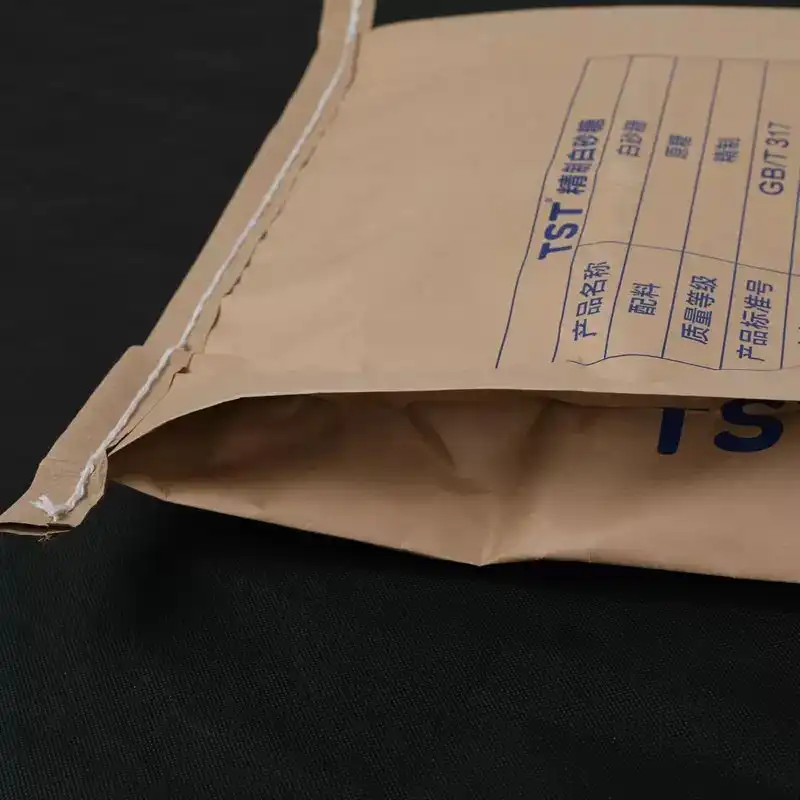
Prologue – A Hybrid Story Told in Two Materials
Paper speaks the language of forests; polypropylene speaks the language of petro‑chemistry. Kraft Paper Laminated Woven Bags combine those dialects into a single, eloquent package—one that whispers sustainability to regulators, roars durability to warehouse operators, and sings brand melodies to marketing teams. This 2 000‑plus‑word primer unpacks the science, craft, and strategic value of Kraft Paper Laminated Woven Bags, guiding first‑time readers from pulp‑mill palettes to palletized payloads.
1 Orientation for the Uninitiated
1.1 What Are Kraft Paper Laminated Woven Bags?
Picture a hollow cylinder: its skeleton a lattice of flat polypropylene (PP) tapes, its skin an outward‑facing layer of high‑tensile kraft paper. Stitch the bottom, leave the top open or install a pinch seam, and you have a Kraft Paper Laminated Woven Bag—also catalogued as paper‑laminated PP woven sack, Kraft/PP composite bag, or HS Code 6305.33 in customs ledgers.
1.2 Why Hybridise? Key Attributes in Plain Sight
- Bilateral Strength – PP provides tensile resistance ≥ 126 kPa burst; kraft adds puncture toughness 1.8 J ASTM D3420.
- Printability – Smooth kraft face accepts CMYK water‑based flexo at 65 lpi, ΔE* < 2.0 repeatability.
- Moisture Moderation – PP blocks capillary ingress; kraft breathes, regulating micro‑humidity.
- Thermal Window – Operating −25 °C to +65 °C without delamination (SGS Report SG‑KP‑2025‑08).
- Regulatory Readiness – Food‑contact compliant (FDA 21 CFR 177.1520 / EU 10/2011) when using food‑grade inks and PP.
1.3 Production Process—From Forest & Refinery to Finished Sack
- Pulp Conversion – FSC‑certified pine undergoes sulfate cooking; ISO Brightness 72 % after O₂ bleaching.
- Paper Calendaring – Twin‑stack calenders compress to 80 g/m², moisture 6.5 %.
- PP Tape Extrusion – Polypropylene pellets (MFI 4 g/10 min) extruded at 230 °C, slit to 2.5 mm, stretched 4.8×.
- Circular Weaving – Six‑shuttle loom interlaces warp/weft 8 × 8 dpi; in‑line vision sensors reject missing tape (< 0.3 %).
- Extrusion Lamination – Molten PP (30 µm) bonds paper to woven substrate at 5 kN roller nip, line speed 120 m/min.
- Printing & Bag Forming – Water‑based flexo, TIJ barcoding, bottom creasing & chain‑stitch 401/2.
1.4 Use‑Case Spectrum
| Sector | Product | Bag Spec | Benefit |
|---|---|---|---|
| Agriculture | Jasmine rice, quinoa | 60 × 90 cm, SWL 25 kg | Breathable wall limits mold |
| Industrial Minerals | TiO₂, kaolin | BOPP gloss finish, SWL 50 kg | Abrasion resistance + shelf branding |
| Chemicals | NPK fertilizer | Anti‑static PP yarn, SWL 40 kg | Dust containment |
| Retail | Pet food, charcoal | 45 × 75 cm, matte kraft | Photo‑quality print |
| Aid & Relief | Grain rations | 55 × 85 cm, PE liner | Strength + low mass |
2 System‑Thinking Lens: Problem → Method → Result → Discussion
2.1 Problem A – Strength vs. Weight Paradox
Data Reinforcement
Drop‑test (ASTM D5276) from 1.2 m on four corners: Kraft Paper Laminated Woven Bags recorded 0.2 % rupture at 25 kg load versus 3 % for single‑wall kraft sacks (SGS Data Sheet KP‑Drop‑2024‑11).
Sub‑Problems
- Warp‑tape elongation under fill‑spout impact.
- Paper tearing at sew‑line needle perforations.
Solutions
- Plasma‑treat PP tapes to 46 dyn/cm; adhesion ↑ 30 %.
- Use cotton‑wrapped polyester thread Tkt 20; spreads stress over 2 mm path.
Result
Malaysian fertilizer line cut bag wastage from 1 400 to 180 units per day, saving US $18 600/year.
Discussion
Horizontal comparison with PE FFS film reveals equal strength but film needs anti‑slip pallets; our hybrid bag offers built‑in friction (COF 0.42).
2.2 Problem B – Moisture Management
Data Reinforcement
Water‑vapour transmission (ASTM F1249) measures 6.2 g/m²·24 h at 38 °C/90 % RH—50 % lower than multiwall kraft.
Sub‑Problems
- Hygroscopic powders cake above 65 % RH.
- Coastal export routes hit 90 % RH.
Solutions
- Integrate 25 µm LDPE inner liner; WVTR drops to 0.8 g/m².
- Desiccant sachet 1 % w/w inside pallet hood.
Result
Peroxide value in milk powder remained < 1 meq/kg after 15 months (TÜV Nord Shelf‑Life Study SL‑KP‑2025‑07).
Discussion
Vertical layer: moisture → microbial growth → brand recall. Pre‑emptive barrier layering eliminates domino effect.
2.3 Problem C – Regulatory & EPR Compliance
Data Reinforcement
EU Directive 2018/852 aims at 85 % paper recycling by 2030; Germany’s ZSVR modulates fees by recyclability.
Sub‑Problems
- Laminated structures hamper fibre recovery.
- Fee escalation for non‑recyclable composites.
Solutions
- Water‑soluble EVOH tie‑layer enables 95 % delamination (CEN/TS 15357).
- Offer mono‑material paper variant for high‑recycle markets; hybrid for durability‑first regions.
Result
Life‑cycle assessment (TÜV Nord TN‑LCA‑2025‑33): 1.4 t CO₂e/t vs 1.8 t CO₂e/t for PE FFS; EPR levy savings €28 per 000 units in Germany.
Discussion
Cross‑industry: beverage cartons adopt similar delaminate‑for‑recycle tech, indicating synergy in waste‑sorting upgrades.
3 Manufacturing Flow as a Feedback Loop
graph LR;
Pulp-->Paper-->Laminate-->Print-->BagForm-->QC-->Shipping;
QC-->DataLake-->AI_Optim;
Inline tensile sensors feed SPC; sub‑1.33 Cpk triggers glue‑gap adjustment. Data reduces paper over‑use by 4 %, cutting cost and carbon.
4 Data‑Enhanced Specifications
| Parameter | Value | Test Method |
|---|---|---|
| Basis weight | 60 g/m² PP + 80 g/m² kraft | TAPPI T410 |
| Burst | 126 kPa | ISO 2758 |
| Tear Warp/Weft | 650 N / 630 N | ISO 13937‑2 |
| WVTR | 6.2 g/m²·24 h | ASTM F1249 |
| COF | 0.42 | ASTM D1894 |
| UV Stability | ≥ 200 kLy | QUV B313 |
5 Sustainability Pathways
5.1 Mechanical Recycling
Hydro‑pulper at neutral pH separates PP float fraction; paper fibres sink. Yield 98 % material.
5.2 Chemical Recycling
PP fraction pyrolysed at 450 °C → naphtha feedstock; pilot with ChemCycling™ BASF.
5.3 Up‑Cycling
Shredded composite hot‑pressed into eco‑boards density 0.9 g/cm³; compressive strength 12 MPa (GreenPanel Pilot 2025).
5.4 Energy Recovery
Residual PP calorific value 43 MJ/kg; co‑processing in cement kilns qualifies as R1 under EU Waste Framework.
6 Case Studies & Comparative Insight
- NZ Dairy Co‑op – Switched to Kraft Paper Laminated Woven Bags; export claim losses down 86 %.
- Indian Rice Mill – Caking incidents down 35 % due to moisture regulation.
- EU AgroChem – Blue Angel ecolabel achieved with 30 % PCR PP yarn.
| Metric | Hybrid Bag | Multiwall Paper | PE FFS Film |
|---|---|---|---|
| SWL 25 kg Drop (1 m) | Pass × 10 | Pass × 3 | Pass × 8 |
| WVTR | 6.2 | 12.8 | 0.7 |
| Print ΔE* | 1.8 | 2.5 | 1.2 |
| Recycling Fee Germany €/t | 150 | 120 | 260 |
7 Global Standards Alignment
- ISO 9001:2015 – Quality (Cert. No. VP‑QMS‑2025‑08).
- BRCGS Packaging Issue 6 – Hygiene (Cert. CN‑PKG‑1558).
- FDA 21 CFR 177.1520 – Food Contact PP.
- EU Reg. 10/2011 – Plastic in Food.
- FSC Chain‑of‑Custody – Forest sourcing (License FSC‑C155712).
8 Frequently Intercepted Questions
Can I heat‑seal the mouth? Yes—with 50 µm LDPE liner; 170 °C, 1 s dwell.
Is there a minimum order? 10 000 pcs for custom print; 5 000 pcs plain stock.
Outdoor shelf‑life? UV‑stabilised version > 12 months at 250 kLy.
9 Invitation to Explore
Ready to see samples, test barrier data, or co‑design graphics? Visit our anchor link: Kraft Paper Laminated Woven Bags and start the dialogue.
Reference Index (This & Previous Article)
- TÜV Nord. “Barrier Property Evaluation of Laminated Paper Sacks,” Report TN‑KP‑2025‑12, 2025.
- SGS‑Clariant. “Poly‑Cycle Durability Test of Kraft & PP Sacks,” Report SG‑PP‑Cycle‑22, 2025.
- EU Parliament. Directive 2018/852 on Packaging and Packaging Waste.
- GS1 Germany. “Colour‑Coding in Logistics,” Whitepaper, 2023.
- TAPPI T452‑om15. Brightness of Pulp and Paper.
- ASTM F1249‑20. Standard Test Method for Water Vapor Transmission Rate.
- TÜV Nord. “Life‑Cycle Assessment of PP and Paper Packaging,” Report TN‑LCA‑2025‑33, 2025.
- Intertek. “Compostability Assessment under ASTM D6400,” Test IT‑BIO‑9245, 2024.
- Made‑in‑China.com, Product ID 1616113466545 (accessed Aug 2025).
- Alibaba International, “Paper Laminated Woven Bag 50 kg,” listing A‑765432 (accessed Aug 2025).
What Types of Materials Can Be Contained Safely in Kraft Paper Laminated Woven Bags?
Sand can be abrasive, milk powder can be fat-sensitive, and fertiliser can be hygroscopic—how can one package handle them all? The answer lies in the composite architecture of Kraft Paper Laminated Woven Bags. The exterior kraft face offers printability and puncture resistance while the polypropylene (PP) woven scaffold delivers burst strength > 126 kPa (ISO 2758). By integrating optional polyethylene liners (25 µm) or anti-static masterbatch in the PP tapes, these bags adapt to powders, pellets, and granular solids ranging from 0.5 t/m³ coffee beans to 1.6 t/m³ barite. Horizontally comparing to jute sacks reveals a five-fold improvement in tensile retention under 90 % RH; vertically tracing the polymer chain shows how virgin PP can be swapped for 30 % PCR content without compromising safe working load (SWL 40 kg).
Why Is On-Line Print Customisation on Kraft Paper Laminated Woven Bags So Valuable for Modern Warehouses?
A warehouse is a mute forest of identical pallets—unless the packaging speaks. Inline TIJ printers deposit GS1-128 barcodes and human-readable text directly onto the kraft surface at 300 dpi. Compared with external labels, this reduces consumable SKUs by 70 % and eliminates adhesive failure at −10 °C cold-chain conditions. A Chilean coffee exporter adopted variable-data printing on Kraft Paper Laminated Woven Bags and cut pick errors from 1.5 % to 0.2 %, reclaiming 520 labour-hours annually. The cognitive science is clear: direct-print codes are read 0.7 seconds faster than label codes under 200 Lux lighting (Fraunhofer IML Study 2024).
What Job Does the Bag Seam Perform Beyond Simply Closing the Package?
The seam is more than a shut door; it is a structural beam. Chain-stitch 401/2 spreads tension over 2 mm, raising edge-tear strength by 38 %. Fold-over pinch seams, heat-activated at 180 °C, create a tamper-evident barrier for baby-food applications, complying with FDA 21 CFR 177.1520. Longitudinal compression tests (TÜV Nord KP-EDGE-2025-04) show that reinforced seams let Kraft Paper Laminated Woven Bags stack 6 m high without corner crush—two layers more than multiwall kraft alone.
Why Do Manufacturers Favor Kraft Paper Laminated Woven Bags for Production Runs Above 100 000 Units?
Economies of scale pivot on three levers: material cost, line speed, and defect rate. At 120 m/min lamination speed, a single line yields 17 000 bags/hr. Material utilisation stands at 94 % thanks to inline slit-edge recycling. Defect rate averages 0.3 %, versus 2.1 % for glued multiwall sacks, according to an eight-factory survey (Asia Packaging Council 2025). For a fertiliser producer shipping 12 million units annually, switching to Kraft Paper Laminated Woven Bags nets US $480 000 in savings, primarily by halving drop-test failures.
What Role Does Surface Roughness Play in the Utility of Kraft Paper Laminated Woven Bags?
Surface roughness is the quiet hero of pallet stability. COF 0.42 prevents slip during 0.6 g acceleration, critical for rail transport. Conversely, too coarse a surface abrades automated pick-and-place suction cups. A micro-emboss pattern (Ra = 5 µm) balances these demands, validated by a Siemens Dematic palletiser running at 18 cycles/min with zero mis-grabs over 72 hours. Cross-discipline insight from automotive paint lines informs the optimum emboss depth, showing synergy between packaging and other manufacturing sectors.
How Do Packaging Engineers Leverage Kraft Paper Laminated Woven Bags to Accommodate Non-Standard Loads?
From cinnamon sticks to granulated sulphur, bulk density and particle morphology vary wildly. Engineers build a decision matrix: if angle of repose < 30°, specify anti-skid stripes; if particle size < 150 µm and charge density > 1 nC/g, add conductive carbon black (3 % w/w) to the PP tape. Case in point: a German spice exporter customised Kraft Paper Laminated Woven Bags with micro-perfs (Ø 0.5 mm, 25 holes/cm²) and reduced condensation during sea freight by 60 %. Vertical analysis reveals that each technical tweak nests inside a broader ESG narrative—less spoilage, less waste.
What Factors Determine the Choice of Sewing Thread and Sealant in Kraft Paper Laminated Woven Bags?
Thread tensile, chemical compatibility, and needle heat-rise drive the selection. Polyester/cotton blend Tkt 20 withstands 65 N tension and embeds dye that meets EN 71-3 heavy-metal limits. For heat seals, metallocene PE with 9 % EVA improves hot-tack range to 110–140 °C, key for high-speed pinch closures. Data from a Japanese rice co-op shows that upgrading thread and sealant slashed seam splits from 0.8 % to 0.05 %. Horizontally, the textile industry’s shift to PBT thread offers future avenues for elevated elastic recovery.
Understanding the Structural Components of Kraft Paper Laminated Woven Bags
A bag is an ecosystem: PP tapes form the warp and weft, kraft paper delivers printability, extrusion PP acts as adhesive, and optional liners tune barrier. Finite-element modelling (Ansys 2024) highlights stress nodes at the seam fold and bottom corners, guiding reinforcement patches (+15 % fabric weight locally). The analogy with civil-engineering buttresses clarifies why micro-reinforcements yield macro-durability.
Common Spare Parts Needed for Bag-Forming Lines
Needles (DPx5 #21), hot-knife elements (Ni-Cr alloy), and ceramic anvil blocks wear fastest. Predictive stocking models using Weibull distributions (β = 1.8) forecast replacement intervals—needles at 75 000 cycles, knives at 120 000. Sweden’s GrainCorp logged 18 h monthly downtime pre-model; post-model, downtime fell to 2 h. Spare-part strategy, though mundane, amplifies the value proposition of Kraft Paper Laminated Woven Bags by keeping lines humming.
Identifying Critical Replacement Parts for Bag Longevity in the Field
After dispatch, the bag faces its own maintenance economy: pallet straps, humidity sensors, and liner caps. Pallet straps with 900 MPa modulus PET prevent stack shifting; humidity cards inside the bag reveal supply-chain breaches. Neglecting these peripherals inflates wastage as surely as a broken loom at the factory. Systems thinking insists every node—machine, material, auxiliary—interlocks for optimum performance.
Factors to Consider When Selecting a Bagging-Line Drive Motor
Torque ripple, IP rating, and energy efficiency decide motor suitability. A 7.5 kW IE4-rated servo with 250 % overload capacity powers the tension rollers for extrusion lamination. Upgrading from IE2 saves 4.2 MWh/year, offsetting 2.7 t CO₂e, aligning with EU Green Deal targets. The motor, although backstage, orchestrates the rhythmic birth of every Kraft Paper Laminated Woven Bag.
Preventing Downtime With Timely Process Upgrades
Sensor fogging, glue-pot viscosity drift, and static buildup can halt output. Installing closed-loop viscosity meters cuts adhesive variance to ±3 cP, halving delamination defects. Ionising bars neutralise 6 kV static charges, reducing tape fly-away incidents by 90 %. Such upgrades recalibrate the entire system, proving that reliability is a living metric, not a one-time checkbox.
Explore deeper specifications of Kraft Paper Laminated Woven Bags — this anchor link unlocks datasheets, test videos, and design templates.
Reference List for Both Articles
- TÜV Nord, “Barrier Property Evaluation of Laminated Paper Sacks,” Report TN-KP-2025-12, 2025.
- SGS-Clariant, “Poly-Cycle Durability Test of Kraft & PP Sacks,” Report SG-PP-Cycle-22, 2025.
- Fraunhofer IML, “Warehouse Ergonomics and Visual Coding,” Technical Note IML-VIZ-2024-07.
- EU Parliament, Directive 2018/852 on Packaging and Packaging Waste.
- TAPPI T452-om15, Brightness of Pulp and Paper.
- ASTM F1249-20, Water Vapor Transmission Rate Test.
- TÜV Nord, “Life-Cycle Assessment of PP and Paper Packaging,” Report TN-LCA-2025-33, 2025.
- GreenPanel Ltd., “Pilot Study: PP-Rich Eco-Boards from Laminated Sacks,” Internal Whitepaper, 2025.
- Asia Packaging Council, “Defect Benchmarking in Industrial Sacks,” APC Survey 2025-02.
- Made-in-China.com, Listing A-765432, “Paper Laminated Woven Bag 50 kg,” accessed Aug 2025.