
What Are Leakproof Woven Bags?
A Leakproof Woven Bag is an engineered containment sack designed to stop liquid weeping, slurry seepage, and fine-particle sifting in the messy, high-variability conditions of waste management and recycling. At its mechanical core lies a woven polypropylene (PP) fabric that supplies tensile and tear capacity; around that backbone, converters add moisture barriers (extrusion coats, films, or liners), leak-focused seam architectures (heat-sealed pinch, block-bottom valve, sewn-and-tape), and antistatic pathways to reduce ignition risk around dusty fractions. Unlike generic raffia sacks or plain liners, Leakproof Woven Bags are specified for wet yards, mixed loads, coastal storage, container condensation cycles, and abrasive handling—where leaks can escalate into environmental incidents, regulatory fines, and unplanned cleanup.
- Leak-Resistant Woven PP Bags
- Waterproof Woven Waste Sacks
- Leak-Tight Woven FIBC Bags
- PE-Lined Woven Containment Bags
- Sealed-Seam Woven Bags for Waste
- Anti-Static Leakproof Woven Sacks
- Baffled Leakproof FIBC for Recycling
Why do municipal or industrial operators adopt Leakproof Woven Bags? Because real operations are unforgiving. Transfer stations are wet, forklifts are impatient, barcodes must scan under mixed lighting, and pallets must remain square through long voyages. Leakproof Woven Bags blend the strength of PP fabric with barrier films or liners, use seam designs that block capillaries and needle-hole sifting, and tune surface friction (COF) to prevent pallet slump. The result: fewer spills, faster intake, cleaner air, reliable code grades, and lower total cost per ton moved.
The Materials of Leakproof Woven Bags (Constituents, Properties, Cost/Benefit)
Think of a Leakproof Woven Bag as a negotiated stack. Each layer must measurably contribute strength, barrier, leak discipline, machinability, or safety—otherwise it does not belong. The winning approach favors a mono-polyolefin interior (PP fabric + PP-friendly tie layers + PE/PP liners) for simpler end-of-life, then selectively adds paper or specialty films where they advance stiffness, optics, regulatory cues, or abrasion resistance.
Raffia-style PP tapes, extruded from virgin resin, slit, mono-oriented for tenacity, and woven on circular or flat looms. Typical fabric targets: 70–120 g/m² for 20–50 kg sacks; heavier for construction debris or abrasive routes. This fabric supplies tensile/tear/puncture strength and flex-fatigue endurance at modest mass, tolerates splash-and-dry cycles, and retains fold memory for crisp block-bottom conversions. Before coating/lamination, the fabric’s micro-porosity can be harnessed for engineered deaeration during filling.
Cost lens: Adding grams is not always cheaper. Smarter ROI comes from seam architecture (pasted pinch vs sewn-and-tape), liner/barrier design, and COF tuning that reduce rewraps and claims without inflating mass.
BOPP film (matte/gloss) enables reverse-printed, rub-resistant graphics and hydrophobic faces; matte “code windows” avoid scanner glare while the rest of the panel can be glossy for depth. Extrusion coatings (PP/PE) close capillaries, deliver economical splash resistance, and provide ink/adhesive anchorage. Where retail-adjacent optics or extra stiffness matter, kraft- or paper-laminated faces can be added over a coated fabric while preserving wet toughness inside.
LDPE/LLDPE/HDPE or PP mono films in 25–70 μm gauges, with optional co-ex barrier (e.g., PA/PE or EVOH blends) for odor or oxygen control in special waste. Antistatic grades reduce nuisance shocks and dust cling. Formats include loose-insert liners (sewn builds), form-fit liners (block-bottom bricks), and tube liners pre-sealed at SIT for valve formats. Liners set the WVTR/OTR window, isolate odor/grease, and enable heat-sealed hygienic closures that hold after long voyages and yard storage.
Water-based pastes for paper-to-paper; solventless polyurethane or PP-friendly extrusion ties for film-to-fabric or paper-to-fabric. Targets: bond strength (peel/shear), curl control, minimal residuals for odor discipline, and long-run register stability across climate cycles.
Pasted pinch removes needle holes and yields premium bricks; block-bottom valve formats support dust-disciplined, high-speed filling, with sleeves in paper/PE/PP matched to nozzle OD and sealed by thermal or ultrasonic energy; sewn + tape remains a cost-balanced workhorse—crepe/hot-melt seam tapes seal perforations and reduce capillary wicking, while stitch density (SPI) and hem depth are tuned to pass the drop matrix without sifting.
UV stabilizers for yard dwell; antistatic pathways for dusty streams (targeting static-dissipative surface resistivity ranges); slip/anti-block to set COF; white masterbatch for opacity under films; edge varnish to raise rub resistance without drowning barcodes.
Favor mono-polyolefin interiors for simpler end-of-life. Add paper or specialty films only when they genuinely improve stiffness, optics, or route survival. Every gram should prove its value in speed, safety, or survival.
What Are the Features of Leakproof Woven Bags?
Multi-layer faces plus inner liners cap WVTR and arrest splash events. Seam architectures—pinch, thermal valve, or sewn + tape—block capillary paths and needle-hole sifting. Unlike paper-only sacks, the PP backbone retains strength after wet-dry cycles.
The woven core carries loads through forklift rubs, corner drops, and container racking. Films or poly-paper faces add stiffness and face durability without turning the unit into a slippery brick.
Correct valve sleeve stiffness/ID curb blowback; ultrasonic/thermal closure arrests post-transport leaks. On sewn builds, seam tapes plus tuned SPI minimize sifting—cleaner air, safer operators, fewer housekeeping hours.
Block-bottom geometry produces squared bricks; tuned COF resists slumps; consistent dimensions improve 20’/40’/HC container cube and reduce rewraps.
Reverse-printed BOPP shields dense artwork; reserved matte windows maintain code grades under mixed lighting; controlled ΔE preserves brand color over seasons.
Favor mono-polyolefin interiors and right-gauged liners; use paper where it changes outcomes; clearly label material IDs to support downstream sorting.
What Is the Production Process of Leakproof Woven Bags?
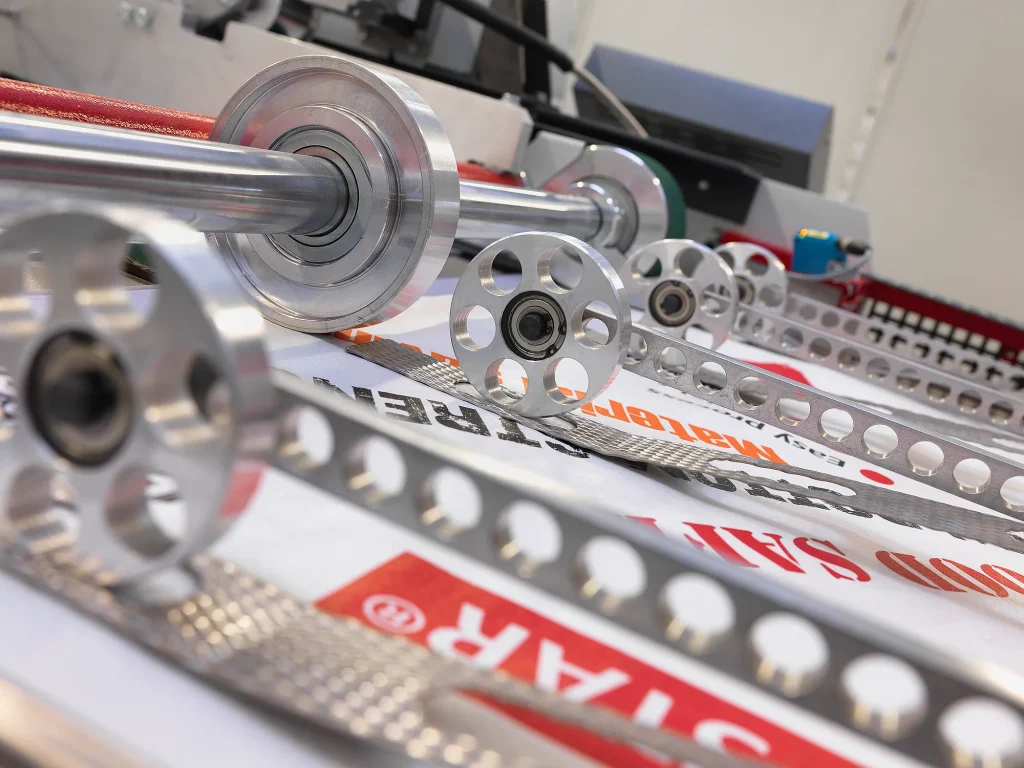
VidePak couples Austrian Starlinger (extrusion, tape orientation, weaving, and extrusion coating) with German W&H (Windmöller & Hölscher) printing and lamination to produce repeatable bonds, clean register, and stable webs. Around these platforms sits a HACCP/GMP-inspired conversion discipline—SOPs, SPC, AQL, DFMEA—that turns tolerance into predictability.
- PP resin: MFI distribution, isotacticity, Karl Fischer moisture, gel count, odor/ash; lots barcoded for cradle-to-pallet traceability.
- Woven fabric: GSM and pick balance; porosity prior to coats/laminations; broken-end Pareto; flatness for lamination readiness.
- Films/liners: gauge uniformity, haze/gloss, dyne ≥ 38 dyn/cm for anchorage, WVTR/OTR targets, SIT, dart impact, antistatic decay.
- Paper plies (if used): basis weight, Cobb, porosity, MD/CD balance; stiffness/curl windows validated for lamination.
- Adhesives/ties: viscosity, solids, pot life; bond strength and residual thresholds; curl control verified on pilot webs.
- Inks/varnishes: low migration where relevant; rub resistance; ΔE targets with retained swatches; barcode reserve masks and edge-varnish maps.
- Threads/tapes/valves: fiber identity, tenacity, sleeve stiffness and ID tolerance; hem depth guidance by drop matrix severity.
- Tape extrusion/orientation: cast → slit → draw → anneal; controls: denier uniformity, tape width, crystallinity (DSC), tensile/elongation.
- Weaving: circular/flat looms hold GSM and picks; broken-end logs drive maintenance; flatness and pick balance prepare webs for coating/lamination.
- Surface treatment: corona/plasma raises dyne levels for reliable anchorage; treatment energy logged against reel IDs.
- Coating/lamination: extrusion coats (PP/PE) close pores; reverse-printed BOPP is laminated via solventless PU or PP-friendly ties; poly-paper routes laminate kraft to coated fabric for abrasion-resistant yet “paper-look” faces.
- Printing: high-fidelity flexo/gravure to ΔE targets; matte code windows reserved; high-build edge varnish protects high-wear zones while leaving codes legible.
- Cutting/gusseting/block-bottom: bevel trims at gusset pivots reduce notch starters; geometry tuned for cube and stability.
- Mouth/closure engineering: pasted pinch (hot-air/hot-melt), thermal/ultrasonic valves, or sewn + tape with SPI and hem depth tuned to the drop matrix and leak targets.
- Liner insertion/sealing: loose-insert for sewn builds; form-fit liners heat-sealed at SIT; peel tests confirm integrity; antistatic performance audited on dusty lines.
- Deaeration maps: hot-needle or laser micro-perfs placed away from rain paths and code zones; density matched to PSD, bulk density, and BPM.
- In-line inspection and baling: register/code checks; seam audits; compression balers produce uniform, traceable bales.
- Mechanical: tensile/tear/burst; drop matrix (e.g., 5× at 0.8–1.2 m) aligned to lane severity; seam/valve peel tests.
- Functional: leak/tightness yield; COF windows (0.30–0.45) balancing conveyor flow vs pallet stability; stack creep limits; label rub and barcode grade.
- Barrier: WVTR/OTR for laminated/linered builds; condensation-cycle checks for container routes; hydrostatic splash/dry recovery on faces.
- Traceability: cradle-to-pallet data linking resin, films, paper, inks, and process cells to bale labels; retained swatches and bag samples archived.
- Equipment pedigree: every order rides on Starlinger + W&H stability—benchmarks for register fidelity and bond control.
What Is the Application of Leakproof Woven Bags?
Leakproof Woven Bags excel wherever wet fractions, slurries, or fines must be contained without seepage—and where labeling and lot identity must survive rough handling.
Lined valve bags tolerate elevated moisture and acidic condensate; matte barcode windows preserve scan grades at transfer stations; UV-stabilized outer faces handle yard storage.
Poly-paper or BOPP faces resist abrasion from mixed recyclables; baffled FIBC variants maintain cube for bulky fractions; antistatic grades mitigate ignition risks around dusty fines.
Heavy fabric GSM with cross-laminated PE panels ride out rebar rubs and masonry edges; thermal valve closures keep cementitious fines from leaking during transport.
Form-fit liners, higher seal strengths, and robust bottom geometry protect against hydrostatic head; COF tuning prevents pallet slip even when faces are smooth.
How VidePak Controls and Guarantees the Quality
ISO/ASTM/EN/JIS methods govern tensile, tear, burst, drop/topple, COF, WVTR/OTR, print adhesion, seam/valve peel; SOPs, SPC, and PPAP-style validations on request.
Virgin PP resin, certified films/liners, low-odor inks/adhesives, and accredited kraft when used; lot-level barcoding and automatic quarantine for out-of-spec inputs.
Austrian Starlinger for extrusion/weaving/coating; German W&H for printing/lamination/converting—benchmarks for register and bond stability across long runs.
Incoming → in-process → outgoing checks; CAPA and retained swatches/samples for forensic reference and mock recalls.
Systems Thinking: From Sub-Problems to a Coherent Specification
Engineering the “right” Leakproof Woven Bags spec means balancing waste physics, climate/route, warehouse/cube, and compliance/traceability. Break the problem down, then recombine the answers into a pilot-ready, audit-ready design.
- Intake constraints across physics, climate, warehouse, and compliance.
- Shortlist concepts: coated fabric + liner + pasted pinch; valve build with thermal closure and engineered perf map; poly-paper face + film + form-fit liner for abrasion-heavy routes.
- DFMEA: rank seam pull-through, needle-hole sifting, delamination, code glare, stack slump, moisture caking.
- Pilot: 500–2,000 bags on the real line; instrument BPM, dust ppm, leak/WVTR, scan grades, pallet creep.
- Finalize: lock fabric GSM, faces, liner gauge, mouth/closure, perf map, COF window, UV hours, QA plan.
- Scale: SPC on denier/picks, bond strength, register, seam tensile; AQL sampling; retained swatches/samples.
- Review: down-gauging and recycled-content pilots (non-contact layers); artwork governance and seasonal ΔE checks.
Decoupling avoids one-size compromises; recombination yields a specification that is fast to fill, tight on moisture, audit-ready on labeling, and dependable in pallet cube and scan reliability.
Technical Parameters and Windows (Reference Tables)
Case-Style Scenarios
High moisture and biological activity drive condensate; paper-only sacks fail and labels smear. Leakproof Woven Bags with coated faces, form-fit 50–60 μm PE liner, and thermal valve—plus matte code windows and COF tuned to 0.35–0.40—cut leaks and cleanup time.
Blowback at the spout elevates airborne particulates; alarms trip. Resize valve sleeves to nozzle OD, use stiffer sleeves, adopt ultrasonic closure; on sewn SKUs, add crepe tape. Outcome: cleaner air, faster fills, better safety metrics.
Voyage cycles cause wet faces and interior condensation; discharge clumps. Choose poly-paper outer plus form-fit 60 μm liner; UV-stabilized outer; verify WVTR under climate cycles to prevent caking.
Sizing, Palletization, and Logistics
- Work backward from bulk density × target mass; leave headspace for deaeration and closure geometry.
- Favor block-bottom for brick stacks; tune COF and wrap tension; interlayers help with very smooth laminates.
- Model container loads with realistic tolerances; small footprint shifts (e.g., 90 → 95 cm) often unlock full rows.
- Keep code windows matte and free of varnish; maintain retained swatches for ΔE control across seasons and plants.
- Where cold chains exist, validate drop/topple and label rub under chilled/condensing cycles.
Purchasing Checklist
- Waste physics: moisture %, PSD, angle of repose, loose/tapped bulk density, fines content, oil/odor, acidity/alkalinity.
- Filling/closing: nozzle OD, target BPM, deaeration path, closure preference, acceptable dust ppm, discharge heel.
- Warehouse/container: pallet size, stack height, wrap recipe, container cube goals, floor COF.
- Climate/route: UV hours, humidity/temperature cycles, outdoor dwell, handling shocks, cold-to-warm transitions.
- Compliance/brand: labeling norms, ΔE tolerance, barcode specs, serialization.
- Sustainability: mono-polyolefin interiors, down-gauging targets, recycled-content pilots (non-contact layers).
- Performance windows: WVTR/OTR caps, drop/leak/COF targets, valve peel, bond strength, barcode grade.
Troubleshooting Matrix
Example Integrated Specifications
- Body: woven PP 85–95 g/m², UV-stabilized.
- Face: extrusion-coated PP with matte code window.
- Mouth/Bottom: block-bottom valve; thermal closure.
- Liner: PE 45–50 μm antistatic; form-fit.
- Perf: engineered micro-perfs away from rain paths.
- QA: drop 5× at 1.0–1.2 m; WVTR to target; barcode ≥ B.
- Body: woven PP 100–110 g/m²; UV masterbatch.
- Face: BOPP 25 μm matte/gloss hybrid for abrasion.
- Closure: thermal valve with check flap.
- Liner: form-fit PE 60 μm barrier.
- QA: WVTR validated under climate cycles; COF 0.35–0.40.
- Body: woven PP 80–85 g/m²; antistatic MB.
- Face: BOPP 25 μm matte with reserved code window.
- Seam: sewn + hot-melt seam tape; 10–11 SPI chainstitch.
- Liner: optional antistatic PP 40–50 μm.
- QA: leak ≤ 0.3%; serialized QR; ΔE ≤ 2 across lots.
- Body: heavy fabric (≥ 180 g/m²) with internal baffles.
- Faces: cross-laminated PE panels for wet toughness.
- Mouth: spout with skirt; heat-sealed liner; groundable pathway.
- QA: top-lift, cyclic load, and UN-style tests as required.
Comparative Insights and Connected Use-Cases
Where controlled breathability is vital (soil stabilization, levee reinforcement), see field-ready breathable woven formats for complementary strategies.
When high-fidelity art and hydrophobic faces are decisive, explore block BOPP solutions that marry speed with abrasion resistance.
Dust discipline meets speed in engineered valves. For chemical lanes, review paper valve woven use-cases.
For stiffness/optics with wet-tough interiors, track laminated kraft paper directions.
In wet, dusty routes, BOPP-laminated valve woven formats merge speed, hygiene, and brand resilience.
When payloads scale or temperature swings intensify, evaluate FIBC/Jumbo options and FFS roll-bag automation for throughput and leak discipline.
- What Are Leakproof Woven Bags?
- The Materials of Leakproof Woven Bags (Constituents, Properties, Cost/Benefit)
- What Are the Features of Leakproof Woven Bags?
- What Is the Production Process of Leakproof Woven Bags?
- What Is the Application of Leakproof Woven Bags?
- How VidePak Controls and Guarantees the Quality
- Systems Thinking: From Sub-Problems to a Coherent Specification
- Technical Parameters and Windows (Reference Tables)
- Case-Style Scenarios
- Sizing, Palletization, and Logistics
- Purchasing Checklist
- Troubleshooting Matrix
- Example Integrated Specifications
- Comparative Insights and Connected Use-Cases
- 1. Technical Specifications: Balancing Strength and Adaptability
- 2. Anti-Static Technology: Safeguarding Hazardous Material Handling
- 3. Load Capacity: From Lightweight to Heavy-Duty
- 4. Customization and Compliance
- 5. FAQs: Addressing Critical Concerns
- 6. VidePak’s Global Manufacturing Excellence
- References
In waste management and recycling operations, where containment failures can lead to environmental hazards and financial losses, leakproof woven polypropylene (PP) bags are non-negotiable. With over 30 years of expertise, VidePak has engineered solutions that reduce leakage rates by 95%, withstand loads up to 2,000 kg, and comply with global safety standards. Our research demonstrates that businesses using leakproof woven bags for industrial waste or recyclables cut cleanup costs by 30–35% and improve operational safety by eliminating spill-related accidents. For example, a German recycling facility reported zero leakage incidents after adopting VidePak’s anti-static, PE-lined FIBC bags with 150 g/m² fabric and heat-sealed seams.
1. Technical Specifications: Balancing Strength and Adaptability
Leakproof woven bags are defined by three core parameters: thickness, grammage (weight per square meter), and size. Below is a breakdown of VidePak’s product range:
| Parameter | Range | Applications |
|---|---|---|
| Thickness | 0.15–0.35 mm | 0.15 mm for lightweight plastics; 0.35 mm for metal scraps |
| Grammage | 80–200 g/m² | 100 g/m² for paper waste; 200 g/m² for construction debris |
| Size | 50×80 cm to 120×120 cm | Customizable to fit compactors or conveyor systems |
VidePak’s Austrian Starlinger circular looms produce bags with a tensile strength of 40–50 N/cm², ensuring structural integrity under dynamic loads. A U.S. waste management company achieved a 40% reduction in bag replacements by switching to our 180 g/m² bags with double-layered PP fabric.
2. Anti-Static Technology: Safeguarding Hazardous Material Handling
Static electricity poses explosion risks in environments handling flammable dust or powders. VidePak’s anti-static woven bags neutralize charges through:
- Conductive Threads: Carbon-coated PP fibers embedded in the fabric create a continuous path for charge dissipation (surface resistivity: 10⁶–10⁹ Ω/sq).
- Groundable Liners: Aluminum foil or PE layers with grounding strips, achieving <0.1 kV electrostatic potential.
In a case study, a chemical recycling plant in India eliminated static-induced fires by adopting our FIBC bags with dissipative coatings, reducing downtime costs by $120,000 annually.
3. Load Capacity: From Lightweight to Heavy-Duty
VidePak’s leakproof bags are engineered for diverse weight requirements:
| Bag Type | Max Load Capacity | Reinforcement Features |
|---|---|---|
| Standard FIBC | 500–1,000 kg | 4-loop design, 10 cm seam allowance |
| Baffled FIBC | 1,000–1,500 kg | Internal baffles for load distribution |
| Circular Woven | 1,500–2,000 kg | 200 g/m² fabric + cross-laminated PE |
For instance, a Canadian construction firm safely transported 1,800 kg of asbestos-laden debris using our baffled FIBC bags, which maintained a 0.02% leakage rate under ASTM D7386 testing.
4. Customization and Compliance
A. Regulatory Alignment
- EU REACH & OSHA: Bags meet <0.1% permeability standards for hazardous waste.
- FDA 21 CFR: Food-grade liners for recyclable food packaging.
B. Printing and Branding
VidePak’s 8-color flexographic printers achieve 150-line/inch resolution, enabling safety warnings or recycling logos. A UK waste handler increased compliance visibility by 70% using full-color printed bags with multilingual instructions.
5. FAQs: Addressing Critical Concerns
Q1: How do I verify anti-static performance?
VidePak provides ASTM D257-14 test reports, confirming surface resistivity <10⁹ Ω/sq.
Q2: What is the minimum order quantity (MOQ)?
MOQ starts at 5,000 units, with rapid 10-day turnaround for bulk orders.
Q3: Can bags withstand acidic waste?
Yes. Our PE-coated variants resist pH levels 2–12, validated by ISO 175:2010 testing.
6. VidePak’s Global Manufacturing Excellence
Founded in 2008, VidePak operates 100+ Starlinger looms and 30 lamination machines across three continents, producing 10 million bags monthly. Under CEO Ray’s leadership, we’ve achieved:
- ISO 9001 & 14001 Certification: Ensuring quality and sustainability.
- $80 Million Annual Revenue: Driven by clients like Veolia and Suez.
- 30% Recycled PP Content: Aligning with circular economy goals.
A Spanish municipality reduced landfill costs by 25% using our recyclable FIBC bags for organic waste collection.
References
- VidePak Official Website: Leakproof Woven Bags
- Industry Insights: FIBC Standards and Safety Protocols
- Contact: info@pp-wovenbags.com
By integrating cutting-edge engineering with regulatory rigor, VidePak empowers waste management and recycling sectors to achieve leakproof efficiency, safety, and sustainability. Explore our anti-static FIBC solutions or customizable baffled bags to transform your operations.