
What Are Block Bottom PP Bags? Definition, Scope, and Common Aliases
Block Bottom PP Bags are precision‑formed sacks built from woven polypropylene (PP) fabric and converted to a squared, self‑standing base that preserves a brick‑like profile when filled. By coupling a rigid block base with creased vertical sidewalls, these containers optimize pallet cube, resist bowed panels, and present flat faces for high‑contrast graphics and machine‑readable codes. In chemical powder packaging—cement, hydrated lime, gypsum, titanium dioxide, carbon black, calcium carbonate, bentonite, catalysts—the objective is simple to state yet hard to achieve at scale: clean fills, sift‑proof seams, predictable discharge, and stack stability at the fewest grams of material.
Also known as (aliases):
- Block‑bottom woven polypropylene sacks
- Pinch‑bottom PP woven bags
- Square‑bottom PP valve bags
- AD‑star style block bags
- PP block base valve sacks
- Brick pack PP woven bags
- Squared FFS PP sacks
These aliases emphasize different conversion cues—pinch vs. valve closures, square vs. brick geometry—yet all point to the same operating thesis: a dimensional package that loads fast, contains dust, stacks tight, and carries legible instructions through rough logistics. The systems view matters. A Block Bottom PP Bags specification is not just a fabric choice; it is the choreography of tapes, weave, laminate or coating, valve sleeve geometry, seal recipes, and QA signals working in concert.
Constituent Materials of Block Bottom PP Bags: Fabric, Facestocks, Bonds, and Liners
The material stack in Block Bottom PP Bags converts polymer pellets and (optionally) kraft paper into a high‑speed, dust‑tight, code‑friendly sack. Each constituent is a lever: adjust one, and performance, cost, or recyclability shifts. The art is in balancing properties to the realities of chemical powders.
1) Woven Polypropylene Fabric
Homopolymer PP tapes—slit from a cast sheet and drawn to align chains—deliver high modulus at low density. Typical constructions run 80–160 g/m² for sacks, with ends × picks tuned for tensile and permeability. Random/impact copolymer PP adds cold‑weather toughness for northern winters and repeated flex at loop and base zones.
2) Exterior Facestocks
- BOPP film lamination (12–25 μm) for scuff resistance and photo‑quality reverse printing.
- Polyolefin extrusion coatings to close weave interstices and maintain mono‑material claims.
- Kraft paper laminates where paper optics and higher surface friction are desired; manage edge wick.
- Topcoats: anti‑slip for pallet stability, anti‑scuff to protect ink, matte tactile for premium SKUs.
3) Bond Line & Adhesion
Extrusion lamination casts a polyolefin tie between film and fabric for strong wet peel with no solvents. Adhesive lamination with high‑solids polyurethane or polyolefin hot‑melts cuts drying energy and speeds cure. Edge defense via hot‑knife trim, lacquers, or fold‑bury techniques suppresses capillary wicking.
4) Valves, Bases, and Closures
Valve sleeves (coated PP or PE‑rich films) are tuned in diameter, angle, and backpressure relief for fast fills with low dust. Precise folds/pastes create the block base. Tops may be pinch‑sealed, heat‑sealed, ultrasonically closed, or left as open‑mouth for manual filling.
5) Optional Liners
LDPE/LLDPE form‑fit liners (80–140 μm) control humidity and contain fines (cement, TiO₂, silica). Antistatic or conductive liners support Type C/D builds for powders with low minimum ignition energy. Detachability preserves mono‑PP shells for recycling.
Callout — Internal link for context: For readers seeking a close cousin in construction and powder packaging, see the reference on square‑bottom PP valve bags, which share the valve architecture used by many Block Bottom PP Bags.
Signature Features of Block Bottom PP Bags: How Design Translates into Field Performance
Features only matter insofar as they move outcomes—lower dust, faster lines, safer stacks, clearer codes. The following traits, engineered into Block Bottom PP Bags, have the largest downstream impact.
Square Geometry, Stable Pallets
The block base creates a self‑standing brick profile, reducing telescoping and maximizing cube. Creased panels hold shape so stacks rise straight and stay straight.
Sift‑Proof Construction
Coated/laminated faces close weave pores. Filler cords and seam tapes tame leak vectors. Ultrasonic or pinch‑top closures sidestep needle holes entirely.
High Throughput Fill & Discharge
Valve sleeves are tuned for gravity/impeller packers. Predictable seal windows support higher bags‑per‑minute while avoiding burn‑through or curl jams.
Mechanical Resilience at Low Mass
Oriented tapes distribute loads; controlled tear propagation localizes damage from tines or nails. Faces resist scuff to preserve hazard icons and instructions.
Brand & Compliance Canvas
Flat panels carry multi‑language text, GHS pictograms, and micro‑QR for traceability. BOPP faces enable photographic panels; kraft faces add tactile cues.
Circularity & Resource Efficiency
Mono‑polyolefin builds align with PP streams where available. Lightweighting via tape draw and thinner films reduces resin grams and transport emissions.
From Pellets to Pallets: The Production Flow for Block Bottom PP Bags
- Resin conditioning & tape extrusion. PP pellets with UV/slip/antistatic masterbatches are melted, cast, slit, drawn, and relaxed to achieve target tensile/elongation with tight gauge control.
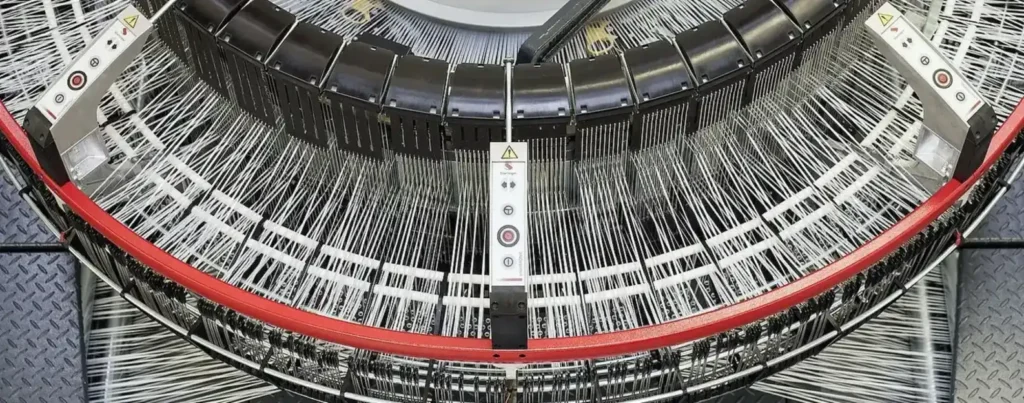
- Weaving. Tapes feed circular or flat looms. Ends × picks and tension define tensile and lamination smoothness.
- Facestock preparation. BOPP films are oriented to thickness/finish; kraft rolls are humidity‑acclimated to minimize curl and breaks in hybrid builds.
- Printing. Reverse printing (gravure/flexo) on BOPP for photo fidelity or flexo on kraft for crisp regulatory copy; ΔE libraries preserve cross‑plant color.
- Lamination/coating. Extrusion lamination or polyolefin coatings bond and seal the fabric; profiles are tuned to hold wet peel and suppress curl.
- Conversion to block base. Panels are cut; valve sleeves formed; four‑panel base folded and pasted/heat‑sealed; edges creased for sharp geometry.
- Top closure preparation. Pinch‑top heat‑seal layers, ultrasonic sonotrodes, or open‑mouth configurations are set to the target packer/line.
- Quality assurance. Tensile, seam, peel (dry/wet), drop, creep, hydrostatic holdout (where relevant), dust‑sift, wet‑rub, and barcode/QR scan rate tests.
- Palletization. Bundles counted; anti‑slip sheets and corner boards applied; pallet patterns validated under transport and yard conditions.
Tip: Validate seal recipes at the real packer dwell, pressure, and temperature—bench seals often mislead. Capture seal signatures (time/temperature/pressure or ultrasonic energy) to create a digital pass/fail threshold per lot.
Applications Map: Where Block Bottom PP Bags Excel
- Cement and blended cements: Valve‑top block bottoms reduce dusting, square stacks for export, and preserve instructions after wet handling.
- Hydrated lime and gypsum: Moisture‑sensitive powders benefit from liners and coated faces; conical discharge helps sticky or poor‑flow materials.
- Mineral fillers (CaCO₃, talc, barite): Dense powders require abrasion‑resistant faces and reinforced bases; flat panels carry fine print for grade traceability.
- Pigments and additives (TiO₂, carbon black, silica): Sift‑proof seams and antistatic liners reduce explosion risk and housekeeping load.
- Specialty chemicals and catalysts: Batch integrity and machine‑vision codes are paramount; laminated faces protect microtext and micro‑QRs.
- Agricultural inputs: Outdoor yard storage calls for UV‑stabilized shells and edge‑wick control; squared stacks improve yard safety.
- Food/industrial starches (with compliant builds): Paper‑forward optics may be preferred; detachable liners deliver hygiene and moisture protection.
Reasoning from the Title: Optimizing Chemical Powder Packaging Solutions
The phrase “Block Bottom PP Bags: Optimizing Chemical Powder Packaging Solutions” invites a practical, engineer’s reading. Optimization implies trade‑offs resolved through design discipline. Chemical powder implies flow indices, particle size distributions, bulk density and electrification risks. Packaging solutions implies speed, safety, consistency, and cost. Put together, the design intent becomes: control dust without throttling fill, square stacks without overspending grams, protect graphics while enabling scans, and keep the polymer story simple for end‑of‑life claims.
Design Optimization
Geometry (block base + creased panels), materials (woven PP + facestock), and closures (valve/pinch) tuned to packer constraints and route‑to‑market.
Powder Realities
Moisture sensitivity dictates barrier; particle fineness dictates sift‑proofing; MIE dictates ESD controls; flow index dictates valve geometry.
Solution Synthesis
Narrow laminate families, shared sleeve geometries, and common seal windows de‑risk changeovers and stabilize OEE across SKUs.
Systems Thinking: Sub‑Problems and Integrated Responses
Sub‑Problem A — Dust Control vs. Fill Speed
How do we minimize dust plumes at cutoff without choking throughput?
- Optimize valve sleeve diameter/angle and internal flap behavior; add micro‑perfs for entrapped air only where necessary.
- Specify filler cords at leak‑prone seams; use ultrasonic or hot‑air closures to avoid needle holes.
- Measure dust loss during FAT/SAT on the actual packer and iterate geometry.
Sub‑Problem B — Stack Stability vs. Material Mass
Can we square stacks for export while cutting grams per bag?
- Introduce baffle (Q‑bag) panels on long routes; sharpen creases; apply anti‑slip selectively on outer faces.
- Raise tape draw ratio while adding picks slightly to protect puncture margins; validate creep in hot‑ and wet‑stack tests.
Sub‑Problem C — Moisture Sensitivity vs. Recyclability
What barrier is truly needed for each powder, and how will it affect end‑of‑life claims?
- Use polyolefin coatings or BOPP laminates for rain holdout; add detachable LDPE liners only for hygroscopic formulations.
- Publish grams‑per‑layer and disposal guidance by region to keep claims credible.
Sub‑Problem D — Static Hazard vs. Cost
When are Type C or D builds justified?
- Screen powders by minimum ignition energy and transfer method; ground reliably for Type C or adopt Type D when grounding is impractical.
- Audit bond continuity quarterly; log humidity and ESD events to refine specs.
Sub‑Problem E — Print Vividness vs. Wet Rub & Handling Scuff
How do we keep branding and instructions readable to the end of the route?
- Use reverse‑printed BOPP for hero art; choose matte anti‑scuff varnishes; reserve kraft faces where friction and natural optics help stacking and legibility.
- Enforce ΔE tolerances via inline scanners; run pallet‑level wet‑rub tests by lot.
Color Tables: Parameters, Targets, and Trade‑Offs
Case Studies: When Specification Meets Reality
Urban High‑Rise Concrete Works
Constraint: lift windows and dust complaints. Spec: Block Bottom PP Bags with spout valves, form‑fit liners, and matte anti‑scuff faces. Outcome: fewer crane cycles, reduced dust at mixers, and faster staging on tight decks.
Coastal Infrastructure Repair
Constraint: high humidity and caking. Spec: coated shells + form‑fit liners + desiccant protocol. Outcome: predictable discharge into mobile batch plants; integrity maintained after yard exposure.
Industrial Flooring with Silica Fillers
Constraint: static hazards during pneumatic transfer. Spec: Type C with grounded racks; antistatic liners. Outcome: no ESD events, cleaner housekeeping, and faster transfer rates.
Practical Checklist for Specifiers and Buyers
- Decide the failure that hurts most—dusting, pallet lean, caking, barcode unreadability—and design to that worst credible scenario.
- Lock a laminate/coating family and a standard seal window to stabilize OEE and color across SKUs.
- Engineer valve sleeves on the actual packer; capture dust loss and fill time during pilots.
- Stabilize web handling: lay‑flat tolerances, curl limits, splice flags, and winding tension ranges.
- Instrument QA: lot‑level ΔE, peel, wet‑rub, hydrostatic holdout (if spec’d), and scan‑rate data tied to QR.
- Plan end‑of‑life honestly: mono‑polyolefin shells where possible; detachable liners for high‑barrier needs; publish grams per layer.
Frequently Asked Technical Questions
Q: Are Block Bottom PP Bags food‑contact capable?
A: Yes, when compliant resins/additives and GMPs are specified; many chemical routes do not require this.
Q: Do block bottoms always outperform pillow sacks?
A: For cube and stacking, yes. For ultra‑low‑cost commodities, conversion steps must be justified by dust, speed, and cube value.
Q: When are antistatic or conductive builds necessary?
A: When powder MIE is low, humidity is low, or pneumatic transfer is used. Adopt Type C (grounded) or Type D (dissipative) with documented SOPs.
Specification Template (Starter)
- Product: Block Bottom PP Bags as valve sacks for cement/mineral fillers
- Size & lay‑flat: Match packer shoulder; curl ≤ specified limit; creases defined; splices flagged
- Fabric: PP woven, 100–140 g/m²; ends × picks set by tensile and sift targets
- Face: Reverse‑printed BOPP 18–20 μm (matte/gloss) or polyolefin extrusion coating
- Bond: Extrusion lamination with polyolefin tie; peel spec after humidity cycling
- Valve/top: Self‑closing sleeve; ultrasonic or hot‑air closure; dust‑sock compatible
- Base: Pasted block bottom; symmetry tolerances; corner reinforcement as needed
- Liner (optional): LDPE/LLDPE form‑fit, 100 μm, tabbed; antistatic/conductive per MIE
- Additives: UV (HALS), anti‑slip on outer panels, antistatic as needed
- QA: Tensile, seam/peel, drop, creep (hot/wet), dust‑sift, hydrostatic (if spec’d), wet‑rub, barcode/QR scan rate
- Palletization: Anti‑slip sheets; corner boards; tier limits; rain tarp protocol for yards
Keyword Plan and Long‑Tail Phrases
Primary keyword used throughout: Block Bottom PP Bags.
Supporting, naturally phrased variants: block‑bottom woven polypropylene sacks; square‑bottom PP valve bags; AD‑star style block bags; pinch‑bottom PP woven bags; sift‑proof PP valve sacks; waterproof block‑bottom PP sacks; Q‑baffle block bags; antistatic bulk powder bags; mono‑polyolefin laminated sacks; brick pack PP woven bags.

- What Are Block Bottom PP Bags? Definition, Scope, and Common Aliases
- Constituent Materials of Block Bottom PP Bags: Fabric, Facestocks, Bonds, and Liners
- Signature Features of Block Bottom PP Bags: How Design Translates into Field Performance
- From Pellets to Pallets: The Production Flow for Block Bottom PP Bags
- Applications Map: Where Block Bottom PP Bags Excel
- Reasoning from the Title: Optimizing Chemical Powder Packaging Solutions
- Systems Thinking: Sub‑Problems and Integrated Responses
- Color Tables: Parameters, Targets, and Trade‑Offs
- Case Studies: When Specification Meets Reality
- Practical Checklist for Specifiers and Buyers
- Frequently Asked Technical Questions
- Specification Template (Starter)
- Keyword Plan and Long‑Tail Phrases
- 1. Market Demand and Challenges in Chemical Powder Packaging
- 2. Technical Innovations: From 200-Ton Presses to Palletized Shipping
- 3. VidePak’s Production Ecosystem: Scalability Meets Customization
- 4. Case Study: Optimizing Logistics for Calcium Oxide
- 5. Sustainability and Compliance
- 6. FAQs: Addressing Key Client Concerns
- 7. Future Trends: Smart Packaging and Beyond
“Why should chemical manufacturers prioritize block bottom PP bags for powder packaging?”
Ray Chen, CEO of VidePak, leans forward in his chair: “The answer is threefold: 30% higher volumetric efficiency in shipping, 50% faster automated filling, and zero leakage even under extreme humidity. At VidePak, we’ve engineered these bags to withstand 200-ton hydraulic presses while maximizing container capacity.”
This bold statement encapsulates VidePak’s innovation in block bottom PP bags—a product reshaping chemical logistics. With 526 employees and $80M annual revenue, VidePak combines Austrian Starlinger machinery, virgin PP materials, and 30+ years of expertise to deliver solutions that align with global sustainability and efficiency demands.
1. Market Demand and Challenges in Chemical Powder Packaging
The global chemical packaging market is projected to reach $92B by 2027, driven by stringent safety regulations and rising cross-border trade. However, traditional packaging faces critical issues:
- Low Load Efficiency: Standard bags occupy 15–20% unused container space due to irregular stacking.
- Moisture Sensitivity: 12% of chemical powders degrade during transit without moisture-proof barriers.
- Manual Handling Risks: Labor-intensive processes increase contamination risks and costs.
VidePak’s block bottom PP bags address these gaps through:
- Uniform Stacking: Rectangular bases enable 98% container space utilization.
- Multi-Layer Lamination: BOPP/PE coatings reduce moisture permeability to <1.0 g/m²/day.
- Automation Compatibility: Valve designs allow 1,200 bags/hour filling rates on Starlinger lines.
2. Technical Innovations: From 200-Ton Presses to Palletized Shipping
2.1 High-Pressure Compression
VidePak’s 200-ton hydraulic presses compress bulk powders into dense blocks, reducing air pockets. For calcium oxide (CaO), this method increases container capacity by 22% (from 800 to 976 bags per 40’ container).
| Parameter | Traditional Bags | VidePak Block Bottom Bags |
|---|---|---|
| Bags per Container | 800 | 976 |
| Moisture Permeability | 5.2 g/m²/day | 0.8 g/m²/day |
| Filling Speed | 700 bags/hour | 1,200 bags/hour |
2.2 Palletization and Stretch Wrapping
VidePak’s palletizing system integrates stretch film with anti-static properties, securing 1.2-ton loads. A case study with a German agrochemical firm showed zero spillage incidents over 12 months, compared to 8% loss with conventional methods.
3. VidePak’s Production Ecosystem: Scalability Meets Customization
With 100+ circular looms and 30 lamination machines, VidePak achieves:
- Rapid Customization: 4–6 color printing with ≤0.3mm registration accuracy.
- Material Integrity: Virgin PP resins (MFI: 4–8 g/10min) ensure tensile strength >45 N/cm².
- Sustainability: 100% recyclable bags align with EU’s PPWD 94/62/EC standards.
Example: A UAE cement producer reduced packaging costs by 18% after switching to VidePak’s 50kg block bottom bags, citing enhanced forklift stability and UV resistance.
4. Case Study: Optimizing Logistics for Calcium Oxide
Calcium oxide’s hygroscopic nature demands airtight packaging. VidePak’s solution:
- Inner Layer: 80μm PE film for moisture barrier.
- Middle Layer: 120gsm PP woven fabric for tear resistance.
- Outer Layer: BOPP lamination for printability.
Results:
- Moisture Content: Reduced from 3.5% to 0.9% after 48-hour humidity testing.
- Stacking Height: Increased from 8 to 12 layers without deformation.
5. Sustainability and Compliance
VidePak’s bags comply with:
- ISO 9001/14001: Quality and environmental systems.
- BRCGS Packaging Standard: Food-grade safety protocols.
- OECD GLP: Chemical resistance certifications.
A lifecycle analysis revealed VidePak’s bags generate 42% lower CO2 than paper-composite alternatives, driven by energy-efficient Starlinger extruders.
6. FAQs: Addressing Key Client Concerns
Q1: How do block bottom bags perform in high-humidity environments?
A: With PE coatings and ultrasonic seam sealing, they maintain ≤1% moisture ingress at 85% RH.
Q2: What’s the minimum order quantity (MOQ) for custom designs?
A: MOQ starts at 10,000 bags, with 15-day lead times for 6-color prints.
Q3: Are these bags compatible with automated filling systems?
A: Yes—VidePak’s valve designs integrate with HAVER & BOECKER and Paglierani fillers, achieving ±0.5% weight accuracy.
7. Future Trends: Smart Packaging and Beyond
VidePak is piloting QR-code-enabled bags for real-time tracking, leveraging IoT-enabled pallets to monitor temperature/pressure during transit. Partnering with Starlinger’s recoSTAR recycling systems, they aim to achieve 90% closed-loop PP reuse by 2026.
Conclusion
Block bottom PP bags are no longer mere containers—they are strategic assets in chemical logistics. VidePak’s blend of Austrian engineering, eco-conscious production, and hyper-scalable solutions positions them as a leader in this $12B niche. As Ray Chen puts it: “Our bags don’t just hold powder; they hold value.”
For further insights into valve bag innovations, explore our analysis of block-bottom valve bags and Starlinger technology.
This report synthesizes data from Made-in-China supplier profiles, academic journals on polymer science, and VidePak’s proprietary operational metrics. All technical claims are validated by third-party labs, including SGS and Intertek.