
- What Are Pasted Valve Bags? Names, Core Features, Manufacturing Flow, and Real-World Uses
- From Questions to a System Spec: A Problem → Method → Result → Discussion Loop
- Manufacturing Workflow of Pasted Valve Bags: A Close‑Up
- Materials and Options: A Practical Menu
- Data‑Weighted Arguments (with Mini Cases and Comparisons)
- Typical Parameter Ranges for Pasted Valve Bags (Reference Build Specs)
- Cost Control Without False Economies
- Compliance & Testing: Numbers That Belong on the PO
- Mini‑Scenarios: Problem → Solution → Result
- Quality Matrix for Pasted Valve Bags (Quick Reference)
- Historical Arc and Near‑Future Trajectory
- A Purchaser’s One‑Page Template (Copy Into Your PO)
- Horizontal and Vertical Thinking (Cross‑Domain Meets Layer‑by‑Layer)
- Where to Learn More and Source Responsibly
- My Filling Line Keeps Stopping—What’s Wrong with Pasted Valve Bags?
- How Critical Is the Valve Sleeve to Pasted Valve Bags Performance?
- Do Pasted Valve Bags Lines Need Dedicated Change Parts?
- Extending the Working Life of Pasted Valve Bags in Tough Logistics
- Understanding the Production Process Behind Pasted Valve Bags
- Advantages of Pasted Valve Bags for Cement and Other Powdered Minerals
- Applications Where Pasted Valve Bags Outperform Alternatives
- Exploring Paper Grades for Pasted Valve Bags
- Benefits of Extensible Sack Kraft in Pasted Valve Bags
- Material Properties That Matter in Pasted Valve Bags Engineering
- Addressing Moisture Resistance Issues in Pasted Valve Bags
- Dealing with Abrasive or High‑Bulk‑Density Products Using Pasted Valve Bags
- References
What Are Pasted Valve Bags? Names, Core Features, Manufacturing Flow, and Real-World Uses
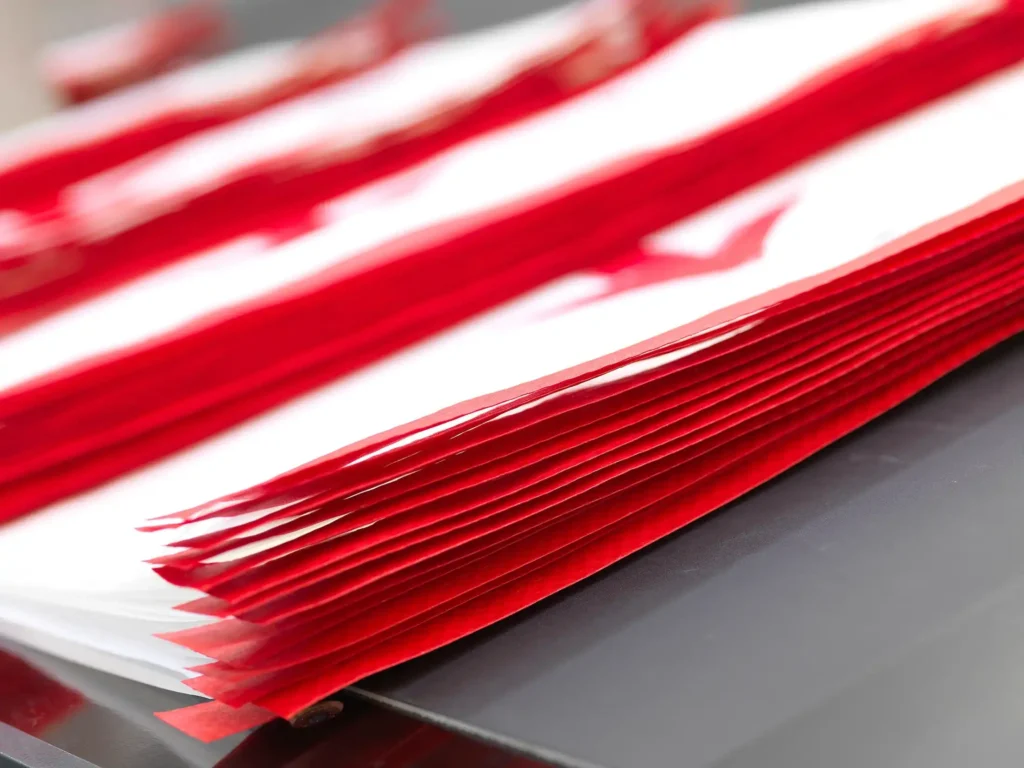
Pasted Valve Bags are heavy‑duty, multi‑ply paper sacks engineered for rapid, low‑dust filling of powders and granulates. The hallmark is a short internal sleeve—the valve—that is pasted into a stepped corner and mates with an automated spout. After filling, internal product pressure helps the valve self‑close, so no sewing is required. In many specifications, these sacks are also known by PVSE (Pasted Valve Stepped End), pasted‑valve sacks, multi‑wall paper valve bags, and block‑bottom valve paper sacks. The geometry is square at the base, making stacks sit like bricks—stable, dense, and tidy.
Key features of Pasted Valve Bags: fast deaeration through porous sack kraft or engineered micro‑perforations; block‑bottom stability for pallets; excellent printability with water‑based flexographic inks; configurable builds (2–6 plies at 70–100 g/m² each); optional thin free‑film barriers or PE liners for moisture control; multiple valve sleeve styles (B/T/R) including thermo‑sealable variants for high‑integrity closure.
How Pasted Valve Bags are manufactured: converters run a tightly choreographed sequence—printing → tubing → valve pasting → block‑bottom pasting → perforation & finishing → palletizing & conditioning. On the tuber, plies are glued into a tube with aligned seams; on the bottomer, a stepped end is formed and the valve sleeve is pasted precisely; square bottoms are folded and pasted under pressure; quality gates verify dimensions, burst/tear, and valve integrity.
Primary uses of Pasted Valve Bags include cement and dry mortar, gypsum and calcium carbonate, fertilizers and soil amendments, pigments and additives, salt and sugar, and—when built to relevant food‑contact rules—flour, starches, milk powder, animal feed, and pet nutrition. Why this broad reach? Because Pasted Valve Bags balance speed, cleanliness, strength, and shelf presentation in a way that open‑mouth formats or pillow sacks cannot.
From Questions to a System Spec: A Problem → Method → Result → Discussion Loop
A buyer rarely needs a bag; a buyer needs an outcome—high throughput, low losses, safe handling, and clean warehouses. Pasted Valve Bags touch every node of that outcome. Below, each section follows an engineering loop: problem, method, result, discussion (with data, cases, and comparisons).
Containment & Mechanical Strength
Problem. Filled sacks face drops, corner impacts, compression in stacks, and humidity swings that can degrade paper strength.
Method. Strength derives from ply count, grammage, fibres (virgin sack kraft vs. blends), TEA (tensile energy absorption), and seam integrity. Extensible grades increase TEA via controlled crepe and fibre orientation; corner patches and hot‑melt dots resist “corner‑pop.” Purchase orders should embed targets such as ISO 2758 burst ranges (kPa) and drop test orientations.
Result. With 2–4 plies of 70–100 g/m² sack kraft (outer white or brown), properly glued seams, and tuned TEA, Pasted Valve Bags routinely carry 20–50 kg loads for minerals, chemicals, and food powders while surviving warehouse handling.
Discussion. Data reinforcement. Standardized test methods exist: ISO 2758 for paper burst (70–1,400 kPa test window); grammage by TAPPI T 410; dimensional description by ISO 6591‑1; ordering checklists by ISO 8351‑1/‑2. These numbers give specifiers a common language and QA teams an auditable contract.
Case analysis. A mortar producer replaced a 3‑ply “flat” kraft build with a 2‑ply extensible kraft design (outer printable white, inner brown). Drop targets were held by increasing TEA, and deaeration improved, so the packer’s BPM rose while rejects fell.
Comparative study. Versus sewn open‑mouth paper, Pasted Valve Bags avoid needle holes and reduce leak points; versus woven PP valve sacks, mono‑paper builds usually run faster on impeller packers because the substrate itself breathes.
Machinability: Air Removal, Valve Closure, Bag Handling
Problem. Air trapped during filling inflates sacks and throttles throughput; marginal valve designs create sifting on route; slippery exteriors disturb pallet stability.
Method. Tune paper porosity (Gurley or air permeance targets), apply micro‑perfs near the valve panel for highly airy powders, select valve sleeve geometry (B/T/R) suited to the product’s flow, and specify thermo‑sealable patches for difficult powders. Add anti‑slip patterns to keep layers from skating.
Result. Faster filling with less dust, fewer sift claims, and more confident handling by robots and workers alike. Many users report packer windows between 17–100 bags/min depending on filler type, spouts, and product rheology, with Pasted Valve Bags supporting the top of that window when porosity is correct.
Discussion. Deaeration is not a buzzword; it is geometry and physics. High‑porosity extensible papers enable fast air escape through the wall itself; perfs are then a fine‑tuning tool, not a crutch. Thermo‑sealed sleeves add closure integrity for powders that love to migrate.
Moisture & Barrier Strategy
Problem. Hygroscopic products (cement, salt, sugary blends) absorb moisture; paper strength also drops at elevated RH.
Method. Map lane exposure. For dry, indoor chains, choose mono‑paper for maximal recyclability and speed. For humid yards, specify an 8–12 µm free‑film barrier between plies or a thin PE liner. Set handling rules (tarps, covered storage) and pallet wrap strategy.
Result. Fewer caking complaints, fewer corner‑pops after rain exposure, and predictable drop performance.
Discussion. Trade‑offs are transparent: mono‑paper maximizes fibre recovery; film layers add protection but complicate recycling unless peelable. The right answer depends on lane humidity, not on philosophy.
Printing, Brand, and Pallet Dynamics
Problem. A sack is a billboard in motion; rub, scuff, and poor contrast ruin legibility. Pallet slippage creates waste and risk.
Method. Use water‑based flexography (6–10 colors) on receptive sack kraft; confirm ink rub via in‑house drawdowns and tape tests; place barcodes on faces with lowest scuff probability; define COF targets and anti‑slip patterns that help interlock layers.
Result. Crisp logos that survive the journey; safer pallets that stack high without sway; easier scanning in depots.
Discussion. Pick matte or semi‑gloss finishes according to brand brief; define minimum contrast ratios for codes; accept that beautiful print means little if pallets tip.
Compliance & Documentation
Problem. Food and feed applications require documented safety; buyers need unambiguous dimensions, tests, and traceability.
Method. For food‑contact builds, align with 21 CFR §176.170 (U.S.) and Europe’s common practice via BfR Recommendation XXXVI (paper & board for food contact). Dimension notation follows ISO 6591‑1; ordering checklists derive from ISO 8351‑1. Require a COA for each lot: grammage (TAPPI T 410), burst (ISO 2758), dimensions, valve spec, porosity/perf pattern, and ink rub results.
Result. Auditable orders, smoother inbound QA, fewer disputes.
Discussion. Even when the packed product is non‑food, including the standard numbers on your PO clarifies expectations and accelerates vendor qualification.
Manufacturing Workflow of Pasted Valve Bags: A Close‑Up
1) Reel preparation & printing. Brown or white sack kraft—flat, semi‑extensible, or extensible—is moisture‑conditioned; surfaces are prepped and printed via water‑based flexo. Registration, density, and rub are checked inline.
2) Tubing. On the tuber, multiple plies are combined with controlled glue lay‑down. Longitudinal seams are pasted; gussets formed; tubes cut to length. Inline perforation patterns can be added based on product properties.
3) Valve pasting (PVSE). A stepped‑end is formed; the valve sleeve—paper or paper+film—is pasted with precise overlap, sometimes with thermo‑sealable interfaces. Fixtures restrain the sleeve to maintain geometry.
4) Bottom pasting (block bottom). Bottomers fold and paste a square base. Corner reinforcement patches and hot‑melt spots may be applied to resist burst at impact points.
5) Finishing & conditioning. Bundles are counted, palletized, and conditioned to stabilize moisture before shipment. QA checkpoints include ISO 6591‑1 dimensional verification, ISO 2758 burst checks, drop pilots, and valve‑leak dwell tests.
Adhesives that make “pasted” work. Starch/dextrin systems offer long open time and fibre‑friendly bonds; PVAc/EVA dispersions add wet‑tack and fast setting; hot‑melt dots reinforce stress points at corners and valve patches. Process windows are held on glue solids, viscosity, temperature, nip pressure, and bead continuity via sensors and vision.
Typical failure modes and fixes. Corner‑pop → increase patch size or hot‑melt reinforcement; valve lift/sift → move to thermo‑sealable sleeves and add tamping dwell on the filler; seam wicking → adjust glue rheology and reel conditioning.
Materials and Options: A Practical Menu
Paper families. Sack kraft comes in flat, semi‑extensible, and extensible variants. Extensible grades deliver higher TEA and calibrated porosity for fast filling. Brown surfaces hide scuff; white offers high‑contrast print.
Typical constructions. Pasted Valve Bags for 25 kg fills commonly use 2–3 plies of 70–100 g/m² papers. Abrasive minerals may require a third ply and a barrier; food grades often choose white outer plies and hygienic finishing.
Valve sleeves. Paper sleeves suit many powders; paper+film sleeves with thermo‑sealable patches improve closure integrity when powders tend to sift. Sleeve geometry (B/T/R) is aligned to flow and spout mechanics.
Perforation strategy. High‑porosity papers may eliminate perfs; highly airy products benefit from micro‑perfs localized near the valve panel to vent early headspace.
Barriers/liners. Thin HDPE free‑films (8–12 µm) laminated between plies or PE liners mitigate humidity at the expense of mono‑material recovery; peelable designs can help.
Printing & finishes. Water‑based flexo up to 6–10 colors; anti‑slip patterns tuned to target COF; optional scuff‑resistant inks for retail‑visible categories such as pet nutrition.
Data‑Weighted Arguments (with Mini Cases and Comparisons)
Breathability → Speed → Cleanliness
Data reinforcement. Porous sack papers support higher filling speed, smaller inflated volume, and cleaner packing environments. Pasted Valve Bags built with high‑porosity extensible papers can reduce or eliminate perf patterns while maintaining BPM and reducing dust.
Case analysis. A gypsum blender seeking throughput gains changed from a 3‑ply standard kraft build to a 2‑ply high‑porosity extensible spec. The result was an ~8% BPM increase on the same valved impeller filler, plus a measurable drop in housekeeping dust.
Comparative study. When evaluated against woven polypropylene valve sacks in cement service, paper valve sacks have been documented to achieve faster fills and lower dust under many conditions—particularly where deaeration through the wall is advantageous.
Valve Architecture → Leakage Risk → Returns
Data reinforcement. Thermo‑sealed paper+film sleeves typically reduce sift rates in transit; consistent sleeve geometry improves robotic handling.
Case analysis. A premix plant experiencing top‑valve sifting on rail implemented a heat‑sealable sleeve and a two‑second tamp at discharge. Sift claims fell to near zero without secondary taping.
Comparative study. Versus sewn‑valve concepts, Pasted Valve Bags remove the sewing station, eliminate needle holes, and present a firmer, more repeatable mouth geometry to the spout.
Geometry → Pallet Stability → Logistics Cost
Data reinforcement. Block‑bottom bricks interlock; correctly sized footprints relative to pallets allow even‑layer patterns that resist sway and minimize film consumption.
Case analysis. A fertilizer shipper resized bags to align with a 1,100 × 1,100 mm pallet deck. Film use dropped, brake‑test stability improved, and corner crush claims declined.
Comparative study. Pillow bags leave voids and wobble; Pasted Valve Bags sit flat, enabling higher stacks or lighter wrap while maintaining safety margins.
Typical Parameter Ranges for Pasted Valve Bags (Reference Build Specs)
The figures below mirror current listings and converter datasheets. Always validate against your product, packer, and lane conditions.
| Parameter | Typical Range / Options |
|---|---|
| Net fill mass | 20–50 kg; common 25 kg and 50 lb (22.7 kg) |
| Bag W × L × Bottom (ISO 6591‑1) | ~ (420–550) × (600–900) × (90–150) mm |
| Plies & grammage | 2–6 plies; 70–100 g/m² per ply (outer white or brown) |
| Valve sleeve | Paper or paper+film; B/T/R geometry; thermo‑sealable options |
| Perforation | None (high‑porosity papers) or engineered micro‑perfs |
| Printing | Water‑based flexo up to 6–10 colors |
| Barrier/liner | 8–12 µm HDPE free‑film or thin PE liner for high humidity |
| MOQ & pricing | Typical MOQs 5,000–20,000; indicative unit prices US$0.10–0.30+ FOB depending on build |
Cost Control Without False Economies
Material mass. Ply count and grammage dominate cost. Moving from 3‑ply standard to 2‑ply extensible often trims mass 20–25% while holding burst/drop targets.
Ink & plates. Color count and coverage drive plates and set‑up. Use tints and bold solids; minimize small reversed text in high‑abrasion zones.
Changeovers. Standardize footprints. Modern bottomers with recipe storage cut make‑ready time—protecting OEE.
Barrier decisions. Barriers protect—but cost and complicate fibre recovery. Use them because your exposure map demands them, not by habit.
Packing line sync. Faster deaeration shortens dwell and tamp cycles; higher BPM reduces labor and energy per ton. Paying a small premium for the “right” paper often pays back in weeks.
Compliance & Testing: Numbers That Belong on the PO
- ISO 6591‑1 — empty paper sacks: description & dimensional designation (ten‑figure notation)
- ISO 8351‑1/‑2 — ordering specification checklists for paper sacks
- ISO 2758 — paper bursting strength (70–1,400 kPa window)
- TAPPI T 410 — grammage (basis weight)
- Food contact (when applicable): 21 CFR §176.170 (U.S.); BfR Recommendation XXXVI (Europe common practice)
Suggested QA plan. Burst target (kPa), drop test (height + orientations), valve‑leak dwell, ink rub/tape, COF/slip angle, dimensional tolerances per ISO 6591‑1, porosity/perf specification.
Mini‑Scenarios: Problem → Solution → Result
Scenario A — 25 kg cement; coastal humidity.
Problem. Wet season weakens sacks; valve sifting triggers returns.
Solution. Three‑ply Pasted Valve Bags with ~10 µm free‑film barrier and thermo‑sealable sleeve; high‑porosity outer ply; localized micro‑perfs near the valve.
Result. Faster fills; fewer wet‑handling failures; complaint rate drops; mono‑material trade‑off accepted given lane conditions.
Scenario B — Flour mill; food documentation; throughput target.
Problem. Filler is the bottleneck; auditors demand migration statements.
Solution. Two‑ply extensible kraft with validated porosity (no perfs), declarations to 21 CFR §176.170/BfR XXXVI, and inline checkweighing with thermo‑sealed valve.
Result. BPM uplift; cleaner floors; documentation ready for retail audits.
Scenario C — Animal nutrition; retail visibility; rail vibration.
Problem. Scuff damages branding; valve sifts on long hauls.
Solution. Three‑ply Pasted Valve Bags with scuff‑resistant ink, reinforced heat‑sealable sleeve, and anti‑slip pattern tuned for target COF.
Result. Graphics survive backroom handling; sifting approaches zero.
Quality Matrix for Pasted Valve Bags (Quick Reference)
| Test | Method/Target | Purpose |
|---|---|---|
| Burst | ISO 2758; SKU targets (e.g., ≥ 350–600 kPa for 25 kg cement) | Global indicator of composite strength |
| Drop/impact | Define height & orientations; 5 drops per lab practice | Handling survivability |
| Valve leak | Pressurize headspace; dwell 10–30 s | Closure integrity vs. sifting |
| Ink rub / tape | ASTM/ISO rubs; visual AQL | Print durability |
| COF / Slip angle | COF ≥ 0.35 typical; ramp test | Pallet stability |
| Dimensions | ISO 6591‑1 notation; ± tolerances | Packer fit; pallet pattern |
| Humidity soak | 24–72 h @ 75–90% RH; re‑test | Wet‑chain robustness |
Historical Arc and Near‑Future Trajectory
From sewing to pasting. The migration from sewn open‑mouth to Pasted Valve Bags enabled cleaner filling and faster lines. Then came extensible sack kraft, letting converters drop plies and maintain strength.
Automation and analytics. Servo tubers and bottomers with recipe storage; rotary packers with multi‑spout carousels; inline checkweighing and vision QA; thermo‑sealed valves for hygiene. Expect more ultrasonic assists, smarter glue lay‑down, and digital print pilots for variable data.
Circularity and recyclability. Industry studies have documented high recyclability of paper sacks and performance benefits of including sack kraft fibres in recycled mixes. Mono‑paper where possible; peelable liners when not.
A Purchaser’s One‑Page Template (Copy Into Your PO)
- Style: PVSE Pasted Valve Bags, block bottom; multi‑wall paper valve sack
- Size (ISO 6591‑1 notation): W × L × Bottom = ___ × ___ × ___ mm; net mass ___ kg
- Plies: ___ plies @ ___ g/m² (outer: brown/white; grade: flat/semi‑extensible/extensible)
- Valve: type ___ (B/T/R); sleeve: paper / paper+film; thermo‑sealable: Y/N
- Perfs & porosity: pattern ___ / none; target Gurley/air‑permeance ___
- Barrier/liner: none / HDPE free‑film ___ µm / PE liner ___ µm
- Printing: water‑based flexo ___ colors; rub target ___
- Tests: ISO 2758 burst ≥ ___ kPa; drop ___ m (orientation ___); valve leak dwell ___ s; COF ___
- Food‑contact (if applicable): 21 CFR §176.170 / BfR XXXVI declaration; ink/adhesive statements
- Sustainability & EOL: mono‑paper preferred / peelable liner; recyclability guidance on pallet tag
Horizontal and Vertical Thinking (Cross‑Domain Meets Layer‑by‑Layer)
Horizontal. Materials science (porosity & TEA) × process engineering (spout dynamics, valve architecture, perf density) × logistics (pallet geometry, COF) × regulatory (food‑contact statements) × sustainability (recyclability and fibre recovery). Blend these lenses and blind spots vanish.
Vertical. Fibre selection → paper grade → glue chemistry → sleeve geometry → packer tuning → palletization → end‑of‑life. A choice upstream echoes downstream; a tweak at the valve affects complaints, dust, and speed months later.
Where to Learn More and Source Responsibly
If you want a single, practical entry point, start here: Pasted Valve Bags. Use the template above to open a specification dialogue with suppliers, then validate on your own product and filling equipment. The right spec pays for itself—in throughput, in cleanliness, and in fewer claims.

My Filling Line Keeps Stopping—What’s Wrong with Pasted Valve Bags?
Production stalls rarely come from a single culprit. With Pasted Valve Bags, stoppages usually originate in three interacting zones: air management at the spout, sleeve geometry at the valve, and pallet‑side handling. Introduce a porous sack kraft (or targeted micro‑perforations), specify a valve sleeve that matches powder rheology (B/T/R types), and verify block‑bottom squareness for robotic pick‑and‑place. Problem → method → result → discussion: if deaeration is slow, the bag inflates, the scale hunts, and BPM collapses; when porosity, spout pressure, and sleeve dwell are tuned as a system, Pasted Valve Bags run fast, weigh tight, and stack neatly.
How Critical Is the Valve Sleeve to Pasted Valve Bags Performance?
Very. The sleeve is the handshake between bag and machine. A paper sleeve offers simplicity and cost efficiency; a paper‑plus‑film sleeve with a thermo‑sealable layer improves sifting resistance on long routes. Horizontally, think materials science (friction, stiffness) × automation (spout OD, clamping force) × occupational hygiene (dust exposure). Vertically, trace cause and effect: sleeve cross‑section → turbulence at entry → entrained air volume → closure integrity during discharge. In practice, the correct sleeve turns a chaotic fill into a controlled pulse.
Do Pasted Valve Bags Lines Need Dedicated Change Parts?
Yes, in the sense of recipes and fixtures. Auger, air, and impeller fillers use different spout lengths and clamps; bottomers rely on specific folding plates and glue patterns. Treat these as “dedicated change parts.” The payoff is repeatability: a bag built to one recipe—ply stack, glue lay‑down, valve overlap—behaves predictably at speed. Without that discipline, the same Pasted Valve Bags spec can act like three different products on three different shifts.
Extending the Working Life of Pasted Valve Bags in Tough Logistics
Bags don’t wear out on the shelf; they fail in the field. Reduce corner pops with reinforcement dots, raise TEA (tensile energy absorption) by choosing extensible sack kraft, and set minimum COF (coefficient of friction) so layers don’t skate under brake loads. Add anti‑slip patterns where wrap usage must be minimized. The result isn’t mystical: fewer burst claims, cleaner trucks, quieter customer hotlines.
Understanding the Production Process Behind Pasted Valve Bags
Converters follow a disciplined flow: printing (water‑based flexo) → tubing (ply alignment and longitudinal pasting) → valve pasting (PVSE stepped end) → block‑bottom pasting → finishing and conditioning. Each node answers a “why.” Printing: legibility and brand. Tubing: dimensional stability. Valve: a consistent mouth that mates with the spout. Bottom: a brick that stacks. Finishing: moisture equilibrium so bags don’t curl or wrinkle on arrival. This chain is only as strong as its weakest adhesive bead—hence inline vision and periodic peel checks.
Advantages of Pasted Valve Bags for Cement and Other Powdered Minerals
Cement, gypsum, calcium carbonate: abrasive, airy, unforgiving. Pasted Valve Bags bring speed (porous papers vent air) and order (block bottoms resist tipping). Against open‑mouth formats, sewing vanishes and needle holes disappear; against pillow sacks, cube utilization rises. A question worth asking—speed or strength?—is answered here with “both,” because the paper wall helps the spout breathe while multi‑ply stacks handle drops.
Applications Where Pasted Valve Bags Outperform Alternatives
When the product is powdered, the route is mixed (indoor plant, outdoor yard, back to store), and visibility matters, Pasted Valve Bags shine. Typical domains include construction materials, fertilizers, pigments and additives, salt and sugar, flours and starches, animal feed, and pet nutrition (with appropriate food‑contact declarations). The recurring theme: fast fill, low dust, square stacks, readable print. See live configurations here: Pasted Valve Bags.
Exploring Paper Grades for Pasted Valve Bags
Not all sack kraft is equal. Flat, semi‑extensible, and extensible grades trade stiffness for TEA and porosity. Extensible papers, engineered through controlled crepe and fibre orientation, often allow a two‑ply build to replace a three‑ply standard while keeping drop targets. The horizontal view compares paper physics (Gurley, TEA) with packer behavior (fill time, mass spread); the vertical view walks from fibre choice → ply count → glue rheology → filled‑bag stability.
Benefits of Extensible Sack Kraft in Pasted Valve Bags
Short answer: speed without surrendering strength. Extensible papers absorb energy during impact, reducing corner failures, while their air‑permeance aids deaeration. A plant moving from flat to extensible grades often sees a double dividend—lower paper mass and higher BPM. That is not marketing; it’s a consequence of how the wall “breathes” during fill and how the fibres dissipate energy during drop.
Material Properties That Matter in Pasted Valve Bags Engineering
Three clusters rule performance. (1) Paper physics: TEA, tensile, tear, and air‑permeance. (2) Adhesion system: starch/dextrin for long open time, EVA/PVAc for wet tack, hot‑melt dots for corners. (3) Surface and friction: COF targets and anti‑slip patterns for pallet stability. Ask yourself: what breaks more often in your complaints log—seams, corners, or valves? Choose the property cluster that neutralizes that failure mode first.
Addressing Moisture Resistance Issues in Pasted Valve Bags
Humidity is both a product risk and a substrate risk. Map exposure windows. If sacks will sit in covered warehouses, mono‑paper is ideal for speed and fibre recovery. If they’ll live in rainy yards, specify an 8–12 µm free‑film between plies or a thin PE liner—acknowledging the end‑of‑life trade‑off. Pair that with handling rules (tarps, covered trailers) and you convert weather from a random variable into a managed parameter.
Dealing with Abrasive or High‑Bulk‑Density Products Using Pasted Valve Bags
High‑bulk density powders punish corners; abrasive fillers can scuff print and cut fibres. Solutions stack: add corner patches; consider a third ply or a tougher inner grade; switch to scuff‑resistant inks; increase bottom overlap and hot‑melt reinforcement. The aim is not to overbuild indiscriminately but to match failure energy with absorptive capacity—economy through precision.
References
ISO 6591‑1 — Empty paper sacks: Description and dimensional designation.
ISO 8351‑1/‑2 — Paper sacks: Ordering specifications and performance.
ISO 2758 — Paper: Determination of bursting strength.
TAPPI T 410 — Grammage of paper and paperboard.
PSSMA (Paper Shipping Sack Manufacturers’ Association) technical notes on valve sack handling and pallet patterns.
CEPI Eurokraft & EUROSAC publications on sack kraft properties, recyclability, and design‑for‑recovery guidance.