
What Are Paper Valve Woven Bags? Definition, Purpose, and Practical Aliases
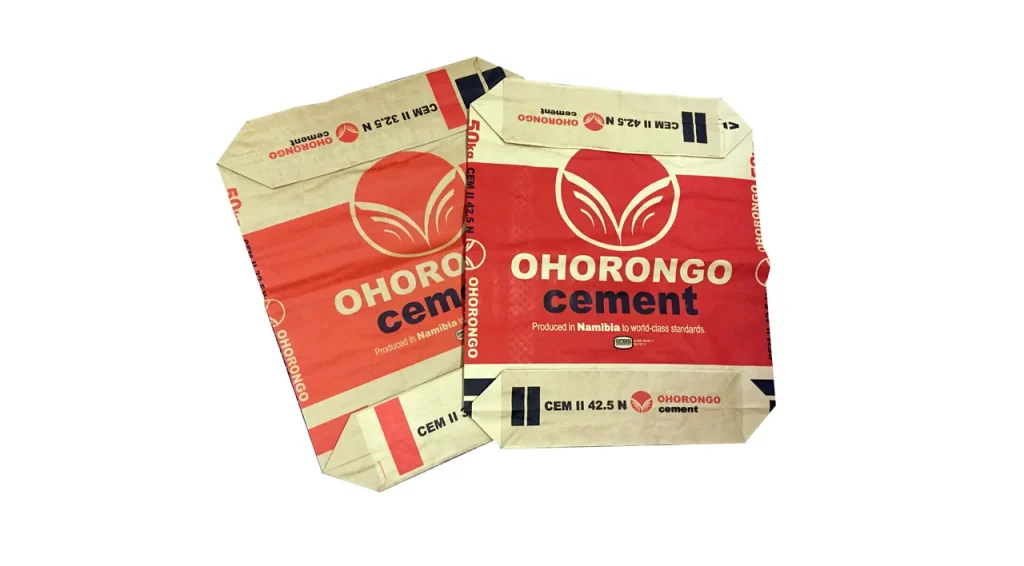
Paper Valve Woven Bags are hybrid industrial sacks that couple a woven polypropylene (PP) fabric substrate with one or more plies of kraft paper and a purpose‑designed valve mouth that closes under product pressure after filling. This configuration consolidates what operations teams often chase through separate packaging choices: the rugged mechanics of woven tapes, the premium look and legibility of paper, and the throughput of a self‑closing valve. In distribution terms, the format simplifies dust management, accelerates line speeds, and enhances pallet stability—without surrendering shelf presence or barcode readability.
- Paper Valve Woven Bags
- Kraft Paper Woven Valve Bags
- Paper–Poly Valve Sacks
- PP Woven Valve Paper Sacks
- Laminated Paper Valve Woven Bags
- Block‑Bottom Paper Valve Woven Sacks (rectangular base choice)
- Pinch‑Bottom Paper–Poly Valve Sacks (selected conversions)
The anchor keyword for this article is Paper Valve Woven Bags; we employ the synonyms because buyers and plant engineers use them interchangeably when searching and specifying. The construction remains the same: a woven PP backbone, a paper presentation face, and a valve optimized for speed and dust control.
The Materials of Paper Valve Woven Bags: From Polymer Physics to Paper Touch
Every property you experience—drop robustness, barcode clarity, valve tightness—begins with materials. Not in isolation, but in careful combination. The target is not an exotic maximum of any single attribute; it is the stability of performance under real operating conditions: impeller or screw fillers, dusty or oily powders, long routes or short hops, sun‑baked yards or climate‑controlled DCs.
1) Woven PP Core
- Substrate: oriented PP tapes woven on circular or flat looms. Typical basis weights: 55–120 gsm depending on payload, drop spec, and abrasion profile.
- Function: primary tensile & tear resistance; puncture toughness; dimensional stability across humidity swings.
- Economics: PP fabric is typically the dominant material cost; tuning tape denier, draw ratio, and loom density maximizes strength‑to‑weight payoff.
2) Kraft Paper Face
- Material: brown or white kraft, often 70–120 gsm per ply; single‑ or multi‑ply depending on design intent and print ambitions.
- Function: smooth printable surface, high barcode contrast, premium tactile feel, and scuff masking for rough routes.
- Trade‑off: modest cost addition versus all‑PP sacks, offset by clearer labeling and stronger brand impact at retail or contractor yard.
3) Adhesion Layers and Optional Films
- Coupling: extrusion‑coated polyolefin tie layers or hot‑melt systems secure paper to fabric while preserving mono‑family recyclability where feasible.
- Optional films: BOPP (for photo‑grade graphics, gloss/matte effects), PE (for slip control or moisture tuning), micro‑perforations (for de‑aeration).
- Design note: more film improves barrier and print but may change stiffness and sealing behaviors—validate on the actual filler and route.
4) Valve Sleeve and Closures
- Materials: PP, PE‑coated paper, or PE films; sleeve friction and stiffness tuned to filler type (impeller, screw, air) and product bulk density.
- Interfaces: easy insertion on the spout; self‑sealing under product pressure; optional heat tack or patch to control fine dust.
- Options: fold geometry, overlap width, and anti‑sift features; easy‑open notches for safe end‑user access.
- PP fabric 85 gsm (natural) + White kraft 90 gsm + PE tie 22 μm
- Valve sleeve: PE‑coated paper 80 gsm, 120 mm width, 2‑ply overlap with heat tack
- Anti‑slip stripes: patterned coat on paper face; friction coefficient tuned to stretch‑wrap strategy
- Inks and coatings: low‑migration systems (where applicable); matte/gloss zones for visual hierarchy
What Are the Features of Paper Valve Woven Bags? Behaviors That Matter
Features are not marketing decorations; they are observed behaviors—on the filler, on the pallet, on the shelf. The hybrid stack in Paper Valve Woven Bags generates a profile that procurement teams can bank on.
Fast, Clean Filling
Valve geometry supports high OEE; internal pressure collapses the sleeve to self‑seal. Tuned stiffness diminishes spillage and suppresses dust plumes.
Mechanical Insurance
Woven PP delivers tear propagation resistance and drop robustness; paper contributes scuff masking and a calm surface for labels, barcodes, and QR.
Brand Legibility
Paper creates high‑contrast zones; BOPP‑lam options yield photo‑grade graphics and abrasion resistance for retail‑adjacent segments.
- Higher barcode contrast → faster scans → fewer mis‑picks and reworks.
- Anti‑slip finishes and block‑bottom geometry → stable pallets at greater stack heights.
- Color‑coded art and valve labels → visual SKU separation at distance and speed.
What Is the Production Process of Paper Valve Woven Bags? End‑to‑End, Gate‑by‑Gate
Manufacturing excellence is systematic: define inputs, stabilize conversions, verify outputs. We model production as three control gates—front‑end selection & tests, mid‑stream conversion & formation, and back‑end QA & release.
Gate A — Front‑End: Raw Materials Selection and Incoming Inspection
- PP resin: melt flow index (MFI), moisture, ash; drying to spec prevents gels and die lines in tapes.
- Paper: basis weight accuracy, moisture content, Cobb values; porosity checks when de‑aeration strategy uses paper micro‑perf.
- Films and ties: thickness uniformity, dyne level; haze/gloss for brand targets; bond agents validated for temperature and pressure windows.
- Inks/adhesives: compliance for food or chemical scenarios; heat resistance to survive post‑fill handling.
- Valve components: sleeve stiffness window matched to filler type and dust behavior; edge sealing behavior checked on lab rigs.
Gate B — Mid‑Stream: Fabrication, Lamination, Printing, and Conversion
- Tape extrusion & orientation: cast → slit → draw 5–7×; monitor fibrillation and break ratio; anneal to fix memory and reduce split‑film risk.
- Weaving: circular or flat looms; ends × picks per cm² define strength and porosity; maintain edge stability for later pasting.
- Surface engineering: extrusion coating or lamination coupling paper and fabric; validate coating weight, peel strength, and surface dyne for print anchorage.
- Printing: CI flexo on paper or reverse‑gravure under BOPP; manage ΔE, dot gain, and trap; barcode/QR grades tested on production substrate, not proof stock.
- Valve formation: sleeve width, fold geometry, overlap; optional heat patches to reduce dust leakage at the mouth; verify self‑seal behavior under realistic fill pressures.
- Bottom conversion: block‑bottom (square base) or pinch‑bottom; glue pattern, platen temperature, and nip pressure tuned to paper and film stack.
- Cutting & edge control: hot knife or ultrasonic; programmable length ±3–5 mm; gusset formation for pallet cube efficiency and automated magazine feeding.
Gate C — Back‑End: Quality Assurance and Release
- Mechanical: tensile MD/CD, seam/valve pull, bursting, drop matrix by fill mass and height.
- Functional: de‑aeration rate on powders, dust‑leak snapshot, moisture‑vapor transmission where relevant.
- Visual & dimensional: width/length/gusset tolerance, registration, ΔE, surface scuff test.
- Sampling & traceability: AQL by defect class; lot coding links resin → fabric roll → conversion batch → QC sign‑off.
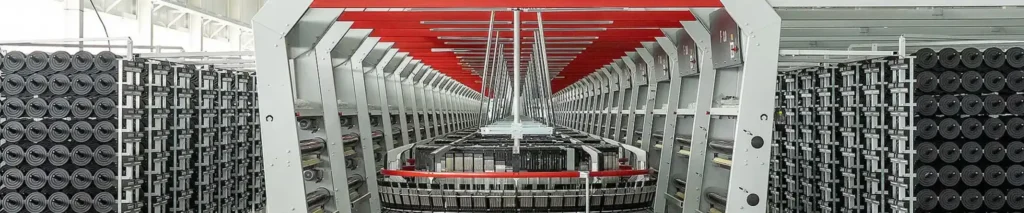
Across extrusion, weaving, coating/lamination, printing, and conversion, VidePak deploys Austrian Starlinger and German W&H (Windmöller & Hölscher) platforms. In paper–poly composites, precise registration, narrow bond weight windows, and repeatable valve geometry are non‑negotiable; these lines deliver tight tolerances, high uptime, and defect rates that withstand third‑party audits.
What Is the Application of Paper Valve Woven Bags? Industry‑By‑Industry Fit
Use cases emerge where powders and granules demand fast filling, dust control, print legibility, and pallet stability. If the product punishes weak seams, if the warehouse punishes dim barcodes, if the route punishes soft stacks—this is where Paper Valve Woven Bags excel.
Construction & Minerals
Cement, mortar, tile adhesives, gypsum, limestone powders: high drop robustness and controlled de‑aeration; dust plumes curbed with valve patches and micro‑perfs.
- Block‑bottom geometry for stable cubic faces
- Anti‑slip stripes enhance layer friction
- High‑contrast barcodes for fast DC scans
Agri‑Inputs & Chemicals
Fertilizers, soil amendments, pigments, carbonates, flame retardants: moisture tuning and low dust escape paired with legible hazard/precaution panels.
- UV packages for yard storage
- Optional liners for hygroscopic grades
- Clear GHS panels on paper face
Food & Pet Nutrition (Selected)
Starches, spices, and pet kibble (with applicable compliance): paper face provides premium feel; valve speed sustains high line OEE.
- Low‑migration inks/adhesives where necessary
- Photo‑grade prints under BOPP for retail visibility
- QR/GS1 zones for traceability
Specialty Powders
Hydrated lime, fine silica, titanium dioxide: engineer sleeve and micro‑perf map to choke dust; reinforce valve area for repeated handling cycles.
- Edge tacking prevents valve lift
- Denser paper face in abrasion zones
- Lot coding with abrasion‑resistant overprint
How VidePak Controls and Guarantees the Quality
- Standards‑aligned manufacturing & testing: specifications and QA methods aligned with ISO/ASTM/EN/JIS for tensile/tear, drop/burst, MVTR, ink adhesion, and barcode grades; documentation is audit‑ready.
- 100% virgin raw materials: stable MFI and resin cleanliness reduce gels and color drift; sourcing from large vendors assures lot consistency and repeatable results.
- Starlinger and W&H platforms: tight basis‑weight control, consistent registration, and reliable lamination bonds; uptime that keeps takt predictable and reduces scrap.
- Closed‑loop inspection: incoming COAs → in‑process coating weight/ΔE/seam checks → final AQL sampling, drop/burst tests, de‑aeration snapshots before release.
System Thinking: From Sub‑Problems to a Coherent Specification
Strength versus cost; dust control versus speed; legibility versus abrasion—must we choose? Not if we decompose, optimize, and recombine. The aim is not the “best bag” in the abstract but the most suitable configuration for this product, this line, this route, and this shelf. Ask: What is the dominant risk—drop rupture, valve dust, mis‑scans, or pallet creep? Then allocate design margin where it counts.
Sub‑problems and principal levers
- Mechanical containment: fabric gsm; glue/stitch pattern; base style (block vs. pinch); corner crush tolerance.
- Dust & de‑aeration: sleeve geometry; micro‑perf density; valve overlap; air‑release paths away from barcode zones.
- Brand & compliance: paper smoothness; ΔE targets; barcode grade; hazard panels and multilingual text fields.
- Throughput: sleeve friction; stiffness window; bag mouth tolerances; magazine feed behavior under vibration.
- Sustainability: resin mass per unit function; paper selection; mono‑family recyclability; return rates from breakage.
- Economics: unit price versus total delivered cost (losses, rework, downtime, claims).
Integrated solution pattern
- Define powder physics: bulk density, particle size, oil/fat content, hygroscopicity.
- Choose sleeve and valve type per filler (impeller/screw/air) and dust behavior; add patches or heat‑tack where warranted.
- Fix fabric gsm and paper ply for drop spec; select block‑ or pinch‑bottom based on pallet stability requirements.
- Select coating/film for print & moisture; map micro‑perfs to encourage clean air release away from critical art.
- Lock color system and ΔE tolerance; position barcode/QR with quiet zones and abrasion‑protected areas.
- Trial on the real line; measure OEE, dust index, scan rate, and pallet stability; adjust and freeze spec.
Engineering Tables: Materials Stack, Valve Types, Filling Compatibility
Printing, Color Systems, and Information Survivability
Paper faces confer an advantage—smoother ink laydown, calmer backgrounds for data, and improved microtext legibility. But an advantage squandered is no advantage at all. A defined color and code workflow keeps lot‑to‑lot outcomes tight and readable.
Color Management
- Pantone anchors with documented CMYK builds; ΔE ≤ 2–3 versus master swatch.
- Approve proofs on the actual production paper, not substitute lab stock—avoid metamerism surprises under warehouse lighting.
Barcode & QR Readiness
- ANSI/ISO grade ≥ B; contrast ≥ 1.5; quiet zones respected on all sides.
- Place codes away from high‑wear corners and valve folds; use matte windows where glare is a risk.
Scuff & Weather
- Optional BOPP overlam or protective varnish in abrasion zones; verify adhesion across fold lines.
- UV stabilizer packages for yard exposure where stacks may sit for weeks.
When your routes scuff, your shelf must sell, and humidity complicates legibility. BOPP elevates print fidelity and wipe‑clean durability while the paper layer maintains tactile appeal. Validate glue/film interactions at the bottom folds before freezing the spec.
Palletization and Warehouse Engineering
Pallets fail not in design meetings but on busy docks. Stable stacks depend on base geometry, surface friction, and wrap strategy—plus honest tests that mimic vibration and corner abuse along the route.
Failure Modes and RCCA: Prevent, Detect, Correct
Comparative Frames: What It Is Not—and Why That Matters
Versus All‑Paper Valve Bags
All‑paper wins on simplified recycling and low‑glare print. Paper Valve Woven Bags trade a small complexity increase for higher tear and drop resistance—an exchange many building‑materials brands gladly make.
Versus Pure PP Valve Sacks
Pure PP excels in moisture resistance and toughness but can struggle with barcode contrast and premium shelf feel. The paper face fixes those issues without abandoning mechanical strength.
Versus PE FFS Tubular
FFS shines with ultra‑high speed and hermetic seals; Paper Valve Woven Bags dominate where retrofitting existing valve packers beats the capital expense of new FFS lines.
Valve Mechanics and Powder Physics: Why the Mouth Matters
Powders trap air. Granules leak air. Some bridge and arch; others flood like water. The valve is a fluid‑mechanics device hiding in plain sight. Shape, stiffness, friction, and overlap determine how quickly a product enters, how cleanly air exits, and how tightly the mouth seals when the column settles. Too tight, and filled bags “bounce” with trapped air; too loose, and dust escapes where operators breathe. A balanced valve spec makes the line calmer and the aisle cleaner.
- Higher bulk density → stiffer sleeve and tighter overlap to prevent blow‑back.
- Finer powders → more micro‑perf and strategic air‑release paths away from data zones.
- Oil‑bearing powders → sleeve materials with predictable friction under light contamination.
Standards and Regulatory Mapping
Specifications are more persuasive when they converse with standards. Across geographies, packaging programs for Paper Valve Woven Bags typically anchor methods and vocabulary in widely recognized frameworks.
- ISO: quality systems (e.g., 9001) and packaging test harmonization; labeling and traceability language for cross‑border moves.
- ASTM: tensile/tear/burst/abrasion method families; conditioning protocols; ink adhesion checks.
- EN: European packaging performance methods; recycling and safety marks for retail channels.
- JIS: Japanese norms for textiles and plastics; dimensional tolerances and strength benchmarks for industrial sacks.
- GHS: hazard communication on chemical bags; pictograms and signal words sized for readability in aisle lighting.
Lifecycle and Sustainability: Material Efficiency, Damage Avoidance
Sustainability is not only what a bag is made of; it is what a bag prevents. A sack that rarely splits and reliably scans saves product, time, and truck miles. Paper Valve Woven Bags advance sustainability on two fronts: material efficiency (high strength per gram via woven PP) and loss prevention (reduced breakage, clearer data, fewer returns). Where policy or EPR frameworks apply, mono‑family design choices and unambiguous labeling help downstream sorting.
Material efficiency levers
- Right‑size fabric gsm to meet drop spec with margin, not excess.
- Use paper where it creates value (graphics/data), not as undisciplined mass.
- Prefer compatible polyolefin ties/films to keep families simple for recyclers.
Damage avoidance levers
- Engineer valve for dust control; preserve operator health and cleanliness.
- Protect codes; reduce mis‑picks and rework miles.
- Stabilize pallets; prevent corner crush and toppling incidents.
Costing and Total Cost of Ownership
Unit price is visible; total cost is decisive. A sack that reduces breakage by a few tenths of a percent and raises scan rate by a few points often repays its price premium many times over. Evaluate system cost: scrap, rework, downtime, claims, route damage, returns, and shelf confusion.
Digital Traceability and Warehouse Integration
Packaging talks to software. Paper Valve Woven Bags become easier to count, pick, and trace when data survives the route and remains scannable at speed. Pair graphics discipline with WMS expectations: lot codes within quiet zones, QR for rich data, linear codes for legacy scanners, and abrasion‑aware placement to keep them readable under forklift life.
If your program expands from valve sacks to broader kraft/PP hybrids, see kraft‑paper woven bag manufacturing expertise for upstream options that share materials logic and print workflows.
Risk Register: From Hypothesis to Control Plan
Case Narratives: Three Illustrations
- Cement, 40 kg: all‑paper valve bags tore at docks. Switching to Paper Valve Woven Bags with block‑bottom, micro‑perf matrix, and external sleeve cut drop failures by 70% and increased OEE by 8% on impeller fill.
- Hydrated Lime, 25 kg: high dust environment; valve patch + heat‑tack + friction window raised. Operator exposure declined, housekeeping hours halved.
- Premium Pet Kibble, 10–15 kg: BOPP‑lam paper–poly; eight‑color gravure with matte/gloss mix; anti‑slip bands. Shelf presence lifted; pallets stabilized; barcode grades remained intact after route abrasion.
KPI Dashboard: Measure What Matters
- Bag failure rate (ppm) across filling and transit
- Drop test survivals at defined heights and masses
- Dust index near filler (mg/m³ baseline), pre‑ and post‑mitigation
- Scan success rate and average barcode grade per lot
- Pallet stability incidents per 1,000 shipments
- CO₂e per shipped tonne (material intensity + losses avoided)
Procurement Checklist for Paper Valve Woven Bags
- Product physics: bulk density, particle size, oil content, hygroscopicity
- Filler: impeller/screw/air; spout geometry; target throughput
- Valve: sleeve material & stiffness; patch need; seal logic and overlap width
- Stack plan: base style, anti‑slip, pallet pattern, wrap tension, cornerboards
- Print: color references, ΔE target, barcode grade, abrasion‑risk zones
- QA: drop matrix, de‑aeration map, dust index, AQL plan, traceability
FAQ for Engineers and Buyers
- Do we always need micro‑perforation? No. Use it for fine powders that trap air; coarse granules may vent through natural interstices.
- Heat seal or stitch? Paper–poly valve sacks typically rely on pasted/pinched bottoms and self‑sealing valves; stitching is more common on pure PP sacks.
- Can the sleeve remain within a recyclability family? Yes—polyolefin sleeves help keep the structure in a mono‑family stream; verify local programs.
- What about moisture? Paper improves aesthetics; films or coatings set barrier. Match barrier to climate and product sensitivity rather than template choices.
October 30, 2025
- What Are Paper Valve Woven Bags? Definition, Purpose, and Practical Aliases
- The Materials of Paper Valve Woven Bags: From Polymer Physics to Paper Touch
- What Are the Features of Paper Valve Woven Bags? Behaviors That Matter
- What Is the Production Process of Paper Valve Woven Bags? End‑to‑End, Gate‑by‑Gate
- What Is the Application of Paper Valve Woven Bags? Industry‑By‑Industry Fit
- How VidePak Controls and Guarantees the Quality
- System Thinking: From Sub‑Problems to a Coherent Specification
- Engineering Tables: Materials Stack, Valve Types, Filling Compatibility
- Printing, Color Systems, and Information Survivability
- Palletization and Warehouse Engineering
- Failure Modes and RCCA: Prevent, Detect, Correct
- Comparative Frames: What It Is Not—and Why That Matters
- Valve Mechanics and Powder Physics: Why the Mouth Matters
- Standards and Regulatory Mapping
- Lifecycle and Sustainability: Material Efficiency, Damage Avoidance
- Costing and Total Cost of Ownership
- Digital Traceability and Warehouse Integration
- Risk Register: From Hypothesis to Control Plan
- Case Narratives: Three Illustrations
- KPI Dashboard: Measure What Matters
- Procurement Checklist for Paper Valve Woven Bags
- FAQ for Engineers and Buyers
- 1. Material Integrity Starts at the Molecular Level: Rigorous PP/PE Testing
- 2. Valve Design: Precision Meets Automation
- 3. Customization: Beyond Logos to Functional Branding
- 4. Manufacturing Scale Meets Precision: The VidePak Edge
- 5. FAQs: Addressing Buyer Concerns
- 6. Global Compliance, Local Adaptability
- 7. Future Trends: Smart Valves and Circular Economy
- References
“How can we balance warehouse efficiency with product visibility in bulk packaging?” asked a logistics manager at a recent industry conference. “Our current bags tear during stacking, and generic designs make SKU identification a nightmare.” These frustrations are common in industries from agriculture to construction. The answer lies in Paper Valve Woven Bags—a hybrid solution combining PP durability, paper valve precision, and customizable branding to streamline operations. At VidePak, we’ve engineered these bags to solve three core challenges: material integrity, warehouse optimization, and brand differentiation.
1. Material Integrity Starts at the Molecular Level: Rigorous PP/PE Testing
Paper Valve Woven Bags rely on two critical components:
- Outer Layer: PP woven fabric for tear resistance.
- Inner PE Film: Moisture barrier and valve functionality.
VidePak subjects raw materials to 8-stage quality checks:
Polypropylene (PP) Testing
| Test Category | Parameters | Industry Standards |
|---|---|---|
| Physical Properties | Melt Flow Index (MFI): 3–5 g/10min | ASTM D1238 |
| Density: 0.905–0.925 g/cm³ | ISO 1183 | |
| Mechanical Strength | Tensile Strength: ≥35 MPa (MD/CD) | ASTM D5035 |
| Elongation at Break: 25–40% | ASTM D638 | |
| Thermal Stability | Heat Deflection Temp: 110–125°C | ISO 75 |
| Visual Inspection | No black spots >0.5mm; ≤3 defects/m² | AATCC 179 |
Case Study: In 2022, a Brazilian fertilizer company reported 12% bag failures due to substandard PP. After switching to VidePak’s ISO-certified granules, failure rates dropped to 0.8%—saving $220K annually in replacement costs.
Polyethylene (PE) Film Additions
For inner liners, we conduct:
- Dart Impact Test: ≥400g/mil (ASTM D1709)
- Pinhole Detection: <1 defect/10m² (ASTM F392)
Example: Our PE films for Australian grain exporters withstand -25°C warehouse temps without brittleness—critical for cold chain logistics.
2. Valve Design: Precision Meets Automation
The paper valve isn’t just a filling port—it’s a warehouse game-changer:
- Anti-Spill Design: 95% dust containment vs. 78% in traditional open-mouth bags (Intertek, 2023).
- Stacking Stability: Interlocking valves enable 25% taller pallets without slippage.
Technical Specs:
| Valve Type | Flow Rate | Compatible Products |
|---|---|---|
| Circular Paper Valve | 50–80 kg/min | Powders (cement, flour) |
| Flat Lock Valve | 30–50 kg/min | Granules (fertilizer, animal feed) |
Client Example: A German cement producer reduced loading time by 40% using our 70mm valves with RFID tags for automated inventory tracking.
3. Customization: Beyond Logos to Functional Branding
VidePak’s 30+ printing machines enable:
- Barcode Integration: QR codes with batch numbers, expiry dates.
- Color Coding: Pantone-matched stripes for instant SKU identification.
Data Point: A 2023 McKinsey study found that customized industrial packaging improves warehouse picking accuracy by 34%.
Table: Customization Options
| Feature | Options | Warehouse Impact |
|---|---|---|
| Valve Position | Top, side, corner | Compatibility with filling lines |
| Print Area | Full-body, panel, or stripe | Visual ID from 20m distance |
| Add-Ons | UV coating, anti-static treatment | Extended outdoor storage |
Case Study: A U.S. pet food brand uses color-coded valve stripes (Pantone 3425 C for dog food, 7416 C for cat food), reducing mis-shipments by 27%.
4. Manufacturing Scale Meets Precision: The VidePak Edge
With 100+ Starlinger circular looms and ISO 9001-certified workflows, we deliver:
- Speed: 15,000 bags/hour across 3 shifts.
- Consistency: ≤0.3% thickness variation in PP tapes.
Production Workflow:
- Extrusion: PP granules → 80–120µm tapes.
- Weaving: 14×14 weave/cm² for 50kg+ loads.
- Lamination: PE film bonded at 250°C with <2% shrinkage.
Sustainability: Our bags use 30% recycled PP (GRS-certified) without sacrificing tensile strength—validated by SGS testing.
5. FAQs: Addressing Buyer Concerns
Q1: How do paper valves compare to plastic valves?
A: Paper valves decompose in 6–12 months vs. 100+ years for plastic—ideal for EU Green Deal compliance.
Q2: Can bags withstand tropical humidity?
A: Our PE liners have 0.02g/m²/24hr WVTR—equivalent to military-grade moisture barriers.
Q3: What’s the lead time for custom designs?
A: 10 days for prototypes; 3–4 weeks for full production.
6. Global Compliance, Local Adaptability
VidePak serves 60+ countries with region-specific solutions:
- EU: REACH-compliant inks; EN 13432 compostable options.
- Middle East: Anti-UV prints withstand 50°C+ temps.
- North America: FDA-compliant PE for food contact.
Client Testimonial: “VidePak’s valve bags cut our warehouse labor costs by 18% through faster stacking and scanning.” — AgriPlus Canada.
7. Future Trends: Smart Valves and Circular Economy
Emerging innovations include:
- IoT-Enabled Valves: Sensors monitor fill levels in real time.
- Chemical Recycling: Breaking down PP/PE blends into virgin-grade pellets.
For insights into sustainable valve designs, explore our guide on paper valve woven bags paving the way for sustainable packaging.
References
- Intertek, Bulk Packaging Performance Benchmark Report (2023)
- McKinsey & Company, Warehouse Automation Trends (2023)
- ASTM International, Standard Test Methods for Polyolefins
Company Contact:
Website: https://www.pp-wovenbags.com/
Email: info@pp-wovenbags.com
From raw material science to warehouse-ready designs, VidePak’s Paper Valve Woven Bags redefine industrial packaging. For advanced valve customization techniques, visit our resource on valve bags for efficient handli