
Polypropylene Bags — Brand & Market Systems Playbook
As a VidePak marketing specialist, this rewrite reframes Polypropylene Bags as a lever for brand influence and competitive advantage. Rather than treating the bag as an inert container, we model it as a connected system—polymer chemistry, woven‑fabric mechanics, surface architecture, color management, closures, compliance, and channel execution—so each upstream choice predicts a downstream result: faster lines, cleaner audits, sharper shelf signals.
What are Polypropylene Bags? (a.k.a. PP woven sacks / PP raffia bags / PP industrial food sacks)
Polypropylene Bags are durable packages built from oriented PP tapes woven into fabric and converted into open‑mouth, valve, or FFS‑reel formats for 5–50 kg loads. Also called PP woven sacks, PP raffia bags, or PP industrial food sacks, they combine high tensile strength with stack‑friendly geometry and large printable faces that double as brand billboards. They do logistics and marketing at once—hold mass, hold attention, hold codes that guide the pick.
Background & domain context. In materials science, Polypropylene Bags perform like tape‑fabric lattices: denier, mesh, and GSM govern tensile, tear, and puncture resistance. In printing, dyne level and surface topography control ink anchorage, dot gain, and barcode contrast. In commercial practice, the bag face stabilizes brand assets (hue, type, iconography) that drive recognition and reduce mis‑picks. Horizontally, the product borrows load‑path logic from geotextiles, optics from oriented films, and governance from food‑contact law. Vertically, capability ladders resin → tape → weave → surface (PE coating/BOPP lamination) → printing → closure (sewn/valve/ultrasonic) → QA → palletization → retail.
Data reinforcement. Market‑credible ranges for Polypropylene Bags include fabric ~60–150 g/m², mesh ~9×9–14×14, tape denier ~600D–1500D; optional PE coating ~10–30 g/m²; BOPP film ~15–25 μm on premium builds. Common footprints: ~40×60 cm (25 kg) and ~50×80 cm (50 kg). Valve sleeve IDs typically fall ~35–55 mm. These numbers are ubiquitous on supplier portals and peer spec sheets because they correlate with drop strength, print fidelity, and pallet stability.
Data‑strengthened insight. Increasing GSM from ~80 to ~105 g/m² often lifts drop endurance without a linear mass penalty, while tightening mesh from 10×10 to 12×12 smooths the lamination lay‑flat—measurably improving barcode grades under LED lighting.
Case analysis. A rice brand upgraded from plain woven to matte‑laminated Polypropylene Bags with hemmed mouths. Shelf glare fell, barcode grades stabilized in the B/A band, and returns tied to mis‑picks declined quarter‑on‑quarter.
Comparative study. Against paper multiwall, Polypropylene Bags deliver wet‑chain resilience and better corner integrity under clamp trucks. Against tubular PE FFS film, they trade a touch of peak line speed for superior pallet friction and seam robustness. Against non‑woven totes, they offer lower unit cost at scale and denser stack geometry.
What are the features of Polypropylene Bags?
Strength‑to‑weight efficiency. Oriented PP tapes deliver high tensile and tear at moderate GSM. The result: lighter packaging moving heavier goods without inflating freight.
Print architecture that signals brand. Flexo (4–6 colors) supports agile commodity layouts; gravure (8–10 colors) enables photographic panels and clean halftones. Matte optics cut LED glare and lift scan reliability; gloss optics intensify saturation for retail theatre.
Surface choices that tune behavior. Plain woven for breathability; PE‑coated for rub life and moisture hold‑out; BOPP‑laminated (clear/matte) for image quality and abrasion resistance. Anti‑slip textures aim bag‑to‑deck COF into the ~0.40–0.55 window so conveyors feed smoothly and tall stacks stay put.
Closure flexibility. Open‑mouth (heat‑cut/hem + sewn) for versatility, valve (self‑closing sleeves with block‑bottom geometry) for dust‑managed powders, ultrasonic/thermal welds for mono‑material stories. Each closure shifts dust behavior, cycle time, and seal variability; none is “best” in isolation.
Brand protection & data carriers. Large faces on Polypropylene Bags accommodate GS1 barcodes and QR serialization. Keeping X‑height ≥ 1.2 mm and ΔE*ab ≤ 3 on brand hues preserves legibility after clamp handling.
Horizontal thinking. Materials engineering flattens the base (mesh ↑, roughness ↓); printing turns flatness into tighter registration; warehouse ergonomics translate higher COF into fewer slides and topple events. Different crafts, one throughput gain.
Vertical thinking. Adjust resin MFI → tape draw stabilizes → weave uniformity increases → lamination lay‑flat improves → halftones sharpen → mis‑scans drop. Adjust seam pitch → strain redistributes → drop failures fall → pallet rework shrinks. Cause ladders to effect.
Data reinforcement. Typical 50 kg builds show substrate ~90–120 g/m², mesh ~10×10–12×12, BOPP ~15–25 μm, dyne ~38–42 dynes post‑corona, COF ~0.40–0.55. These settings are not cosmetic—they are operational dials.
Case analysis. A fertilizer brand specified matte front + anti‑slip back and widened the valve sleeve from 42 to 45 mm to match a new auger nose. Feed steadied, pallet creep dropped, and art panels arrived unmarred.
Comparative study. Matte vs gloss: matte hides scuffs and raises barcode grades; gloss heightens color pop but can glare in high‑bay LEDs. Coated vs laminated: coating wins on ruggedness and economics; lamination wins on optics and rub resistance for premium SKUs.
What is the production process of Polypropylene Bags?
1) PP granules selection & compounding. Start with raffia‑grade PP (MFI ~2–4 g/10 min at 230 °C/2.16 kg, ISO 1133; density ~0.90–0.91 g/cm³). Add UV stabilizers for yard exposure, antistatic for powders, and process stabilizers for draw temperatures. Resin quality determines drawability and seam retention.
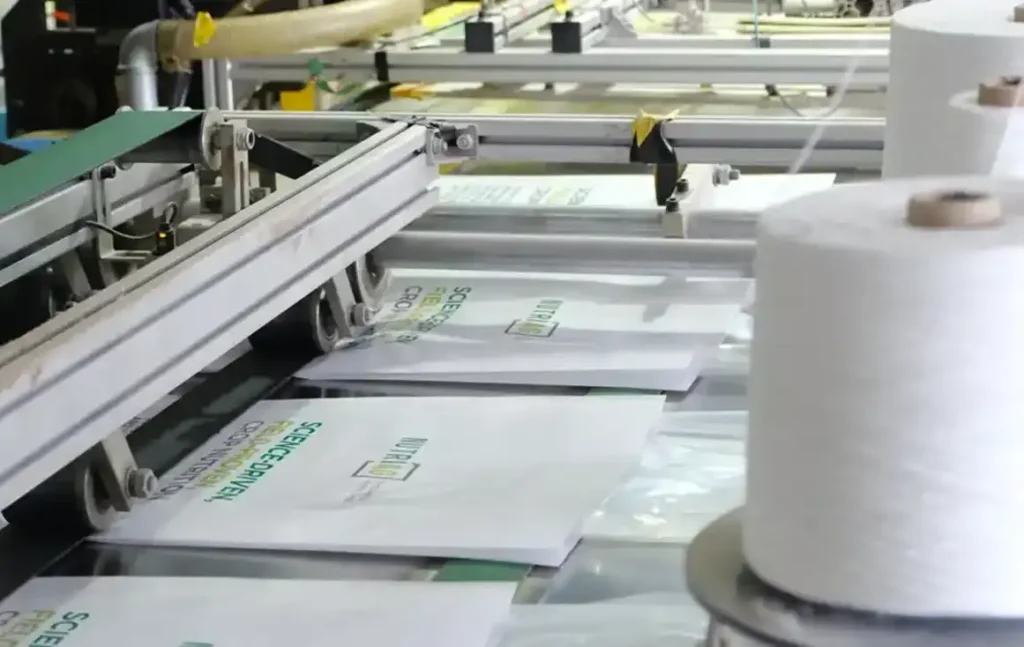
2) Tape extrusion & orientation. Melt → cast film → slit to tapes → stretch/anneal. Tight gauge control narrows tape modulus/width dispersion—a precondition for predictable weave geometry and flat lamination.
3) Weaving (circular or flat looms). Interlace tapes to the target mesh/GSM under controlled warp tension. Weft‑stop and warp‑break detection localize defects; tight width tolerance underpins accurate cutting and registration later.
4) Surface architecture (coating/lamination). Extrusion‑coat PE ~10–30 g/m² for rub life and moisture control, or laminate BOPP ~15–25 μm (clear/matte) for high‑fidelity graphics. Corona treatment lifts dyne to ~38–42 dynes to stabilize ink/adhesive bonds.
5) Printing. Flexo for agile sets; gravure for photo‑rich campaigns. Spectrophotometers manage ΔE*ab ≤ 3 on brand‑critical hues; inline scanners grade barcodes to ISO/IEC 15416.
6) Conversion & closures. Cut bodies to length; add M‑gussets for volume efficiency; finish mouths by heat‑cut or hem (20–40 mm typical); close bottoms with single/double fold and single/double stitch, or use ultrasonic/thermal welds; insert valve sleeves (ID ~35–55 mm) where specified.
7) QA & compliance. Mechanics: tensile/tear, seam strength, ASTM D5276 (drop). Friction: ASTM D1894 (COF). Barrier (if laminated): ASTM E96 (WVTR) and ASTM D3985 (OTR). Food‑contact dossiers cite Regulation (EU) No 10/2011 (overall migration ≤ 10 mg/dm²), FDA 21 CFR §177.1520 (olefin polymers), and GB 4806.7‑2016 where applicable. QMS under ISO 9001:2015; many buyers request BRCGS Packaging or ISO 22000:2018.
Data reinforcement. Clear PE/BOPP stacks routinely achieve WVTR in low single‑digit g/m²·day at standard lab conditions; tightening weave width tolerance by ±2 mm commonly halves registration drift in long gravure runs.
Case analysis. Switching to solventless lamination reduced orange‑peel on textured fabric and raised photographic clarity—allowing a mid‑tier brand to command premium shelf fees without changing the formula inside.
Comparative study. Solventless lamination over woven PP yields uniform bonds and clearer optics; extrusion coating wins on speed and ruggedness. Choose by artwork ambition and route severity.
What is the application of Polypropylene Bags?
Staple foods (10–50 kg). Rice, flour, sugar, pulses. Matte BOPP fronts support legible nutrition tables; optional PE liners elevate hygiene and moisture control; woven strength keeps pallets square across long routes.
Feed & agriculture. Seeds and compound feed: UV‑stabilized fabrics survive yard exposure; anti‑slip backs reduce pallet slides; large panels host bilingual labeling and QR traceability.
Minerals & salts. Antistatic packages temper charge; matte faces hide rub marks; double‑fold/double‑stitch bottoms resist high drop energy on aggressive routes.
Resins & industrial additives. Valve formats pair with legacy fillers; tuned valve IDs reduce spillage and speed weight stabilization; brand panels remain legible after clamp handling.
Data reinforcement. Typical 50 kg builds: GSM ~90–120, mesh ~10×10–12×12, widths ~50–80 cm, BOPP ~15–25 μm, COF ~0.40–0.55. These are not decorations—they are the envelope of reliable performance.
Case analysis. A salt producer added inner liners and matte faces. Clumping declined, pallets arrived drier after exposure events, and QC at the dock shifted from rework to green‑light.
Comparative study. Laminated woven vs paper multiwall: better wet‑chain survival and fewer corner ruptures. Laminated woven vs plain woven: stronger shelf impression and superior face scuff resistance.
What is the application of Polypropylene Bags? (brand influence & route‑to‑market)
Color as a sorting language. Assign hues by family (blue = urea, green = NPK, yellow = specialty) and lock ΔE*ab ≤ 3 so meaning does not drift between runs. Stable color shortens search time, lowers mis‑picks, and multiplies brand recall.
Anti‑counterfeit & digital hooks. QR serialization tied to traceability or loyalty programs becomes table stakes. Place codes away from clamp arcs and fold lines; keep X‑height ≥ 1.2 mm for scan‑at‑distance in high‑bay lighting.
Channel‑specific optics. Matte faces suit LED‑lit wholesale aisles; gloss accents drive theatre at retail. Same product, tuned perception.
Competitive cost story. GSM right‑sizing, COF tuning, and hem/seam geometry shave total landed cost—less rework, less wrap film, fewer damage claims. Price per bag matters; dollars per delivered pallet matter more.
Cross‑disciplinary lens. Raise GSM and drop endurance rises—but freight mass follows. Increase COF and stacks grip—but conveyors may need retune. Add lamination and print dazzles—but heat transfer shifts. Winning specs are negotiated, not memorized. For a practical bridge from this playbook to purchasable SKUs, explore Polypropylene Bags.
Compliance & testing (credentials that open markets)
- EU: Regulation (EU) No 10/2011 for plastics in contact with food (overall migration ≤ 10 mg/dm²; SML/QM as applicable). Maintain a Declaration of Compliance with migration and organoleptics.
- US: FDA 21 CFR §177.1520 for PP/PE contact layers under stated conditions of use.
- CN: GB 4806.7‑2016 (food‑contact plastics, where applicable) and GB/T 8946‑2013 (plastic woven sacks—dimensions, seam strength, marking, inspection rules).
- QMS: ISO 9001:2015 for resin‑to‑pallet traceability; many brands also request BRCGS Packaging or ISO 22000:2018.
- Methods: ASTM D5276 (drop), ASTM D1894 (COF), ASTM E96 (WVTR), ASTM D3985 (OTR where barrier films are used), tensile/tear & seam strength per woven‑sack norms, barcode grading per ISO/IEC 15416.
Rhetorical check. Is compliance just paperwork? Hardly. It is the handshake between engineering and law—the passport that lets pallets cross borders without drama.
Key Parameters & Options (market‑referenced)
| Parameter | Typical Range / Option | Field Purpose | Notes |
|---|---|---|---|
| Fabric GSM | ~60–150 g/m² | Drop/stack strength vs mass | Heavier routes → higher GSM |
| Mesh density | ~9×9 – 14×14 | Surface smoothness & puncture control | Denser mesh → flatter print/coat base |
| Tape denier | ~600D – 1500D | Impact tolerance & clamp survival | Interacts with GSM; validate on line |
| PE coating (optional) | ~10–30 g/m² | Moisture/rub & ink hold‑out | Alters stiffness & seam behavior |
| BOPP film (optional) | ~15–25 μm (matte/gloss) | Optics & abrasion resistance | Matte hides scuffs; gloss lifts saturation |
| Width × Length | ~40×60 cm (25 kg); ~50×80 cm (50 kg) | Filler/pallet alignment | Gussets raise volume efficiency |
| Mouth finish | Heat‑cut / hem 20–40 mm | Fray control & mouth stiffness | Hemming improves shelf look |
| Bottom seam | Single/double fold; single/double stitch | Impact load distribution | Double‑fold/double‑stitch for heavy drops |
| Valve sleeve (ID) | ~35–55 mm | Fast, clean fill (valve formats) | Ultrasonic, hot‑melt, or flap options |
| COF (bag/deck) | ~0.40–0.55 | Conveyor feed vs stack stability | Set via anti‑slip coat or film texture |
| Dyne level | ~38–42 dynes post‑corona | Ink anchorage & bond strength | Monitor drift on long runs |
| Barcode X‑height | ≥ 1.2 mm | Warehouse scan reliability | Keep codes off seam/clamp zones |
| Additives | UV / antistatic / anti‑slip | Exposure & powder behavior | Tune to climate and route |
Integrated solution (synthesis for VidePak buyers)
Design for the shelf and the spreadsheet. Begin with stabilized PP that draws into uniform tapes; weave to a mesh/GSM that delivers lay‑flat; select surface architecture—plain, PE‑coated, or BOPP‑laminated—to balance optics, route severity, and sustainability. Tune COF to feed smoothly yet lock stacks; print to ΔE and barcode‑grade targets; finish with hemmed mouths and double‑fold/double‑stitch or valve sleeves as the product demands. Validate the build with COF, drop, seam, WVTR/OTR, and migration data under ISO 9001:2015 governance. When the spec is a system, Polypropylene Bags stop being a cost and start becoming a competitive instrument.
- Polypropylene Bags — Brand & Market Systems Playbook
- What are Polypropylene Bags? (a.k.a. PP woven sacks / PP raffia bags / PP industrial food sacks)
- What are the features of Polypropylene Bags?
- What is the production process of Polypropylene Bags?
- What is the application of Polypropylene Bags?
- What is the application of Polypropylene Bags? (brand influence & route‑to‑market)
- Compliance & testing (credentials that open markets)
- Key Parameters & Options (market‑referenced)
- Integrated solution (synthesis for VidePak buyers)
Polypropylene (PP) bags are at the forefront of modern packaging solutions, offering versatility, durability, and customization. With advancements in materials and technology, these bags have become essential for industries ranging from agriculture to retail. However, the dynamics of brand influence and market competition significantly impact their adoption and success. This article delves into these aspects, providing actionable insights and exploring the latest trends shaping the industry.
Key Specifications of Polypropylene Bags
Polypropylene bags come in various designs tailored to meet specific industry needs. Here’s a detailed comparison:
| Type | Features | Applications | Advantages |
|---|---|---|---|
| BOPP Laminated Bags | High-quality multicolor printing, moisture-resistant | Pet food, fertilizer, retail products | Superior branding, enhanced protection |
| Valve Bags | Automated filling, tight sealing | Cement, chemicals, minerals | Reduced spillage, efficient handling |
| Kraft Paper Woven Bags | Eco-friendly, reinforced with PP | Food packaging, agricultural products | Sustainability, tear resistance |
| FFS Tubular Bags | Seamless production, automated filling | Grains, resins, powders | Cost-efficient, streamlined logistics |
| Jumbo Woven Bags | Large capacity, UV resistant | Construction materials, bulk storage | Heavy-duty, reusable |
Brand Influence: How It Shapes the Market
- Perceived Quality: A strong brand signals reliability. Companies like VidePak leverage their 30+ years of experience and cutting-edge equipment to instill confidence in customers.
- Innovative Designs: Customization is a critical factor. For instance, BOPP laminated bags are designed with vibrant, multicolor prints to meet branding needs. Learn more about these advancements here.
- Sustainability Commitment: As environmental concerns rise, brands focusing on eco-friendly options like transparent or kraft paper woven bags gain traction.
Market Competition: Strategies for Success
- Adopting Advanced Technology: Companies that integrate automated production lines, such as FFS systems, achieve higher efficiency and consistency. For details on FFS innovations, refer to this article.
- Global Market Penetration: A diverse market presence across North America, Europe, and Asia enhances resilience. VidePak’s annual revenue of $80 million showcases the potential of this strategy.
- Customization Capabilities: Tailored solutions like square-bottom PP valve bags provide a competitive edge by addressing specific consumer needs.
Steps to Strengthen Brand Influence in the PP Bag Industry
- Leverage Cutting-Edge Technology:
- Utilize Starlinger equipment for precision and quality.
- Incorporate high-grade PP materials to ensure durability.
- Focus on Sustainability:
- Offer eco-friendly options such as kraft paper and transparent woven bags.
- Highlight certifications and compliance with environmental standards.
- Enhance Customization:
- Provide multiple size, color, and design options.
- Use digital printing for high-definition graphics.
- Strengthen Customer Relationships:
- Offer comprehensive after-sales support.
- Maintain consistent communication to build trust.
FAQs on Polypropylene Bags
- What are the key advantages of PP bags over other packaging solutions?
PP bags are durable, lightweight, and customizable, making them suitable for various applications. Their resistance to moisture and UV rays adds to their versatility. - How sustainable are PP bags?
Many PP bags are recyclable and can incorporate eco-friendly designs, such as kraft paper woven bags, enhancing their environmental appeal. - What industries benefit most from PP bags?
Industries such as agriculture, construction, retail, and logistics commonly use PP bags due to their robustness and adaptability. - How does customization impact market success?
Customization enhances brand visibility and consumer engagement. For instance, vibrant designs on BOPP laminated bags create a strong shelf presence. - What trends are shaping the future of PP bags?
Automation, sustainability, and digital printing are key trends. Companies adopting these innovations stay ahead in the competitive landscape.
Trends and Future Outlook
- Sustainability Initiatives: The push for eco-friendly packaging is driving innovation. Transparent woven bags and recyclable options are increasingly in demand.
- Automation and Efficiency: Automated production lines, such as those used for FFS tubular bags, ensure cost-effectiveness and scalability.
- Digital Printing Revolution: High-quality, multicolor printing enables brands to stand out, particularly in retail packaging.
Polypropylene bags are not merely functional packaging solutions; they are strategic tools for branding and market competitiveness. By focusing on innovation, customization, and sustainability, businesses can navigate the complexities of this dynamic industry.