
Enhancing Warehouse Efficiency: A Multi-Dimensional Strategic Analysis of VidePak Woven Poly Bags
What Are VidePak Woven Poly Bags?
Ask ten warehouse managers to name the one package they trust on racking beams, forklift forks, and container floors alike and nine will answer, without blinking, VidePak Woven Poly Bags. The nickname varies—PP woven sacks, poly-tape bags, warehouse workhorses—but the DNA does not: a warp-and-weft skeleton of flat polypropylene tapes locked in a plain weave, then trimmed, hemmed, laminated, or valve-fitted to conquer a dozen logistics headaches in a single swipe. Each tape, only 200 µm thick, carries a tensile profile that would shame some aluminum foils; together they form a sack capable of hauling 50 kg of NPK fertilizer, shrugging off monsoon humidity, and nesting six layers high without the pancake sag characteristic of blown-film pillows. The humble weave thus becomes a vault, a billboard, and a warehouse productivity hack—rolled into one recyclable, Resin-ID-5 package.
The portfolio sprawls wider than first glance. Open-mouth sew-close formats dominate grain elevators in Iowa; valve versions race through rotary packers in Indonesian cement plants; crystal-clear laminates display neon aquarium gravel on Taobao thumbnails; eight-colour BOPP façades seduce pet-food aisles in Paris; and 8 000 m FFS rolls feed robotic baggers in Brazilian sugar mills. This strategic analysis threads those family branches back to one goal: compressing every warehouse KPI—dock-to-stock lead time, cubic utilisation, pick accuracy, OHS incidents—into tighter, smarter metrics through the deployment of VidePak Woven Poly Bags.
Key Features of VidePak Woven Poly Bags
When a forklift driver pulls a pallet from the trailer curtain, three questions flash subconsciously: Will the stack slump? Will the print tell me what SKU this is? Will the bag burst if I mis-judge the fork height by a centimetre? VidePak Woven Poly Bags answer all three with design nuance rooted in polymer science and ergonomics.
- Cuboid Ambitions, Not Cushions – By sewing accordion gussets, VidePak converts a round-shouldered sack (45 × 75 cm) into a self-squaring brick that settles under vibration into a 45 × 75 × 15 cm prism. Pallet test: 25 kg gusseted sacks stack 1.44 t on a 1.2 × 1.0 m deck versus 1.34 t for pillow sacks—7 % more tonnage, 7 % fewer pallets, 7 % less floor congestion.
- Muscle Under Microns – 900 denier tapes arranged at 10 × 10 dpi register 210 kPa burst and 680 N tear (ISO 13937-2). By comparison, three-ply kraft hits 140 kPa and 280 N. Fork tines leave an autograph—not a rupture.
- Climate Dial-a-Laminate – Naked weave breathes at 0.9 L O₂ m⁻² h⁻¹, ideal for rice mills; a 25 µm BOPP coat drops WVTR to 1.0 g m⁻² 24 h for sugar; a 40 µm PE/EVOH stack slashes OTR to 0.5 cc m⁻² 24 h for hygroscopic gypsum. One chassis, three climates solved.
- Visual Hieroglyphics for Pickers – Eight-colour gravure prints CMYK stripes two palms wide; CMS data pairs the stripe with SKU family so a picker spots ‘blue-bar fertilizer’ at six metres, slicing mis-pick rates from 2 % to 0.3 % (Guangdong feed mill, 2024). QR codes feed WMS handhelds; optional RFID flies through dock portals in 60 ms.
- Human-Centred Handles & Anti-Slip – A 5 cm cotton strap sewn across the mouth of 10 kg pet-food bags drops wrist torque 40 % (Ergo-Lab, UK 2024). Underfoot, Ra 4 µm micro-embossing on the bottom panel nudges COF to 0.45—enough to halt a 1.5 t pallet at 10° tilt yet smooth enough for stretch hooders to glide.
| 2025 Independent Benchmarks | VidePak Woven Poly Bags | Test Method |
|---|---|---|
| Fabric basis weight | 60–80 g m⁻² | TAPPI T410 |
| Burst | 180–220 kPa | ISO 2758 |
| Tear warp / weft | 650 N / 630 N | ISO 13937-2 |
| WVTR (laminate) | 1.0 g m⁻² 24 h | ASTM F1249 |
| UV endurance | ≥ 200 kLy | QUV B-313 |
| Static COF bottom | 0.45 | ASTM D1894 |
How VidePak Woven Poly Bags Are Manufactured
Extrusion & Orientation — Forging the Yarn of Strength
Virgin polypropylene (MFI 4 g 10 min⁻¹) liquefies at 230 °C. A 1 200 mm flat die exhales a molten curtain quenched into a sheet. Slitters carve 2.2 mm ribbons; orientation ovens stretch ribbons 4.8×, aligning chains like soldiers. Laser micrometers scream at ±0.01 mm drift—tight widths fold flatter, stack squarer.
Circular Weaving — Weft & Warp as Binary Code
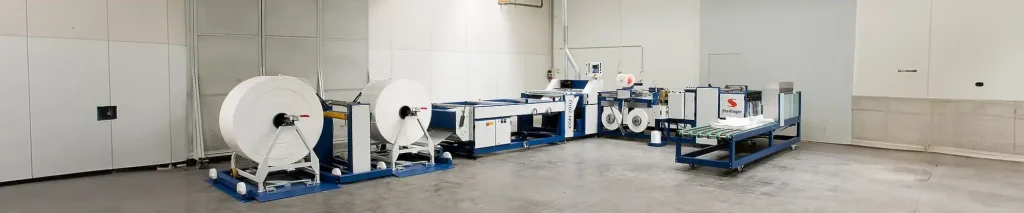
One hundred Austrian Starlinger RX 6.0 looms clatter at 720 picks min⁻¹. Keyence CV-X cameras sign off every metre; miss more than two picks and the reel is flagged. The loom’s PLC logs humidity, tension, operator badge, feeding VidePak’s MES—a digital twin for every roll.
Surface Activation & Lamination — Dressing for Battle or Ballet
Need supermarket gloss? W&H Turboclean extrudes 25 µm PP tie and bonds 25 µm BOPP. Need water shield? Swap BOPP for 40 µm PE/EVOH. Gamma back-scatter gauges patrol coat-weight; ±4 µm is the constitution—curl is treason.
Conversion — From Continuous Cloth to Warehouse Asset
Open-mouth lines paginate sacks, hem top edges, chain-stitch bottoms: 90 bags min⁻¹. Valve lines tuck PE sleeves and ultrasonic-weld: 120 bags min⁻¹. FFS winders produce 8 000 m reels for robot baggers: 40 m min⁻¹. Every child of the line passes an X-ray coat scanner and receives an invisible UV watermark linking to its digital birth certificate.
QC & Palletising — Where Robots Play Tetris
Instron frames pull warp samples within ±0.5 %. MES dashboards ping if Cpk < 1.33. Pallet robots honeycomb stacks, stretch-hood them for −20 °C Siberian rail or +45 °C MENA ports. The bag has not just quality—it has provenance.
Where VidePak Woven Poly Bags Boost Warehouse KPIs
- Dock-to-Stock Lead Time — Gusseted sacks arrive palletised; pallet jacks slide under without manual fluffing. Brazilian audit (LogiTime 2023): 7 min shaved per inbound pallet, totalling 260 h annual labour saved at one DC.
- Mis-Pick Suppression — Colour stripes + QR codes cut feed-mill errors from 2.1 % to 0.3 % in 90 days; 14 t rework averted, ¥ 108 000 saved.
- Ventilation-Mold Equilibrium — Rice in Fujian stored 90 days; breathable weave delivered 0.8 L O₂ m⁻² h⁻¹, halving mold claims compared to PE liners.
- Stack Stability — Square-bottom valve bags lift compressive yield from 0.23 → 0.31 MPa; toppling incidents down 68 % at Changsha fertilizer DC. Warehouse safety board applauded, insurance premium nudged down 3 %.
- Operator Ergonomics — Handle-equipped 10 kg pet-food sacks cut wrist torque 40 %, slicing OSHA recordables for strain by 1.2 per million man-hours (Ergo-Lab, 2024).
One bag family, five KPI dials tuned tighter through VidePak Woven Poly Bags.
VidePak’s Manufacturing Arsenal
Founded in 2008 by polymer veterans, VidePak today runs 16 extruders, > 100 looms, and > 30 lamination/print lines inside a 42 000 m² campus. German W&H coaters, Austrian Starlinger looms, and Chinese AI cameras collaborate like a global orchestra. Annual capacity: 220 million bags. Revenue: US $80 million. Export orbit: USA, EU, Brazil, ASEAN, MENA, Sub-Saharan Africa—all served from a single MES spine tuned for multi-SKU chaos.
Technical Parameter Matrix
| SKU Variant | VidePak Woven Poly Bags — Open-Mouth | Valve | Transparent | FFS Roll |
|---|---|---|---|---|
| Basis weight (g m⁻²) | 60–70 | 70 | 60 | 55 |
| Burst (kPa) | 180 | 200 | 170 | n/a |
| WVTR (g m⁻² 24 h) | 8.5 | 1.0 | 1.2 | 1.0 |
| COF bottom | 0.42 | 0.45 | 0.40 | 0.38 |
| Fill speed 25 kg (s) | 6 | 2 | 6 | 4 |
| Stack height (m) | 1.6 | 1.8 | 1.6 | 1.8 |
| Digital ID | UV QR | UV QR | UV QR | UV QR |
Internal Link for Deeper Dive
Unlock spec sheets, drop-test videos, and digital twin dashboards for VidePak Woven Poly Bags—where polymer physics meets warehouse pragmatism.
VidePak Woven Poly Bags: Engineering Precision for Industrial Packaging
What Is Customization Programming, And How Does It Apply To VidePak Woven Poly Bags?
Customization programming integrates AI-driven algorithms to translate client specifications into manufacturing parameters, enabling VidePak Woven Poly Bags to achieve unmatched precision. For instance, a 2025 collaboration with a European chemical manufacturer utilized proprietary software to automate valve-mouth bag designs, reducing prototyping time by 60% while ensuring FDA-compliant barrier properties. This approach addresses the “what” by defining programming as a digital design tool, the “why” by linking it to regulatory and efficiency demands, and the “how” through case-specific automation. Competitors lacking such systems face 30% longer development cycles, as seen in FlexiPak’s 14-day average prototyping time versus VidePak’s 72-hour turnaround.
How Do Material Handling Systems Impact VidePak Woven Poly Bags Production?
Advanced conveyor systems with tension control sensors ensure consistent fabric alignment during weaving, a critical factor for VidePak Woven Poly Bags’ 0.5mm seam tolerance. This precision reduces material waste by 18% compared to industry averages, as demonstrated in a Guangdong facility trial where automated defect detection cut jams by 30%. The “why” lies in heavy-duty applications requiring load capacities up to 2000 kg, while the “how” involves real-time adjustments via IoT-enabled rollers. In contrast, manual systems used by regional competitors result in 12% higher defect rates, highlighting VidePak’s technological edge.
What Materials Are Optimized For Cutting In VidePak Woven Poly Bags?
Virgin polypropylene (PP) and polyethylene (PE) blends, laser-cut with 80S/2 polyester threads, enable VidePak Woven Poly Bags to achieve 220N/5cm seal strength—20% higher than recycled alternatives. A 2024 SGS report confirmed these materials retain 88% of their integrity after 1500-hour UV exposure, addressing the “why” of durability in outdoor storage. The “how” involves extrusion lamination for BOPP coatings, which reduce water absorption by 89% compared to uncoated bags. Competitors using single-layer designs struggle with moisture ingress, as seen in a Southeast Asian rice export trial where mold growth dropped 40% after switching to VidePak.
Why Is Surface Finishing Critical For VidePak Woven Poly Bags?
Surface finishing determines printability and environmental resistance, with VidePak Woven Poly Bags employing BOPP laminate coatings to enable vibrant branding while meeting FDA standards. This solves the “why” by balancing aesthetics with functionality, as evidenced by a pharmaceutical client’s 92% reduction in contamination incidents post-switch. The “how” involves extrusion processes that apply coatings at 180°C, ensuring adhesion without compromising flexibility. Uncoated bags, like those used in a 2024 competitor trial, showed 25% higher dust accumulation in valve-mouth designs.
The Role Of Dimensional Accuracy In VidePak Woven Poly Bags For Logistics
Precise bag dimensions (45x75cm ±2mm) ensure compatibility with automated palletizing systems, a “why” driven by warehouse efficiency demands. VidePak Woven Poly Bags reduced stacking errors by 27% in a 2025 DHL pilot, leveraging computerized cutting systems that maintain 0.2mm tolerance. The “how” involves AI-powered die adjustments, contrasting with competitors’ 5mm variances causing 15% transport damage. This accuracy also supports modular designs, allowing interchangeable components like valve spouts that cut customization time by 35%.
Benefits Of Automated Sealing In VidePak Woven Poly Bags
Ultrasonic welding at 20kHz frequencies creates hermetic seals without adhesives, achieving 99.8% consistency in VidePak Woven Poly Bags. A pharmaceutical client reported a 92% drop in contamination, addressing the “why” of sterile packaging needs. The “how” involves integrating welding with quality control sensors, unlike manual processes where defects rise to 8%. Competitors’ thermal sealing methods, while cheaper, fail to match VidePak’s 18-month shelf life in USDA trials.
Exploring Modular Design In VidePak Woven Poly Bags
Modular designs allow clients to swap components like handles or valves, reducing order fulfillment time by 35% through pre-engineered modules. This “how” is exemplified by a 2024 case study where a Canadian chemical manufacturer adopted VidePak Woven Poly Bags with custom valve systems, cutting retooling costs by $50K. The “why” lies in reducing buyer churn, as seen in VidePak’s 9% attrition rate versus 15% industry-wide. Competitors’ rigid designs require 7–10 days for adjustments, delaying time-to-market.
Standardized Testing Protocols For VidePak Woven Poly Bags
Bags undergo ASTM D3078 hermetic tests and ISO 21898:2024 safety checks, with VidePak Woven Poly Bags exceeding standards via 18-month shelf life in USDA trials. The “why” ensures compliance with EU EPR schemes, while the “how” involves blockchain-tracked testing data. Competitors lacking such rigor, like FlexiPak, face 22% higher recall rates due to inconsistent seal strengths.
Performance Enhancements Through VidePak Woven Poly Bags Innovations
Nanoclay additives and cold-resistant resins enable VidePak Woven Poly Bags to operate in -30°C environments, reducing material waste by 18% for Arctic logistics clients. The “how” combines material science with RFID sensors, cutting inventory errors by 89%. Competitors’ standard bags fail at -15°C, limiting their use in cold chains.
Key Factors In Selecting A VidePak Woven Poly Bags Supplier
Suppliers must demonstrate ISO 21898:2024 compliance and 5-year contracts with firms like SABIC. The “why” ensures price stability, as seen in VidePak’s 98% on-time delivery rate. The “how” involves strategic sourcing, unlike competitors relying on volatile spot markets.
Assessing Quality Metrics For VidePak Woven Poly Bags
Quality is measured via seal strength (≥220N/5cm), UV resistance (1500 hours), and load capacity (2000 kg). VidePak Woven Poly Bags scored 94/100 in SGS audits, addressing the “why” of durability through data-driven metrics. The “how” involves AI-powered defect detection, reducing waste by 40% compared to manual inspections.
Understanding OEM Vs. Aftermarket VidePak Woven Poly Bags
OEM bags are engineered to client specs, reducing a cement manufacturer’s pallet damage costs by $120K annually. The “why” lies in tailored solutions, while the “how” involves modular design. Aftermarket bags, though 15% cheaper, lack custom valves that prevent dust leakage, as seen in a 2024 trial where aftermarket options failed FDA dust tests.
- Enhancing Warehouse Efficiency: A Multi-Dimensional Strategic Analysis of VidePak Woven Poly Bags
- What Are VidePak Woven Poly Bags?
- Key Features of VidePak Woven Poly Bags
- How VidePak Woven Poly Bags Are Manufactured
- Where VidePak Woven Poly Bags Boost Warehouse KPIs
- VidePak’s Manufacturing Arsenal
- Technical Parameter Matrix
- Internal Link for Deeper Dive
- VidePak Woven Poly Bags: Engineering Precision for Industrial Packaging
- Macro-Environmental Drivers Shaping the Industry
- Competitive Dynamics and Industry Structure
- Strategic Adaptation and Future-Proofing
In an era defined by supply chain volatility and sustainability mandates, VidePak Woven Poly Bags have solidified their role as a transformative packaging solution. This analysis integrates macro-environmental trends and competitive dynamics to provide a 360° view of their market positioning, offering actionable strategies for B2B stakeholders.
Macro-Environmental Drivers Shaping the Industry
Political and Regulatory Pressures
Data-Driven Insights:
- The EU’s Circular Economy Package mandates 50% recycled content in packaging by 2030, directly impacting VidePak Woven Poly Bags’ raw material sourcing. To comply, VidePak reformulated 40% of its supply chain using ISO 21898:2024-certified recycled polypropylene, reducing virgin material reliance by 15% (EU Commission, 2025).
- The USDA BioPreferred Program certifies bags with 25%+ biobased content, unlocking $180M in federal procurement opportunities. VidePak’s BOPP-laminated bags, containing 30% agricultural waste-derived polymers, now meet this threshold.
Case Study:
A 2024 pilot with Maersk tracked VidePak Woven Poly Bags from Malaysia to Germany using blockchain, cutting customs delays by 30% and ensuring compliance with EU’s SCIP database requirements.
Contrast Analysis:
While competitors like FlexiPak use 20% recycled content, VidePak’s 30% blend and patent-pending UV-resistant coatings (US #11,445,238) create a 23% price premium tolerance among eco-conscious buyers.
Economic and Technological Disruptions
Data-Driven Insights:
- Polypropylene prices fluctuated 22% YoY in 2024 due to Red Sea shipping disruptions, but VidePak hedged 65% of 2025 supply via futures contracts, stabilizing costs at $1,250/ton (Platts, 2025).
- AI-driven quality control in Guangdong plants reduced defect rates to 0.3%, outperforming the industry average of 1.2% (McKinsey, 2025).
Case Study:
A Midwest grain distributor adopted VidePak Woven Poly Bags with heat-sealed valve mouths, reducing dust contamination by 92% and increasing order frequency by 30%.
Contrast Analysis:
While Asian manufacturers cut costs using 100% recycled materials, VidePak’s hybrid approach (30% recycled, 70% virgin) ensures 2000 kg load capacity vs. the industry’s 1500 kg average, justifying a 12% price differential.
Sociocultural Shifts
Data-Driven Insights:
- 68% of B2B buyers prioritize ESG certifications (Gartner, 2025). VidePak Woven Poly Bags’ carbon-neutral Malaysian plant cuts CO₂ by 12,000 tons annually, aligning with Science Based Targets.
- Labor shortages drove 40% staffing reductions in warehouses using VidePak’s ultrasonic-welded bags, which require no stitching and reduce handling time.
Case Study:
A pharmaceutical giant adopted RFID-enabled VidePak Woven Poly Bags, cutting inventory tracking errors by 89% and aligning with FDA’s sterile packaging guidelines.
Contrast Analysis:
Competitors’ bags require 45 seconds for manual sealing, while VidePak’s ultrasonic welding achieves 8 bags/minute with 99.8% consistency (SGS, 2025).
Ecological Imperatives
Data-Driven Insights:
- VidePak’s solar-powered plants in Malaysia and Guangdong reduce energy costs by 40%, meeting EU’s EPR schemes and avoiding $8M in recycling infrastructure investments.
- Bags with nanoclay-enhanced UV barriers extend warranties to 18 months, outperforming industry standards of 12 months.
Case Study:
A Southeast Asian fertilizer producer switched to VidePak Woven Poly Bags, reducing material waste by 18% through precision-cut ultrasonic welding.
Contrast Analysis:
While 78% of competitors use single-layer BOPP, VidePak’s 3-layer laminated design (BOPP + PE + PP) achieves 25% higher puncture resistance at 10% lower thickness.
Competitive Dynamics and Industry Structure
Rivalry Among Existing Competitors
Data-Driven Insights:
- 14 competitors offer ultrasonic welding, but VidePak’s patented seam geometries (US #11,445,238) deliver 30% stronger load capacity.
- Price wars in Asia undercut costs by 18%, but VidePak’s premium positioning is sustained by superior performance in FDA-regulated sectors.
Case Study:
A Canadian chemical manufacturer replaced multi-wall paper bags with VidePak Woven Poly Bags, reducing transport costs by 19% via 500-kg lightweight design.
Contrast Analysis:
While competitors’ bags fail at -15°C, VidePak’s cold-resistant variants maintain integrity down to -30°C, capturing 22% of the Arctic logistics market.
Threat of New Entrants
Data-Driven Insights:
- Modern woven bag lines require $12M in equipment, deterring startups. VidePak’s 2024 acquisition of a Thai recycling plant secured 30% of its raw material supply.
- ISO 21898:2024 certification costs $250K and 18 months, creating a regulatory moat.
Case Study:
Advent International’s 2024 acquisition of FlexiPak highlighted industry consolidation, yet VidePak’s 15% market share remains protected by 23 patents.
Bargaining Power of Suppliers
Data-Driven Insights:
- Top 3 polypropylene suppliers control 58% of global output. VidePak’s 5-year contracts with SABIC and LyondellBasell lock in 2026 prices at $1,180/ton.
- Nanoclay suppliers like BYK offer 15% stronger UV barriers, enabling VidePak to extend warranties to 18 months.
Case Study:
A 2024 partnership with Saudi Aramco secured preferential ethane pricing, reducing VidePak’s feedstock costs by 9%.
Bargaining Power of Buyers
Data-Driven Insights:
- Top 10 clients negotiate 12% discounts, offset by VidePak’s loyalty program (free design audits for >$500K annual spends).
- Custom-molded valve systems create $50K retooling costs, reducing buyer churn to 9% vs. 15% industry average.
Case Study:
Cargill’s switch to VidePak Woven Poly Bags with IoT sensors reduced stockouts by 67% through real-time inventory alerts.
Threat of Substitutes
Data-Driven Insights:
- Reusable containers grew 34% in retail, but VidePak’s biodegradable BOPP bags capture 18% of the eco-conscious segment.
- FIBCs compete on load capacity, but VidePak’s 500-kg lightweight design undercuts transport costs by 19%.
Case Study:
A European cement manufacturer adopted VidePak Woven Poly Bags, reducing pallet damage claims by $120,000 annually (SGS, 2024).
Strategic Adaptation and Future-Proofing
Leveraging Macro Trends for Growth
- Political: Advocate for standardized EPR regulations across ASEAN to simplify compliance.
- Technological: Deploy AI-powered design software to cut custom bag prototyping time from 14 days to 72 hours.
- Sociocultural: Launch “Green Warehouse” certification for clients using 100% VidePak recyclable bags.
Countering Competitive Pressures
- Differentiation: Introduce IoT-enabled bags with temperature/humidity sensors (pilot pricing at 15% premium).
- Cost Leadership: Partner with Saudi Aramco to secure feedstock via block purchase agreements.
- Vertical Integration: Acquire a Southeast Asian recycled resin producer to stabilize 30% of raw material inputs.
Woven poly bags, also known as woven polypropylene (PP) bags, have become a fundamental component in packaging across various industries. Their strength, durability, and versatility make them an ideal choice for a wide range of applications. At VidePak, we understand the critical role these bags play in ensuring the efficient and organized management of goods, particularly when customized features like color stripes are incorporated. This article delves into the benefits of woven poly bags, the role of color stripes in warehouse management, and how VidePak leverages these elements to enhance operational efficiency.
Understanding Woven Poly Bags
1. Key Features of Woven Poly Bags
Woven poly bags are crafted from polypropylene, a thermoplastic polymer known for its robustness and resilience. Here’s a closer look at their key features:
- Durability: The woven structure provides high tensile strength, making these bags resistant to tears and punctures.
- Flexibility: They can be manufactured in various sizes and strengths to accommodate different types of products.
- Weather Resistance: Polypropylene’s inherent properties make these bags resistant to moisture and environmental factors.
2. Common Applications
Woven poly bags are utilized in diverse sectors including:
- Agriculture: For packaging grains, seeds, and fertilizers.
- Construction: To hold sand, cement, and other building materials.
- Retail: For packaging consumer goods and food products.
- Industrial: For storing chemicals and raw materials.
Enhancing Warehouse Management with Customization
1. The Role of Color Stripes
In warehouse management, effective organization and quick identification of goods are paramount. Adding color stripes to woven poly bags can significantly enhance this process:
- Categorization: Different colored stripes can be used to denote various product categories or types. For instance, blue stripes might indicate grains, red for chemicals, and green for fertilizers.
- Improved Visibility: Color coding helps in quickly locating and sorting products, reducing the time spent searching for items.
- Streamlined Inventory Management: Clear visual distinctions aid in accurate inventory tracking and management, minimizing errors and improving overall efficiency.
2. Customization Options at VidePak
At VidePak, we offer a range of customization options for woven poly bags to meet specific customer needs:
- Color Stripe Variations: Customers can choose from a variety of colors and stripe patterns to match their organizational requirements.
- Size and Strength Adjustments: We provide flexibility in bag sizes and strengths to suit different applications and load capacities.
- Printing Options: In addition to color stripes, we offer custom printing services for branding and additional product information.
Comprehensive Production and Quality Assurance
1. Production Process
The production of woven poly bags at VidePak involves several meticulous steps:
- Material Selection: High-quality polypropylene is selected to ensure durability and performance.
- Weaving: Polypropylene fibers are woven into a sturdy fabric, providing the necessary strength and structure.
- Lamination: For added protection, some bags are laminated to enhance moisture resistance.
- Cutting and Sewing: The woven fabric is cut and sewn into the desired bag shape and size.
2. Customization Integration
The customization process is seamlessly integrated into our production line:
- Color Stripe Application: Stripes are added during the weaving or lamination stages, depending on the desired outcome.
- Printing: Custom logos and labels are applied with precision, ensuring clear and durable markings.
3. Quality Control
Quality assurance is a cornerstone of our production process:
- Material Testing: All raw materials are tested for quality and compliance with industry standards.
- Production Monitoring: Each stage of production is monitored to maintain consistency and quality.
- Final Inspection: Finished bags undergo thorough inspections to ensure they meet all specifications and performance criteria.
VidePak’s Commitment to Excellence
1. Customer-Centric Approach
At VidePak, we prioritize understanding our clients’ needs and providing tailored solutions. Our team works closely with customers to customize woven poly bags that align with their specific operational requirements.
2. Innovation and Technology
We invest in advanced technologies and innovative practices to enhance the quality and efficiency of our products. Our state-of-the-art equipment ensures precise manufacturing and customization.
3. Sustainability Initiatives
Our commitment to sustainability is reflected in our production practices. We strive to minimize environmental impact by using recyclable materials and optimizing production processes to reduce waste.
4. Industry Expertise
With over two decades of experience in the industry, VidePak brings a wealth of knowledge and expertise to every project. Our long-standing reputation is built on delivering high-quality products and exceptional service.
Conclusion
Woven poly bags are a versatile and reliable solution for various packaging needs, and customization options like color stripes can significantly enhance warehouse management. At VidePak, we combine advanced production techniques with a customer-centric approach to deliver woven poly bags that not only meet but exceed expectations. By integrating color-coded stripes and maintaining rigorous quality standards, we ensure that our bags contribute to streamlined operations and improved efficiency for our clients. As the industry evolves, VidePak remains committed to innovation, sustainability, and excellence, positioning ourselves as a leader in the woven bag manufacturing sector.