
What Are Anti-Bulge FIBC Bags and Why Does Their Shape Matter?
In modern bulk logistics, anti-bulge FIBC bags sit at the intersection of engineering, safety, and cost control. These large, flexible containers look simple at first glance, yet they are designed to solve a very specific problem: traditional bulk bags tend to balloon outward once filled, encroaching on pallet edges, pushing into aisles, and undermining stack stability. By contrast, anti-bulge FIBC bags – sometimes called square profile bulk bags – are engineered to hold a near-cubic shape, with straighter walls, defined corners, and a more predictable footprint.
Instead of behaving like soft pillows that sag and swell, anti-bulge bulk bags behave more like modular blocks. Internal baffles, carefully positioned seams, and well-chosen fabrics work together to resist lateral expansion. When hundreds or thousands of kilograms of powder or granules settle inside, the material is gently guided into internal compartments rather than left free to deform the side walls. That is why these containers are equally at home in high-bay racking, automated warehouses, and long-distance export routes where every centimetre of width and every degree of tilt matters.
In practice, this family of solutions appears under several closely related names. Buyers, engineers, and logistics managers may talk about:
- Anti-bulge FIBC bag
- Anti-bulge FIBC bags
- Anti-bulge bulk bags
- Form-stable FIBC bags
- Baffled FIBC bags or Q-bags
- Anti-bulging jumbo bags
- Form-stable jumbo bags
- Square FIBC bulk bags
Technically, not every jumbo bag or ton bag is automatically an anti-bulge FIBC bag. The defining feature is the presence of internal elements and panel geometry that restrict outward deformation. Nonetheless, in day-to-day conversations, people often begin by saying “jumbo bag” or “ton bag” and only later clarify that they are struggling with pallets that bulge, racks that cannot be fully used, or containers that cannot be tightly loaded. At that point, the discussion usually converges on anti-bulge FIBC bags as the engineered answer.
When viewed as part of a system, anti-bulge FIBC bags are not just containers. They are interfaces between the filling line and upstream processing, between warehouse racking and handling equipment, and between road, rail, or sea transport and the downstream customer. If the bag deforms, the entire system feels it. If the bag holds its cube, the whole chain becomes simpler, safer, and more efficient.
This is exactly why producers such as VidePak approach anti-bulge FIBC bags as engineered systems rather than generic “big bags.” Geometry, fabric design, internal structure, and quality control are treated as interlocking variables rather than isolated checkboxes.
Materials and Architecture of Anti-Bulge FIBC Bags
Behind every apparently simple cube-shaped bag lies a composite architecture. Anti-bulge FIBC bags are not made from a single uniform sheet; they are built from interacting layers – woven polypropylene fabrics, internal baffle panels, liners, loops, seams, and functional additives. Understanding how these parts work together is the first step to understanding why a form-stable bag behaves so differently from a conventional FIBC.
Polypropylene Base Fabric: The Structural Skeleton
The backbone of any anti-bulge FIBC bag is its woven polypropylene (PP) fabric. Polypropylene is chosen because it balances strength, density, cost, and recyclability. Virgin PP pellets are melted, extruded into thin films, slit into narrow tapes, and then drawn to align polymer chains. This stretching process produces tapes with high tensile strength and limited elongation. When these tapes are woven into fabric, they create a lightweight but remarkably strong structure capable of carrying 500 to 2,000 kilograms or more.
- Resin selection focuses on melt flow index, impact strength, and consistency. Virgin resin provides predictable performance, which is critical when safety factors of 5:1 or 6:1 must be demonstrated in testing.
- Fabric GSM and weave density – for example 160 to 230 grams per square metre and 13 × 13 or 14 × 14 tapes per inch – are tuned to the bulk density and abrasiveness of the product. Heavy mineral powders demand different fabrics than light plastic pellets.
- Dimensional stability under tension is especially important for form-stable FIBC bags, because the outer walls must cooperate with internal baffles to maintain a square profile instead of stretching into a barrel.
Baffle Panels: The Engine of the Anti-Bulge Effect
What truly distinguishes anti-bulge FIBC bags from standard bulk bags is the presence of internal baffles. These vertical panels are sewn between opposite side walls to create channels that control material flow and resist sidewall expansion. In a sense, baffles are to the bag what ribs are to a ship’s hull: subtle, mostly hidden, but absolutely decisive for shape and strength.
Baffle panels are usually made from lighter PP fabric – sometimes coated, sometimes uncoated – to balance structural support and material cost. Each baffle contains cut-outs or slots that let product pass through during filling. The shape, size, and spacing of these openings are calculated to strike a delicate compromise. If openings are too small, filling becomes slow and inconsistent. If they are too large, material flows freely and the anti-bulge effect weakens. In well-designed baffled FIBC bags, baffles carry a portion of the internal load, sharing the stress with the outer walls and preventing long-term creep.
Liners and Barrier Films: Protecting Product and Controlling Flow
Many anti-bulge bulk bags are paired with internal liners, especially for food ingredients, hygroscopic chemicals, or very fine powders that must be protected from moisture, oxygen, or contamination. Liners have their own design logic and must cooperate with both baffles and outer fabric.
- Liner materials typically include LDPE, LLDPE, or HDPE, each offering different balances of flexibility, barrier performance, and cost. High-barrier structures may use multi-layer coextrusions or foil laminates for oxygen-sensitive goods.
- Liner geometry can be simple and loose, tabbed to the fabric, or fully form-fit. In form-stable jumbo bags, form-fit liners are often preferred because they follow the cubic shape created by the baffles, reducing wrinkles and dead zones where material could be trapped.
- Functional options such as anti-static liners (for flammable dusts), black light-blocking liners (for light-sensitive products), or ultra-clean liners (for pharmaceuticals) enable anti-bulge FIBC bags to serve a wide range of regulated sectors.
Loops, Seams, and Closures: Transferring Loads Safely
Even the best fabric and baffle design fails if loads are not transferred safely to handling equipment. That is why lifting loops, seams, and closures play a critical role in the architecture of anti-bulge FIBC bags.
Corner loops or cross-corner loops made from woven PP or polyester are stitched into reinforced zones of the body fabric. Their length and width, together with stitch density and seam patterns, must match the lifting method – forklift forks, crane hooks, or spreader bars. Top constructions range from simple open tops to filling spouts and full duffle tops, while bottom constructions include discharge spouts, full-open bottoms, and conical bases. Each choice interacts with product flow characteristics: sticky powders may need conical or larger discharge systems, while free-flowing granules can work with simpler spouts.
Additives and Surface Treatments: Adapting to Real Environments
Real-world logistics are messy: sunlight, static electricity, dust, moisture, and abrasion are constant threats. To cope, anti-bulge FIBC bags rely on carefully chosen additives and surface treatments.
- UV stabilizers extend outdoor life for bags stored in yards, fields, or open loading areas.
- Anti-static additives keep surface resistivity in safe ranges when handling flammable powders.
- Color masterbatches standardize branding and support quick visual identification of different grades.
- Anti-slip coatings enhance friction between bag and pallet, supporting stack stability without making conveyor handling too difficult.
When all these elements are integrated thoughtfully – the PP skeleton, the baffle engine, the tailored liner, the robust loops, and the fine-tuned additives – the result is a family of anti-bulge FIBC bags that are not only strong and safe, but also highly configurable. The same core concept adapts smoothly to sugar, cement, fertilizers, pigments, biomass, and more.
Key Features and Performance Advantages of Anti-Bulge FIBC Bags
Why have anti-bulge FIBC bags moved from niche experiments to mainstream solutions in so many industries? The answer lies in the way they bundle several benefits together – geometric stability, safer handling, better space utilization, improved product protection, and cleaner operations. Each advantage is important on its own, but the real power appears when they are viewed as a coordinated set.
Form Stability and Space Utilization
The most obvious advantage of anti-bulge bulk bags is also the one that gave them their name: they drastically reduce bulging. Internal baffles guide product into the corners and slow down lateral flow. Instead of swelling into a barrel shape that overhangs pallets, the bag remains close to a cube. This has several immediate consequences:
- Pallet footprints remain within racking tolerances, allowing full use of pallet positions without the fear of bags pushing into uprights or beams.
- Stacked columns of form-stable FIBC bags lean less, so the risk of progressive instability and toppling is reduced.
- Containers, trucks, and railcars can be packed more tightly and predictably, increasing tonnes per trip without compromising safety.
In practice, logistics managers often discover that switching from conventional jumbo bags to anti-bulge FIBC bags lets them raise stack heights, reduce stretch-wrap consumption, and reclaim aisle space that had been lost to uncontrolled bulging. What looks like a small geometric improvement on paper becomes a tangible gain in usable cubic volume.
Load Stability and Handling Safety
Shape is not just about aesthetics; it is about dynamics. When a forklift turns, when a truck brakes, when a ship rolls, the product inside a bulk bag wants to move. In a round, loosely filled bag, this movement can be sudden and uneven, causing loads to sway or stacks to shift. In a baffled FIBC bag, internal compartments resist this surge. Material is free to settle, but not free to rush from one side to the other.
The result is a calmer, more predictable load. Drivers feel fewer surprises; warehouse staff see fewer leaning stacks; safety managers record fewer near-misses linked to collapsing pallets. For hazardous, high-value, or tightly regulated products, this additional layer of stability is often decisive when choosing between a conventional FIBC and a form-stable jumbo bag.
Mechanical Strength and Safety Factors
Despite their focus on geometry, anti-bulge FIBC bags never compromise on strength. They are typically designed with Safe Working Loads between 500 and 2,000 kilograms, supported by safety factors such as 5:1 for single-use and 6:1 for multi-use applications. These numbers are not marketing slogans; they are validated through standardised top lift tests, cyclic loading trials, tear-strength measurements, and drop tests.
In other words, the promise of an anti-bulge FIBC bag is twofold: it should carry the load without failing, and it should hold the shape without bulging. Safety is not only vertical (resisting gravity) but also horizontal (resisting sidewall deformation).
Barrier Performance and Hygiene Options
Different sectors impose different hygiene and barrier demands. A sugar refinery worries about moisture and caking; a pigment producer worries about dust containment; a food-additive plant worries about cross-contamination and odour transfer. Through combinations of coated fabrics, liners, and controlled sewing techniques, anti-bulge FIBC bags can be tuned to fit each case.
- Food-grade constructions rely on certified materials, cleanroom-like sewing zones, and traceable lot control.
- For hygroscopic chemicals and fertilizers, thicker liners and higher coating weights protect against moisture ingress and product degradation.
- For light-sensitive or oxygen-sensitive powders, multi-layer film structures including barrier layers can be integrated without sacrificing the form-stable geometry.
Compatibility with Automated and Data-Rich Logistics
As warehouses become more automated and data-driven, packaging must keep pace. The cubic geometry of anti-bulge FIBC bags fits comfortably into automated storage and retrieval systems, shuttle systems, and robotic palletisers. Consistent bag height and footprint simplify algorithmic decisions in warehouse management systems. Clearly printed areas on the bag surface host barcodes, QR codes, and tracking labels that remain visible because the bag’s walls stay relatively flat instead of curving away from scanners.
In this sense, anti-bulge FIBC bags do not simply ride the wave of logistics automation; they actively enable it by behaving like repeatable, machine-friendly unit loads.
Production Process of Anti-Bulge FIBC Bags: From Resin to Form-Stable Cube
The performance of anti-bulge FIBC bags is no accident. It is the cumulative effect of disciplined material selection, tightly controlled processing, and robust inspection. VidePak’s approach can be viewed as a chain of linked stages: front-end raw material control, core manufacturing steps, and back-end quality verification. Throughout, advanced equipment from Austrian Starlinger and German W&H plays a central role in achieving repeatability.
Front-End Raw Material Qualification
Everything begins with what goes into the extruder. VidePak works with large, reputable resin and film producers, verifying their quality systems and consistency. Each batch of polypropylene pellets, liner film, and masterbatch is checked for melt flow index, tensile performance, density, moisture content, and visual cleanliness. Anti-static and UV-stabiliser masterbatches are trialled in small extrusion runs to confirm dispersion and target performance.
By insisting on 100 percent virgin PP for structural tapes in anti-bulge FIBC bags, VidePak avoids unpredictable weaknesses that can arise from poorly controlled recycled content. Controlled recycling may still be used in non-critical components or specific markets, but the load-bearing skeleton of the bag is built on stable, traceable resin.
Tape Extrusion and Drawing on Starlinger Lines
On Starlinger extrusion lines, PP pellets are melted and formed into a thin sheet, then slit into tapes and drawn at precisely defined ratios. Temperature profiles, die pressures, take-off speeds, and stretching ratios are all controlled. Online sensors monitor tape width and thickness; data are recorded for each production run. The goal is simple but demanding: every tape used in an anti-bulge FIBC bag must behave predictably during weaving and under load.
Weaving: Creating the Fabric Backbone
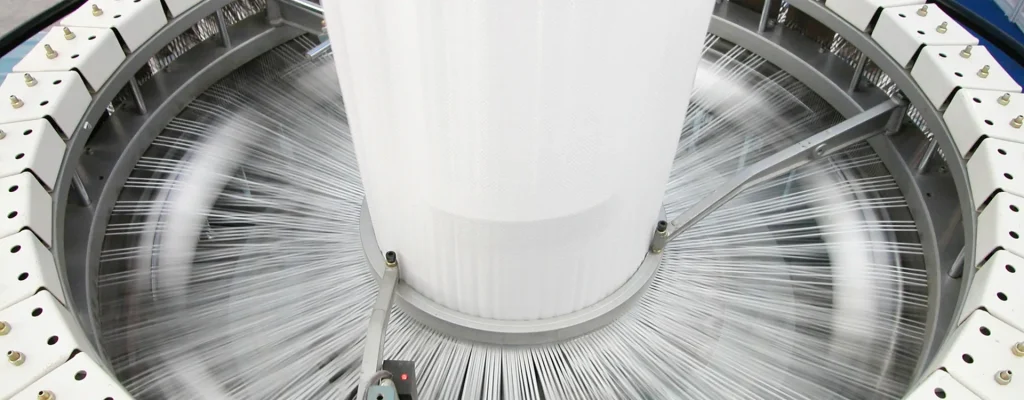
The tapes then move to circular or flat looms, where they are woven into fabric with the target GSM and weave density. Loom speed, pick density, and warp tension are monitored continually. Automatic systems identify broken tapes and mispicks, ensuring that defective fabric is isolated. For form-stable FIBC bags, consistent weave tightness is especially important, because local variations can lead to uneven bulging even when baffles are present.
Coating, Lamination, and Printing with W&H Technology
Where barrier performance or high-impact graphics are required, the woven fabric is coated or laminated. Extrusion coaters add thin PE or PP layers that reduce dust emission and moisture ingress, while laminators can bond BOPP films to create smooth, printable surfaces. Flexographic or gravure printing units, often from W&H, then apply product data, handling symbols, and brand identities.
This step also links anti-bulge FIBC bags to other woven packaging families. Plants that produce bulk FIBCs frequently also produce BOPP laminated sacks for smaller weights, as discussed in resources on laminated waste-management bags and other formats such as innovative laminated woven bags for waste streams.
Cutting, Baffle Preparation, and Panel Assembly
Converted fabric rolls are then cut into panels for the four sides, top, and base. Separately, baffle panels are cut, reinforced at their edges if required, and perforated with openings that allow product to flow during filling. Precision in these operations is vital: if baffle dimensions deviate even by a few centimetres, the internal compartments of the anti-bulge FIBC bag may become asymmetric, and the bag may no longer hold its cube properly.
The panels are then sewn together. Baffles are stitched to opposing side panels at defined distances from the corners, creating a three-dimensional lattice that controls lateral expansion. Bottom panels are added with seam designs that distribute load evenly and resist abrasion from pallets or conveyor surfaces. Top panels and lifting loops are then attached, completing the structural shell.
Liner Fabrication and Integration
For lined anti-bulge bulk bags, liner production is a parallel stream. Films are extruded, sometimes gusseted or shaped, and occasionally welded into form-fit, cubic liners. Corner welds and dimensional controls ensure that the liner mirrors the geometry of the bag. Liners may be inserted manually or by semi-automatic systems and fixed in place with ties or tabbing points, so they do not slump during filling or obstruct discharge.
Back-End Quality Checks and Testing
Before shipment, VidePak applies multi-layer quality checks. Individual bags are checked visually for seam quality, fabric damage, and printing accuracy. Dimensional checks verify length, width, height, and diagonal measurements, including bulge-limited dimensions. Representative samples undergo tensile tests on fabrics and loops, seam-strength tests, and top lift tests in line with international FIBC standards.
The outcome of this process is simple to describe but hard to achieve: an anti-bulge FIBC bag that behaves the same way every time it is filled, handled, stacked, and transported. Consistency is just as important as peak strength.
Applications of Anti-Bulge FIBC Bags Across Industries
Because they combine high capacity, controlled geometry, and configurable barrier performance, anti-bulge FIBC bags have become a cross-industry solution. Wherever large volumes of bulk solids must be moved or stored efficiently, these form-stable containers are increasingly part of the picture.
Food Ingredients, Sweeteners, and Additives
Flour, sugar, starch, proteins, and complex premixes all benefit from the cubic stability of form-stable jumbo bags. Warehouses for food ingredients are often highly structured environments with strict hygiene controls and limited floor space. Here, the combination of form-fit liners, coated fabrics, and clean sewing practices keeps contamination risk low while ensuring that stacks remain tidy and predictable.
Food and feed additives – vitamins, enzymes, flavour powders – are often high in value per kilogram. Losing a bag due to collapse or tearing is far more costly than the packaging itself. In such contexts, the additional shape stability and load security of anti-bulge FIBC bags function as a form of risk insurance.
Spices, Seasonings, and Aroma-Sensitive Products
Spices and seasonings are intensely aromatic and often shipped across long distances. They demand packaging that blocks odours from escaping and protects against ingress of foreign smells. Multi-layer liners and coated fabrics, combined with baffled FIBC bags, keep these high-value products secure, while the neat, cubic profile communicates quality to every warehouse that touches the load.
Fertilizers, Seeds, and Agro-Inputs
Agriculture is an area where bulging can be particularly problematic. Fertilizer depots and seed warehouses often use racking and high stacks in non-climate-controlled buildings. UV exposure, rough handling, and varying moisture all come into play. UV-stabilised fabrics, robust seams, and cubic geometry make anti-bulge bulk bags a natural choice for straight fertilizers, blended nutrients, seed mixtures, and even soil conditioners. For smaller volumes and bag-in-bag strategies, paper-based solutions such as those discussed in guides to multiwall paper packaging for animal feed or customisable multiwall bags in feed applications can complement FIBCs in a tiered packaging strategy.
Chemicals, Minerals, and High-Value Powders
Chemical powders, pigments, catalysts, and mineral fillers make intensive use of anti-bulge FIBC bags. Here the key drivers are safety and dimensional consistency. Warehouses filled with hazardous materials must avoid bag failures and spills; automated systems rely on precise dimensions to avoid collisions and jams. Anti-static constructions, high GSM fabrics, and carefully engineered baffles work together to support these requirements.
Waste Management, Recycling, and Secondary Materials
As recycling and circular-economy operations expand, bulk flows of shredded plastics, biomass, and secondary raw materials increasingly rely on FIBCs. Anti-bulge FIBC bags deliver space-efficient, stackable units that support high-throughput collection and sorting facilities. In many such plants, smaller laminated woven sacks, as explored in resources on waste-management woven bags, work alongside jumbo bags to create an integrated packaging ecosystem that ranges from 10-kilogram collections to one-tonne cubes.
How VidePak Controls and Guarantees the Quality of Anti-Bulge FIBC Bags
Delivering one strong bag is relatively easy; delivering millions of anti-bulge FIBC bags with consistent performance year after year is a different challenge. VidePak addresses this challenge through a structured quality framework built on four pillars: standards, raw materials, equipment, and inspection. Together, these pillars convert engineering designs into reliable everyday reality.
Standards-Based Design, Production, and Testing
VidePak aligns its design and testing with internationally recognised frameworks. For load and safety performance, standards for FIBCs specify test methods and safety factors. For food and pharmaceutical applications, additional packaging and food-contact rules apply. This creates a shared language between supplier and customer: instead of saying “strong enough,” both sides can talk about specific test results, safety factors, and documented compliance.
Use of 100 Percent Virgin Structural Materials
As highlighted in broader discussions of polypropylene purity and testing in PP woven packaging – for example in analyses of how pellet purity underpins woven-bag quality – the reliability of anti-bulge FIBC bags depends heavily on the consistency of structural materials. VidePak prioritises virgin PP for tapes and fabrics in its form-stable lines. Liner films and masterbatches are sourced from large, audited suppliers, and full batch traceability is maintained from resin to finished bag lot.
Investment in Top-Tier Equipment: Starlinger and W&H
Equipment is not simply a production asset; it is a quality guarantee. Starlinger extrusion and weaving systems ensure tight control over tape dimensions, fabric GSM, and weave uniformity. W&H printing and converting equipment deliver accurate registration and stable performance at industrial speeds. In combination, they allow VidePak to hold narrow tolerances on critical features such as body dimensions, baffle positions, and loop locations, all of which are crucial for the behaviour of form-stable FIBC bags in racks and stacks.
Layered Inspection: Incoming, In-Process, Finished, and Sampling
A layered inspection regime ensures that no single checkpoint must catch everything. Instead, multiple gates share responsibility:
- Incoming inspection verifies that resin, films, and masterbatches meet specification before entering production.
- In-process checks monitor tape breakage rates, fabric GSM, weave regularity, coating weights, and printing quality.
- Finished product inspection confirms dimensions, appearance, and mechanical properties through sample testing.
- Statistical sampling and data analysis use structured sampling plans to balance inspection effort and risk while identifying trends and improvement opportunities.
This disciplined approach is not unique to FIBCs. Similar philosophies underpin VidePak’s work on flexible valve sacks for building materials, as discussed in explorations of valve bag types and their construction applications. The common theme is clear: precision in process, discipline in testing, and transparency in data.
System Thinking: Viewing Anti-Bulge FIBC Bags as an Integrated Solution
One of the easiest mistakes to make when specifying anti-bulge FIBC bags is to treat each technical parameter in isolation: fabric GSM here, liner thickness there, loop length somewhere else. In reality, these parameters interact. System thinking asks a different question: how do all these elements work together to produce the behaviour we actually care about – safe lifting, stable stacking, efficient filling, and reliable discharge?
Structural Subsystem: Fabric, Baffles, and Seams
The structural subsystem includes the fabric body, internal baffles, lifting loops, and seams. If fabric GSM is increased without adjusting baffle design, the bag may become over-stiff, causing uneven filling. If baffle apertures are increased without considering fabric stretch, the anti-bulge effect may be lost. If seam designs are changed without recalculating stress paths, loop attachments may become the weak link.
Material Subsystem: Resins, Liners, and Additives
Material choices influence performance, cost, and environmental footprint. Higher-performance resins and thicker liners often deliver better safety margins but increase weight per unit. Additional UV or anti-static additives may be essential for some routes, but unnecessary for others. By analysing actual storage conditions, routes, and hazards, VidePak can recommend material configurations that deliver the required performance without unnecessary overspecification.
Process Subsystem: Extrusion, Weaving, Conversion, and Filling
Extrusion and weaving create the structural backbone, but conversion and filling processes complete the system. For example, if bags are filled on high-speed lines designed for roll-fed woven webs, such as the installations that use advanced form-fill-seal woven roll technology, FIBC design must account for how bags are presented to and removed from the filling equipment. Turntable speeds, clamp designs, and de-dusting systems all affect how much stress bags experience during operations.
Performance Subsystem: Logistics, Safety, and Perception
Ultimately, what matters is not only what the bag is made of, but also how it behaves: on a forklift, in a truck, on a ship, and in a customer’s warehouse. Does it maintain a near-rectangular footprint? Does it resist scuffing, UV, and moisture for the intended storage duration? Does it discharge cleanly without leaving excess residue? Does it present labels in a readable way for scanning and inventory control? System thinking keeps these real-world questions in focus while adjusting technical details.
Regulatory and Sustainability Subsystem
Regulations and sustainability expectations form another subsystem. Many users are looking for mono-material solutions that facilitate recycling, which favours all-PP approaches where both fabric and liner are polypropylene. At the same time, certain markets require paper-faced solutions – for instance, poly-paper bags or hybrid structures as discussed in studies of poly-paper packaging trends. Designers of anti-bulge FIBC bags must balance these factors: sometimes pure PP is optimal; other times, a mixed system is justified by regulatory or marketing requirements.
Technical Parameters and Design Options for Anti-Bulge FIBC Bags
To turn abstract discussion into actionable specification, it helps to summarise typical parameter ranges. The following colourful table offers a compact overview of common design choices for anti-bulge FIBC bags. Actual values are always fine-tuned to the specific product, route, and regulations.
| Parameter | Typical Range / Options | Practical Implication |
|---|---|---|
| Safe Working Load (SWL) | 500–2,000 kg | Defines maximum product mass per bag; must match bulk density and handling equipment. |
| Safety Factor (SF) | 5:1 for single use, 6:1 for multi-use | Higher factors support reuse and more demanding logistics scenarios. |
| Nominal Size (L × W × H) | 90 × 90 × 110 cm to 100 × 100 × 120 cm | Sized to fit common pallets and container widths while preserving cube geometry. |
| Body Fabric Weight | 160–230 g/m² | Heavier GSM for abrasive or dense products; lighter for low-density materials. |
| Baffle Fabric Weight | 90–120 g/m² | Balances rigidity and filling speed; lighter fabrics reduce resistance to flow. |
| Weave Density | 13 × 13 to 14 × 14 tapes per inch | Tighter weaves improve strength and sifting control. |
| Coating Weight | 18–30 g/m² | Higher coating weights enhance dust control and moisture resistance. |
| Liner Thickness | 50–120 µm (LDPE/LLDPE/HDPE) | Thicker liners protect hygroscopic or sensitive products, but cost more. |
| Top Construction | Open top, filling spout, duffle top | Spouts support closed filling; duffles provide wide infeed and flexibility. |
| Bottom Construction | Flat, discharge spout, full-open, conical | Conical and spouted bottoms improve discharge of poorly flowing materials. |
| Loop Configuration | Four corner loops, cross-corner loops, two-loop designs | Must correspond to forklifts, cranes, or spreader bars used in the route. |
| UV Stabilisation | Rated for 200–300+ hours of UV exposure | Protects bags stored outdoors or on open transport routes. |
| Compliance Options | Food-contact, hazardous-material, sector-specific rules | Ensures that anti-bulge FIBC bags meet the regulatory context of their application. |
Comparing Conventional FIBC Bags and Anti-Bulge Designs
It is natural to ask: if conventional FIBCs already carry bulk materials effectively, why invest in anti-bulge FIBC bags? The answer lies in a careful comparison of real-world behaviour. Standard bulk bags have flexible walls and no internal baffles. When filled, they bulge; when stacked, they compress; when transported, they sway. In some scenarios, this is acceptable. In others – high racks, narrow aisles, shared containers, or strict safety rules – it becomes a recurring headache.
Form-stable designs introduce internal structure to address exactly these weaknesses. They reduce overhang beyond pallet edges, keep stacks tidier, and reduce strain on stretch-wrap and racking components. In many documented projects, companies that switched to anti-bulge bulk bags reported fewer damaged loads, fewer forklift interventions for restacking, and more predictable logistics planning. The additional cost per bag is often offset quickly by reduced wastage, lower labour for handling incidents, and higher utilisation of transport and storage space.
The real question is therefore not “Are anti-bulge FIBC bags more expensive?” but rather “Measured across the entire supply chain – from filling line, through warehouse, into transport, and on to the customer – do they produce a better cost-to-risk balance?” In many cases the answer is yes, especially for high-value products, high stacks, or long international routes.
Connecting Anti-Bulge FIBC Bags to the Wider Packaging Portfolio
Bulk packaging decisions rarely exist in isolation. Companies that use anti-bulge FIBC bags also rely on smaller PP woven sacks, roll-fed FFS woven webs, multiwall paper bags, and hybrid poly-paper constructions. Each packaging type serves a band of product weights, distribution channels, and end-user expectations. For example, while tonnage shipments of animal feed may use FIBCs, retail and small-business deliveries may use multiwall paper sacks such as those explored in detailed discussions of animal-feed multiwall paper bags.
Similarly, while form-stable jumbo bags handle one-tonne batches, smaller BOPP laminated woven sacks can support branded waste-management programmes, as shown in analyses of laminated woven bags for waste applications. Valve sacks play a central role in construction and cement markets, where detailed guides to valve-bag usage in building materials complement the understanding of FIBCs. At the same time, broader resources on the evolution of bulk FIBC innovations in design and technology and on roll-fed woven webs for form-fill-seal systems help engineers design coherent packaging ecosystems rather than isolated bag types.
In that larger context, anti-bulge FIBC bags play a specific but strategic role: they are the high-capacity, high-stability, high-flexibility blocks that tie the heaviest flows of material together. Whether they carry sugar to refineries, fertilizers to farms, pigments to paint plants, or recycled plastics to reprocessors, their job is the same – to keep bulk solids safely contained in a square, stackable, predictable form.
2025-11-27
- What Are Anti-Bulge FIBC Bags and Why Does Their Shape Matter?
- Materials and Architecture of Anti-Bulge FIBC Bags
- Key Features and Performance Advantages of Anti-Bulge FIBC Bags
- Production Process of Anti-Bulge FIBC Bags: From Resin to Form-Stable Cube
- Applications of Anti-Bulge FIBC Bags Across Industries
- How VidePak Controls and Guarantees the Quality of Anti-Bulge FIBC Bags
- System Thinking: Viewing Anti-Bulge FIBC Bags as an Integrated Solution
- Technical Parameters and Design Options for Anti-Bulge FIBC Bags
- Comparing Conventional FIBC Bags and Anti-Bulge Designs
- Connecting Anti-Bulge FIBC Bags to the Wider Packaging Portfolio
The primary answer this article provides is: Anti-bulge FIBC bags are engineered to prevent material expansion during storage and transport, ensuring structural integrity for sensitive food ingredients like flour, sugar, spices, and additives. Key selection criteria include load capacity (500–4,000 kg SWL), UV resistance, food-grade certifications (ISO, BRC), and customized liners (HDPE/LDPE) to meet diverse industry demands. VidePak’s 30+ years of expertise, Starlinger machinery, and 800+ global clients demonstrate our capability to deliver tailored solutions for bulk food packaging.
Introduction
In the fast-paced world of bulk food logistics, anti-bulge FIBC (Flexible Intermediate Bulk Container) bags are revolutionizing how manufacturers handle ingredients like flour, sugar, spices, and food additives. Unlike standard FIBCs, these bags incorporate reinforced designs to resist lateral pressure caused by granular shifts, preventing bulging and maintaining stackability. For industries requiring precise control over product integrity, selecting the right anti-bulge FIBC involves balancing load capacity, regulatory compliance, and environmental adaptability.
VidePak, founded in 2008 by CEO Ray, combines 30+ years of industry expertise with cutting-edge technology—including 100+ circular looms and 30+ lamination machines—to produce FIBCs that meet stringent global standards. With annual sales exceeding $80 million and a presence in over 50 countries, our solutions are trusted by food processors, agricultural exporters, and chemical manufacturers alike.
Sector-Specific Requirements for Anti-Bulge FIBC Bags
1. Flour and Grain Powders
- Key Challenges: Moisture absorption, dust generation, and weight distribution.
- Solutions:
- Breathable fabric (plain or vented) to prevent condensation.
- Food-grade liners (HDPE/LDPE) for moisture resistance.
- SWL 1,000–2,250 kg to accommodate dense powders.
- Example: A U.S. flour mill reduced waste by 15% after switching to VidePak’s UV-stabilized, anti-static FIBCs with baffle designs.
2. Sugar and Sweeteners
- Key Challenges: Hygroscopic properties, UV degradation.
- Solutions:
- UV-protected coating to prevent melting or crystallization.
- Coated polypropylene for water resistance.
- Circular-shaped bags for even weight dispersion.
- Case Study: A Brazilian sugar exporter reported a 20% longer shelf life using VidePak’s laminated FIBCs with discharge spouts.
3. Spices and Seasonings
- Key Challenges: Aroma retention, contamination risks.
- Solutions:
- Multi-layer lamination (BOPP/PE) for odor sealing.
- Dust-proof seams with overlock stitching.
- Custom printing for branding and compliance labeling.
4. Food Additives and Agro-Processing
- Key Challenges: Chemical reactivity, regulatory compliance.
- Solutions:
- Conductive or anti-static liners for flammable additives.
- BRC/ISO 9001 certifications for global market access.
- Reinforced lifting loops (4-belt cross-corner) for heavy loads (up to 4,000 kg SWL).
Technical Parameters: Choosing the Right FIBC
| Parameter | Flour | Sugar | Spices | Additives |
|---|---|---|---|---|
| Fabric Weight | 150–180 g/m² | 170–200 g/m² | 130–150 g/m² | 200–220 g/m² |
| Liner Type | HDPE | LDPE | PE/Aluminum | Conductive LDPE |
| SWL | 1,500 kg | 1,000 kg | 1,000 kg | 2,250 kg |
| UV Treatment | Required | Critical | Optional | Optional |
| Certifications | FDA, BRC | ISO 22000 | HACCP | UN Certification |
FAQs: Addressing Buyer Concerns
Q1: How does fabric weight impact durability?
Higher g/m² fabrics (e.g., 220 g/m²) enhance puncture resistance for abrasive materials like animal feed or cement, while lighter fabrics (130 g/m²) suit lightweight spices.
Q2: When is a coated vs. uncoated FIBC preferable?
Coated bags (e.g., PE-laminated) are ideal for humid climates or water-sensitive products like sugar. Uncoated options reduce costs for dry, free-flowing powders.
Q3: What certifications are mandatory for EU food contact?
BRC Global Standard for Packaging and ISO 22000 are critical. VidePak’s FIBCs also comply with EU Regulation 10/2011 for food-grade materials.
Q4: Can anti-bulge FIBCs be reused?
Yes, but only if cleaned thoroughly and inspected for wear. VidePak offers SF 6:1 safety factor bags for extended reuse cycles.
VidePak’s Manufacturing Excellence
- Advanced Machinery: Starlinger extrusion lines ensure consistent fabric tensile strength (≥35 N/cm²).
- Customization: 10-color rotary printing for branding, with MOQs as low as 3,000 units.
- Sustainability: Recyclable PP materials and energy-efficient production reduce carbon footprint by 30%.
References
- VidePak Company Profile: https://www.pp-wovenbags.com/
- Industry Standards: ISO 9001, BRC Packaging, FDA CFR 21.
- Technical Guides: FIBC Design for Food Safety (Global Packaging Alliance, 2024).
For inquiries, contact info@pp-wovenbags.com.
External Resources:
- Learn about FIBC bulk bag innovations in our detailed guide: FIBC Bulk Bags: Enhancing Efficiency in Industrial Packaging.
- Explore anti-bulge design principles: Anti-Bulge FIBC Bags: Engineering for Stability.
Authored by VidePak’s Technical Team | Updated: March 2025