
- What Are Multi‑Wall Woven Bags?
- The Materials of Multi‑Wall Woven Bags
- What Are the Features of Multi‑Wall Woven Bags?
- What Is the Production Process of Multi‑Wall Woven Bags?
- What Is the Application of Multi‑Wall Woven Bags?
- How VidePak Controls and Guarantees the Quality
- System Thinking: From Hazards to Specs to Outcomes
- Parameters and Ranges: Color‑Coded Quick Reference
- Quality and Performance Tests That Matter
- Troubleshoot Once, Fix for Good
- Cost, Risk, and the Pallet You Actually Ship
- Sustainability and End‑of‑Life
- KPI Dashboard Ideas
- RFQ/RFP Checklist for Multi‑Wall Woven Programs
- Comparative Notes: Multi‑Wall Woven vs. Paper vs. Film
- Frequently Asked Questions (Straight Answers)
- Implementation Timeline (From Spec to First Shipments)
- Operator SOP Snippets (Adapt and Adopt)
- Technical Case Notes (Condensed but Useful)
- Glossary
- Keyword Cluster (Natural Weaving)
What Are Multi‑Wall Woven Bags?
Multi‑Wall Woven Bags are layered packaging systems that combine a textile load‑bearing chassis with one or more functional walls engineered for sealing, barrier, graphics, cleanliness, and pallet discipline. At the heart of every build sits a woven polypropylene (PP) fabric made from draw‑oriented tapes. Around this structural core, converters add coatings, laminates, liners, venting arrays, and finishes so that a bag stops being a mere container and becomes a tuned tool for a specific lane. Rather than pushing you to overbuild a single layer until it does everything poorly, Multi‑Wall Woven Bags let you apportion capability: strength here, barrier there, friction here, print there. The result is fewer surprises at the filler, fewer leakers at the sealer, and fewer topples on the dock.
Also known as (clear aliases for contracts and RFQs)
- Multi‑Wall Woven Sacks
- Paper‑Poly Woven Bags
- Laminated Woven PP Bags
- Kraft Paper Laminated Woven Sacks
- Aluminum‑Foil Laminated Woven Bags
- PP Woven Bags with Inner Liner
- Multi‑Layer Woven Polypropylene Bags
- Barrier‑Laminate Woven Sacks
- BOPP‑Printed Woven Bags
- Recyclable Monomaterial Woven PP Bags
There is a simple operational reason why names multiply: they track the way value is delivered. A warehouse likes the square, quiet pallet. A food‑safety auditor likes tamper‑evident seams and rub‑fast labels. A brand owner likes crisp colors that survive the journey. A production manager likes fills that don’t mist dust or trap air pillows. By layering function into the build, Multi‑Wall Woven Bags create a travel‑ready package that speaks to each stakeholder without forcing trade‑offs that used to feel inevitable.
One‑line outcome
Turn fragile logistics into predictable logistics by matching layers to hazards rather than hoping one layer does everything.
Primary use cases
Powders, granules, and pellets across agriculture, food, feed, fertilizer, resin, chemical, mineral, and retail pet/garden channels.
Why woven + walls?
Textile load path for toughness, film‑like surfaces for sealing/print, paper‑like friction for calm stacks—together in one disciplined package.
The Materials of Multi‑Wall Woven Bags
Every component in Multi‑Wall Woven Bags earns its keep by controlling a measurable behavior: tensile, tear, burst, peel, WVTR, odor hold, COF, rub, scan rate, dust index, pillow index. Stop thinking in parts; start thinking in levers. When the levers are tuned to your fillers and routes, complaints fall away like background noise.
Layer‑by‑layer: what it is and why it’s there
- Woven polypropylene fabric (structural chassis): extruded film slit to tapes, draw‑oriented, and interlaced on circular or flat looms. Denier (e.g., 600–1200 D), weave (10×10–14×14), and GSM (70–120 g/m²) set the load path and puncture/tear balance.
- Coatings (PP/PE extrusion, ≈15–30 µm): add splash resistance, provide a heat‑sealable face, smooth the print laydown, and shape COF. Thicker coats widen the seal window but increase mass and may reduce bag/bag friction.
- BOPP laminates (18–35 µm, reverse‑printed): protect graphics under a scuff‑resistant film; finish balance (matte/gloss) tunes glare and barcode behavior while enabling monomaterial PP pathways.
- Kraft paper facings: tactile look and higher surface friction for stable pallets; may require liners or heavier coats in humid lanes.
- Aluminum foil laminate: powerful oxygen/light barrier for aroma‑critical or oxidation‑sensitive goods; used judiciously due to cost and recycling trade‑offs.
- Liners (PE/PP 30–80 µm): loose or form‑fit; antistatic for flammable powders; high‑slip for clean discharge; the first line of defense for moisture and odor.
- Venting architecture: micro‑perfs, hot‑needle arrays, or laser vents tuned to product bulk density and fill profile; allow entrained air to escape so scales settle and seals don’t trap pillows.
- Finishes & anti‑slip: matte zones, micro‑embossing, or applied stripes to target COF windows that keep tall stacks honest without shredding wrap.
- Additives: UV stabilizers for yard life; antistats for dust control; color masterbatches for opacity and branding; slip/anti‑block aids for conversion flow.
Cost is not a verdict; cost is a set of dials. Add 5 g/m² to fabric and you may delete a field complaint category. Step up coat from 18 µm to 25 µm and you may move seals from touchy to tolerant. Choose BOPP instead of direct print and you may turn rub returns into past tense. The least expensive bag is the one that avoids rework, repacks, and claims across a million units.
| Component | Typical Options | Influence on Behavior |
|---|---|---|
| Fabric GSM | 70–120 g/m² | Strength versus pliability; drop/seam performance |
| Tape denier | 600–1200 D | Tensile/tear balance; puncture tolerance; creep |
| Weave density | 10×10 to 14×14 | Dimensional stability; porosity; print laydown |
| Coating thickness | 15–30 µm | Heat‑seal window; splash resistance; COF |
| BOPP gauge | 18–35 µm | Graphic fidelity; rub resistance; glare control |
| Liner gauge | 30–80 µm | WVTR/odor barrier; discharge ease; hygiene |
| COF target | 0.35–0.55 via matte/stripes | Pallet stability; wrap cuts reduction |
Tip: design a deliberate weak link you can monitor—the seal or seam—rather than leaving failure to invisible delaminations discovered in transit.
What Are the Features of Multi‑Wall Woven Bags?
Features do not win arguments unless they solve recurring problems. The attributes below map engineering nouns to line behaviors and logistics outcomes.
- Strength at low weight: woven tapes share load, so a well‑tuned 25–50 kg format passes drops and seam tests without becoming a rigid brick.
- Moisture control by design: leave fabric breathable, or close porosity with coats/laminates, then add liners when shelf life or odor says so.
- Graphic headroom: coated flexo for economy; BOPP reverse print for premium branding with rub‑fast protection and barcode stability.
- Pallet discipline: COF tuning via matte finishes or anti‑slip stripes yields calmer stacks through ramps, vibration, and sea legs.
- Closure flexibility: universal sewn tops or clean, peel‑tested heat seals on coated mouths; easy‑open options for retail comfort.
- Abuse tolerance: woven PP shrugs off scuffs and fork‑tine brushes that would punish monolayer films and single‑ply paper.
- Monomaterial potential: all‑PP builds (woven + PP coat + BOPP) align with many PP recycling programs; separable liners keep options open.
Reader prompt
Which hurts more today—sifted dust, toppled stacks, or scuffed branding? Your answer tells you where to spend: venting, COF, or BOPP.
What Is the Production Process of Multi‑Wall Woven Bags?
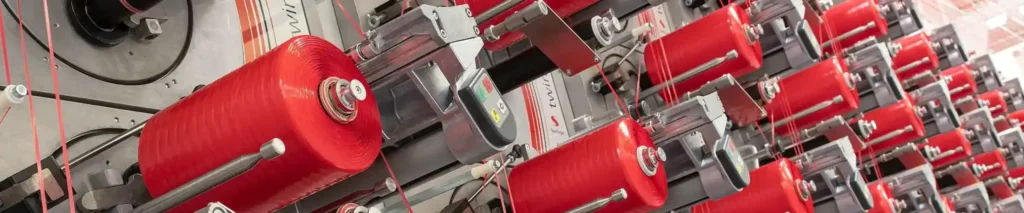
Consistency beats heroics. VidePak standardizes on Austria’s Starlinger for tape extrusion/drawing, weaving, and coating, and Germany’s W&H (Windmöller & Hölscher) for high‑register printing, lamination, and precision converting. Stable tension, stable register, stable gauge—these are not slogans; they are risk controls that convert variability into predictability.
Upstream: raw‑material selection and checks
- Virgin PP matched to melt‑flow and draw targets; pellet moisture verified; CoAs reconciled; off‑spec quarantined.
- Masterbatches for UV, antistat, and color checked for compatibility and let‑down stability.
- Films and papers audited for gauge, haze/opacity, and surface energy; liners assessed for gauge, slip, and hygiene class.
Core manufacturing
- Tape extrusion & drawing (Starlinger): film extruded, slit to tapes, draw‑oriented to align molecules; tight tape width/gauge stabilizes weaving and seam integrity.
- Weaving: circular looms for tubular sleeves; flat looms for panel builds; weave density set for load, porosity, and print needs.
- Coating/lamination: PP/PE coats create sealable faces and tune COF; BOPP reverse print laminated for premium graphics; paper/foil laminates added when tactile or barrier outcomes demand.
- Venting engineering: micro‑perfs or laser arrays applied per product PSD and fill profile; validated against dust and pillow indices.
- Printing (W&H presses): register precision holds small text; rub‑fast varnishes protect icons and codes; barcode x‑height and quiet zones proven.
- Conversion: cutting, gusseting, bottom formation, header options, and easy‑open features; photoeyes read eye‑marks to keep pace at speed.
- Palletizing: squareness targets; COF‑matched wrap recipes; corner boards for columns; pallet cards carry lot and revision.
Downstream QA and release
- Dimensions: width/height/gusset; tube squareness; header accuracy.
- Mechanicals: fabric tensile/tear; seam strength (sewn) or peel/burst (sealed); drop tests at specified temps.
- Surfaces: COF (bag/bag, bag/board), rub/adhesion, barcode readability, ΔE to golden sample.
- Venting: flow metrics at line speed; pillow index 10–30 min after sealing.
- Sampling: AQL‑driven release; retain packets archived per lot for trace.
The fewer the surprises on the floor, the quieter the claims inbox. Stable equipment + clear specs + disciplined tests = predictable pallets.
What Is the Application of Multi‑Wall Woven Bags?
Because their layers can be tuned without overbuilding, Multi‑Wall Woven Bags fit a wide industrial map. The scenarios below translate constraints into design choices you can order and defend.
- Agriculture & seed: breathable faces and optional micro‑perfs manage off‑gas; BOPP or paper facings raise shelf appeal; UV packages extend yard life.
- Food staples (flour, rice, sugar, salt): food‑grade inputs; tamper‑evident closures; liners for barrier; reverse‑printed BOPP shields regulatory text from rub.
- Fertilizers & soil amendments: coated/laminated faces resist humidity; matte stripes stabilize pallets over long inland hauls.
- Animal nutrition: odor‑sensitive mixes prefer thicker liners and peelable seals; antistat reduces dust attraction.
- Chemicals & resins: antistatic builds and controlled venting make high‑speed fills safer and cleaner; liner‑in‑bag simplifies hygiene.
- Minerals & building materials: abrasion‑tolerant fabric and reinforced bottoms; COF targets keep tall stacks aligned; graphic panels aid yard ID.
- Retail pet & garden: BOPP reverse print for premium presentation; easy‑open tear tapes; matte fronts that read like paper without the fragility.
Recommended reading
If you are configuring a custom spec for branding, barrier, and line speed, review this companion guide: tailored PP woven bag solutions.
How VidePak Controls and Guarantees the Quality
Quality is a schedule you can keep. VidePak converts standards into habits and habits into outcomes—step by step and shift by shift.
- Standards first: design and testing aligned with ISO/ASTM/EN/JIS. Suites include tensile/tear, seam efficiency or peel/burst, drop, compression/stack, COF, rub, barcode, and liner WVTR when specified.
- 100% new raw materials: virgin PP and certified masterbatches; compliant inks/varnishes; traceable liners. Predictable inputs simplify root‑cause analysis and raise first‑pass yield.
- Best‑in‑class equipment: Starlinger for extrusion/drawing/weaving/coating and W&H for lamination/printing/converting curb variation before it becomes downtime or claims.
- Full‑stack inspection: IQC on resins/films/inks; IPQC on tape width/gauge, weave density, bond strength, vent geometry, seal peel/burst; FQC on dimensions, mechanics, sift‑proofing, COF, graphics. AQL release with retains archived.
Why standards?
Comparable data builds trust across plants and audits. Only numbers with methods can be defended.
Why virgin inputs?
Predictable strength and bond behavior beat cheapness that arrives with surprises. Fewer surprises, fewer claims.
Why Starlinger & W&H?
Tight tension windows and crisp register are invisible safety nets that keep little errors from becoming big ones.
System Thinking: From Hazards to Specs to Outcomes
Treat Multi‑Wall Woven Bags as interacting subsystems. Decompose the problem—mechanics and load path, filling interface, moisture/odor control, identity and communication, logistics and pallet stability, end‑of‑life—and then recombine into a coherent spec that behaves the same way every shift.
| Subsystem | Levers | What Shifts When You Pull Them |
|---|---|---|
| Mechanics & load path | Fabric GSM/denier; hem or seal geometry; reinforcements | Drop survival; corner crush; seam retention |
| Filling interface | Vent pattern; liner venting; fill profile; jaw temp/pressure/dwell | Fill speed; weight variance; dust index; pillow index |
| Moisture & odor | Coat vs. BOPP; liner gauge/material; storage SOPs | Caking risk; aroma retention; shelf comfort |
| Identity & communication | Color coding; iconography; barcode targets; varnish | Right action at a glance; scan rates; rub‑fast text |
| Logistics | COF tuning; corner boards; wrap recipe; pattern | Topple frequency; damage rate; container utilization |
| End‑of‑life | Monomaterial PP; separable liners; recycling marks | Sorting ease; reclaim; waste avoidance |
Recombine thoughtfully. For odor‑critical organics, choose generous liner gauge and peelable seals. For moisture‑sensitive powders in coastal lanes, target lower WVTR and add matte varnish for pallet stability. For returns‑sensitive consumer packs, specify easy‑open features and rub‑fast graphics with larger barcode x‑height.
Parameters and Ranges: Color‑Coded Quick Reference
| Parameter | Typical Range / Options | Purpose / Notes |
|---|---|---|
| Fabric GSM | 70–120 g/m² | Strength vs. pliability; seam and drop performance |
| Weave density | 10×10 to 14×14 | Dimensional stability; porosity; print laydown |
| BOPP gauge | 18–35 µm | Rub‑fast premium graphics; barcode life |
| COF (bag/bag) | 0.35–0.55 via stripes/matte | Pallet stability through vibration and ramps |
| Seal plan | Hem ≥ 25 mm (sewn) or 8–14 mm heat‑seal | Tamper evidence; dust control; peel/burst margin |
Quality and Performance Tests That Matter
| Test | Protects Against | Tighten When |
|---|---|---|
| Seam strength (sewn) / peel‑burst (sealed) | Top/bottom pull‑out; leakers | High density products; dusty fills; cold starts |
| Drop | Corner crush; impact puncture | Rough yards; export; forklift ramp stress |
| COF | Stack slippage; wrap cuts | Tall columns; glossy laminates; sea vibration |
| Rub/adhesion | Illegible graphics/codes | Retail‑facing SKUs; high coverage prints |
| Vent flow & pillow index | Seal swell; rework | Fast fills; fine powders; low headspace SKUs |
Troubleshoot Once, Fix for Good
Most field issues trace to repeat offenders. A seam opens because hem depth is thin, the needle too large, or stitch density too low. A pallet leans because COF mismatches the wrap recipe. Odor escapes because liner gauge is light and seals are narrow. Each has a countermeasure you can code into the spec and train into the shift.
| Symptom | Likely Causes | Corrective Actions |
|---|---|---|
| Pillow after sealing | Vent density too low; aggressive fill profile | Increase micro‑perfs; add vent band; modulate fill profile |
| Seal leakers | Low jaw temperature/dwell; contamination | Raise temp/dwell; clean jaws; adjust fold geometry |
| Barcode scan failures | Gloss glare; ink/varnish mismatch | Add matte varnish; increase x‑height; retune ink set |
| Pallet slippage | Low COF; glossy BOPP | Matte balance; anti‑slip stripes; adjust wrap recipe |
| Sifted dust in transit | Over‑vented face; weak hem | Reduce perf density; increase hem depth/stitch density |
Cost, Risk, and the Pallet You Actually Ship
A unit price can seduce; a total cost can educate. The bag that looks cheap but pillows into its neighbor is not cheap. The line that moves fast but pushes rework downstream is not fast. Specify to the lane you have: define barrier bands, seal windows, pallet recipes; and measure outcomes you actually pay for—intact pallets per hundred shipped, rewrap hours per week, kilograms per container, claims per million, days between issues. Multi‑Wall Woven Bags specified with discipline will lower those numbers without calling attention to themselves.
A quiet KPI dashboard is not an accident; it is the echo of a well‑written specification executed on stable equipment by teams who watch the right numbers.
Sustainability and End‑of‑Life
Multilayer packaging can complicate recycling, but wise layer choices soften trade‑offs. Favor monomaterial PP structures—woven + PP coat + BOPP—so the package enters PP streams as a single family. Where liners are PE, make them separable and give clear on‑pack guidance. The highest‑impact sustainability move is durability: bags that do not fail prevent emergency repacking, wasted trips, and distressed product.
KPI Dashboard Ideas
- Mechanics: tensile/tear, seam strength or peel/burst, drop, compression.
- Dimensions: width/length/gusset variance, squareness, GSM, coat gauge.
- Seals: peel/burst distributions, dust index, weight variance, pillow index.
- Graphics: ΔE drift, register, rub resistance, barcode scan rate.
- Process: lamination bond strength, press waste, first‑pass yield (FPY).
- Field: claims per million, time to CAPA close, topple/overhang incidents.
RFQ/RFP Checklist for Multi‑Wall Woven Programs
- Product map: particle size distribution, bulk density, hygroscopicity, oil/fat level, odor sensitivity, flammability class.
- Lane map: fill method and rate, storage (indoor/yard), transport (road/sea/rail), climate extremes.
- Geometry: width × cut length, gusset yes/no, bottom format, squareness target, header and easy‑open options.
- Surface & graphics: coat vs. BOPP vs. paper; matte/gloss balance; iconography; barcode targets and quiet zones.
- Closure plan: hem depth and stitches/inch; or seal width and jaw temperature/pressure/dwell windows.
- COF & pallet recipe: bag/bag and bag/board COF targets; wrap tension; corner boards; brick/column pattern.
- QA plan: tests, acceptance bands, AQL, retain policy, reporting cadence.
- Sustainability: monomaterial preference; separable liner policy; end‑of‑life labeling.
Comparative Notes: Multi‑Wall Woven vs. Paper vs. Film
- Versus paper‑only sacks: woven PP tolerates abrasion and humidity; paper delivers tactile appeal but wrinkles and tears under wet handling unless reinforced.
- Versus monolayer films: films seal simply and run ultra‑fast; woven formats trade minor sealing complexity for superior tear/plunge resistance and stack discipline.
- When in doubt: map hazards (dust, humidity, abrasion, print wear) and choose the platform whose failure modes you can comfortably control on your floor.
Frequently Asked Questions (Straight Answers)
- Are all Multi‑Wall Woven Bags heat‑sealable? Only if the mouth face is coated/laminated with a sealable layer; uncoated woven requires sewing or tape.
- Do micro‑perfs weaken the bag? Correctly patterned vents bleed air without creating tear paths; validate with burst/drop tests at real line speed.
- Is BOPP recyclable with PP fabric? Yes, both fall under PP; many regions accept monomaterial PP builds. Label clearly and verify locally.
- How wide should a heat seal be? Typically 8–14 mm; widen for dusty lanes or higher variability; confirm via peel/burst distributions, not anecdotes.
- Why emphasize Starlinger and W&H? Consistency in tension control, register, and thickness translates to fewer excursions, higher FPY, and quieter claims inboxes.
Implementation Timeline (From Spec to First Shipments)
- Week 0–1: discovery—product map, lane map, compliance requirements.
- Week 1–2: draft spec—GSM, weave density, coating/lamination choice, vent plan, seal plan, COF targets, pallet recipe; begin artwork proofing.
- Week 2–3: pilot lot—run tensile/tear, peel/burst or seam tests, drop, COF, rub; on‑line trial at real fill rates; measure dust and pillow indices.
- Week 3–4: DOE adjustments; lock spec; finalize plates/cylinders; sign AQL and retain plan.
- Week 4–6: ramp with FPY monitoring; CAPA loop active; operator SOP snippets posted at stations.
Operator SOP Snippets (Adapt and Adopt)
Form & feed
Verify shoulder alignment; track eye‑marks; keep tension even; use anti‑static measures for dusty pellets; keep scrap indicators visible.
Sealing or sewing
Confirm jaw temperature/pressure/dwell or stitch‑per‑inch and needle size; audit peel/burst or seam pull every 50 bags; keep jaws/needles clean.
Print & code
Measure ΔE; check quiet zones; run rub tests on the intended surface; confirm QR/barcode scan at three angles and three distances.
Technical Case Notes (Condensed but Useful)
Multi‑Wall Woven Bags handled coastal export for a moisture‑sensitive premix. Raising coat from 18 µm to 25 µm and switching to fold‑over heat‑seals widened the sealing window and cut leakers by more than two‑thirds. Pallet wobble in a resin lane vanished when matte stripes lifted bag/bag COF from 0.28 to 0.42 and the wrap recipe was tuned. In a retail pet food SKU, direct‑print woven scuffed in transit; moving to BOPP reverse print with a matte/gloss split reduced rub complaints nearly to zero while improving scan rates through larger x‑height and cleaner quiet zones.
Glossary
- COF: coefficient of friction; governs pallet stability and wrap behavior.
- WVTR: water vapor transmission rate; lower values indicate better moisture barrier (liners).
- ΔE: color difference metric used for print QA and brand control.
- BOPP: biaxially oriented polypropylene; often reverse‑printed and laminated for premium graphics.
- CAPA: corrective and preventive action; closes quality loops with documented fixes.
Keyword Cluster (Natural Weaving)
multi‑wall woven bags; multi‑wall woven sacks; laminated woven pp bags; paper‑poly woven bags; kraft paper laminated woven sacks; aluminum‑foil laminated woven bags; polypropylene multi‑wall woven bags; woven pp with inner liner; barrier‑laminate woven sacks; recyclable woven polypropylene bags; bopp printed woven bags; anti‑slip woven sacks with matte stripes; breathable woven polypropylene packaging.
October 25, 2025
Multi-wall woven bags, also known as multi-wall woven sacks, are increasingly becoming a preferred choice for various packaging needs. Their unique construction and material properties offer a range of advantages that are especially beneficial in industries such as agriculture, construction, and food packaging. This article will delve into the benefits of multi-wall woven bags, the significance of laminated woven bags, and the various materials used in their production, including the differences in manufacturing processes such as co-extrusion blow molding.
Advantages of Multi-Wall Woven Bags
Multi-wall woven bags are characterized by multiple layers of woven fabric, which contribute to their durability and strength. Here are some key advantages:
- Enhanced Strength and Durability:
- The layered structure of multi-wall woven bags provides superior strength compared to single-layer alternatives. This makes them capable of holding heavier loads without the risk of tearing or breaking, making them ideal for packaging bulk materials.
- Protection Against Contamination:
- The multiple layers can offer better protection against moisture, dust, and contaminants, which is particularly crucial when packaging agricultural products or food items.
- Cost-Effectiveness:
- Although the initial investment might be higher, the durability and reusability of multi-wall woven bags can lead to long-term cost savings. Businesses benefit from reduced waste and lower replacement costs.
- Customization:
- Multi-wall woven bags can be customized in terms of size, color, and printing, allowing brands to maintain visibility and ensure that the bags meet specific requirements.
- Eco-Friendliness:
- Many multi-wall woven bags are made from recyclable materials, contributing to sustainability efforts within various industries.
The Role of Laminated Woven Bags
Laminated woven bags are a specific type of multi-wall woven bag that incorporates an additional layer of material, such as polyethylene or aluminum foil, to enhance barrier properties. Here are the primary advantages of laminated woven bags:
- Moisture Resistance:
- The laminate layer helps prevent moisture from penetrating the bag, making it suitable for packaging products sensitive to humidity.
- Improved Shelf Life:
- For food products, the additional barrier can help prolong shelf life by protecting against oxygen and light, which can degrade the quality of the contents.
- Versatility:
- Laminated woven bags can be used in various applications, including packaging grains, fertilizers, and chemicals, thanks to their enhanced protective features.
- Aesthetic Appeal:
- The smooth surface of laminated bags allows for high-quality printing, making them visually appealing for retail and marketing purposes.
Material Choices in Woven Bags
The choice of materials is critical in determining the performance characteristics of woven bags. Here are some commonly used materials:
- Polypropylene (PP):
- Known for its strength and resistance to chemical damage, PP is a common choice for woven bags. It is lightweight yet durable, making it ideal for various applications.
- Polyethylene (PE):
- Often used in the lamination process, PE adds moisture resistance and is flexible, enhancing the bag’s usability.
- Polyvinyl Chloride (PVC):
- While less common in woven bags due to environmental concerns, PVC can provide excellent durability and chemical resistance when needed.
- Aluminum Foil:
- Used primarily in laminated woven bags, aluminum foil offers excellent barrier properties, protecting sensitive products from moisture and light.
Manufacturing Processes: Co-Extrusion Blow Molding
Co-extrusion blow molding is a manufacturing technique that allows for the production of multi-layered films and bags. This process involves melting and extruding multiple materials simultaneously to create a single, cohesive product. The advantages of this technique include:
- Material Versatility:
- Different materials can be combined to achieve specific properties, such as strength, flexibility, and barrier resistance.
- Cost Efficiency:
- Co-extrusion can reduce material waste since multiple layers are produced in one process.
- Consistent Quality:
- The ability to control the thickness and composition of each layer results in a high-quality finished product.
Choosing the Right Multi-Wall Woven Bag
When selecting multi-wall woven bags, businesses should consider several key parameters to ensure they meet their specific needs. The following table summarizes these parameters:
| Feature/Parameter | Description |
|---|---|
| Material | Typically PP, PE, PVC, or Aluminum foil |
| Strength | High tensile strength suitable for heavy loads |
| Layer Structure | Multiple layers for enhanced durability |
| Moisture Resistance | Varies based on lamination; crucial for food packaging |
| Customization Options | Size, print, and color options available |
| Application | Ideal for agriculture, food, construction, and more |
Conclusion
Multi-wall woven bags offer a robust, versatile, and environmentally friendly packaging solution for various industries. Their layered construction, combined with advanced manufacturing techniques such as co-extrusion blow molding, ensures that they meet the evolving demands of the market. By understanding the advantages of laminated woven bags and the materials used, businesses can make informed decisions that enhance their operational efficiency and contribute to sustainability.
References
- A. P. Smith, “Advances in Woven Bag Technology: A Comprehensive Review,” Journal of Packaging Science and Technology, vol. 45, no. 3, pp. 123-135, 2022.
- J. K. Liu, “Material Choices for Industrial Woven Bags,” International Journal of Industrial Packaging, vol. 12, no. 2, pp. 89-102, 2023.
- R. T. Johnson, “The Role of Laminated Woven Bags in Modern Packaging,” Packaging Innovations Review, vol. 37, no. 4, pp. 56-72, 2021.
- T. B. Reynolds, “Understanding Co-Extrusion in Flexible Packaging,” Journal of Manufacturing Processes, vol. 29, no. 1, pp. 33-48, 2023.