
What are Kraft Paper Woven Bags?
A bag is not merely a container; it is a contract between product and journey, between brand and shelf, between manufacturer and market. Kraft Paper Woven Bags occupy an unusual middle ground: they present the warm, printable face of paper while drawing strength from the woven polypropylene skeleton and protection from polyethylene liners. This hybrid construction is deliberate, not accidental. It answers competing demands—appearance and robustness, compliance and logistics, sustainability and performance—within a single engineered system.
In short: Kraft Paper Woven Bags combine consumer-facing kraft paper surfaces with woven PP strength and inner PE protection to create packaging that is both attractive and industrially resilient.
Why should you care? Because packaging decisions ripple. A change in liner thickness can alter moisture ingress; a change in seam pattern can transform stackability; a change in outer surface can shift buyer perception. Each choice carries technical, commercial, and environmental consequences. The following sections unpack those consequences, examine trade-offs, and propose practical selection and validation pathways.
Product names and keyword focus
This article centers on the keyword Kraft Paper Woven Bags and related long-tail variants. To aid searchability and clarity, the following aliases will be used interchangeably and emphasized throughout the text: Kraft Paper laminated Woven Bags, Kraft Paper Woven Sack, Multi wall Kraft Paper Woven Bags, Paper Valve Woven Bags, and Kraft Paper Sacks. These variants reflect construction choices and use-case subtleties; their differences will be highlighted where relevant.
The material composition of Kraft Paper Woven Bags
A robust product brief begins with materials. Each layer has a job; each job has measurable attributes. Understanding what each layer does, why it matters, and how it impacts cost and recyclability is the first step toward an optimized specification.
Kraft paper supplies printability, a natural look, and perceived sustainability. Grammage decisions (commonly 70–120 g/m²) affect stiffness and handling. However, on its own, paper lacks moisture resilience—hence lamination or inner liners in most commercial designs.
PP tapes form the woven backbone, providing tensile strength, puncture resistance, and seam reliability. Fabric grammages often span 90–150 g/m². The combination of tape width, draw-ratio and weave density determines mechanical capacity and price sensitivity to resin markets.
PE liners control moisture ingress and product migration. Typical thickness ranges from 15 to 50 g/m². Thicker films reduce Moisture Vapor Transmission Rate (MVTR) but increase cost and may affect recyclability when trying to separate layers.
Additional functional layers such as BOPP lamination, metallized foil, adhesives, anti-slip coatings, and printing inks are applied selectively. Each adds capability—gloss, aroma barrier, or frictional grip—but each also introduces complexity in recycling pathways. Balancing performance against end-of-life impacts is a central theme in modern packaging design.
Key features and performance metrics of Kraft Paper Woven Bags
Features alone have no value unless they map to outcomes: fewer claims, lower spoilage, faster fill rates, improved shelf appeal. Below we translate features into measurable metrics and decision rules.
High tensile strength, tailored MVTR, aroma protection, and pallet-ready geometry—these are the operating promises of Kraft Paper Woven Bags.
Mechanical strength. Measured by tensile and seam strength, these figures determine maximum safe filled weight and the bag’s resistance to forklift or conveyor abuse. Common targets range to exceed typical values for sewn sacks to reduce seam failures and drop-damage.
Barrier performance. MVTR (measured in g/m²/day) is the primary metric that informs liner selection. For hygroscopic materials, target MVTRs below 2 g/m²/day are often necessary to prevent caking and microbial growth in transit.
Aroma and volatile protection. For spices and other volatile-rich goods, metallized or multi-layer liners reduce aroma loss and protect sensory quality. This translates to higher acceptance rates at destination and less value depreciation.
Palletization and stacking behavior. The bag’s stiffness, geometry, and any anti-slip finish determine stacking height and in-transit stability. Good design increases pallet density and reduces the incidence of collapsed stacks—therefore lowering freight claims.
Production process: from raw materials to finished Kraft Paper Woven Bags
Producing high-quality bags is a chain of controlled steps. Each link must meet specification to deliver consistent product performance. Below is an end-to-end walkthrough that highlights critical control points and the reasoning behind them.
Pre-production: supplier qualification and incoming inspection
Start with supplier selection. Require Certificates of Analysis (COAs), manufacturing specifications, and proof of compliance with relevant food-contact regulations if the bag will touch edible goods. Incoming tests should include grammage verification, MFI (melt flow index) for polymers, moisture content, visual checks, and random mechanical testing of slit tapes and paper reels.
Core manufacturing steps
Core steps include tape extrusion (if performed in-house), weaving, printing and lamination, cutting, valve insertion (for valve bags), sewing or heat-sealing, and finishing. Each stage has measurable parameters:
- Tape extrusion: manage film thickness, slit tolerance, and additive dispersion. Variability here propagates downstream into fabric strength.
- Weaving: control pick count, warp/weft tension, and selvedge quality. Precision looms reduce dimensional variance and seam issues.
- Printing & lamination: choose printing technology (rotogravure vs flexo) and lamination method (extrusion or adhesive) based on barrier and recyclability priorities.
- Conversion & finishing: ensure valve alignment, seam stitch counts, and consistent heat-seal profiles to avoid leaks during filling.
Using advanced equipment—precision looms, stable extruders, and high-registration printing lines—reduces defect rates. Manufacturers investing in top-tier machinery typically achieve tighter tolerances and higher first-pass yields.
Quality control: metrics and sampling strategies
Quality control is not a single test, but a program. It begins before production and continues through shipping. Below are core QC pillars and how they should be implemented.
- Incoming material verification: COAs, random physical tests, and documentation checks.
- In-process control: SPC charts for critical parameters (tape width, fabric grammage, lamination bond strength).
- Final inspection and tests: AQL-based sampling for dimensional conformity, tensile and seam strength, MVTR/OTR for barrier performance, and visual/print quality checks.
- Traceability: record raw-material lot numbers, machine IDs, operator IDs, and test data for each finished batch.
When a non-conformance occurs, perform structured root-cause analysis (5-Why or fishbone), implement corrective actions, and monitor for recurrence. Continuous improvement is not optional; it is necessary to maintain process capability as orders scale.
Where Kraft Paper Woven Bags are used: applications and case nuances
Applications range across food, feed, specialty ingredients, and some industrial sectors. But the same bag construction can be tuned to different uses by altering liners, grammage, lamination and finishing. Below are common application categories and the design levers that matter most in each.
Flour, grains and powdered food ingredients
These commodities demand dust control, moisture resistance, and robust seams. Typical solutions use 25–50 kg bag sizes, PE liners of adequate thickness to hit MVTR targets, and reinforced seams for stacking and handling. Valve designs can enhance fill speed and minimize dust during filling operations.
Spices and volatile-rich products
Aroma retention is the principal need. Here, metallized liners, multi-layer laminates, and tight seals reduce odor migration. The trade-off is recyclability: metalized layers complicate recycling streams, so product teams must weigh retained product value against end-of-life impact.
Retail-facing pet foods and specialty blends
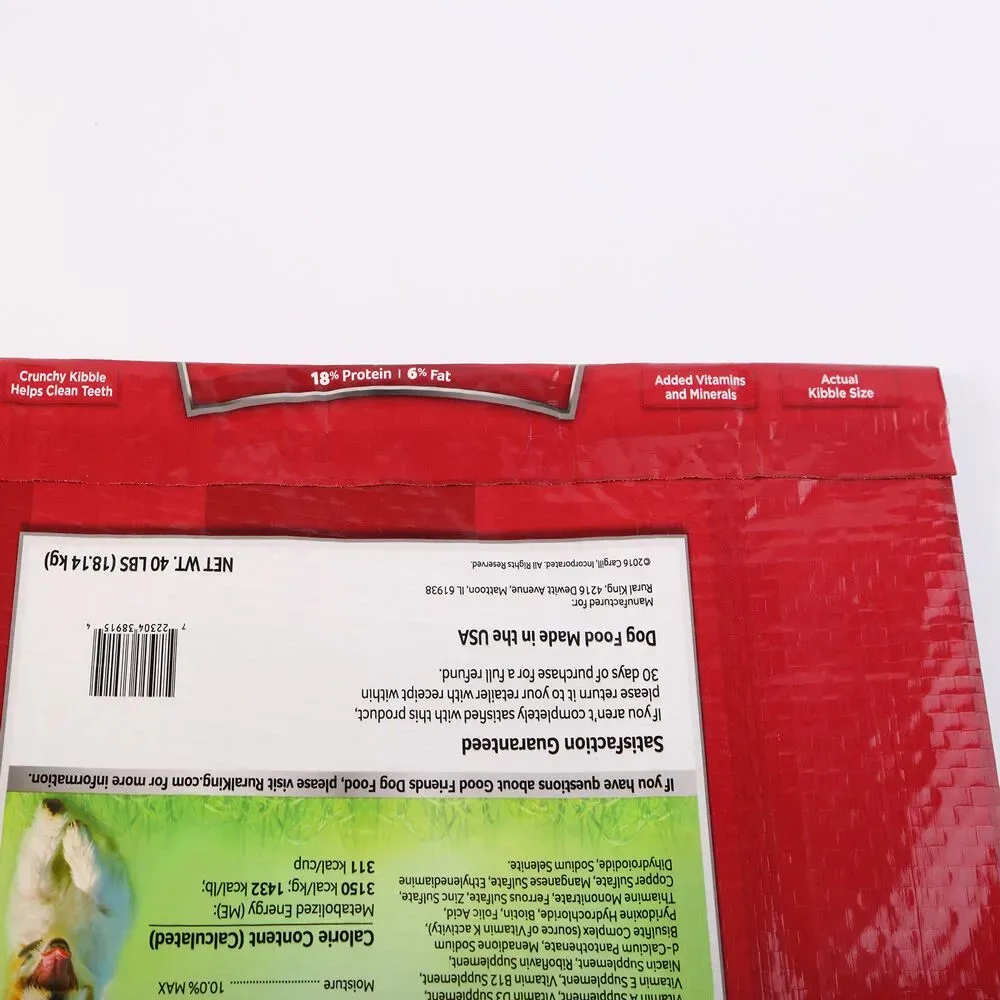
These packs need to look good on the shelf while surviving pallet handling. Laminated kraft faces with rotogravure printing deliver premium aesthetics; woven PP cores provide the necessary mechanical resilience.
System-level thinking: decomposing the packaging decision
A useful method for selecting and validating packaging is systems thinking: break the decision into subproblems, solve each with measurable criteria, and then integrate. Below is a practical decomposition and recommended solutions.
Subproblem A: Protecting product integrity
Define the product’s vulnerabilities: water activity, particle size, volatility, abrasion. Then map to barrier and liner choices. For example, low water activity goods may survive with thinner liners, whereas hygroscopic powders need thicker PE or metallized options.
Subproblem B: Filling and handling compatibility
Match bag geometry and valve options to filling lines. High-speed valve fillers require precisely positioned valves and consistent welds. Mismatches lead to downtime and damage; specification ignorance is expensive.
Subproblem C: Logistics resilience and pallet strategy
Stacking height, pallet pattern, and anti-slip finishes influence in-transit stability. Choose stiffness and geometry to minimize deformation under compression. Small changes in grammage or gusset size can yield major improvements in pallet density.
Technical parameter table (colored and practical)
A practical table below summarizes typical specification ranges used in the industry. These are starting points for pilots and must be validated against your product and logistics profile.
| Parameter | Typical Range | Application note |
|---|---|---|
| Outer kraft paper grammage | 70–120 g/m² | Higher for better printing and stiffness. |
| Woven PP grammage | 90–150 g/m² | Select for load and puncture resistance. |
| PE liner thickness | 15–50 g/m² (or microns) | Thicker lowers MVTR; trade-off with cost. |
| Target MVTR | <2 g/m²/day (high-barrier) | Critical for hygroscopic products. |
| Filled weight | 5–50 kg | 25–50 kg common for flour, feed. |
| Stacking capability | Up to 12–15 pallets optimized | Depends on geometry and load. |
How VidePak ensures quality for Kraft Paper Woven Bags
A robust supplier demonstrates traceability, standards alignment, and continuous improvement. The following stepwise program outlines a practical quality assurance approach.
- Standards-driven design: Map product attributes to international standards and customer requirements (ISO, ASTM, EN, JIS), then translate those into testable acceptance criteria.
- New, traceable raw materials: Procure virgin PP, PE and paper from reputable suppliers; require COAs and supplier audits to reduce variability.
- Best-in-class equipment: Invest in precision looms, stable extruders and high-registration printing/lamination lines to minimize process variance and improve registration quality.
- Comprehensive QC workflow: Implement incoming, in-process and final checks; use SPC; apply AQL sampling; and maintain batch-level traceability.
For new products or markets, run pilot batches and full acceptance testing at the packer or filler. Validate fill-line compatibility and in-field durability before committing to large production runs.
Economic and environmental trade-offs
Cost is not only material price. Think in Total Cost of Ownership terms: unit cost, spoilage avoided, freight claims avoided, filling downtime avoided, and end-of-life disposal. A more expensive bag that reduces spoilage and freight claims can lower landed cost. Conversely, a cheaper bag that fails in transit creates hidden costs that exceed the initial savings.
Environmental trade-offs are equally nuanced. Single-material mono-polymer constructs ease recycling, but might not deliver the barrier required to prevent spoilage. Multi-material laminates secure product quality but complicate recycling. The right choice depends on local recycling infrastructure and the product’s value proposition.
Related resources and further reading
For additional perspectives on related bag types and manufacturing technologies, consider these resources:
- Sewn open-mouth PP bags: customization and typical fields
- BOPP-laminated options and non-food construction uses
- Multiwall paper bags for chemical and fertilizer packaging
- Poly-paper hybrids as sustainable alternatives
- Block-bottom valve bags and automation integration
- Anti-bulge FIBC bags and coextruded film strategies
- FFS roll bags: parameters and performance characteristics
Practical checklist for procurement and engineering teams
- Characterize product vulnerabilities (water activity, particle size, volatility).
- Map logistics: transit time, climates, stacking patterns.
- Match bag geometry and valve options to filling equipment.
- Agree on MVTR and mechanical targets, then pilot and validate.
- Document end-of-life handling and recycling pathways.
Design patterns and integration tips
Good designs share common patterns: localize high-barrier materials to zones that require aroma or moisture protection; reinforce seam areas with extra tape or stitching; use BOPP lamination solely on display panels to reduce the volume of non-recyclable material. Small, disciplined choices compound into reliable outcomes.
Designing with data, validating with pilots, and iterating based on measured results turns packaging from a cost center into a strategic tool. The choices you make today set the performance and environmental footprints of tomorrow’s supply chains.
November 28, 2025
- What are Kraft Paper Woven Bags?
- Product names and keyword focus
- The material composition of Kraft Paper Woven Bags
- Key features and performance metrics of Kraft Paper Woven Bags
- Production process: from raw materials to finished Kraft Paper Woven Bags
- Pre-production: supplier qualification and incoming inspection
- Core manufacturing steps
- Quality control: metrics and sampling strategies
- Where Kraft Paper Woven Bags are used: applications and case nuances
- Flour, grains and powdered food ingredients
- Spices and volatile-rich products
- Retail-facing pet foods and specialty blends
- System-level thinking: decomposing the packaging decision
- Subproblem A: Protecting product integrity
- Subproblem B: Filling and handling compatibility
- Subproblem C: Logistics resilience and pallet strategy
- Technical parameter table (colored and practical)
- How VidePak ensures quality for Kraft Paper Woven Bags
- Economic and environmental trade-offs
- Related resources and further reading
- Practical checklist for procurement and engineering teams
- Design patterns and integration tips
- Key Features of Breathable Woven Bags
- Applications of Breathable Woven Bags
- Design and Customization Options
- Product Specifications: Breathable Woven Bags
- Advantages of Breathable Woven Bags
- Conclusion
In the world of packaging, Breathable Woven Bags stand out for their versatility, strength, and specialized design tailored to suit a variety of applications. These bags offer the unique feature of allowing airflow through the material, making them ideal for products that require ventilation during storage or transport. From agricultural products to industrial materials, breathable woven bags provide the perfect balance between durability and functionality.
Breathable PP Woven Bags Supplier
Professional manufacturer of high-quality breathable woven bags for various industrial applications.
Check More →Woven Fabric PP Bags Features
Core breathable and structural features of PP woven fabric bags for optimal ventilation.
Check More →Breathable PP Woven Bags Factory
Custom manufacturing of breathable woven bags with advanced design and production technology.
Check More →Heavy Duty HDPE Bags With Venting
Durable vented packaging bags designed with breathable properties for moisture control.
Check More →This blog will explore the features, applications, and design options of Breathable Woven Bags, discussing how they can be customized with different materials like PE liners and BOPP films. By understanding the specific needs of various industries, businesses can select the most appropriate breathable woven sacks to ensure optimal performance in any environment.
Key Features of Breathable Woven Bags
Breathable Woven Bags, also known as Breathable Woven sacks, are primarily made from woven polypropylene (PP) fabric. This material allows for the controlled passage of air, which is essential for products that need ventilation to prevent spoilage or moisture buildup. The weave structure in the fabric allows for small gaps, enabling the movement of air without compromising the bag’s strength or protective qualities.
Main Characteristics
- Ventilation
The key feature of Breathable Woven Bags is their ability to provide airflow. This is particularly useful for products such as grains, seeds, and certain chemicals that may generate moisture or heat. By allowing air to circulate, these bags help maintain the quality of the stored product. - Strength and Durability
Like other woven PP bags, breathable versions retain the excellent tensile strength of polypropylene. They are capable of carrying heavy loads without tearing, which is essential for industrial and agricultural uses. Additionally, the bags are resistant to punctures and abrasions, providing a long-lasting packaging solution. - Lightweight
Despite their strength, breathable woven sacks are lightweight. This makes them easy to handle, transport, and store. The lightweight nature also reduces shipping costs, making these bags a cost-effective option for bulk packaging. - Customizable
Breathable woven sacks can be customized with different designs and layers depending on the product’s specific needs. For instance, they can include internal liners made of PE (polyethylene) or have an external lamination with BOPP (biaxially oriented polypropylene) film to provide additional protection against moisture and contaminants. - Eco-Friendly
Polypropylene is a recyclable material, and many breathable woven sacks can be reused multiple times, making them an environmentally friendly packaging option. Businesses concerned with sustainability often opt for these types of bags to reduce their environmental impact.
Applications of Breathable Woven Bags
Due to their unique characteristics, Breathable Woven Bags are widely used across several industries. Below are some common applications:
Agricultural Sector
The agricultural industry is one of the largest consumers of breathable woven sacks. These bags are used to store and transport products like potatoes, onions, grains, seeds, and fertilizers. The ventilation provided by the woven structure helps keep these products fresh by preventing the buildup of moisture and heat. This is especially important for crops that need to “breathe” during storage to avoid spoilage.
Industrial Materials
In industries dealing with chemicals or powdered materials, breathable woven bags are often used for storage. The bags’ strength ensures that they can handle the heavy weight of bulk materials, while the breathable feature helps in managing condensation or heat buildup, which could otherwise lead to clumping or spoilage of the contents.
Food Packaging
Breathable woven bags are commonly used to package food products that require ventilation, such as flour, sugar, and rice. For these applications, the bags are often lined with PE or laminated with BOPP to provide additional moisture resistance while maintaining breathability.
Construction Materials
Materials like sand, cement, and gravel are sometimes packaged in breathable woven bags to prevent moisture accumulation during storage. In the construction industry, where materials are often stored in outdoor environments, the ventilation provided by these bags helps ensure the quality of the materials over time.
Design and Customization Options
When selecting Breathable Woven Bags, businesses can choose from several design options to suit the specific requirements of their product. These designs can vary based on the type of liner used, the lamination options, and the bag’s overall structure. Below are some common design types and how they affect the performance of the bag.
FFS PP Bags
FFS (Form-Fill-Seal) PP Bags are a popular choice for automated packaging processes. These bags are made from PP woven fabric and are specifically designed to be filled and sealed in a single, automated process. The form-fill-seal process is highly efficient, making it ideal for industries that require rapid packaging of large volumes of product.
FFS PP Bags are often used in conjunction with breathable woven materials for products that need ventilation during storage. For instance, in the agricultural and industrial sectors, FFS breathable woven bags are a common packaging solution for bulk products that benefit from airflow while being packed at high speeds.
PE Liner Integration
To further enhance the protective qualities of breathable woven sacks, many bags come with an internal PE (polyethylene) liner. This liner provides an additional barrier against moisture while maintaining the breathability of the bag. The liner is especially useful for products that are sensitive to moisture but still require some ventilation, such as certain chemicals, seeds, or food ingredients.
The PE liner can be easily integrated into the bag during the manufacturing process and provides a flexible option for customers who need enhanced moisture protection without compromising breathability.
BOPP Lamination
For products that require a more aesthetically pleasing appearance and enhanced protection, BOPP (biaxially oriented polypropylene) lamination is an excellent option. BOPP films can be applied to the outside of the woven bag, providing a smooth surface that is ideal for high-quality printing and branding.
BOPP-laminated bags are commonly used in consumer-facing industries where the packaging must be visually appealing. These bags offer additional moisture resistance while maintaining the durability and strength of the woven PP material. BOPP lamination can also be combined with breathable properties, allowing manufacturers to create a versatile bag that serves both functional and marketing purposes.
Product Specifications: Breathable Woven Bags
To better understand the capabilities and options of Breathable Woven Bags, the table below outlines some common product parameters:
| Parameter | Description |
|---|---|
| Material | Woven polypropylene (PP) |
| Breathability | Available with varying degrees of airflow |
| Bag Size | Customizable (e.g., 25 kg, 50 kg) |
| Liner Options | Optional PE liner for enhanced moisture protection |
| Lamination Options | BOPP lamination for high-quality printing and extra protection |
| Strength | High tensile strength, suitable for heavy loads |
| UV Protection | Available with UV stabilizers for outdoor storage |
| Printing | Customizable printing up to 8 colors |
| Recyclability | Fully recyclable depending on material composition |
| Applications | Agriculture, food packaging, industrial materials, construction |
Advantages of Breathable Woven Bags
Breathable Woven Bags offer several key advantages that make them a preferred choice for various packaging needs:
- Ventilation for Product Freshness
The most significant benefit of these bags is their ability to allow airflow, which helps maintain the freshness of perishable products. In industries like agriculture, this feature is critical for preventing spoilage and extending the shelf life of products. - High Strength and Durability
These bags provide excellent durability and can withstand rough handling and heavy loads. This makes them ideal for bulk packaging in industries such as construction and agriculture, where materials need to be transported and stored safely. - Cost-Effective
Breathable woven sacks are lightweight, which reduces shipping costs. Additionally, their durability means they can be reused multiple times, further increasing their cost-effectiveness for businesses. - Customizable Design
With various options for liners, lamination, and printing, Breathable Woven Bags can be tailored to suit the specific needs of different products and industries. This level of customization ensures that businesses can select a packaging solution that meets both functional and branding requirements. - Eco-Friendly
Made from recyclable polypropylene, these bags are an environmentally responsible choice for businesses looking to reduce their environmental impact. The option to reuse the bags also contributes to sustainability efforts.
Conclusion
Breathable Woven Bags offer a versatile and highly functional packaging solution for a wide range of industries. From agricultural products to industrial materials, these bags provide the necessary ventilation to keep products fresh and in good condition during storage and transport. With design options like PE liners and BOPP lamination, businesses can tailor their breathable woven sacks to meet specific product needs, ensuring optimal performance in any environment.
By understanding the characteristics and applications of breathable woven bags, businesses can make informed decisions about their packaging choices, ensuring the highest level of quality, efficiency, and sustainability for their products.