
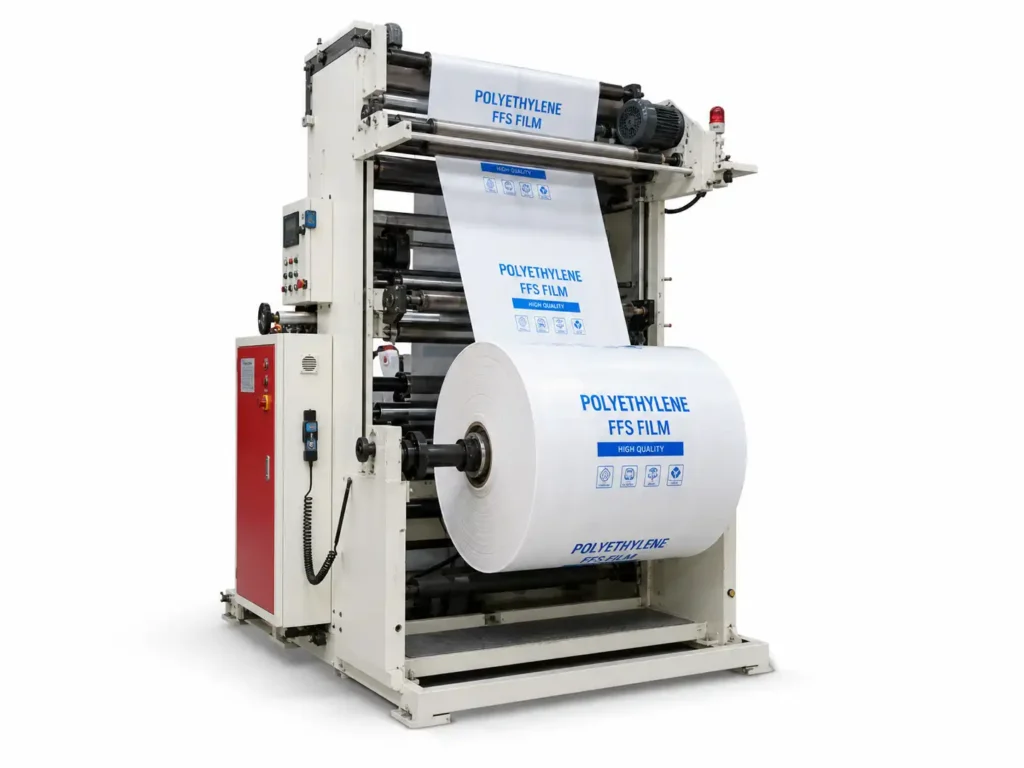
VIDEPAK FFS Roll Bags and FFS roll film: Reliable PE Packaging for Automated Industrial Lines
Industrial packaging has one clear job: keep production moving while protecting every kilogram from filling line to warehouse. A package must form cleanly, fill quickly, seal securely, travel without leaks, stack without sliding, and carry a clear brand message. VIDEPAK develops FFS Roll Bags and FFS roll film as one connected packaging system.
At the center of this system is PE, or polyethylene, a flexible and widely used film material that can be designed for strength, sealing, puncture resistance, stiffness, surface friction, moisture protection, and print quality. Through multilayer co-extrusion, different PE grades can perform different jobs inside one FFS polyethylene film. One layer can support smooth machine travel. Another can improve toughness. Another can create a stable heat seal. The result is a roll that becomes a bag, a bag that becomes a clean production unit, and a production unit that becomes a dependable part of the customer’s supply chain.
VIDEPAK’s published range includes multilayer co-extruded polyethylene bags and tubular films with options of up to nine layers, widths of 35–65 cm, thicknesses of 0.10–0.25 mm, roll diameters of 100–150 cm, and printing in up to ten colors. Final specifications must match the product, bag weight, machine, sealing jaws, logistics route, and climate.
What FFS Roll Bags and FFS roll film Mean in Real Production
From a continuous roll to a finished package
FFS Roll Bags are not normally supplied as separate empty sacks. They begin as a continuous tube or web of FFS roll film wound on a reel. On an automatic form-fill-seal line, the machine pulls the material forward, forms the package length, seals one end, fills the measured product, seals the other end, and cuts or separates the completed bag. Forming, filling, and sealing take place in one linked cycle. This is the core reason the format supports automation: fewer manual steps, fewer loose bags to handle, and a more direct path from product dosing to palletizing. VIDEPAK describes tubular FFS polyethylene film as a solution for high-speed automated filling of bulk products such as grains, fertilizers, and chemicals.
Key idea: The value of FFS Roll Bags does not come from the bag alone. It comes from the fit between the FFS roll film, the filling machine, the sealing window, the packed product, and the transport route. A good manufacturer designs these factors together.
The terms buyers often use
The words overlap, but the buying questions differ. Customers see FFS Roll Bags; engineers manage FFS roll film; quality teams define FFS polyethylene film tests and tolerances; procurement evaluates the manufacturer. VIDEPAK brings these views into one specification.
How PE Builds the Performance of FFS polyethylene film
One material family, several useful behaviors
PE is not one single resin with one fixed behavior. High-density polyethylene can add stiffness and shape control; low-density polyethylene can support processing flexibility; linear low-density polyethylene can add tensile strength, stretch, impact resistance, and puncture resistance. Official resin guidance describes HDPE as strong and rigid, LDPE as flexible and easy to process for film, and LLDPE as a balance of strength, puncture resistance, stretch, and durability. This is why a skilled manufacturer may combine several PE grades instead of asking one resin to do everything.
Stiffness and forming
An HDPE-rich layer can help FFS roll film track, fold, and form with better shape control. It can also help filled FFS Roll Bags stand more squarely on the conveyor and pallet.
Toughness and impact
LLDPE and related performance PE grades can raise puncture resistance, elongation, and impact strength, helping FFS polyethylene film survive drops, sharp product edges, and rough handling.
Sealing and hot tack
A seal-focused inner layer helps the jaws create a stable closure during a short machine cycle. Strong hot tack supports the seal while it is still warm and under load.
Why multilayer co-extrusion matters
In a multilayer structure, each layer has a clear task. The outer skin may be tuned for printing, machine contact, scuff resistance, and controlled slip. The core may carry much of the mechanical load. The inner skin may be designed for seal initiation, seal strength, and contact with the packed product. Optional additives can support anti-block behavior, anti-slip performance, ultraviolet resistance, static control, color, opacity, or controlled venting. The structure is one film, yet it behaves like a small team: one layer guides, one layer carries, one layer closes.
VIDEPAK states that its heavy-duty polyethylene products can be made with up to nine co-extruded layers. More layers do not automatically mean a better package; they mean the manufacturer has more freedom to place specific functions where they are needed. A well-designed three-layer FFS polyethylene film may be ideal for one product, while a more complex structure may help another product balance stiffness, impact, sealing, appearance, and processing. The right question is not “How many layers can we buy?” but “What should every layer do?”
Design rule: Stronger is not always faster, and faster is not always safer. The best FFS roll film balances stiffness with flexibility, low friction with pallet grip, easy sealing with heat resistance, and low material use with enough safety margin.
Mono-material thinking and practical sustainability
Because the structure can remain within the polyethylene family, PE-based FFS polyethylene film can support mono-material design, subject to inks, additives, and local recycling rules. This does not make every bag recyclable everywhere. A responsible manufacturer should first protect product performance, then evaluate source reduction, film optimization, and suitable recycled-content options.
The Parameters That Control FFS roll film Performance
A specification is a working agreement
The specification for FFS Roll Bags should connect material values with line behavior and logistics results. Width affects forming and filled-bag shape. Thickness affects strength, sealing energy, and material use. Roll diameter affects run time between changes. Friction affects both web travel and pallet stability. Venting affects how quickly powder-filled bags release trapped air. Print repeat affects eye-mark reading and graphic position. No single value can be selected alone.
Published VIDEPAK values in the table describe available production capability, not a universal recommendation. A 25 kg resin pellet bag and a 25 kg fine mineral powder bag may need different FFS roll film, even though the filled weight is the same. Pellets may challenge puncture and corner impact; fine powder may challenge dust-tight sealing and air release. The manufacturer therefore needs product density, particle size, fill temperature, line speed, jaw style, drop height, pallet pattern, warehouse temperature, and transport route before locking the design.
The important trade-offs
Thickness versus efficiency: Increasing gauge can raise the safety margin, but it also increases material use and may change sealing energy. Better resin selection and better layer placement may sometimes improve performance without a simple one-for-one increase in thickness. The target is not the thickest FFS polyethylene film; it is the lightest structure that repeatedly passes line, drop, seal, and logistics requirements.
Slip versus stack stability: Low friction can help FFS roll film move through guides and over metal surfaces, but an outer surface that is too slippery can reduce pallet stability. Anti-slip areas, embossing, resin selection, and additive control can separate “move here” from “hold here.” ASTM D1894 is the standard method used to measure static and kinetic coefficients of friction for plastic film and sheeting, but the useful target must still be set around the customer’s equipment and pallet design.
Easy sealing versus heat resistance: A low seal-initiation temperature can support speed and reduce the risk of incomplete sealing during short dwell times. Yet the seal also needs enough hot tack to resist product pressure while warm, and enough final strength after cooling. The manufacturer should study the full sealing window rather than offer one temperature as a universal setting.
How VIDEPAK Manufactures and Controls FFS polyethylene film
A controlled flow from resin to reel
Confirm PE grades, color, slip, anti-block, UV, and compliance needs.
Build the layer structure and control melt flow, bubble stability, and thickness.
Prepare the surface, print graphics, and control repeat and registration.
Set tube geometry, tension, edge alignment, roll diameter, and core fit.
Check dimensions, mechanics, friction, seal behavior, print, and roll condition.
A reliable manufacturer controls more than the final bag. Incoming materials must be identified. Extrusion conditions must remain stable. Film thickness must be measured across the web and along the roll. Surface treatment must support ink adhesion. Printing must match artwork and eye-mark position. Gussets must remain consistent. Winding tension must be strong enough to build a stable reel but not so high that the tube blocks, stretches, or develops hard bands. Each stage affects the next; each small variation can become a large line problem.
VIDEPAK states that it uses multilayer co-extrusion technology for heavy-duty PE bags and tubular film, and that it follows an ISO 9001:2015 quality-management framework. ISO 9001 does not replace product testing, but it gives the manufacturer a system for controlled procedures, records, corrective actions, and continuous improvement. VIDEPAK also states that its products are developed and tested with reference to international standards, including ASTM, JIS, EN, and AS requirements as applicable.
Tests that turn claims into evidence
ASTM D882 applies to tensile testing of thin plastic sheeting and film; ASTM D1709 measures impact resistance by a free-falling dart; ASTM D1894 covers static and kinetic friction; and ASTM F88/F88M measures seal strength in flexible barrier materials. These methods create a shared language, but acceptance limits must be agreed for each project. A result is useful only when it connects to a real failure mode: web break, puncture, sliding pallet, weak seal, or inconsistent bag size.
VIDEPAK quality principle: test the material, test the seal, test the roll, and test the filled package. Laboratory control finds variation; line validation proves usability; logistics testing proves protection.
Where FFS Roll Bags Create the Most Value
Resin pellets and masterbatch
Polymer pellets flow quickly but can create sharp point loads at corners during drops and transfers. For this use, FFS Roll Bags need strong seals, puncture resistance, stable dimensions, and controlled surface friction. Clear, white, or colored FFS polyethylene film can match visibility and brand needs, while accurate print repeat supports eye-mark reading.
Fertilizer, feed, grain, and agricultural inputs
These products often combine high weight with long distribution routes and changing humidity. The PE structure must resist handling damage and limit unwanted moisture entry, while venting may be needed to release air trapped during fast filling. Gusseted FFS roll film can help the bag settle into a more regular shape, improving pallet use and warehouse appearance. The design should also consider dust, product temperature, seasonal storage, and outdoor exposure.
Fine powders, minerals, salts, and building materials
Fine particles can enter the sealing area and trap air, leaving a swollen bag. The answer is not simply more holes. A good manufacturer balances air release with product retention, moisture protection, and cleanliness. Perforation pattern, film stiffness, gusset depth, and filling speed should be tested together. Abrasive products may also need extra puncture and tear margin in the FFS polyethylene film.
Chemical and specialty industrial products
Industrial chemicals vary widely, so compatibility must be reviewed case by case. Product form, temperature, chemical contact, regulatory classification, static behavior, contamination sensitivity, and dangerous-goods rules may all change the required design. VIDEPAK can customize FFS Roll Bags with color, printing, venting, anti-slip features, and multilayer PE construction, but the final package must be qualified for the exact product and destination market. A responsible manufacturer does not treat the word “chemical” as one specification.
Choose a flat tube when
The machine is designed for a simple tube, the product fills evenly, and the target pallet geometry does not require extra side volume.
Choose gusseted FFS roll film when
The pack needs more volume, squarer corners, a defined face panel, or improved filled-bag shape for stacking and presentation.
Add venting when
Fast filling traps air and slows settling, but only after testing product loss, dust release, moisture needs, and hole blockage.
The information VIDEPAK needs for a precise proposal
A fast quotation can be based on size and thickness. A reliable proposal needs more. VIDEPAK recommends sharing the packed material, net weight, bulk density, particle size, fill temperature, target bags per minute, machine model, tube width, current film thickness, roll core, maximum roll diameter, gusset depth, print artwork, eye-mark position, venting need, pallet pattern, drop height, storage climate, and destination regulations. Samples of the current FFS Roll Bags and a short filling video can reveal details that a drawing may miss.
This information lets the manufacturer work backward from the real process. The team can estimate filled volume, define tube geometry, select a PE layer structure, set a thickness window, choose surface properties, prepare printing, and plan trial rolls. First understand the product. Then understand the machine. Then design the FFS polyethylene film. This order reduces guesswork and shortens the path to stable production.
Why Buyers Choose VIDEPAK as Their manufacturer
Capability that connects design, production, and supply
VIDEPAK is an industrial packaging manufacturer founded in 2008. The company publishes an annual overall bag production capability of up to 800 million pieces and states that its polyethylene operation can supply more than 500 million heavy-duty PE bags annually. For the FFS roll film range, VIDEPAK publishes widths of 35–65 cm, thicknesses of 0.10–0.25 mm, roll diameters of 100–150 cm, up to nine co-extruded layers, and printing in up to ten colors. These capabilities allow one source to support both standard programs and highly customized FFS Roll Bags.
Capacity matters, but repeatability matters more. A large reel is valuable only if it unwinds evenly. A strong film is valuable only if it seals within the customer’s normal operating window. A bright print is valuable only if it stays registered and readable. A low price is valuable only if the line does not lose it through stops, leaks, rejects, and unstable pallets. VIDEPAK’s approach is to connect material design, dimensional control, printing, winding, testing, and technical communication so the customer buys usable production, not just kilograms of film.
Customization without losing control
VIDEPAK can engineer FFS polyethylene film around bag width, thickness, layer count, gusset style, color, opacity, print design, anti-slip needs, embossing, micro-perforation, sealing behavior, roll diameter, and core size. Customization is not decoration added at the end. It begins with machine and product data, then continues through trial, approval, and controlled repeat production. The manufacturer and customer should agree on critical tolerances, test methods, artwork version, packing method, pallet format, labeling, and change-control rules before full-scale supply.
The VIDEPAK value equation
Stable PE structure + controlled FFS roll film geometry + reliable sealing + clear printing + verified roll quality = fewer interruptions, cleaner packages, stronger pallets, and more predictable cost.
Support from first sample to repeat order
VIDEPAK can review the current package, propose a starting specification, and prepare trial FFS roll film. Sealing, drop, leak, stack, and transport results guide adjustment. During repeat production, approved standards and traceable records support consistency. If a problem occurs, roll number, batch data, samples, photos, line settings, and failure location give the manufacturer evidence for analysis.
This service model is valuable when customers change from pre-made sacks to FFS Roll Bags, raise line speed, reduce gauge, launch artwork, or pack a new product. Change creates risk; controlled trials turn risk into data. VIDEPAK follows a clear sequence: define, sample, run, measure, improve, approve.
Frequently Asked Questions About VIDEPAK FFS Roll Bags
Are FFS Roll Bags the same as FFS roll film?
They describe two stages of the same system. FFS roll film is the continuous material supplied on the reel. The automatic machine turns that material into filled and sealed FFS Roll Bags. Buyers often use the terms as synonyms, but technical specifications should clearly state whether a value refers to the reel, the tube, or the finished bag.
What is the best thickness for FFS polyethylene film?
There is no single best thickness. VIDEPAK publishes a production range of 0.10–0.25 mm for its heavy-duty polyethylene film, but the correct gauge depends on load, density, particle shape, fill temperature, drop height, sealing system, venting, route, and safety margin. The right manufacturer validates performance rather than selecting thickness by habit.
Can VIDEPAK print high-quality graphics on FFS roll film?
Yes. VIDEPAK publishes printing capability of up to ten colors for this product range. Final results depend on artwork, color targets, film color, surface treatment, ink system, print repeat, eye marks, and scuff requirements. Early artwork review helps align brand goals with production limits.
Can PE FFS Roll Bags include anti-slip and venting features?
Yes. VIDEPAK lists embossing, micro-perforation, and related surface or air-release options for heavy-duty polyethylene packaging. These features should be positioned and tested around the filling line and pallet pattern. Too much slip may reduce stack safety; too little may harm machine travel. Too much venting may release dust or admit moisture; too little may leave the bag swollen. Balance is the design goal.
How should a buyer compare one manufacturer with another?
Compare more than price per kilogram. Review layer capability, dimensional tolerances, roll winding, print control, test methods, trial support, quality records, delivery planning, traceability, and problem response. Ask how the proposed FFS polyethylene film was selected and which tests will confirm it. A capable manufacturer should explain not only what it can make, but why the design fits the customer’s product and machine.
Built for speed. Designed for protection. Supported by evidence.
VIDEPAK FFS Roll Bags combine automated packaging efficiency with the adaptable performance of PE. VIDEPAK FFS roll film can be engineered for forming, filling, sealing, printing, venting, handling, and stacking as one connected system. With multilayer FFS polyethylene film, broad customization, published heavy-duty production capability, and a quality approach based on controlled processes and recognized test methods, VIDEPAK gives industrial buyers a clear path from packaging problem to validated solution. Not film alone. Not a bag alone. A reliable packaging program from an experienced manufacturer.
- VIDEPAK FFS Roll Bags and FFS roll film: Reliable PE Packaging for Automated Industrial Lines
- What FFS Roll Bags and FFS roll film Mean in Real Production
- How PE Builds the Performance of FFS polyethylene film
- The Parameters That Control FFS roll film Performance
- How VIDEPAK Manufactures and Controls FFS polyethylene film
- Where FFS Roll Bags Create the Most Value
- Why Buyers Choose VIDEPAK as Their manufacturer
- Frequently Asked Questions About VIDEPAK FFS Roll Bags
- Are FFS Roll Bags the same as FFS roll film?
- What is the best thickness for FFS polyethylene film?
- Can VIDEPAK print high-quality graphics on FFS roll film?
- Can PE FFS Roll Bags include anti-slip and venting features?
- How should a buyer compare one manufacturer with another?
- Built for speed. Designed for protection. Supported by evidence.
- What are FFS Roll Bags?
- Key Product Parameters of FFS Roll Bags
- Advantages of FFS Roll Bags
- Comparison with Other Types of Woven Bags
- Conclusion
Flexible packaging solutions have become increasingly popular in various industries due to their versatility and efficiency. Among these solutions, FFS Roll Bags stand out for their adaptability and ease of use in packaging processes. This article explores the characteristics of FFS Roll Bags, including how many bags are typically included in a roll, as well as key product parameters such as thickness, weight, size, and weight capacity.
What are FFS Roll Bags?
FFS Roll Bags (Form-Fill-Seal Roll Bags) are a type of flexible packaging made from woven polypropylene (PP) or other materials. They are produced in a continuous roll, allowing for high-speed filling and sealing during the packaging process. FFS Roll Bags are commonly used in various applications, including food packaging, agricultural products, and industrial materials.
How Many Bags Are Typically in a Roll?
The number of bags per roll can vary based on several factors, including the size and specifications of the bags, the manufacturer, and the intended application. Generally, a standard roll of FFS bags may contain anywhere from 100 to 1,000 bags. Here are some factors that can affect the number of bags in a roll:
- Bag Size: Smaller bags will allow more bags to fit on a roll. Conversely, larger bags will result in fewer bags per roll.
- Thickness and Weight: Thicker and heavier materials may take up more space, thereby reducing the total number of bags in a roll.
- Manufacturing Standards: Different manufacturers may have varying production standards, leading to differences in the number of bags produced on a roll.
Key Product Parameters of FFS Roll Bags
When selecting FFS Roll Bags for specific applications, understanding key parameters is essential. These parameters help ensure that the bags meet the requirements for durability, functionality, and compliance with industry standards. Here are some of the critical product parameters:
1. Product Thickness
The thickness of FFS Roll Bags is crucial for determining their durability and suitability for various applications. Thickness is typically measured in microns or mil, with thicker bags generally offering greater strength and resistance to tearing.
- Standard Thickness: Common thickness ranges for FFS Roll Bags are from 50 to 120 microns. Thicker bags are often used for heavy-duty applications, while thinner bags may suffice for lighter products.
- Impact on Cost: While thicker bags provide added strength, they may also be more expensive. Thus, manufacturers must balance cost and performance based on the intended application.
2. Product Weight (GSM)
The weight of FFS Roll Bags is usually expressed in grams per square meter (GSM), which is a measure of the fabric’s density. A higher GSM typically indicates a heavier and more robust bag.
- Weight Range: FFS Roll Bags can have GSM values ranging from 40 to 120 GSM, depending on the specific application. For example, bags used for packaging heavy agricultural products might have a higher GSM compared to those used for lightweight food items.
- Durability: The GSM plays a significant role in the bag’s ability to hold weight and withstand stress during handling and transport.
3. Product Size
The size of FFS Roll Bags can vary significantly based on their intended use. Standard sizes typically include:
- Width: Ranges from 30 cm to 120 cm, allowing for flexibility in packaging different types of products.
- Length: Can vary based on customer requirements, usually between 50 cm and 150 cm.
- Capacity: The size of the bag directly influences how much product it can hold, which is critical for efficient packaging processes.
4. Weight Capacity
The weight capacity of FFS Roll Bags is an essential consideration, especially for products that are heavy or bulky. The weight capacity is affected by several factors, including:
- Material Strength: Woven polypropylene bags are known for their high tensile strength, allowing them to hold considerable weight.
- Design Features: Some bags come with reinforced seams or additional layers to enhance their load-bearing capacity.
Typically, FFS Roll Bags can support weights ranging from 5 kg to 50 kg, depending on the bag’s dimensions and thickness.
Advantages of FFS Roll Bags
- Efficiency in Production: The roll format allows for continuous production, which minimizes downtime during packaging operations.
- Versatile Applications: FFS Roll Bags can be used for a wide variety of products, including food, pet food, and agricultural materials.
- Cost-Effectiveness: The production of bags in rolls can be more economical, reducing labor costs and packaging waste.
- Customizable Features: Manufacturers can customize FFS Roll Bags with various features such as prints, colors, and closure methods to meet specific customer needs.
Comparison with Other Types of Woven Bags
While FFS Roll Bags are popular in the industry, it is important to consider how they compare with other types of woven bags, such as Tubular Woven Bags, FFS PP Bags, and FFS Woven Bags.
| Feature | FFS Roll Bags | Tubular Woven Bags | FFS PP Bags | FFS Woven Bags |
|---|---|---|---|---|
| Form | Continuous roll | Individual bags | Individual bags | Individual bags |
| Application | Versatile, food, agriculture | Primarily agricultural | Versatile, food, industry | Versatile, food, agriculture |
| Production Speed | High | Moderate | Moderate | Moderate |
| Customization Options | High | Moderate | Moderate | Moderate |
| Weight Capacity | 5 kg to 50 kg | Variable | 5 kg to 25 kg | 5 kg to 40 kg |
Conclusion
In summary, FFS Roll Bags provide an efficient and versatile packaging solution for various industries. Understanding the parameters such as thickness, weight, size, and weight capacity is essential for selecting the right type of bag for specific applications. With their ability to offer durability and customization options, FFS Roll Bags are a popular choice among manufacturers seeking to optimize their packaging processes.
As a leading manufacturer of FFS Roll Bags, FFS Roll Sacks, and Tubular Woven Bags, VidePak emphasizes quality and innovation in our production processes to meet the diverse needs of our clients.
References
- Smith, J., & Brown, T. (2022). “Advancements in Flexible Packaging.” Journal of Packaging Technology, 15(3), 201-214.
- Lee, A., & Zhao, M. (2021). “The Role of Woven Bags in Sustainable Packaging.” International Journal of Packaging Science, 10(2), 45-56.
- ISO. (2018). “ISO 18601:2013 Plastic Packaging – Environmental Assessment.” International Organization for Standardization.