
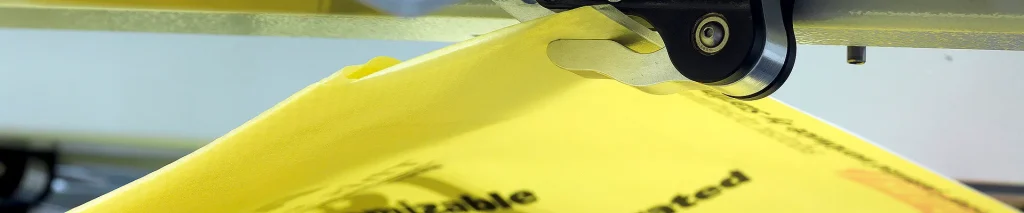
What Are Block Bottom Valve Bags?
A modern supply chain has many silent heroes. Block bottom valve bags are one of them: heavy‑duty industrial sacks that marry a box‑like, self‑standing base with a short one‑way valve sleeve designed for high‑speed, low‑dust filling. When powders or fine granules are charged into the bag, entrained air escapes through the fabric or engineered vents; the sleeve then closes under product head pressure or is sealed by thermal, ultrasonic, or hot‑melt methods. The rectangular footprint stacks like a brick, not a pillow, which explains why block bottom valve bags dominate cement, gypsum, dry mortar, fertilizer, feed, pigment, and mineral logistics.
Also known as (aliases):
- Block bottom valve sacks
- Square bottom valve bags
- AD*STAR‑type valve bags
- PP woven valve bags
- BOPP laminated valve bags
- Kraft paper block bottom valve bags
- Polyethylene (PE) block bottom valve bags
- Box‑bottom valve sacks
- Flat‑bottom valve bags
They look simple, yet they are systemic. A block bottom valve bag is not a single material but a tuned composite engineered for conflicting goals: let air out yet keep moisture out, move smoothly on conveyors yet sit still on pallets, carry bold branding yet survive abrasion, fill faster yet leak less. The rest of this article dissects those trade‑offs and recomposes them into a specification that works on the line, in the warehouse, and out in the world.
The Materials of Block Bottom Valve Bags
A block bottom valve bag is best understood layer by layer. Each layer exists for a reason—strength, barrier, breathability, print quality, machinability—and each layer introduces trade‑offs that must be balanced with data rather than habit.
1) Woven Polypropylene (PP) Fabric — The Structural Skeleton
Drawn polypropylene (PP) tapes—raffia—are woven on circular or flat looms into tubular or sheet fabric. The weave carries the load. The result is high tensile and tear resistance at low mass, admirable flex‑fatigue, and adjustable breathability via weave openness and micro‑perforation. Typical GSM for PP woven valve bags ranges 60–120 g/m², with denier choices aligned to drop‑test targets. PP’s low density (~0.90 g/cm³) and loom productivity deliver cost efficiency, but the very openness that promotes fast de‑aeration can, if overdone, invite dust sifting. Balance matters.
2) BOPP Film — The Printable, Protective Face (Optional)
Biaxially Oriented Polypropylene (BOPP) adds a smooth, printable face. Reverse‑printed by rotogravure or high‑definition flexo, then laminated to the woven substrate, it enables photo‑grade imagery, crisp microtype, and barcode clarity while protecting inks beneath the film. It also improves moisture resistance compared with uncoated fabric. The trade‑off? Film, cylinders/plates, and lamination energy add cost. Yet the return—premium branding, fewer secondary labels, better rub resistance—often pays back in retail and in warehouses. This is why BOPP laminated valve bags lead categories like fertilizers, pet food, and premium feed.
3) Polyethylene (PE) Coatings and Liners — The Sealable Barrier
LDPE/LLDPE, sometimes metallocene‑PE, shows up as heat‑sealable coatings or inner liners. It reduces WVTR for hygroscopic powders—cement, gypsum, starch, salt—and can be formulated with antistatic agents to dissipate charge in fine powders. Thicker liners strengthen the barrier but reduce breathability and raise cost. The craft is in choosing a gauge that maintains fill speed while suppressing caking: 20–60 μm is a practical window for many block bottom valve bags.
4) Kraft Paper and Paper/PP Hybrids — The Stiff, Premium Face (Optional)
High‑strength Kraft (often 70–120 g/m²) laminated to PP fabric produces a face with natural tactility, sharp fold lines, and higher surface friction (COF). In some markets, the look signals eco‑friendliness. In others, the stiffness helps pallets stand to attention. The watch‑out is humidity: paper faces require disciplined storage and, often, engineered vents to keep filling speeds high.
5) Valve Sleeve Materials — The Precision Inlet
A sleeve made from PP fabric, PE film, or paper forms the inlet throat. Its internal diameter, length, stiffness, and surface sealability govern dust control, fill rate, and leak performance. The sleeve’s mass is tiny, its importance huge: mis‑fit sleeves are a top cause of slow fills and after‑fill leakage in block bottom valve sacks. Elastic cuffs and check‑flaps can dramatically improve margins for fine powders.
6) Additives and Masterbatches — Hidden Tuners
UV stabilizers extend outdoor life for construction and agriculture chains. Antistatic agents reduce nuisance shocks and dust cling. Slip/anti‑block packages tune friction for conveyor flow versus pallet grip. White and color masterbatches guarantee opacity and brand fidelity under film or on coated fabric. These small percentages matter because they decide whether a bag that looks right also behaves right.
7) Typical Constructions — From Breathable Workhorses to Barrier‑Rich Hybrids
- Unlaminated PP woven: Woven PP plus optional coating; direct flexo print; highly breathable; the workhorse of cement and mortar where de‑aeration governs throughput.
- BOPP laminated valve bags: Woven PP plus reverse‑printed BOPP and optional PE liner; strong moisture control and retail‑grade graphics.
- Paper/PP composite: Kraft‑PP hybrids for rigidity and tactile appeal; venting strategy needed to preserve fill speed.
- Mono‑PE film bags: Co‑extruded LD/LLDPE formed into valve bags for hygienic niches; less breathable; chosen for specific foods or cleanroom‑adjacent flows.
Curious how block‑bottom geometry interacts with warehouse operations like lane striping and scanning? See our related primer on warehouse‑ready striping for block‑bottom PP bags for layout patterns that improve pick‑rate and pallet discipline.
What Are the Features of Block Bottom Valve Bags?
Features matter when they change outcomes. Below, each attribute is explained not as a bullet in a brochure but as leverage in a system—filler speed, operator health, pallet stability, brand reception, regulatory comfort, and total cost of ownership (TCO).
1) High‑speed, low‑dust filling. A matched spout‑and‑sleeve geometry lets product in while air escapes through tuned weave windows or micro‑perfs. Cleaner operator air and higher bags‑per‑minute (BPM) follow.
2) Self‑sealing or quickly sealed. Many powders close the sleeve by their own head pressure; others prefer thermal bars, ultrasonic welding, or hot‑melt tapes. Either way, no tying cords, no messy staples.
3) Box‑like pallets. The rectangular base creates brick‑like packs. Pallets resist toppling and cube better in containers.
4) Breathability vs. barrier—by design. Cement wants air release; starch wants moisture defense. The architecture adapts so both can have what they need.
5) Strength without bulk. PP woven valve sacks achieve drop and tear performance with fewer grams than multiwall paper. Less mass, more miles.
6) Surfaces that sell. BOPP laminated valve bags carry photo‑quality branding; paper faces deliver a premium feel with higher friction.
7) Warehouse discipline. Tuned COF and anti‑slip features raise safe stack heights and reduce collapsed loads—less rework, fewer claims.
8) Compliance without drama. Food‑contact liners, low‑migration inks, and traceable codes simplify audits and cross‑border movement.
Brand teams asking about film‑face positioning and category trends can explore branding dynamics with BOPP laminated woven bags to see how finish, texture, and color management affect perceived value.
What Is the Production Process of Block Bottom Valve Bags?
VidePak operates an end‑to‑end, equipment‑intensive flow anchored by Austrian Starlinger and German W&H (Windmöller & Hölscher) platforms. The sequence below is expressed as checks and balances: qualify inputs, stabilize unit operations, then verify outputs under real‑world stress.
A) Pre‑Material Selection and Incoming Testing
- Virgin PP resin: Melt Flow Index (MFI), isotacticity, ash, odor, moisture (Karl Fischer), and gel count; lot barcoding for traceability.
- BOPP film: Thickness control (±1–2 μm), haze/gloss targets, dyne level (≥38 dyn/cm), COF, heat‑shrink behavior, surface cleanliness.
- PE liners/coatings: WVTR by ASTM/ISO, seal initiation temperature, dart impact, slip migration, antistatic decay time.
- Paper/Kraft: Burst/tensile, Cobb water absorption, stiffness, print surface evaluation.
- Inks/adhesives: Viscosity window, solids, solvent balance, residual thresholds, migration suitability for food contact.
- Valve sleeve components: Dimensional tolerances, stiffness, peel/shear bond strength; compatibility with thermal/ultrasonic sealing.
B) Core Unit Operations (Starlinger + W&H)
- Extrusion & tape orientation (Starlinger): Polypropylene pellets are plastified, extruded into a cast sheet, slit into tapes, and mono‑oriented through draw and anneal zones. Control denier uniformity, tape width, crystallinity (DSC), tensile, and elongation.
- Weaving (Starlinger circular/flat looms): Tapes become fabric. Monitor picks per inch, GSM, broken‑end rate, loom speed, and defects.
- Surface treatment: Corona/plasma to elevate dyne for strong ink and adhesive anchorage.
- Printing route A — direct flexo on coated fabric: Breathable builds; 4–8 colors; flat‑top plates for solids and fine type; high‑build varnishes boost rub resistance.
- Printing route B — reverse print on BOPP (W&H gravure or HD flexo): Photo‑grade imagery and high barcode grades; requires lamination and precise register.
- Lamination (W&H or Starlinger): Extrusion coating with PP/PE ties or PU adhesive lamination; verify bond strength, residuals, curl, and register stability.
- Conversion & bottom formation: Cutting, creasing, and pasting form the block/square bottom; edges fold clean; seams are hot‑air or heat‑sealed.
- Valve sleeve fabrication & insertion: Sleeves (PP/PE/paper) are built to spec and inserted with controlled overlaps for leak resistance; optional elastic cuffs/check‑flaps added as required.
- Perforation/de‑aeration engineering: Pattern micro‑perfs or breathable windows to evacuate trapped air during fill without sacrificing storage moisture protection.
- In‑line inspection & counting: Vision systems verify register and code legibility; seam integrity checks; automatic baling and barcoded labels for traceability.
C) End‑of‑Line QA and Compliance
- Mechanical: Tensile, tear, burst; 5× drop tests at 1.2 m on corner/edge/flat orientations.
- Valve integrity & leak: Simulated fill pressure and timed leak‑down; acceptance typically ≤0.5% mass loss.
- COF/stackability: Static/kinetic COF to balance conveyor flow and pallet stability.
- Barrier: WVTR validation for linered/laminated constructions.
- Dimensional audit: Length, width, bottom depth, GSM, and bale counts.
- Migration/compliance (food/feed): Inks/adhesives/liners evaluated to FDA/EU; GMP and retention samples logged.
For storage‑efficiency comparisons between valve formats and bottom styles, cross‑check our engineering note on pasted valve bags and warehouse efficiency.
What Is the Application of Block Bottom Valve Bags?
Where powders and small granules must be filled fast, handled cleanly, and stacked safely, block bottom valve bags excel. The list is long, but the reasoning is short: limited dust at fill, good cube on pallets, predictable behavior in transit.
- Cement, gypsum, and dry mortar: Breathable builds with engineered vents; rugged drops; weather‑resilient panels.
- Construction chemicals and tile adhesives: Often linered/coated to resist humidity; crisp pallet faces for safer stacks.
- Fertilizers and soil amendments: Moisture‑sensitive; laminated or linered builds with UV stabilization favored.
- Minerals and pigments: Calcium carbonate, TiO₂, carbon black (ESD awareness); leak‑tight sleeves and precise closure are non‑negotiable.
- Food ingredients: Flour, starch, sugar, salt—food‑contact liners, low‑migration inks, and matte zones for barcode reliability.
- Agricultural and animal nutrition: Pet food and feed premixes—BOPP laminated valve bags for retail‑grade branding; grease/odor control required.
- Specialty chemicals: Resin powders, catalysts, absorbents; antistatic management with snug valve/nozzle fit to prevent dust excursions.
For fiber‑based options and their trade‑offs, compare Kraft paper PP bags, which combine tactile stiffness and higher COF with humidity watch‑outs and venting strategies.
How VidePak Controls and Guarantees the Quality
Certificates matter, but behavior matters more. VidePak’s quality architecture is designed so the bag that leaves the plant is the bag that behaves on your line a month later, a climate zone away.
Step 1: Standards‑aligned manufacturing and verification (ISO/ASTM/EN/JIS). SOPs cover tensile, tear, burst, drop, COF, WVTR/OTR, print adhesion, and migration. SPC tracks denier, pick rate, lamination bond, and register. AQL sampling and CAPA loops drive learning, not blame.
Step 2: Virgin, big‑brand raw materials. 100% virgin PP resin, certified BOPP films, food‑safe PE liners, and approved additives with SDS/CoC. Lots are traced from silo to bale.
Step 3: Best‑in‑class equipment. Austrian Starlinger for extrusion/tape/loom; German W&H for printing/lamination/converting. Equipment pedigree is not vanity, it is variance control.
Step 4: Full test chain—Incoming → In‑Process → Outgoing. Incoming verification of resin/film/paper/inks/adhesives; in‑process vision/peel/weight checks; outgoing drop/leak/COF/WVTR/dimensions and pallet audits; retention samples for forensic reference.
Material discipline begins even before extrusion. For why resin purity and rheology windows matter, see ensuring quality through PP granules.
Types and Customization Options for Block Bottom Valve Bags
Customization is engineering by another name. It is how a bag becomes your bag—matched to your powder, your spout, your climate, your retail moment.
A) Valve Geometry and Closure
- Pasted vs. sewn valves: pasted profiles are flatter and leak less; sewn variants absorb abuse and are easier to rework.
- Internal vs. external sleeves: internal sleeves hide better and seal tidier; external sleeves are easier to access and retrofit.
- Closure: self‑closure for coarse powders; thermal bar on PE‑rich sleeves; ultrasonic weld for laminates; hot‑melt tapes for paper composites.
- Elastic cuffs and check‑flaps: small cost, big improvement in leak margins with fines.
B) Bottom Structure and Edges
- Block/square bottom (SOS): best for pallet density and billboard‑like faces.
- Edge reinforcement: additional layers or corner patches for aggressive lanes and high drop energy.
C) Breathability vs. Barrier
- Open weave + micro‑perfs for cement/mortar—fill rate rules the day.
- Lamination + liner for hygroscopic or greasy goods—moisture and odor control first.
D) Printing and Surface Aesthetics
- Reverse‑printed BOPP (matte or gloss) for photo‑grade branding; matte windows around data for scannability.
- Direct flexo on coated fabric for breathable builds; high‑build varnishes in high‑touch zones.
- Pantone locking, ΔE≤2, retention swatches; simple practices that prevent costly color drift.
- Anti‑counterfeit touches: tactile varnish, microtext, subtle color shifts, serialized QR.
E) Ergonomics and Handling
- Anti‑slip strips or textures to maintain pallet friction without choking conveyors.
- Tear‑assist notches (where appropriate) for user opening without hurting seal integrity.
- Hand‑hold cutouts for 10–20 kg retail‑adjacent SKUs.
F) Sustainability Levers
- Mono‑PP builds (woven PP + BOPP + PP‑compatible ties) that simplify end‑of‑life recovery.
- Down‑gauging enabled by PP’s high tensile—verify against drop matrix and COF targets.
- Recycled content pilots in non‑food SKUs—screen odor/mechanics before scale.
- Design‑for‑disassembly—minimize cross‑material adhesives and plan closures for mono‑stream recycling.
G) Capacity, Size, and Tolerances
- 5–50 kg common; 25 and 50 kg dominate in cement/fertilizers.
- Dimensional targets around ±5 mm on length/width; bottom depth tolerance per converter capability.
- Valve engagement: sleeve ID and length matched to nozzle OD/clamp style; run trials rather than guess.
For large‑format options, see how FIBC bulk bags extend the same logic to tonnage with loops, liners, and discharge designs that echo the valve‑and‑barrier trade‑offs in smaller bags.
A System‑Thinking Blueprint: From Sub‑Problems to an Integrated Specification
Good decisions begin with good decomposition. Break the choice into smaller problems, solve each with measurements, then recombine into a specification that a supplier can run and a warehouse can live with.
Sub‑Problem 1: Powder and Process Characterization
- Flowability (angle of repose), loose/tapped bulk density, PSD, and hygroscopicity/grease presence.
- Filler: nozzle OD, aeration path, target BPM, allowable dust ppm in the breathing zone.
- Ambient/logistics: humidity/temperature extremes, road quality, pallet height, outdoor dwell time.
Checkpoints: pick breathable vs. barrier‑rich architectures; tune micro‑perfs and weave openness; match sleeve geometry to nozzle; choose closure with leak ≤0.5% mass loss; set COF window and bottom style for safe stacks and smooth conveyors.
Sub‑Problem 2: Brand, Regulatory, and Sustainability Goals
- Brand intent: photography vs. vector, matte vs. gloss, tactile effects, color matching.
- Regulatory: food contact, migration limits, traceability and label copy.
- Sustainability: mono‑PP claim, recycled content viability, down‑gauging roadmap.
Checkpoints: choose BOPP reverse print for premium panels and lock Pantone/ΔE; document migration tests and keep retention swatches; specify mono‑PP paths when recyclability claims matter and mark material IDs on pack.
Sub‑Problem 3: TCO and Operational Risk
- Direct costs: resin/film, plates/cylinders, adhesive energy, press time.
- Indirect costs: cleanup downtime from dust, product loss, pallet collapses, returns, reprints from color drift.
- Logistics: pallet density, container cube, stretch‑wrap use, claim rates.
Checkpoints: model pallet configurations and container loads; compare pillow vs. block‑bottom ROI; validate leak targets and instrument dust ppm; run pilot lots (500–2,000 bags) on your actual filler and capture BPM, dust, leak, and pallet data.
For high‑speed automated lines, the same logic scales to form‑fill‑seal. See FFS tubular woven bags for how continuous forming, printing, and sealing achieve speed without abandoning woven‑fabric strength.
Technical Parameters and Target Windows
Numbers are not decoration; they are contracts. The tables below collect practical ranges and the rationale behind them so that every tolerance communicates intent.
Table 1. Dimensional and Mass Parameters
| Parameter | Typical Range | Notes |
|---|---|---|
| Capacity | 5–50 kg (25/50 kg common) | Align with industry filler presets |
| Fabric GSM | 60–120 g/m² | Step up for rough lanes; validate drop |
| BOPP film | 18–35 μm (matte/gloss) | Matte aids scanning; gloss adds depth |
| Liner gauge | 20–60 μm | Higher barrier, lower breathability |
| Valve sleeve | 60–120 g/m² PP or 40–80 μm PE | Match ID/length to nozzle |
| Dimensions | e.g., 480 × 780 × 120 mm (25 kg) | Tune bottom depth to pallet plan |
Table 2. Mechanical and Functional Targets
| Attribute | Target/Method | Why It Matters |
|---|---|---|
| Drop performance | 5× at 1.2 m, flats/edges/corners | Predicts transit survival |
| Leak/tightness | ≤0.5% mass loss (set pressure/time) | Cleanliness and yield |
| COF (static/kinetic) | 0.25–0.50 window | Conveyors vs. pallet grip |
| Tensile/tear/burst | Per ISO/ASTM/EN/JIS | Baseline structural integrity |
| WVTR/OTR | Application‑specific | Moisture/oxygen sensitivity |
Table 3. Printing and Aesthetic Control
| Parameter | Target | Impact |
|---|---|---|
| Dyne level | ≥38 dyn/cm | Ink/adhesive anchorage |
| Color tolerance | ΔE ≤ 2.0 vs. master | Brand consistency |
| Barcode grade | ISO/IEC 15416 grade B or better | Scan reliability |
| Varnish | High‑build on edges/data zones | Rub resistance and scannability |
Table 4. QA/Compliance Matrix
| Checkpoint | Method | Notes |
|---|---|---|
| Incoming | COA verification; spot tests | Resin, film, paper, inks, adhesives |
| In‑process | Vision register; peel/weight checks | Defect logs feed CAPA |
| Outgoing | Drop, leak, COF, WVTR, dimensions | Pallet audits and compression where specified |
| Compliance | FDA/EU migration; GMP | Retention samples and traceability |
If your products oscillate between valve and open‑mouth runs, you may benefit from hybrid planning. Browse pasted valve bag optimization for storage views, and balance that with film‑face branding effects when shelves matter.
Comparative Profiles and Neighbor Technologies
No format is an island. Formats around block bottom valve bags occupy nearby niches and sometimes substitute when constraints shift.
When the bottom style is fixed but the filling logic differs, pasted‑valve and sewn‑valve designs adjust line speeds and sealing behavior. Revisit pasted valve bag efficiency to weigh cube vs. speed.
When bulk density and unit weight jump to ton‑scale, FIBC bulk bags carry the argument: loops, discharge spouts, liners, and stack stability echo the same system levers.
At the other end, where continuous throughput dominates, FFS tubular woven bags integrate form, fill, and seal on the same chassis. The logic is consistent: laminated films for graphics and barrier; woven fabric for strength; carefully tuned COF for conveyors.
Case‑Style Scenarios: Changing One Choice to Move Many Outcomes
Stories persuade because they show consequences. Here are field‑tested pivots that raised speed, cut waste, or stabilized pallets.
Scenario A — Cement on windy jobsites
Problem: nuisance dust peaks trigger line stoppages; pallets slump in transit. Intervention: switch from pillow sacks to square bottom valve bags with higher weave GSM and engineered micro‑perfs; add a check‑flap sleeve; tune COF to 0.35–0.40. Outcome: faster fills, cleaner air, fewer toppled pallets.
Scenario B — Coastal fertilizer caking
Problem: humidity drives clumping and customer claims. Intervention: adopt BOPP laminated valve bags with a 40–50 μm PE liner; lock WVTR targets; add UV‑stabilized masterbatch and matte windows for codes. Outcome: significantly fewer clumps; stable outdoor stacks; better scan grades.
Scenario C — Pet food grease halos
Problem: oil bleed leads to rewraps and brand degradation. Intervention: use BOPP laminated valve bags with high‑build varnish on edges and a higher‑gauge liner; ultrasonic closure for tight seals. Outcome: eliminated grease transfer; fewer store‑level complaints.
Scenario D — Pigment fines and static shocks
Problem: dust cling and shocks reduce throughput. Intervention: antistatic liner, grounded spout and conveyors, perf patterns away from dust‑sensitive faces. Outcome: safer operator zone; better housekeeping metrics.
Sizing, Palletization, and Logistics Discipline
Match bag size to powder realities: bulk density × target mass, with headspace for de‑aeration and valve closure. Choose brick‑bond patterns for block bottom valve sacks, align graphics when retail‑adjacent, confirm pallet compression targets, and use interlayers for very smooth films. Maximize 20’/40’ loads by tuning bag and pallet size; print lot codes/QR for traceability; keep retention samples for 12–24 months.
When brand and engineering both care about the bottom panel’s look and function, consult customizable stripes for block‑bottom PP bags to coordinate visual guidance, scanning lanes, and safety marks.
Purchasing Checklist — Information That Accelerates Specification
- Powder/granule description, PSD, bulk density (loose/tapped), hygroscopicity, oil/odor notes.
- Filler data: nozzle OD, clamp style, target BPM, air evacuation method, dust limits.
- Logistics: pallet heights, container goals, outdoor dwell time, climate profile.
- Compliance: food contact, migration plan, traceability format, label copy.
- Branding: art complexity, matte vs. gloss, color targets, anti‑counterfeit cues.
- Sustainability: mono‑PP aim, down‑gauging targets, recycled content policy.
- Performance: drop matrix, leak target, COF window, WVTR cap, UV hours.
Troubleshooting Matrix — Symptoms, Likely Causes, Fixes
| Symptom | Likely Cause | Corrective Action |
|---|---|---|
| Barcode fails at retail | Gloss glare, color drift, low contrast | Matte windows; lock ΔE; varnish over codes |
| Delamination blisters | Low dyne, residual solvent, poor nip | Raise treatment; extend drying; adjust nip temperature/pressure |
| Pallet slippage | COF too low; glossy film + wrap | Add texture; tune COF; change wrap recipe; interlayers |
| Dust during filling | Insufficient de‑aeration; sleeve mis‑fit | Add micro‑perfs; open weave; retune sleeve ID/length |
| Corner ruptures | Low GSM at stress points | Reinforce corners; step up GSM locally; verify drop |
| Caking after storage | WVTR too high; liner too thin | Increase liner gauge; improve lamination; tighter seals |
Glossary and Neighbor Reading
- Block bottom valve bags: square‑base valve sacks for fast filling and clean stacking.
- Square bottom valve bags: synonym commonly used in construction and agriculture.
- PP woven valve sacks: emphasizes the polypropylene raffia skeleton.
- BOPP laminated valve bags: woven PP covered with printed BOPP for graphics and barrier.
- AD*STAR‑type valve bags: a widely used style in cement; box‑bottom construction.
- COF: coefficient of friction; governs pallet stability vs. conveyor flow.
- WVTR/OTR: water vapor/oxygen transmission; core barrier metrics.
- ΔE: color difference; measures drift across lots.
- DFMEA: design failure mode and effects analysis; risk ranking before scale‑up.
Stretch beyond the format: explore Kraft paper PP for tactile faces, or shift scale with FIBC versatility. Market teams can also review BOPP branding dynamics to coordinate print finishes with shopper studies.
November 25, 2025
- What Are Block Bottom Valve Bags?
- The Materials of Block Bottom Valve Bags
- 1) Woven Polypropylene (PP) Fabric — The Structural Skeleton
- 2) BOPP Film — The Printable, Protective Face (Optional)
- 3) Polyethylene (PE) Coatings and Liners — The Sealable Barrier
- 4) Kraft Paper and Paper/PP Hybrids — The Stiff, Premium Face (Optional)
- 5) Valve Sleeve Materials — The Precision Inlet
- 6) Additives and Masterbatches — Hidden Tuners
- 7) Typical Constructions — From Breathable Workhorses to Barrier‑Rich Hybrids
- What Are the Features of Block Bottom Valve Bags?
- What Is the Production Process of Block Bottom Valve Bags?
- What Is the Application of Block Bottom Valve Bags?
- How VidePak Controls and Guarantees the Quality
- Types and Customization Options for Block Bottom Valve Bags
- A System‑Thinking Blueprint: From Sub‑Problems to an Integrated Specification
- Technical Parameters and Target Windows
- Comparative Profiles and Neighbor Technologies
- Case‑Style Scenarios: Changing One Choice to Move Many Outcomes
- Sizing, Palletization, and Logistics Discipline
- Purchasing Checklist — Information That Accelerates Specification
- Troubleshooting Matrix — Symptoms, Likely Causes, Fixes
- Glossary and Neighbor Reading
Over 40% of industrial powder leakage incidents result from substandard valve bag designs. At VidePak, our block bottom valve bags integrate ISO 9001-certified PP/PE materials, 14-layer quality inspections, and customizable features that reduce spillage by 99.5% while aligning with EU, ASTM, and JIS standards. With 30+ years of expertise and 16 extrusion lines producing 25 tons of fabric daily, we deliver solutions trusted by titanium dioxide, cement, and pharmaceutical powder handlers across 85 countries.
1. Anatomy of Excellence: Block Bottom Valve Bag Types
Block bottom valve bags are engineered for high-speed filling and 360° structural integrity. VidePak’s three core variants address distinct industry needs:
A. Sewn Block Bottom Bags
- Seam Strength: Double-stitched seams withstand 1,200 N/cm² pressure (tested per ISO 13934-1).
- Applications: Ideal for abrasive powders like calcium carbonate (50–100 µm particle size).
- Case Study: A Mexican cement producer reduced bag rupture rates from 3% to 0.1% using our 180 g/m² sewn bags with 200D PP yarns.
B. Pasted Block Bottom Bags
- Adhesive Bonding: Hot-melt adhesives achieve 25 N/cm peel strength (ASTM D903).
- Airtightness: ≤0.01% dust emission during 5 m drop tests (EN 277:2016).
C. Hybrid Laminated Bags
- Structure: BOPP outer layer + 80 µm PE inner liner + PP woven body.
- Performance: Moisture barrier <5 g/m²/24h (ASTM E96), ideal for hygroscopic materials like sodium sulfate.
2. Material Science: The 14-Point PP/PE Quality Protocol
VidePak’s raw material inspections ensure every granule meets global benchmarks:
PP Granule Testing (Woven Layer)
| Test Category | Parameters | Standards | VidePak’s Thresholds |
|---|---|---|---|
| Physical | Melt Flow Index (230°C/2.16 kg) | ISO 1133 | 8–12 g/10 min |
| Density (23°C) | ISO 1183 | 0.905–0.915 g/cm³ | |
| Mechanical | Tensile Strength (MD) | ASTM D638 | ≥35 MPa |
| Elongation at Break | ASTM D638 | ≥500% | |
| Thermal | HDT (0.45 MPa) | ISO 75-2 | ≥95°C |
| Visual | Black Speck Count (per kg) | Internal SOP | ≤15 particles >0.3 mm |
PE Film Testing (Inner Liner)
- Film Impact: Dart drop weight ≥400 g (ASTM D1709) for explosion-prone powders.
- Puncture Resistance: ≥8 N/µm (ISO 12236) to withstand sharp-edged fillers like titanium dioxide.
Example: Our 2024 upgrade to bimodal PE resins increased liner tear resistance by 40%, cutting logistics damage claims by $220,000 annually for a Brazilian chemical client.
3. Customization Engineered for Industry 4.0
Technical Customization Matrix
| Feature | Options | Industry Fit |
|---|---|---|
| Valve Diameter | 50–150 mm ±0.5 mm tolerance | 75 mm for free-flowing flour |
| Printing | 8-color flexo with Pantone + UV coating | Food-grade ink compliance (FDA 21 CFR) |
| Closure | Heat seal, zip-lock, adhesive flap | Reusable designs for premium pet food |
| Additives | Anti-static (10⁶–10⁸ Ω/sq), UV inhibitors | Explosive dust environments |
Case Study: A Korean battery material supplier uses our 120 mm valve bags with carbon-black-loaded PP (surface resistivity 10⁷ Ω) to prevent lithium cobalt oxide static discharge.
4. Global Compliance: Beyond the Data Sheet
- EU REACH: Full traceability of 156 SVHC substances via SAP-integrated batch tracking.
- US FDA: Food-contact compliance (21 CFR 177.1520) for PE liners in flour/sugar applications.
- JIS Z 0238: ≤0.1% leakage after 10,000 vibration cycles (10–50 Hz sweep).
Innovation Spotlight: Our R&D team recently patented a laser-perforated PE liner that reduces residual powder in valves by 92%, achieving Australia’s AS 2070-1999 “zero waste” certification.
5. Sustainability Through Material Science
- Recycled PP Content: Up to 50% post-industrial regrind without compromising tensile strength (tested per ASTM D5034).
- Closed-Loop System: Partnering with European recyclers to achieve 85% PP recovery rate by 2026.
- Bio-PE Pilot: 30% sugarcane-derived PE liners reduce carbon footprint by 1.2 kg CO2 per bag.
FAQs: Solving Procurement Complexities
Q1: What’s the lead time for 50,000 custom bags?
A: 18–25 days, including 3-day PP/PE material validation and 5-day pre-shipment ISTA 3E testing.
Q2: How does 50% recycled PP affect pricing?
A: 6–8% cost increase offset by 15% EPR tax credits in EU/NA markets.
Q3: Can bags withstand -30°C frozen storage?
A: Yes. Our cold-chain PP blend retains 90% elongation at -30°C (ISO 527-2).
Conclusion
In an industry where 1% leakage can mean $50,000 in lost product, VidePak’s block bottom valve bags redefine reliability through scientific rigor. Explore our valve bag technical specifications and PP woven material innovations to transform your packaging into a competitive asset.
References
- VidePak Material Testing Protocol 2024: PP/PE Granule Quality Assurance.
- European Committee for Standardization: EN 277:2016 – Packaging for Dangerous Goods.
- Alibaba Industrial Standards Database: PP Woven Bag Manufacturing Parameters.
Contact VidePak:
- Website: https://www.pp-wovenbags.com/
- Email: info@pp-wovenbags.com