
What Are PP Woven Bags? Definition, Scope, and Frequently Used Aliases
PP Woven Bags are industrial and retail packaging sacks engineered from woven polypropylene tapes (sometimes called raffia) that are converted into open‑mouth, valve, or block‑bottom formats. The woven substrate, created on circular or flat looms, offers unusually high tensile strength at very low mass, enabling reliable containment of dense or abrasive goods such as grains, flours, fertilizers, mineral powders, polymer pellets, and animal feeds. The blend of structural efficiency, abrasion tolerance, printability, and moisture management keeps PP Woven Bags at the center of global logistics where durability, stack stability, and cost per filled kilogram are decisive.
Callout — Common aliases used in tenders and specifications:
- polypropylene woven sacks
- woven PP bags
- laminated BOPP woven bags
- block‑bottom PP sacks
- PP valve bags
- coated PP woven packaging
- raffia PP bags
Where PP Woven Bags make the most impact
Bulk commodities that punish weak packaging—sharp‑edged minerals, dense fertilizers, grain stacks needing square geometry, and dusty powders that require controlled venting.
Why specifiers continually return to the format
High strength‑to‑weight ratios, broad availability from a global converting base, compatibility with open‑mouth and valve fillers, and adaptable moisture/barrier strategies at competitive cost.
The Materials of PP Woven Bags: Resins, Tapes, Coatings, Laminations, and Liners
Although the name is concise, the construction of PP Woven Bags is a layered conversation about resin chemistry, tape orientation, fabric geometry, and finishing options. Each choice unlocks performance in one domain while demanding attention in another—strength versus flexibility, stiffness versus formability, breathability versus moisture holdout. Understanding the palette below turns the buying decision from guesswork into grounded engineering.
Polypropylene resin and tape orientation
Isotactic polypropylene is extruded into a thin sheet, slit into narrow tapes, and drawn to align polymer chains. Orientation elevates tensile strength and reduces creep. Tape denier (e.g., 600–1200) and draw ratio govern modulus and elongation, which then govern how the fabric behaves during sewing, drop tests, and pallet compression. Because PP density is roughly 0.90 g/cm³, strength arrives without excessive mass—one reason PP Woven Bags remain cost‑efficient against paper or foil‑laminate systems.
Coatings to manage moisture and sifting
Extrusion‑coated polyethylene adds moisture resistance and a smoother print face. Coating mass (e.g., 15–40 g/m²) is a dial: higher mass increases holdout and stiffness, lower mass maintains flexibility and breathability. Where powders tend to sift through open weaves, coating tightens the system without resorting to heavier base fabric.
BOPP lamination for graphics and surface stiffness
Biaxially oriented polypropylene film laminated to the fabric provides a premium, scuff‑resistant outer surface compatible with photorealistic gravure or high‑line flexographic printing. Retail‑facing PP Woven Bags often use this route. The laminate also sharpens edges for tidy pallet stacks, but requires compatible inks and adhesives to keep the pack in a mono‑polyolefin recycling stream.
Liners, antistatic options, and UV packages
Where hygroscopic or odor‑sensitive goods are involved, a loose PE or PP liner may be introduced. Liners can be micro‑perforated for air release in valve formats or left intact for moisture control. For dusty or explosive atmospheres, antistatic agents reduce ignition potential. UV stabilization is selected for outdoor dwell, extending fabric life without overbuilding GSM.
At the level of fabric architecture, warp and weft tensile targets are balanced via picks per inch and tape denier. A tighter weave limits sifting and improves print clarity but can complicate sewing and heat‑cut edges. Corona or flame treatment elevates surface energy before printing or lamination; maintaining dyne level after storage is crucial for code adhesion and abrasion resistance.
Tip for buyers: specify both bag‑to‑metal and bag‑to‑bag coefficient‑of‑friction windows. Packaging runs smoothly when fabric, coatings, and any laminate create predictable friction paths through forming shoulders, jaws, and pallet layers.
Key Features of PP Woven Bags in Real Operations
What separates marketing claims from shop‑floor reality? Repeatability. When evaluating PP Woven Bags, focus on the traits that convert directly into uptime, pallet safety, and product preservation.
- Strength without bulk. Oriented tapes form a load‑bearing lattice that resists stretch and tear without excessive weight.
- Puncture and abrasion tolerance. The woven grid disperses energy from sharp granules and forklifts; corner reinforcements push failure modes away from seams.
- Moisture control on demand. Coatings, laminations, and liners are modular tools—dial the barrier to the climate and season.
- Square, stable pallets. Block‑bottom formats interlock in transit, while anti‑slip textures lower the risk of toppling in humid or high‑vibration corridors.
- Print and data readability. Treated surfaces accept high‑fidelity graphics and durable codes for traceability.
- Compatibility with automation. Consistent width, modulus, and COF support both open‑mouth and valve filling, checkweighing, and robotic palletizing.
- Recyclability pathways. Mono‑polyolefin builds simplify sorting relative to paper‑plastic or foil composites.
Feature dial — fabric GSM
Raising GSM increases burst and tensile, but try reinforcement at corners and optimized weave before defaulting to heavier fabric.
Feature dial — coatings vs. liners
Coating is efficient for seasonal moisture; liners are decisive for highly hygroscopic fills but add changeover time and end‑of‑life complexity.
Feature dial — valve geometry
Self‑closing sleeves accelerate filling and reduce dust exposure; micro‑perforated liners help air escape without contaminating seams.
How PP Woven Bags Are Produced: From Resin to Ready‑to‑Fill Sacks
The manufacturing of PP Woven Bags follows a linear flow with checkpoints that strongly influence field performance. Managing tape quality, weave uniformity, and adhesion at conversion is just as important as choosing the right GSM on paper.
- Extrusion and drawing. Melt, extrude, slit, and draw PP into oriented tapes. Control draw ratio, chill conditions, and masterbatch dispersion to avoid fibrillation and ensure consistent modulus.
- Weaving. Circular or flat looms interlace warp and weft. Adjust picks per inch and loom tension to hit tensile targets without compromising sewability.
- Coating or lamination. Apply PE coating or bond BOPP film. Verify bond strength after heat and humidity conditioning; monitor curl and dimensional stability.
- Conversion. Cut to length, construct the bottom (sewn, heat‑cut + sewn, or block‑bottom), add valve sleeves or handles, and trim gussets. Dimensional accuracy drives automated filling efficiency.
- Printing and finishing. Flexographic or gravure printing delivers branding and codes. Specify dyne levels and abrasion resistance, especially for export corridors with long dwell times.
- Quality verification. Test warp/weft tensile, seam strength, drop, burst, abrasion, valve air‑evacuation, and COF. Record data for traceability and continuous improvement.
Process note: align bottom construction with the pallet pattern and transport vibration profile. A square base that resists shear saves more product than a marginal increase in fabric weight.
Applications: Sector‑Specific Maps for PP Woven Bags
Versatility is the quiet strength of PP Woven Bags. By switching fabric weight, surface finishing, and bottom style, the same base platform can traverse industries without forcing buyers into bespoke, fragile solutions.
- Agriculture and staples. Rice, wheat, pulses, and sugar benefit from breathability with just enough coating to prevent caking in humid seasons.
- Fertilizers and soil amendments. Valve formats accelerate filling and reduce dust; anti‑slip skins keep stacked pallets coherent through distribution.
- Construction minerals. Cement, lime, gypsum, silica sand, and pigments demand abrasion resistance and corner strength; block‑bottoms sharpen pallet geometry.
- Polymers and chemical powders. Liners protect hygroscopic resins; antistatic packages lower ignition risk where dust clouds can form.
- Retail and pet care. BOPP‑laminated variants deliver high‑resolution graphics and scuff resistance without sacrificing toughness.
- Relief and infrastructure. Sandbags and flood barriers rely on woven PP for quick deployment and robust handling.
Related reading
For a product‑level overview aligned with the practices discussed here, consult polypropylene woven sacks for additional context on construction styles and common specifications.
Market Perspective: Comprehensive Supply with Enhanced Features
The phrase that orients this entire discussion—“PP Woven Bags: Comprehensive Supply with Enhanced Features for Modern Packaging Needs”—is not rhetorical flourish; it captures the market’s dual expectation: dependable capacity at scale and incremental, targeted improvements that interact cleanly with automated equipment and circularity ambitions. In practice, buyers do not want exotic polymers that break their recycling maps, nor do they want fragile high‑gloss showpieces that scuff on the first pallet. They want PP Woven Bags that reconcile speed, safety, sustainability, and cost without drama.
Automation and labor
The strongest lever is often not higher GSM but smoother machine interaction: predictable COF, stable width, and a bottom that keeps geometry under compression.
Sustainability and policy
Mono‑polyolefin structures simplify recycling. PIR/PCR content is introduced where tape strength and adhesion allow, with transparent chain‑of‑custody.
Volatile input costs
Selective reinforcement at stress points beats blanket over‑engineering; coatings and laminations are used as scalpels, not hammers.
Data surfaces
Codes must survive pallet heat and abrasion; dyne retention after storage is a real‑world KPI, not a lab curiosity.
System Thinking: Decompose the Challenge, Recompose the Answer
Engineering is the art of choosing. To specify PP Woven Bags intelligently, map the problem into smaller questions that can be answered with evidence, then recombine the pieces into a spec that runs on your equipment, with your product, in your climate.
Sub‑problem A — Speed and uptime
Root causes of downtime include COF drift, inconsistent modulus from tape variability, and bottoms that deform under compression. Define COF windows, stabilize tape draw, and align base geometry to pallet pattern.
Sub‑problem B — Survivability
Forklifts, conveyor edges, and sharp granules threaten seams and corners. Reinforce stress points, verify MD/TD balance, and run drop tests at ambient and cold temperatures.
Sub‑problem C — Moisture and dust
Hygroscopic goods and humid corridors call for adjustable barrier. Choose coating mass or liners according to climate and product sensitivity; specify stitch hole sealing where sifting appears.
Sub‑problem D — Circularity
Keep the build within a polyolefin family; use compatible inks/adhesives; document recycled content honestly; and design labels to depart cleanly during reprocessing.
The integrated answer is not a single trick but a tuned stack: an oriented PP fabric with the right GSM and weave density; a coating or laminate chosen for climate and shelf needs; a bottom model that preserves geometry; and quantitative windows for COF, dyne retention, seam strength, and drop performance.
Specification Table — Color‑Coded Snapshot
| Parameter | Typical Range / Option | Why It Matters |
|---|---|---|
| Fabric weight (GSM) | 55–80 g/m² for 25–50 kg sacks; higher for extreme duty | Sets tensile/burst baseline and interacts with denier and weave density. |
| Tape denier & draw ratio | 600–1200; draw tuned for strength/elongation | Controls modulus, tear behavior, and sewing performance. |
| Weave density (picks/inch) | 8–14 (application‑specific) | Higher counts lower sifting; too high can hurt sewability. |
| Coating weight | 15–40 g/m² PE | Balances moisture control with flexibility and cost. |
| Lamination | BOPP gloss/matte with compatible systems | Enables high‑fidelity graphics, scuff resistance, and stiffer stacks. |
| Bottom format | Sewn; heat‑cut + sewn; block‑bottom | Determines pallet geometry and handling stability. |
| Valve design | Standard sleeve; self‑closing; ultrasonic | Drives fill speed and dust control. |
| COF windows | Define bag‑to‑metal and bag‑to‑bag ranges | Prevents tracking alarms and pallet shear. |
| Dyne level | ≥38 dynes after treatment and storage | Ensures print/coding adhesion over the logistics cycle. |
| Seam strength | Specify N/15 mm in warp/weft | Controls failure mode during drops and conveyor transitions. |
| Recycled content | PIR/PCR in non‑critical layers where available | Supports climate and compliance targets while protecting function. |
Keyword Strategy and Long‑Tail Phrasing
The nucleus phrase PP Woven Bags is accompanied in this text by pragmatic synonyms and query shapes used by engineers and buyers: polypropylene woven sacks, woven PP packaging, laminated BOPP woven bags, block‑bottom PP sacks, PP valve bags, coated polypropylene sacks, and heavy‑duty woven packaging. These phrases are not ornamental; they mirror the decision tree buyers actually traverse—graphics vs. ruggedness, coating vs. liners, open‑mouth vs. valve, square bottoms vs. conventional sewing.
Actionable Playbook for Specifiers
- Define the product and climate. Particle morphology, dust behavior, target bag weight, and humidity exposure across the route.
- Select the structure. Choose a base GSM and weave, then add coating or BOPP lamination according to barrier and branding needs; consider liners only when moisture or odor demands it.
- Set machinability windows. Specify COF for both machine and pallet interfaces; confirm dyne retention for your ink/varnish system.
- Validate mechanics. Test tensile, seam, puncture, and drop in ambient and cold conditions; inspect failure modes and adjust corners and hems before raising GSM.
- Address circularity. Keep to mono‑polyolefin builds, use compatible inks/adhesives, document PIR/PCR, and plan for label removal in reprocessing.
- Launch with training and SPC. Train operators on splice handling and valve setup; track statistical control for gauge, COF, dyne, seam strength, and alarms.
Follow these steps and PP Woven Bags stop being a commodity and become a calibrated system component—a fabric that respects the machine, protects the product, and makes the pallet behave.
- What Are PP Woven Bags? Definition, Scope, and Frequently Used Aliases
- The Materials of PP Woven Bags: Resins, Tapes, Coatings, Laminations, and Liners
- Key Features of PP Woven Bags in Real Operations
- How PP Woven Bags Are Produced: From Resin to Ready‑to‑Fill Sacks
- Applications: Sector‑Specific Maps for PP Woven Bags
- Market Perspective: Comprehensive Supply with Enhanced Features
- System Thinking: Decompose the Challenge, Recompose the Answer
- Specification Table — Color‑Coded Snapshot
- Keyword Strategy and Long‑Tail Phrasing
- Actionable Playbook for Specifiers
Introduction
In the rapidly evolving packaging industry, PP woven bags with specialized designs like valve openings and block bottoms are revolutionizing logistics efficiency and sustainability. These innovations address critical challenges in modern supply chains, from reducing material waste to enabling faster loading/unloading processes. For companies like VidePak, which combines decades of expertise with cutting-edge technology, the integration of these features positions them as a leader in meeting global demand for high-performance, eco-conscious packaging solutions.
Ray, CEO of VidePak, remarks: “Our valve and block-bottom designs aren’t just functional upgrades—they’re responses to the real-world pain points of our clients. When a chemical manufacturer saves 30% in loading time or a retailer cuts packaging waste by 15%, that’s the competitive edge we deliver.”
1. Market Trends Driving Demand for Enhanced PP Woven Bags
The global PP woven bag market is projected to grow at a CAGR of 5.7% from 2025 to 2030, driven by sectors like agriculture, construction, and retail. Key trends include:
- Automation Compatibility: Valve bags streamline filling processes in automated systems, reducing labor costs by up to 40%.
- Sustainability Pressures: With 500 billion plastic bags produced annually worldwide—many ending up in landfills—brands are shifting to reusable PP bags with recyclability rates exceeding 90%.
- Customization Needs: Block-bottom designs, which allow stable stacking and reduced spillage, are increasingly adopted for granular products like fertilizers and pet food.
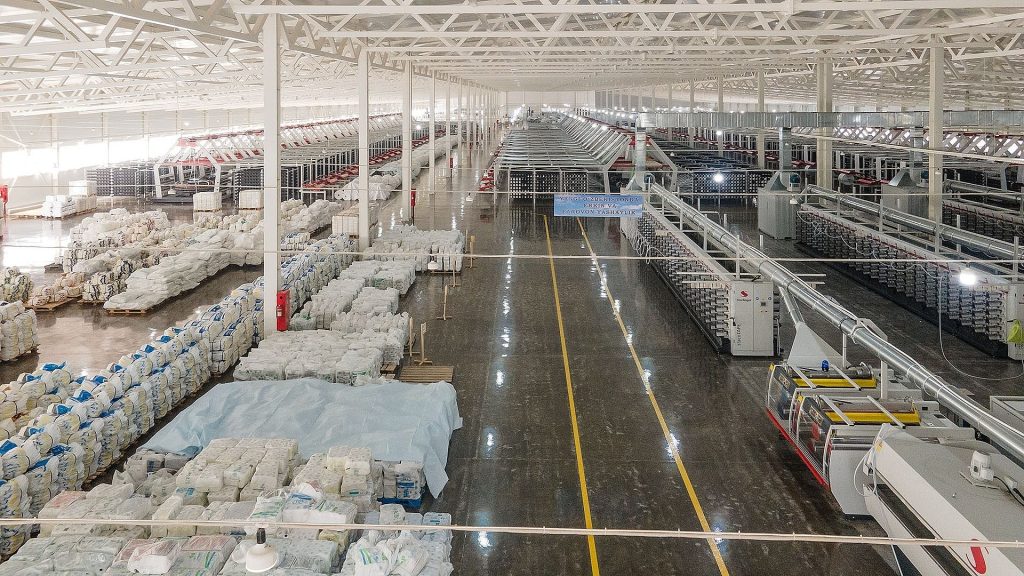
VidePak’s Austrian Starlinger machinery—including 100+ circular looms and 30+ lamination machines—enables the production of 5 million bags daily, tailored to client specifications such as multi-layer laminations and UV-resistant coatings.
2. Design Innovations: Valve and Block-Bottom Features
2.1 Valve Bags: Precision in Filling and Sealing
Valve bags integrate a one-way airflow mechanism, enabling rapid filling without dust leakage. For example, a European cement producer reduced packaging time by 35% after switching to VidePak’s pasted valve bags, which feature heat-sealed seams for airtight closure.
Key Advantages:
- Speed: Filling rates up to 1,200 bags/hour, ideal for high-volume industries like agriculture.
- Safety: Reduced particulate exposure for workers, aligning with OSHA standards.
2.2 Block-Bottom Bags: Stability and Versatility
Block-bottom designs create a flat base, allowing upright stacking and minimizing storage space. A case study with a U.S. pet food brand showed a 20% reduction in warehouse costs after adopting VidePak’s block-bottom bags, which withstand stacking heights of up to 8 meters.
| Feature | Traditional Bags | VidePak Block-Bottom Bags |
|---|---|---|
| Stacking Stability | Moderate | High (No tilting) |
| Filling Efficiency | 800 bags/hour | 1,200 bags/hour |
| Material Waste | 6% | 1.5% |
3. VidePak’s Technological and Operational Edge
Founded in 2008, VidePak operates 526 employees and generates $80 million annually. Its competitive advantages include:
- Advanced Manufacturing: Starlinger’s extrusion lines produce PP fabric with tensile strengths up to 12 N/mm², surpassing industry averages by 25%.
- Customization Capabilities: Multi-color printing and PE liners for moisture resistance cater to industries like pharmaceuticals and food packaging.
- Sustainability Initiatives: A 2MW solar power system covers 40% of energy needs, reducing CO₂ emissions by 1,200 tons annually.
4. Case Study: Valve Bags in Chemical Logistics
A German chemical company reduced spillage-related losses by $250,000/year using VidePak’s PE-coated valve bags. The bags’ laminated layers provided chemical resistance, while the valve design cut filling time by 50%. Post-implementation surveys revealed a 98% client satisfaction rate on durability and compliance with REACH regulations.
5. FAQs: Addressing Client Concerns
Q1: How do block-bottom bags enhance supply chain efficiency?
A: Their flat base allows automated palletizing, reducing manual handling and warehouse space by 30%.
Q2: Are VidePak’s bags compliant with food-grade standards?
A: Yes, all materials meet FDA and EU Regulation (EC) No 1935/2004 for direct food contact.
Q3: Can VidePak handle small-batch orders with custom prints?
A: With 30+ printing machines, we support orders from 1,000 to 10 million units, including QR codes and brand-specific graphics.
6. Future Outlook: Smart Packaging and ESG Integration
Emerging trends like QR-code tracking and biodegradable PP blends will further elevate the utility of valve and block-bottom bags. VidePak’s R&D team is piloting blockchain-enabled traceability to enhance supply chain transparency—a feature demanded by 68% of Fortune 500 companies.
External Resources
- Explore how valve bags optimize chemical packaging: Valve Bags for Chemical Products
- Learn about sustainable PP bag innovations: Recyclable PP Bags
By merging engineering precision with ESG commitments, VidePak is redefining the benchmarks for modern packaging. As industries prioritize efficiency and sustainability, solutions like valve and block-bottom PP woven bags will remain indispensable.