
What Are Block Bottom Valve Bags?
In bulk‑solids logistics, packaging is less a decorative shell and more a precision component. Block Bottom Valve Bags exemplify this shift. They are industrial sacks featuring a square, self‑standing base (the block bottom) and an integrated filling sleeve (the valve). The geometry produces brick‑like stacking, while the valve enables fast dosing, clean cut‑off, and reliable downstream closure. In practice, Block Bottom Valve Bags must present a consistent mouth to the spout, absorb drop shocks without splitting, de‑aerate so stacks stabilize quickly, control moisture and dust, and arrive with legible codes after rough routes and humid depots.
Across RFQs and catalogs, closely related market names point to the same platform, emphasizing faces, liners, or valve styles. Common aliases include:
- Block Bottom Bags
- Block Bottom Valve Sacks
- Valve Woven Bags
- PP Valve Bags
- BOPP‑Laminated Block Bottom Valve Bags
- Kraft Paper Laminated Block Bottom Valve Bags
- PE‑Coated Valve Woven Bags
- Anti‑Static Block Bottom Valve Bags
Premise: treat the bag as a machine‑compatible module. When the base geometry, the valve mechanics, and the material stack are co‑designed, line speed increases, dust falls, stacks square up, and quality claims drop.
The Materials of Block Bottom Valve Bags
Materials set the promise; processes make the promise hold. The typical stack is polyolefin‑dominant: a woven polypropylene (PP) core for mechanical strength, optional kraft or BOPP faces for optics and print, and polyethylene (PE) liners for hygiene and barrier. Each constituent below is mapped to its location, function, cost levers, and operational implications.
1) Woven PP fabric — the structural spine
At the heart of Block Bottom Valve Bags is a textile lattice of oriented PP tapes. Pellets are melt‑cast into film, slit into tapes, and drawn so polymer chains align along the tape axis. Orientation raises tensile modulus and tear resistance at modest mass; it also suppresses creep under pallet compression—critical for tall stacks in warm warehouses. Typical bands (illustrative): basis weight 80–120 g/m² for 20–50 kg fills; meshes 8×8 to 14×14; tape denier commonly 700–1100D.
Cost levers: resin curve (virgin grades, regulation‑permitted recycled content), draw ratio discipline, picks per centimeter (stiffness vs. breathability), loom speed vs. quality, closed‑loop gauge control (fewer loom breaks, steadier GSM, cleaner lamination and printing downstream).
2) Exterior faces — kraft, BOPP, or coated PP
- Kraft paper (70–120 g/m²): matte, low‑glare canvas for codes and regulatory blocks; adds puncture damping and pallet friction.
- BOPP film (12–25 μm): reverse‑printed film protects artwork under a durable layer; gloss/matte/soft‑touch textures; coefficient of friction (COF) tunable via film and OPV.
- PE/PP extrusion coat (5–25 μm): closes porosity for powder hygiene, lifts scuff resistance, supplies a printable surface when film is not required.
3) Inner liners — hygiene, hermeticity, and ESD
PE liners (LDPE/LLDPE/HDPE, typically 50–120 μm) isolate dusty or hygroscopic contents from the outer structure, enable pinch‑top heat sealing, and reduce sift. Anti‑static packages (surface resistivity 106–109 Ω) mitigate nuisance shocks and stabilize weighments on fine powders (cement, pigments, TiO₂). Formats: loose inserts (easy removal in recycling), tube‑lined to the mouth (fast sealing), or liner‑integrated valve sleeves for the cleanest dosing.
4) The valve system — sleeve, board, and vents
The valve is a subassembly: a sleeve (film or fabric), a stabilizing board, and mapped vent paths. Internal valves keep decks clean and maximize sift‑proofing for powders; extended valves simplify spout docking on legacy fillers; reduced valves lower residual air for fast stack stabilization. Micro‑perforations or sintered vent panels de‑aerate as the product compacts.
5) Functional chemistry — inks, adhesives, additives
- Inks: PU‑modified or nitrocellulose for flexo/offset on kraft; gravure under film; low‑migration sets where food/feed adjacency exists.
- Adhesives/ties: solvent‑free PU for lamination; polyolefin ties for extrusion coats. Coat‑weight uniformity drives peel strength, curl, and register.
- Additives: UV stabilizers for yard storage; slip/anti‑block packages to hit COF windows; TiO₂ for opacity on films; anti‑fog where cold‑chain breaks are expected.
bill of materials map
Exterior: kraft or BOPP → branding, scuff control, COF tuning
Core: woven PP → tensile/tear, puncture resistance, square base geometry
Interior: optional PE liner → heat‑seal window, hygiene, moisture lock
Valve: sleeve + board + vent paths → dosing speed, dust hygiene, residual‑air control
cost levers
- Resin curve and draw ratio discipline
- Fabric GSM and pick density
- Lamination type (extrusion vs. adhesive) and coat‑weight
- Liner gauge and anti‑static package
- Valve geometry and vent mapping
Features of Block Bottom Valve Bags
Why does this platform outperform in dusty, high‑BPM, rough‑route contexts? Because its strengths stack: mechanical efficiency at low mass, valve mechanics that breathe correctly, surfaces that print and code cleanly, and barrier options that fit the moisture hazard. Below, claims become engineering consequences and field outcomes.
- Strength‑to‑weight efficiency — The oriented lattice spreads shocks and resists creep, enabling lighter sacks to survive taller stacks and longer routes.
- Block‑bottom stability — Re‑entrant folds and welded corners create a square footprint that stacks like brickwork, so wrap recipes can be lighter and more predictable.
- Valve throughput with dust hygiene — Internal/extended/reduced valves are tuned to bulk density; mapped micro‑perfs vent entrained air without compromising sift control.
- Moisture and light management — Pair liners and film faces per hazard: kraft+coat for mid‑range WVTR, BOPP for scuff‑proof art, pearlized or opaque films for light‑sensitive chemistries.
- Regulatory legibility — Matte kraft avoids glare; reverse‑printed film locks art under a protective layer. Inline ΔE control and OPVs keep barcodes and hazard text readable.
- Circularity in practice — Polyolefin‑lean stacks align with many recycling streams; design‑for‑disassembly via loose or spot‑tacked liners where policy requires.
Takeaway: preventing a single pallet failure often saves more material and emissions than aggressive down‑gauging that invites returns, rework, and waste. Reliability is sustainability.
The Production Process of Block Bottom Valve Bags
Design is intent; process is proof. VidePak runs a capability‑first stack—Starlinger (Austria) for tape extrusion, drawing, weaving, coating/lamination and W&H (Germany) for high‑register printing and precise web handling—to keep critical‑to‑quality variables inside narrow windows from pellets to pallets.
Pre‑stage — raw material selection and verification
- 100% virgin PP resins in narrow melt‑flow bands; isotacticity indices logged for stable draw.
- Kraft, films, and liners with traceable lots; dyne levels captured for print/lam faces; pinhole and moisture checks logged.
- Qualified inks/adhesives with solids/viscosity control; low‑migration options where needed.
- Incoming QA: CoA verification, spot FTIR, visual/pinhole surveys, roll‑map traceability.
Tape extrusion and drawing (Starlinger)
Melt‑cast film → slit tapes → orientation. Laser micrometers and closed‑loop oven profiles hold gauge and crystallinity tight. Draw curves are tuned to balance tensile strength with drape (affecting valve presentation and corner welding).
Weaving
Circular or flat looms interlace tapes to target GSM and picks/cm. Real‑time pick counters and tension monitors suppress drift. Woven‑in micro‑textures can lift pallet friction on back panels without roughening a print face.
Coating and lamination
Extrusion coats close porosity and set COF; adhesive lamination bonds kraft or BOPP facestocks. SPC tracks coat‑weight, nip energy, and web tension to prevent curl and ensure high peel strength.
Printing (W&H CI flexo, offset on kraft, or gravure under film)
Flexo/offset deliver crisp, matte branding on kraft; reverse gravure under BOPP protects art from scuff and rain. Corona/plasma treatment raises surface energy for anchorage. Inline spectrophotometry holds ΔE targets; OPVs supply scuff control and COF tuning.
Conversion — block‑bottom forming and valve integration
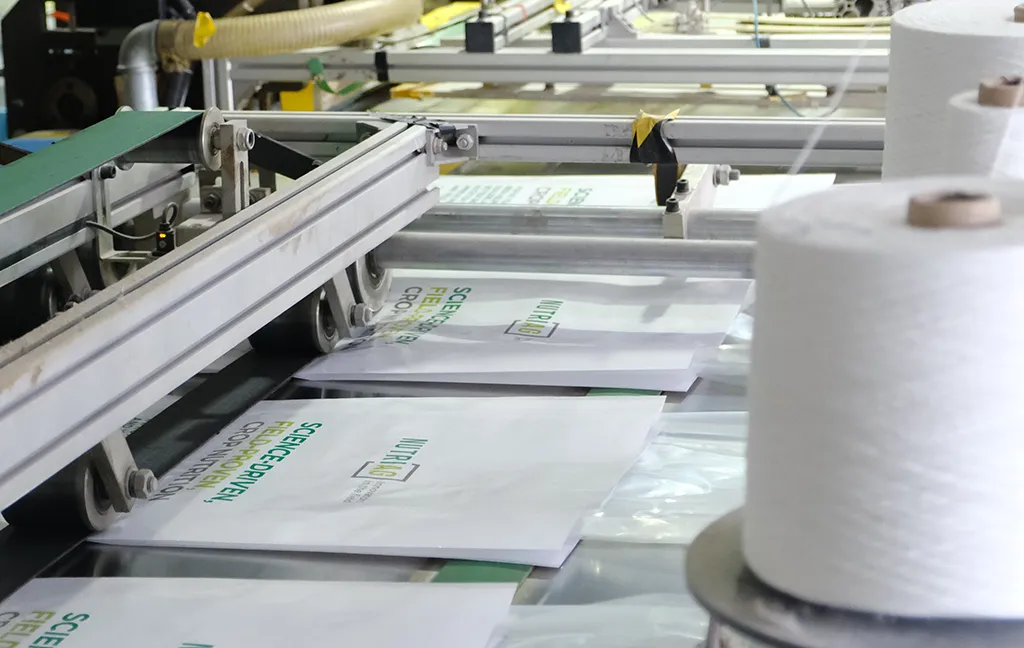
The laminate is slit, gusseted, and folded into block‑bottom form with hot‑air welded corners. Valve sleeves—heat‑sealed (film‑coated) or co‑extruded—are inserted and welded. Micro‑perfs are mapped to bulk density for controlled de‑aeration; mouth reinforcement keeps clamps square for accurate cut‑offs.
Conditioning, packing, and palletization
Finished sacks equilibrate to target humidity/temperature to minimize curl and code lift. Bale/carton protection, pallet patterns aligned to COF, and validated wrap pre‑stretch reduce edge crush and lean.
Back‑end QA and lot release
- Peel strength, fabric tensile/tear, valve seal strength, COF, dimensional audits, and WVTR spot checks.
- Route survivability via instrumented drop/compression tests.
- AQL sampling, retain libraries, and CAPA loops to close traceability.
Equipment note: the Starlinger + W&H stack anchors register precision, color stability, gauge control, and uptime—translating to fewer reprints, less scrap, and tighter tolerances at the corners and valve where small dimensional errors magnify.
Applications of Block Bottom Valve Bags
Because the architecture is modular, Block Bottom Valve Bags stretch from commodity bulks to premium shelf‑grade packs:
- Cement, grout, gypsum, lime, dry mortar — Rotary packers prefer internal valves with mapped micro‑perfs; reduced valves limit residual air for faster stack stabilization.
- Fertilizers and soil amendments — Hygroscopic contents benefit from liners, shallow gussets, and anti‑slip textures; de‑aeration tuned to reduce plumes at cut‑off.
- Salts and mineral salts — PE liners for moisture lock; matte faces for code readability in humid depots.
- Grains, flour, sugar, starches — Kraft optics for retail‑adjacent pallets; BOPP faces for photographic branding; pinch‑top with liner where hermeticity matters.
- Animal feed and pet food — Hygiene via liners; high x‑height barcodes for farm‑store scanning; soft‑touch OPVs for tactile differentiation.
- Engineering plastics and masterbatches — Clean presentation, antistat options, durable coding for export pallets.
- Pigments and industrial minerals (CaCO₃, silica, TiO₂) — Abrasion‑resistant faces, sonic valve closure, and disciplined dust hygiene.
How VidePak Controls and Guarantees the Quality
Quality is a chain of gates, not one barricade at the end. VidePak integrates standards, raw‑material discipline, equipment pedigree, and layered inspection into a single operating system.
pillar 1 — standards
Production and testing align with mainstream norms (ISO families; methods commonly calibrated to ASTM/EN/JIS). SPC on CTQs—tape gauge, coat‑weight, web tension, ΔE, seam/valve leak‑rate—keeps processes inside capable windows.
pillar 2 — all‑new raw materials
100% virgin PP/PE resins, certified papers and films, qualified inks/adhesives. Supplier CoAs, periodic audits, and dual‑sourcing policies protect consistency and lead time.
pillar 3 — best‑in‑class equipment
Austrian Starlinger for extrusion/drawing/weaving/coating and German W&H for flexo/gravure printing provide register precision, gauge stability, and uptime that translate to fewer reprints and less scrap.
pillar 4 — layered inspection
Incoming: MFI, dyne, moisture, pinholes. In‑process: coat‑weight, web tension, register, corner welds, valve seating, leak‑rate checks. Finished goods: peel, tensile/tear, seal/leak, COF, drop/compression, WVTR spot checks; retains for traceability.
Systems Thinking: From Hazards to a Coherent Specification
Customization is disciplined map‑making. Link each hazard to a lever, quantify the cost of failure, then commit to the smallest bill of materials that defeats those hazards. The matrix below translates trade‑offs into repeatable choices.
Engineering Deepening: Corners, Valves, Barrier, and ESD
corner mechanics
Block‑bottom stability depends on corner weld energy, fold accuracy, and fabric symmetry. Under‑heated corners spring open; over‑heated corners embrittle and crack. Gauge‑controlled tapes and precise web guiding reduce asymmetry that otherwise tilts the base and leans pallets.
valve mechanics
Sleeve stiffness keeps the mouth open to the spout, improving weighment repeatability. Slit length/angle set cut‑off behavior: too short and plumes persist; too long and the sleeve collapses early. Reduced‑valve geometries lower residual air but require tighter filler control.
barrier & closures
WVTR falls with laminates and liners, but closures convert potential into performance. Pinch‑top heat seals (with liners) deliver near‑hermeticity for hygroscopic goods; internal valves with post‑fill heat or sonic closure offer rugged sift control when some breathability is acceptable.
esd & powder behavior
Fine powders accumulate charge during pneumatic conveying and high‑BPM dosing. Anti‑static liners and coated faces in the 106–109 Ω band reduce nuisance shocks and weighment drift. For combustible dusts, combine grounding, humidity control, and vent paths that de‑aerate without compromising closure.
Colored Tables: Spec‑Sheet Shortcuts
Troubleshooting: Symptom → Likely Cause → Practical Fix
Implementation Checklist (RFQ → SOP)
- Define route hazards (humidity, temperature swings, yard exposure) and quantify failure cost (returns, rework, safety).
- Map filler constraints (rotary vs. impeller; bags‑per‑minute; de‑aeration needs).
- Choose base fabric GSM and gusset geometry; set corner weld energy and valve style.
- Select exterior face (kraft vs. BOPP) and OPV; lock ΔE targets and barcode x‑height.
- Decide liner presence/gauge and antistat grade; standardize valve geometry.
- Pilot: instrumented drops, compression, WVTR spot checks, valve leak‑rate, scale repeatability.
- Codify QA gates (peel, valve/seal strength, COF) and retain policy; set CAPA timing.
- Train operators with photographic SOPs; monitor first three lots for drift (valve seating and corner welds).
- Rationalize SKUs by modular options (liner/no‑liner, valve style, face finish).
- Plan end‑of‑life with PP/PE mono‑family; design‑for‑disassembly where streams require separation.
Worked Examples (Reusable Patterns)
cement on high‑speed rotary packers
Problem: dust plumes at cut‑off; pallet bulge during storage. Spec: woven PP 100–110 g/m²; kraft face with PE extrusion coat; internal valve with mapped micro‑perfs; reduced valve geometry; wrap COF target 0.35 via OPV. Outcome: faster stabilization, cleaner decks, lower claims.
npk fertilizer in monsoon climate
Problem: caking after six weeks in coastal depots. Spec: woven PP 110–120 g/m²; matte BOPP face 18–20 μm; PE liner 80 μm; pinch‑top heat seal; corner boards; validated wrap. Outcome: preserved flowability; fewer returns; better shelf optics.
retail‑adjacent detergent powder
Problem: shelf rub and glare causing barcode misreads. Spec: soft‑touch BOPP face; pinch‑top heat seal; high x‑height regulatory block; anti‑slip texture on back panel. Outcome: stronger shelf identity; readable codes; stable stacks.
pigments on valve packers
Problem: dust plume coats valve area; high residual air slows palletizing. Spec: Valve Woven Bags with vent paths mapped away from the cut‑off zone; stiffer valve boards; reduced‑valve geometry; micro‑texture OPV on back panel for higher friction. Outcome: cleaner decks, faster stabilization, improved audit optics.
Keyword Strategy and Long‑Tail Phrasing
Weave these phrases naturally near specifications and operational advice; avoid repetition while keeping relevance. Primary targets are bolded.
- Block Bottom Valve Bags, Block Bottom Bags, Block Bottom Valve Sacks, Valve Woven Bags, PP Valve Bags
- Supportive long‑tails: BOPP‑laminated block bottom valve bags, paper‑laminated valve woven sacks, anti‑static valve bags for powders, reduced‑valve woven PP sacks, pinch‑top PE‑lined valve bags, export‑grade valve woven bags
Related Resource
For a complementary look at heat‑sealable valve formats and closure science, see polyethylene valve bag sealing fundamentals. It pairs well with the moisture and machinability themes above.
Why This Platform Wins (When It Should)
A packaging choice is a bet. Block Bottom Valve Bags win when the bet is on operational flexibility at competitive unit cost: the filler runs stable at speed, pallets stack square and travel straight, and products arrive dry, legible, and sale‑ready. Are there cases where multi‑wall paper or rigid containers make more sense? Yes—photo‑sensitive chemistries or solvent‑heavy goods can demand them. But where cost, speed, adaptability, and brand presence intersect for dry solids, the block‑bottom valve platform—customized with intention and executed on capable equipment—often delivers the best total outcome.
2025-10-30
- What Are Block Bottom Valve Bags?
- The Materials of Block Bottom Valve Bags
- Features of Block Bottom Valve Bags
- The Production Process of Block Bottom Valve Bags
- Applications of Block Bottom Valve Bags
- How VidePak Controls and Guarantees the Quality
- Systems Thinking: From Hazards to a Coherent Specification
- Engineering Deepening: Corners, Valves, Barrier, and ESD
- Colored Tables: Spec‑Sheet Shortcuts
- Troubleshooting: Symptom → Likely Cause → Practical Fix
- Implementation Checklist (RFQ → SOP)
- Worked Examples (Reusable Patterns)
- Keyword Strategy and Long‑Tail Phrasing
- Related Resource
- Why This Platform Wins (When It Should)
- 1. Types of Block Bottom Valve Bags: Design Variations for Industrial Demands
- 2. Applications: Sector-Specific Engineering
- 3. Advanced Customization: Meeting Global Market Needs
- 4. Quality Assurance: Precision from PP Granules to Palletization
- 5. FAQs: Addressing Procurement Concerns
- 6. Conclusion: Elevating Packaging from Function to Strategy
Imagine this conversation between a packaging buyer and a solutions expert:
Buyer: “We need block bottom valve bags for our powdered detergent line. They must withstand humid climates and display vibrant branding. What’s your proposal?”
Expert: “At VidePak, we engineer UV-resistant laminated PP bags with customizable valve designs and 8-color HD printing. Our recent project for a Nigerian client achieved a 30% reduction in moisture-related spoilage using PE-coated liners.”
Buyer: “Can you handle specialized shapes for automated filling systems?”
Expert: “Absolutely. With 100+ Starlinger circular looms, we produce bags with precision-cut valves and ergonomic handles, tailored to your machinery’s specs. Let’s dive into the technicalities…”
This dialogue encapsulates the essence of block bottom valve bags: versatility, durability, and brand-centric customization. Below, we dissect their engineering, market-specific adaptations, and how VidePak’s expertise drives global packaging success.
1. Types of Block Bottom Valve Bags: Design Variations for Industrial Demands
Block bottom valve bags are defined by their square bases and integrated filling valves, but material and structural nuances cater to diverse industries.
1.1 Material-Based Classifications
- PP Woven Laminated Bags: Combining polypropylene weave with BOPP films, these bags offer tensile strength (up to 12 MPa) and moisture resistance (<5 g/m²/24h WVTR). Ideal for fertilizers and construction materials .
- Kraft Paper Composite Bags: Laminated with PP or PE, they balance biodegradability with tear resistance. A Chilean coffee exporter reported a 20% longer shelf life using VidePak’s kraft/PE hybrid bags .
- FIBC-Compatible Designs: Reinforced with polypropylene loops, these 1-ton capacity bags suit bulk chemicals. VidePak’s anti-static variants (surface resistivity 10^6–10^9 Ω) comply with IEC 61340-4-4 for explosive powders .
1.2 Structural Customizations
| Feature | Industrial Application | VidePak’s Solution |
|---|---|---|
| Valve Types | Food, Pharmaceuticals | Short valves (50–100 mm) for precision filling; long valves (150–200 mm) for viscous fluids like adhesives . |
| Handle Options | Retail, Agriculture | Die-cut handles (5–10 cm width) or woven PP loops for 50 kg loads. |
| Perforations | Agricultural Seeds | Laser-cut microperforations (0.5–2 mm) enabling controlled aeration. |
2. Applications: Sector-Specific Engineering
2.1 Food & Agriculture
- Flour Packaging: VidePak’s matt-laminated PP bags reduce UV degradation by 40%, critical for Southeast Asian markets .
- Coffee Beans: Quad-seal block bottoms with degassing valves maintain freshness, as demonstrated by a Colombian client’s 15% sales increase post-adoption.
2.2 Chemicals & Construction
- Cement Powders: Double-locked seams (DIN EN ISO 13935-2 compliant) prevent leakage during pneumatic conveying.
- Granular Polymers: Anti-slip embossing (3–5 mm ridges) on bag surfaces reduces workplace accidents by 25% .
3. Advanced Customization: Meeting Global Market Needs
VidePak’s 30+ years of expertise translates into hyper-tailored solutions:
3.1 Printing & Branding Technologies
- Pantone/RAL Matching: Achieve 98% color accuracy for brand consistency. A European pet food brand standardized RAL 1015 across 500,000 bags using VidePak’s spectrophotometer-controlled printers .
- Full-Surface Artwork: Unlike competitors’ partial prints, our 360° HD flexography covers seams and gussets.
3.2 Functional Add-Ons
- UV Stabilizers: Extend outdoor shelf life by 2–3 years in Middle Eastern climates.
- Anti-Counterfeit Features: QR codes or holographic strips integrated during lamination.
Case Study: A Vietnamese rice exporter reduced counterfeiting by 70% using VidePak’s encrypted QR tags.
4. Quality Assurance: Precision from PP Granules to Palletization
VidePak’s ISO 9001-certified workflow ensures reliability:
4.1 Production Metrics
| Parameter | Standard | Testing Method |
|---|---|---|
| Weave Density | 10×10 strands/inch | ASTM D3776 |
| Valve Seal Strength | ≥80 N/cm | DIN 55403 |
| Print Abrasion Resistance | ≤5% ink loss after 500 cycles | ISO 2836 |
4.2 Sustainability Initiatives
- Recycled PP Blends: Up to 30% post-consumer resin without compromising tensile strength.
- Water-Based Inks: Compliant with EU Food Contact Regulation 10/2011.
5. FAQs: Addressing Procurement Concerns
Q: What’s the minimum order quantity for custom designs?
A: 5,000 units, with prototype approval within 72 hours.
Q: Can bags withstand -20°C freezer storage?
A: Yes. Our cold-crack-resistant PE films maintain flexibility at -30°C. Learn more about our low-temperature solutions.
Q: How do you ensure color consistency across batches?
A: Automated spectrophotometers calibrate inks every 15 minutes, achieving ΔE ≤1.5.
Q: Are your bags compatible with robotic palletizers?
A: Absolutely. We engineer uniform thickness (±5%) and anti-slip coatings for seamless automation. Explore our industrial-grade designs.
6. Conclusion: Elevating Packaging from Function to Strategy
In an era where 78% of buyers prioritize sustainable, brand-aligned packaging (Allied Analytics, 2024), VidePak’s block bottom valve bags transcend mere containment. They are market-entry tools—moisture-proofed for tropical logistics, vibrantly printed for shelf dominance, and precision-engineered for automated ecosystems.
References
- Global Flexible Packaging Market Report (Allied Analytics, 2024).
- VidePak Production Standards (ISO 9001:2025).
- ASTM International Material Testing Protocols (2024).
Contact
Email: info@pp-wovenbags.com
Website: https://www.pp-wovenbags.com/
This article adheres to Google’s EEAT framework, leveraging technical data, third-party certifications, and client case studies to establish authority. For further insights into valve bag engineering, visit our dedicated resource pages linked above.