
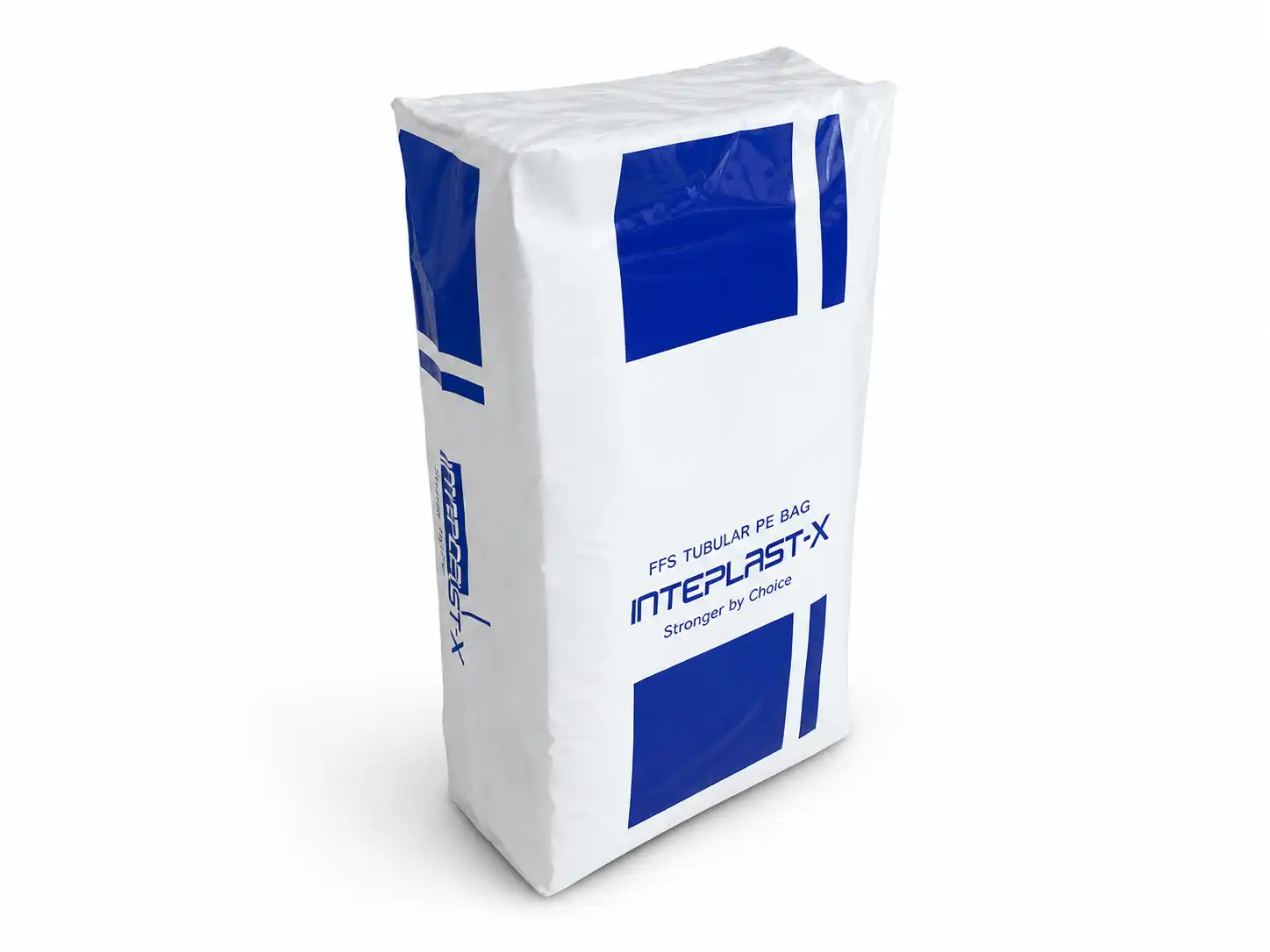
VIDEPAK polyethylene valve bags: Valve Engineering for Cleaner Filling, Stronger Closure, and More Stable Pallets
Industrial powders and granules can look simple, but packaging them well is rarely simple. Fine powders carry air into the bag. Hygroscopic materials need protection from humidity. Free-flowing granules demand a valve that fills quickly without creating an uncontrolled return path. Heavy products put pressure on seams, corners, pallets, and every transfer point between the filling plant and the final customer. VIDEPAK polyethylene valve bags are designed around these connected problems rather than around one isolated specification.
The basic idea is efficient: VIDEPAK polyethylene valve bags are filled through a valve positioned at the bag corner, normally through a filling spout matched to the sleeve geometry. After filling, the valve can close through product pressure, manual tucking, or a positive sealing process, depending on whether the selected construction uses an Internal Valve, Tuck-In Sleeve, Sonic Seal Sleeve, or Reduced Valve. In parallel, a dedicated Air Valve can be used as an air-management feature where controlled venting is required. This distinction matters: the filling valve controls product entry, while the Air Valve is designed to help manage displaced or trapped air.
VIDEPAK design principle: a good industrial package is not created by choosing the thickest film, the smallest valve, or the largest number of vents. It comes from balance: enough strength but efficient material use; enough air release but controlled powder retention; enough friction for pallet stability but smooth enough feeding for automation. With polyethylene valve bags, every part must work with every other part.
Why VIDEPAK polyethylene valve bags Work as a Complete Packaging System
Material Structure Designed Around Real Factory Conditions
VIDEPAK polyethylene valve bags use polyethylene film as the main structural material, with multi-layer co-extrusion available to combine properties such as stiffness, toughness, sealability, puncture resistance, surface behavior, and print performance. VIDEPAK publishes a polyethylene platform using multi-layer co-extrusion with configurations up to nine layers, while its current product information lists typical widths of approximately 35–65 cm, film thicknesses of approximately 0.10–0.25 mm, customizable lengths, flat or M-gusseted formats, block-bottom construction, micro-perforation options, embossing strips, heat sealing, an optional Air Valve, and printing up to 10 colors. These figures should be treated as engineering starting points rather than a universal specification for every application.
That flexibility is important because two 25 kg products can behave completely differently. A mineral powder may trap a large volume of air while filling. A polymer pellet can de-aerate easily but create concentrated impact points against the film. A hygroscopic salt may place moisture protection ahead of maximum ventilation. A fine pigment may make valve containment the first priority. Therefore, VIDEPAK polyethylene valve bags are most effective when film structure, bag dimensions, filling spout, Air Valve, micro-perforations, and closure design are specified as one system. VIDEPAK itself recommends evaluating factors including bulk density, particle form, moisture sensitivity, fill temperature, spout dimensions, line speed, pallet pattern, storage environment, and transport risk before freezing a bag structure.
Published Starting Parameters for Project Discussion
The numbers above are useful for an initial quotation, but the final specification for VIDEPAK polyethylene valve bags should be validated with the actual packed product and intended filling equipment. Film thickness alone cannot tell a buyer whether a valve will fit the spout, whether air will leave quickly enough, or whether a filled pallet will remain stable after road vibration. Specification is not one number. It is a chain of connected decisions.
Understanding the Air Valve and Internal Valve
Air Valve: Controlling Air Without Confusing It with the Filling Valve
An Air Valve performs a different job from the main product-filling valve. In VIDEPAK polyethylene valve bags, the product valve creates the passage through which powder or granules enter the package; an optional Air Valve is an air-management feature that can provide directed or one-way air release. VIDEPAK also offers micro-perforations as another venting method, which means the Air Valve and the micro-perforation map should be selected according to the product rather than added automatically.
This matters most when fast-moving powder carries air into the bag. If the air cannot leave at a suitable rate, a filled package can remain swollen, placing temporary pressure around the valve and making the bag slower to settle into a compact pallet-ready shape. VIDEPAK therefore treats air release as a controlled design problem: breathe enough to improve filling and settling, but not so much that the package creates unnecessary paths for fine product or moisture. For moisture-sensitive powders, fewer perforations or a more controlled Air Valve strategy may be preferable to simply increasing open vent area.
Important: more ventilation is not automatically better. With polyethylene valve bags, excessive venting can work against the barrier and containment objectives that made polyethylene attractive in the first place. The ideal Air Valve or perforation design releases the air that needs to leave while keeping the product that needs to stay.
Internal Valve: Simple Self-Closing Performance
The Internal Valve is built mainly inside the bag rather than extending far outside the valve corner. During filling, the machine spout opens the sleeve and transfers material into the package. When the bag leaves the spout, the sleeve collapses, and pressure from the packed product helps press the valve material against the inner wall. This makes the Internal Valve attractive for automation because there is no long external sleeve that an operator must fold after every filling cycle. VIDEPAK describes the same closure principle across its valve-bag engineering guidance.
The strength of the Internal Valve is simplicity. Fill, withdraw, close. Yet that same simplicity defines its limitation: self-closing is not identical to a validated welded seal. With very fine or highly fluid powders, particles can travel farther into folds and small passages than coarse granules do. For such products, the dimensions and overlap of the Internal Valve may need adjustment, or the project may move toward a Tuck-In Sleeve, Sonic Seal Sleeve, or another positive closure strategy. VIDEPAK specifically notes that extremely dusty or fine products can require tighter valve construction or added anti-sift measures.
Air Valve Focus
Manage displaced and trapped air. Use the Air Valve as part of the ventilation strategy for VIDEPAK polyethylene valve bags, particularly when barrier performance makes uncontrolled perforation undesirable.
Internal Valve Focus
Manage product entry and self-closing. Select an Internal Valve where straightforward automation, compact valve geometry and product-assisted closure match the powder or granule behavior.
Tuck-In Sleeve and Sonic Seal Sleeve: Two Different Closure Philosophies
Tuck-In Sleeve: Mechanical Closure with Practical Flexibility
A Tuck-In Sleeve extends outside VIDEPAK polyethylene valve bags after filling. Instead of depending only on an internal flap, the extended sleeve gives the operator material that can be folded and pushed into the valve pocket. The basic idea is easy to understand, easy to inspect visually, and useful when a customer wants stronger mechanical containment than a simple self-closing valve but does not want to build an ultrasonic sealing step into the line. VIDEPAK notes that sleeve details such as a thumb notch, shaped edge, appropriate length and pocket geometry can make the manual operation easier.
The Tuck-In Sleeve creates an important commercial trade-off. It can reduce dependence on dedicated sealing equipment, but it introduces a manual closure action. For moderate-speed filling lines, frequent product changes, pilot operations, or factories where operators already manage the final bag position, that trade-off can be sensible. For very high throughput, however, the manual step may become the constraint. In other words: the Tuck-In Sleeve saves complexity in equipment but spends time in labor; it gives flexibility, but asks for consistency from the operator.
Geometry is critical. A Tuck-In Sleeve that is too short may not provide enough material for an easy, deep fold. A sleeve that is unnecessarily long can become cumbersome at the filling station. Film stiffness also matters: the sleeve must present itself cleanly to the filling spout and then fold without fighting the operator. Therefore, VIDEPAK treats the Tuck-In Sleeve as a customized functional element of polyethylene valve bags, not simply an extension added to a standard drawing.
Sonic Seal Sleeve: Positive Closure for Automated and Containment-Focused Lines
A Sonic Seal Sleeve takes a different route. The sleeve extends from the valve area and is designed so compatible thermoplastic surfaces can be joined through ultrasonic energy after filling. Instead of folding the valve manually, the sealing equipment brings the sleeve surfaces together and forms a fused closure. VIDEPAK identifies the Sonic Seal Sleeve as a strong direction for polyethylene valve bags carrying very fine powders, moisture-sensitive materials, or products for which a more positively closed valve is important. turn3search1
However, a Sonic Seal Sleeve should never be specified only because “sealed sounds better.” Reliable ultrasonic sealing depends on a controlled process window and a clean enough sealing zone. If powder contaminates the interface heavily, or if the sleeve and equipment settings are mismatched, closure quality can suffer. Venting is therefore connected to sealing: correctly designed micro-perforations or an Air Valve can help manage internal air pressure so that material is less likely to be pushed back toward the sleeve during the transition from filling to sealing. The Sonic Seal Sleeve, Air Valve, product flow and filling speed should be engineered together.
For quality planning, seal performance can also be assessed through recognized flexible-packaging test methods. ASTM F88/F88M covers measurement of seal strength in flexible barrier materials and describes seal strength as useful for process validation and control. For VIDEPAK polyethylene valve bags using a Sonic Seal Sleeve, such laboratory evidence can support quality control, but filled-line trials remain essential because actual powder contamination, spout alignment, cycle timing and equipment settings cannot be reproduced by a film-only test.
Reduced Valve: A Smaller Opening with a More Controlled Interface
A Reduced Valve is defined by its geometry: the valve tube opening is narrower than the full width of the bag top or bottom. In VIDEPAK polyethylene valve bags, this format can be useful when the filling machine uses a smaller spout, when a compact valve pocket is preferred, or when the customer wants to reduce the size of the open product-flow path. VIDEPAK’s valve engineering materials emphasize that the advantage comes from correct matching—not from making the opening as small as possible.
A smaller Reduced Valve can provide more controlled geometry around an appropriately sized filling spout, but narrowing the flow path also changes the filling process. If the Reduced Valve is undersized for the product flow or the spout, filling speed can fall, back pressure can rise, and airborne powder may be pushed toward places where it is not wanted. For this reason, spout outside diameter, sleeve inside dimension, product bulk density, target bags per minute and air-release capacity should be reviewed together.
Smaller is not automatically cleaner. A well-designed Reduced Valve can improve control, while an excessively restrictive Reduced Valve can work against filling speed and air release. The correct question is not “How small can the valve be?” It is “What Reduced Valve geometry gives the cleanest stable filling cycle on this specific machine?”
The Reduced Valve can also be combined conceptually with the broader ventilation strategy of VIDEPAK polyethylene valve bags. A smaller product opening and a carefully designed Air Valve or micro-perforation field can divide two jobs more clearly: one path primarily moves product in, while another controlled path helps air out. This does not mean every application requires both features. It means the designer has more than one lever. Valve size controls product interface; the Air Valve controls air-management strategy; together they can be optimized around the behavior of the packed material.
How to Select the Right Valve for VIDEPAK polyethylene valve bags
The best valve is not the valve with the longest feature list. It is the valve that matches the product, filler and closure process with the least unnecessary complexity. For one customer, that may mean an Internal Valve that keeps the line simple. For another, it may mean a Tuck-In Sleeve because flexibility matters more than maximum automation. For a fine powder, the more secure direction may be a Sonic Seal Sleeve. Where spout geometry calls for tighter control, a Reduced Valve may become the starting point. Where trapped air is the main problem, the conversation should also include an Air Valve and the micro-perforation map.
A Practical Selection Flow for polyethylene valve bags
Measure particle form, bulk density, flow behavior, moisture sensitivity and trapped-air tendency.
↓
Confirm filler type, spout diameter, target bag weight, bags per minute and available closure equipment.
↓
Compare Internal Valve, Tuck-In Sleeve, Sonic Seal Sleeve and Reduced Valve; add an Air Valve where dedicated air control is useful.
↓
Set film structure, thickness, dimensions, gussets, embossing and micro-perforation pattern around the valve choice.
↓
Measure filling behavior, dust, closure, de-aeration, drops, pallet shape and transport stability before freezing the specification.
This sequence prevents one of the most common specification errors: beginning with a bag drawing rather than with the material being packed. VIDEPAK recommends supplying information such as product form, target net weight, bulk density, moisture sensitivity, fill temperature, packer type, spout dimensions, target line rate, pallet pattern, stack height and known failure points. That information allows the polyethylene valve bags, Air Valve, product valve, surface treatment and film structure to be defined around measurable operating needs.
Matching Valve Types to Typical Product Behavior
For free-flowing polymer pellets or coarse granules, an Internal Valve can be a strong starting point because product-assisted self-closing may provide the required balance of simplicity and speed. For an airy mineral powder, valve selection should be considered together with an Air Valve or calibrated micro-perforations so the package can settle without uncontrolled dust release. For a plant that needs improved containment but values simple equipment, the Tuck-In Sleeve can create a practical middle ground. For finer powders, products with stronger moisture-protection requirements, or operations pursuing automated positive closure, the Sonic Seal Sleeve deserves close consideration. Where a filling spout is smaller or a compact opening is needed, the Reduced Valve can provide a more targeted interface.
These are starting directions, not universal rules. Powder behavior can change with particle size distribution, temperature, moisture content and filling method. The same nominal material can run differently on an air packer and a screw packer. That is why VIDEPAK polyethylene valve bags should be trialed with the real product whenever possible. The objective is not merely to make the bag survive filling. The objective is to make filling, closing, settling, palletizing and shipping work as one smooth sequence.
How VIDEPAK Builds and Validates polyethylene valve bags
From Co-Extruded Film to the Finished Valve Bag
Performance begins before the valve is formed. For VIDEPAK polyethylene valve bags, polyethylene grades and additives are selected according to the required stiffness, toughness, sealing behavior, friction and end-use conditions. During multi-layer co-extrusion, coordinated melt streams form a film structure designed to deliver different functions through different layers. After extrusion, surface preparation supports printing and further conversion. Functional areas such as embossing strips and micro-perforations can then be created according to the line and pallet requirements. Finally, the film is converted into the bag geometry, the valve system is installed, and the block-bottom structure is formed.
That process is why valve choice cannot be separated from film design. An Internal Valve needs the right stiffness and memory to present itself to the filling spout and collapse properly afterward. A Tuck-In Sleeve needs enough flexibility to fold comfortably while remaining easy to handle. A Sonic Seal Sleeve needs suitable sealable surfaces and controlled dimensions. A Reduced Valve must remain geometrically consistent so that the smaller opening matches the intended spout. An Air Valve must be positioned and specified according to the desired air path. In each case, the valve is not an accessory attached at the end. It is part of the package architecture.
Quality Control Should Connect Laboratory Tests with Line Performance
Film properties can be evaluated using recognized test methods. ASTM D882 covers tensile testing of thin plastic sheeting and film; ASTM D1709 addresses impact resistance of plastic film using a free-falling dart method; ASTM D1894 addresses static and kinetic coefficients of friction for plastic film and sheeting; and ASTM F88/F88M covers seal strength of flexible barrier materials. These methods are useful because they turn broad terms such as “strong,” “impact resistant,” “anti-slip” and “well sealed” into measurable properties.
Yet laboratory data are only part of the decision. ASTM itself notes that film impact results depend on factors including film quality and thickness, while friction measurements relate to surface behavior and can vary with film condition. In real production, the bag must also meet the filler correctly, release air at the required speed, close consistently, resist drops, form a stable shape and maintain suitable friction through palletizing. For VIDEPAK polyethylene valve bags, the most useful approval process therefore combines material testing with actual filling and logistics trials.
Filling Fit
Check how the Internal Valve, Tuck-In Sleeve, Sonic Seal Sleeve or Reduced Valve presents to and releases from the real spout.
Air Control
Observe bag inflation and settling. Adjust the Air Valve or micro-perforation design when air release is too slow or too open.
Closure Control
Inspect self-closing performance, the manual Tuck-In Sleeve, or the fused Sonic Seal Sleeve after realistic powder exposure.
Pallet Control
Confirm that filled polyethylene valve bags settle into repeatable shapes and provide suitable friction for the intended pallet pattern.
What VIDEPAK Needs to Build a Better Specification
A productive project begins with facts. The most useful information includes the packed material, particle form, bulk density, target net weight, moisture sensitivity, filling temperature, current bag dimensions, filling-machine type, spout drawing or diameter, target bags per minute, closure equipment, pallet dimensions, planned stack height, storage conditions, transport route and any problems with the existing package. With those inputs, VIDEPAK can evaluate whether the strongest starting point is an Internal Valve, Tuck-In Sleeve, Sonic Seal Sleeve, Reduced Valve, a dedicated Air Valve, or a combination of these functions.
The VIDEPAK product logic is straightforward:
Choose the film structure for the product and transport route. Choose the Internal Valve, Tuck-In Sleeve, Sonic Seal Sleeve, or Reduced Valve for the filling and closure process. Choose the Air Valve and micro-perforation strategy for the air that must escape. Then test the complete package under realistic conditions.
The result is not merely a polyethylene sack with a valve. Properly engineered VIDEPAK polyethylene valve bags become part of the production system itself: receiving the filling spout cleanly, accepting product quickly, controlling trapped air, closing in the required way, settling into a compact shape, carrying clear graphics, stacking efficiently, and protecting the packed material through storage and transport.
That is the real value of VIDEPAK polyethylene valve bags. The Air Valve controls where air can leave. The Internal Valve offers compact self-closing simplicity. The Tuck-In Sleeve provides flexible mechanical closure. The Sonic Seal Sleeve supports a positively fused valve for applications that demand greater closure control. The Reduced Valve creates a smaller, more controlled product interface when machine and product conditions support it. Different designs, different strengths, one purpose: to make industrial filling cleaner, closure more reliable, and the complete package more predictable from the filling line to the final pallet.
Multi-layer Polyethylene Valve Bags
High-strength multi-layer PE valve bags with excellent barrier and sealing performance.
Check More →Paper Valve Bags vs PE Valve Bags
Comprehensive comparison of polyethylene valve bags and paper valve bags for industrial use.
Check More →Valve Bags & Valve Types
Complete guide to valve structures designed for polyethylene valve bag applications.
Check More →Heavy-duty HDPE Bags With Venting
Durable HDPE valve bags with venting function for industrial bulk packaging.
Check More →- VIDEPAK polyethylene valve bags: Valve Engineering for Cleaner Filling, Stronger Closure, and More Stable Pallets
- Why VIDEPAK polyethylene valve bags Work as a Complete Packaging System
- Understanding the Air Valve and Internal Valve
- Tuck-In Sleeve and Sonic Seal Sleeve: Two Different Closure Philosophies
- Reduced Valve: A Smaller Opening with a More Controlled Interface
- How to Select the Right Valve for VIDEPAK polyethylene valve bags
- How VIDEPAK Builds and Validates polyethylene valve bags
- What is a Polyethylene valve bag? Aliases, features, manufacturing flow, and uses
- Why modified PE pellets change the behavior of a Polyethylene valve bag
What is a Polyethylene valve bag? Aliases, features, manufacturing flow, and uses
A Polyethylene valve bag is a heavy‑duty, self‑sealing packaging format designed for fast filling, clean handling, and secure stacking of free‑flowing powders and granulates. In different industries you will also hear the aliases PE valve sack, block‑bottom valve bag, poly valve bag, film valve bag, and—when the square bottom is emphasized—BBVB (block‑bottom valve bag). The signature detail is the valve: product enters through an internal sleeve or external spout and, under its own pressure, closes the opening, yielding a neat, sift‑resistant finish that suits high‑throughput packers and mechanized logistics.
Key features of a Polyethylene valve bag. Smooth outer skins reduce drag on forming shoes and feed plates; tuned coefficient of friction (COF) keeps layers from sliding on pallets; multi‑layer film delivers dart impact and seal integrity; and the block‑bottom geometry forms a brick‑like footprint that stacks densely. When we formulate with modified PE pellets (metallocene LLDPE‑rich cores, low‑bloom slip, and engineered antiblock), the bag stays glossy, resists crease memory, and avoids stress‑whitening even after aggressive compression.
Manufacturing overview. A modern Polyethylene valve bag typically starts as a 3–5 layer blown film. The core blends metallocene LLDPE for toughness and drawdown; LDPE/LLDPE skins contribute sealability and print hold‑out. After corona treatment (and primer where heavy ink coverage is planned), the web is converted on high‑speed bottomers into block‑bottom or pillow profiles; internal or external valve sleeves are formed; micro‑perforation or laser venting is added where air release is necessary; and optional anti‑slip emboss or stripes are laid down. In‑line or near‑line printing (1–8 colors) completes the conversion. Finished bags are qualified for film gauge, tensile/elongation, dart impact, COF, seal strength, and drop performance before palletization.
Where a Polyethylene valve bag is used. The application map is broad and practical: cementitious blends, industrial minerals, fertilizers, engineered resins, pigments, carbon black, salt, animal nutrition, sugar, starches, filter media, and specialty chemicals. For food‑adjacent ingredients, food‑contact films and clean‑room conversion are available; for combustible dusts, antistatic or conductive film options are specified.
Why modified PE pellets change the behavior of a Polyethylene valve bag
Every complaint you have heard—blocking on the roll, stubborn creases after folding, the tell‑tale white line at bends—traces back to polymer physics. A Polyethylene valve bag made from conventional blends can craze at sharp folds; a metallocene‑rich core with controlled nucleation resists that failure mode. Why?
Vertical analysis (within the material). Metallocene LLDPE increases tie‑molecule density and narrows molecular weight distribution. The film stretches without forming micro‑voids; dart impact rises; tear balance improves; whitening under flex recedes. The core does the heavy lifting while the skins stay sealable and printable.
Horizontal analysis (across the surface). Slip agents and antiblocks aren’t mere additives; they are COF dial‑knobs. Long‑chain amide slips reduce drag for infeed speed; inorganic or silicone‑resin antiblocks control blocking without the residue bloom that smears ink or labels. When these levers are matched to your line—air packers, impellers, augers—the Polyethylene valve bag moves smoothly when speed matters and holds its ground when pallets are tall.