
VIDEPAK Multiwall Kraft Paper Valve Bags: Engineered Packaging for Fast Filling, Strong Protection, and Reliable Industrial Performance
For industrial powders, granules, food ingredients, minerals, chemicals, agricultural materials, and construction products, packaging is never “just a bag.” It is part of the filling line, part of the pallet, part of the transport system, and part of the customer’s first impression. A package that fills slowly reduces output. A package that releases dust creates housekeeping problems. A package that loses shape weakens pallet stability. A package that tears can turn a small material saving into a much larger product loss. This is why VIDEPAK approaches multiwall kraft paper valve bags as an engineered packaging system rather than a simple commodity sack. VIDEPAK’s published product range covers heavy-duty kraft paper sacks from approximately 2 kg to 60 kg, including brown and white structures, multiwall designs, valve formats, open-top formats, PE-coated options, and liner configurations.
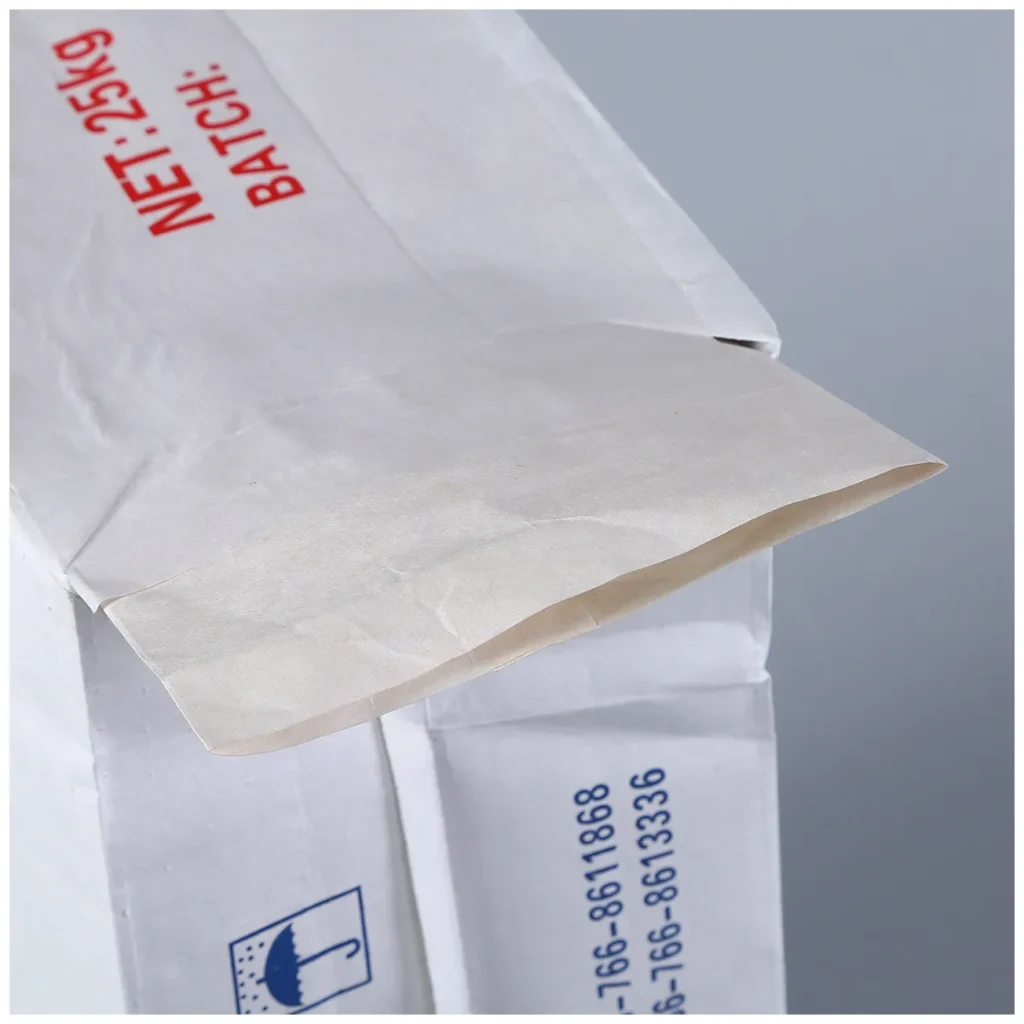
At the center of this product family are multiwall kraft paper valve bags: industrial sacks that combine several functional layers of kraft paper with a valve opening designed for efficient spout filling. The idea is simple, but the engineering is not. The outer surface needs strength and print quality. Inner plies need to support the filled weight and resist handling stress. Air has to escape during filling without creating an uncontrolled path for powder. The valve needs to receive the filling spout smoothly and then help contain the product after discharge from the packer. For moisture-sensitive materials, an optional PE coating or inner liner can add another level of protection. VIDEPAK therefore designs kraft paper valve bags around the product, the filling equipment, the logistics route, and the required appearance—not around one fixed construction.
VIDEPAK PACKAGING PRINCIPLE: The best multiwall kraft paper valve bags are not necessarily the bags with the most material. They are the bags with the right kraft paper grade, the right multiwall structure, the right valve, the right air-release behavior, and the right barrier for the actual filling and distribution conditions.
Understanding the Multiwall Kraft Paper Valve Bags Product Family
Multiwall kraft paper valve bags bring together two important industrial packaging concepts. The first is the multiwall body: instead of asking a single sheet to provide every required property, several plies share the work. The second is the valve: instead of leaving the whole top open, kraft paper valve bags are manufactured with a controlled filling opening, commonly positioned at a corner of the pasted end. The filling spout enters this opening, the product moves into the bag, air leaves through the engineered paper structure or venting design, and the valve is designed to close or be sealed according to the selected configuration. VIDEPAK describes its valve sacks as particularly suitable for powders where filling speed, cleanliness, and controlled product containment matter.
From Kraft Paper to a Multiwall Industrial Structure
The foundation is sack-grade kraft paper. Long fibers and a packaging-oriented paper structure give sack papers the mechanical properties required for industrial handling, while porosity can support the release of displaced air during high-speed filling. Industry research reports that advances in sack paper have improved both strength and porosity over time, allowing manufacturers to use material more efficiently while maintaining strong filling performance. The paper-sack industry specifically identifies natural porosity as an important reason paper packages can vent rapidly during filling. In practical terms, this means the kraft paper is doing two jobs at once: carrying the load and helping the package breathe when the product enters.
A multiwall construction extends that principle. VIDEPAK describes multiwall sacks using several paper plies, with the number of layers selected according to strength, puncture resistance, print requirements, product density, and logistics needs. Its current product information describes common structures in the range of roughly two to five paper layers, depending on design. An optional PE inner bag can be introduced when the packed material needs additional moisture resistance or improved containment of fine particles. This modular approach is the key advantage of multiwall kraft paper valve bags: one ply can focus on print and surface appearance, another on mechanical strength, another on product-side performance, while an optional film layer addresses barrier requirements.
That does not mean “more plies always means better.” A correctly specified two- or three-ply multiwall design may be more efficient than an unnecessarily heavy construction, while a demanding export application may justify additional strength or a functional liner. VIDEPAK therefore evaluates the filled weight, powder behavior, bulk density, valve-filling conditions, storage climate, stacking height, handling method, and transport route before defining the final multiwall kraft paper valve bags specification. Strength without air release can cause filling problems; air release without sufficient product containment can increase sifting risk. Good engineering balances both.
Think in layers, but buy by performance. For VIDEPAK multiwall kraft paper valve bags, the goal of the multiwall structure is not to create complexity for its own sake. The goal is to place strength, venting, printability, barrier performance, and filling compatibility exactly where they are needed.
How Kraft Paper Valve Bags Work with Industrial Filling Lines
In many powder operations, packaging performance begins at the filling spout. With conventional open-top sacks, operators or downstream machines may need an additional closing step after filling. Kraft paper valve bags take a different route. The bag is supplied substantially closed except for the valve opening; the filling spout enters the valve, material is introduced, and the filled product helps the package form its final block-like shape. Depending on valve construction, the opening may function as a self-closing internal valve, may be tucked after filling, or may be positively sealed. VIDEPAK currently offers valve options including paper insert, sonic-seal, tuck-in, and poly-lock configurations.
This operating principle is one of the strongest reasons customers choose multiwall kraft paper valve bags for cementitious powders, minerals, dry chemical products, food ingredients, and other flowable materials. The valve creates a controlled interface between the bag and the filling machine. The multiwall body contains the load. The kraft paper structure can help displaced air leave the package. Together, these elements support a filling process designed to be fast, repeatable, and cleaner than a poorly matched sack-and-spout combination. Industry testing has confirmed the importance of porous paper structures for rapid deaeration, and a 2025 comparative cement-filling study reported faster filling for the tested high-porosity paper sacks than for the tested woven alternatives. That result should not be treated as a universal guarantee for every machine or product, but it demonstrates why air management is a major specification parameter.
Valve Choice and Deaeration Must Work Together
A valve cannot be selected in isolation. Fine powder may behave very differently from coarse granules. A product with a high level of entrained air may need greater deaeration capacity. A moisture-sensitive ingredient may justify a stronger barrier around the valve. A customer running a highly automated line may value a sealable sleeve, while another operation may prefer the simplicity of an internal paper valve. This is why VIDEPAK’s kraft paper valve bags can be configured with different sleeve designs rather than forcing every customer into one closure concept.
Critical engineering point: Air must leave the multiwall kraft paper valve bags quickly enough to support filling, but the finished package must still protect the product. Too little deaeration can cause inflation, unstable filling, or slow output. Too much uncontrolled venting can work against fine-powder containment or barrier goals. The answer is not “maximum venting.” The answer is controlled venting.
Product Analysis
Particle size, density, flow, moisture sensitivity and entrained air
Bag Engineering
Multiwall ply structure, kraft paper grade, liner and venting
Valve Matching
Paper insert, tuck-in, sonic-seal or poly-lock
Line Validation
Filling, deaeration, closure, drop handling and pallet behavior
The flow above reflects an important rule: do not select multiwall kraft paper valve bags from a photograph alone. A good-looking valve bag may still perform badly if its valve width does not match the spout, if its body volume does not match the product’s bulk density, or if air cannot escape at the required rate. Conversely, well-engineered kraft paper valve bags can become an active part of production efficiency because bag dimensions, valve geometry, multiwall structure, and filling behavior are designed as one system.
Why Multiwall and Kraft Paper Matter After Filling
Fast filling matters, but the bag still has a long journey ahead. It may fall from a filling machine onto a conveyor. It may pass through a checkweigher. It may be flattened or shaped, palletized, stretch-wrapped, loaded into a truck or container, stored in a warehouse, unloaded again, and handled at a distributor or job site. Each movement pushes, bends, rubs, or drops the package. This is where the relationship between multiwall construction and kraft paper quality becomes visible. Several properly selected paper plies can distribute stress instead of asking one layer to carry every load. The resulting multiwall kraft paper valve bags can be designed for strength while retaining the rectangular geometry that supports organized stacking. VIDEPAK specifically identifies stackability, puncture resistance, and burst strength as key reasons for adjusting its multi-ply structures.
Mechanical Strength
The multiwall body can be adjusted for filled weight, handling severity, puncture risk, and pallet pressure. Strong kraft paper fibers provide the structural base, while multiple plies share the work.
Air Management
Porous sack-grade kraft paper can help displaced filling air escape, making deaeration an inherent part of properly engineered kraft paper valve bags.
Brand Presentation
Brown or white kraft paper gives customers a broad printable surface for product identity, handling information, instructions, and market-specific artwork. VIDEPAK offers both unbleached and bleached paper options.
Barrier performance adds another dimension. Standard paper-led multiwall kraft paper valve bags are attractive where strength, filling performance, and fiber-based packaging are the main priorities, but some products need stronger resistance to environmental moisture or fine-powder leakage. In those applications, VIDEPAK can introduce PE-coated paper or an inserted or pasted PE inner bag. The kraft paper then provides the outer structure and printable surface, while the polymer layer performs a more specialized barrier function. This hybrid construction is particularly useful when a customer wants the handling and presentation of kraft paper valve bags but needs extra protection during humid storage or long-distance logistics.
The environmental story also deserves precision rather than slogans. Paper-sack industry guidance describes sack fibers as natural and renewable and identifies used sack kraft paper as a useful source of strong fiber for recycling. At the same time, recyclability of a finished package depends on the complete structure, contamination after use, local collection systems, coatings, liners, adhesives, and regional recycling rules. Therefore, a paper-only multiwall structure can offer a simpler fiber-based end-of-life route than a more complex barrier construction, while PE-lined multiwall kraft paper valve bags should be evaluated against the actual recycling infrastructure of the destination market.
VIDEPAK Multiwall Kraft Paper Valve Bags Specifications and Customization
Industrial customers rarely need one universal size. A low-density powder can require much more bag volume than a dense mineral at the same nominal weight. A 25 kg chemical ingredient and a 25 kg cementitious product may therefore need different dimensions, different valves, different multiwall constructions, and different barrier strategies. VIDEPAK’s published kraft paper program covers approximately 2 kg to 60 kg heavy-duty packaging and includes flat, gusseted, pasted block-bottom, valve, sewn open-mouth, liner, coating, and several closure options. The company also describes brown, white, and different fiber-grade choices for tailoring strength and print appearance.
Dimensions should also be treated as an engineering output rather than a starting guess. VIDEPAK has published broad customizable dimensional ranges across its technical materials, but the better method is to calculate the package around the required filled volume, expected bag shape, valve position, filling-spout geometry, pallet footprint, and headspace. Current international standards recognize paper sacks as both single- and multi-ply packages and provide standardized terminology and dimensional measurement methods. ISO 6590-1:2025 covers terminology for paper sacks, including single- and multi-ply constructions, while ISO 6591-1:2026 specifies dimensions and methods for measuring empty paper sacks.
Testing is equally important because specification values on paper do not reproduce the full distribution environment. A properly developed program for multiwall kraft paper valve bags may include dimensional checks, paper-basis-weight verification, tensile or seam evaluations, valve alignment inspection, filled-bag drops, pallet tests, and real filling-line trials. ISO 7965-1:2024, for example, specifies a vertical-impact drop-test method for filled paper sacks. VIDEPAK states that its wider quality system works with ISO 9001 and uses batch inspection and testing approaches aligned with international methods, including impact and tensile-related controls.
A specification is only complete when it connects material to reality. For VIDEPAK multiwall kraft paper valve bags, that means connecting kraft paper grade to filled weight, multiwall structure to transport stress, valve dimensions to the filling spout, deaeration to powder behavior, and barrier design to shelf-life conditions.
Matching Multiwall Kraft Paper Valve Bags to Real Applications
The strongest application for multiwall kraft paper valve bags is not defined by one industry name; it is defined by product behavior. Dry powders and granules that can be delivered through a valve-filling spout are natural candidates. VIDEPAK identifies cement and other construction materials, food ingredients, agricultural products, chemicals, and minerals among the common markets for its kraft paper valve bags. Yet two products in the same industry can still need different bags. Fine tile adhesive may require different venting from coarse mortar. A hygroscopic ingredient may require more barrier protection than a dry mineral. A premium food powder may favor white kraft paper for presentation, while a construction product may favor a robust natural-brown appearance.
A sensible selection discussion therefore starts with questions, not assumptions. What is the bulk density? What is the particle size? How much air is carried into the bag with the product? Does the product absorb moisture? What filling technology is being used? What is the valve-spout size? What is the required net weight? How many bags must the line fill per minute? Will pallets move by truck only, or also by sea container? How high will they be stacked? Will bags sit in humid warehouses? Is the customer prioritizing natural brown kraft paper, bright white printing, or additional barrier protection? Each answer changes the ideal multiwall kraft paper valve bags design.
This is also why replacing an existing package should be treated as a controlled conversion rather than a direct dimensional copy. The previous bag may have been oversized to compensate for poor shaping, overbuilt to compensate for weak material, or excessively perforated to compensate for slow deaeration. Simply reproducing every dimension can reproduce every old problem. VIDEPAK’s objective is to understand what the existing kraft paper valve bags do well, identify where they fail, and then tune the multiwall structure, valve, venting, surface, barrier, and dimensions around the required result.
The right question is not “How many plies do you sell?” The better question is: “What combination of multiwall structure, kraft paper, valve design, ventilation and barrier will let this exact product fill cleanly, travel safely and arrive in the condition our customer expects?”
Why VIDEPAK for Multiwall Kraft Paper Valve Bags
A technically good bag still needs repeatable manufacturing behind it. VIDEPAK states that its kraft paper sack program is produced on German-engineered paper-bag production equipment, with published annual capacity exceeding 300 million kraft paper bags and manufacturing managed under an ISO 9001 quality framework. The company also highlights more than a decade of industrial-bag production experience and the ability to customize printing, dimensions, thickness or material structure, bottoms, valves, and liners. For customers purchasing multiwall kraft paper valve bags across multiple plants or markets, this manufacturing depth matters because consistency must continue after the first approved sample.
VIDEPAK’s published quality approach begins with material control and continues through production and finished-bag evaluation. It describes incoming raw-material sampling, process checks, dimensional tolerance management, and testing aligned with ISO, ASTM, EN, and JIS methods according to product requirements. For paper sacks, contemporary ISO standards provide useful common language for terminology, measurement, and distribution testing; ISO 6590-1:2025 defines paper-sack terminology, ISO 6591-1:2026 covers dimensional measurement of empty paper sacks, and ISO 7965-1:2024 defines a filled-paper-sack vertical-impact drop-test method. These standards do not replace application-specific trials, but they make specifications clearer and test communication more repeatable.
Customization also has a commercial purpose. Brown kraft paper can communicate a natural, industrial, straightforward identity. White kraft paper can create higher color contrast for brand-led graphics. A pasted block-bottom construction can help create a regular filled shape. An appropriate valve can support automated filling. A PE liner can strengthen the moisture-barrier strategy. A carefully selected multiwall structure can give customers the strength they need without simply adding material. One decision supports another; one layer supports another. That is the logic behind VIDEPAK multiwall kraft paper valve bags.
The sustainability value is similarly practical. The European paper-sack sector identifies sack kraft paper as a renewable fiber-based material and a useful feedstock for paper recycling, while continued development in paper strength and porosity has allowed the industry to improve material efficiency and filling performance together. For VIDEPAK customers, the best sustainability strategy is therefore not merely to replace one material with another; it is to design the multiwall kraft paper valve bags so that they use the appropriate amount of material, protect the packed product from loss, work efficiently on the filling line, and use a structure compatible with realistic end-of-life systems in the target market.
VIDEPAK VALUE IN ONE SENTENCE
We engineer multiwall kraft paper valve bags by connecting the strength and printability of kraft paper, the layered protection of multiwall construction, the filling efficiency of kraft paper valve bags, and the specific realities of your product, equipment, storage climate, logistics route, and brand.
For a purchasing team, that translates into fewer unknowns. For a production team, it means a package designed around the machine rather than against it. For a quality team, it means specifications that can be measured. For a marketing team, it means a broad printable paper surface that can carry clear branding and product information. And for the final customer, it means something even simpler: the product arrives where it should, inside a package that looks and performs as expected.
Multiwall kraft paper valve bags succeed because they combine opposites. They are strong, yet they can breathe during filling. They are industrial, yet they can present a clean branded face. They are based on kraft paper, yet they can be upgraded with functional liners when the product requires greater barrier protection. They use multiple layers, yet a well-designed multiwall structure can pursue material efficiency instead of unnecessary weight. They look simple, yet every successful bag reflects dozens of decisions about fiber, ply count, valve, air, dimensions, glue, barrier, printing, palletization, and transport.
That is the difference between buying sacks and engineering packaging. VIDEPAK develops kraft paper valve bags for the point where production speed meets product protection, where multiwall engineering meets practical logistics, and where kraft paper becomes more than an outer material—it becomes part of a complete industrial packaging system. For cement, minerals, chemicals, food ingredients, agricultural materials, and other dry flowable products, VIDEPAK multiwall kraft paper valve bags are built around one clear objective: fill efficiently, protect reliably, stack consistently, present professionally, and perform from the packing line to the final destination.
- VIDEPAK Multiwall Kraft Paper Valve Bags: Engineered Packaging for Fast Filling, Strong Protection, and Reliable Industrial Performance
- Understanding the Multiwall Kraft Paper Valve Bags Product Family
- How Kraft Paper Valve Bags Work with Industrial Filling Lines
- Why Multiwall and Kraft Paper Matter After Filling
- VIDEPAK Multiwall Kraft Paper Valve Bags Specifications and Customization
- Matching Multiwall Kraft Paper Valve Bags to Real Applications
- Why VIDEPAK for Multiwall Kraft Paper Valve Bags
- Whispers Before the Storm – A Four‑Part Warm‑Up
Whispers Before the Storm – A Four‑Part Warm‑Up
1. What on Earth Is a Multiwall Kraft Paper Valve Bag?
Imagine a paper sack that behaves like a seasoned dockworker—tough, dependable, and able to shut itself without anyone shouting “Tie the knot!” That is the Multiwall Kraft Paper Valve Bag. Industry veterans may greet it by other nicknames—valve sack, pasted‑valve paper bag, pasted open‑mouth (POM) bag. Regardless of the moniker, its essence remains: a multi‑ply kraft fortress purpose‑built for powders that flow like water yet misbehave like smoke.
2. What Makes It Special?
Layers. Not one, not two, but typically three to five plies of long‑fiber, tear‑resistant kraft pulp pressed into tight alliance. Add a pre‑formed valve sleeve—think of a one‑way breathing lung—and the bag seals itself under the very pressure of the product it carries. No sewing. No taping. No stray dust escaping to settle on your profits.
Kraft Paper Valve Bags Solutions
Professional multiwall kraft paper valve bags with reliable sealing and strong load-bearing capacity.
Check More →Valve Bags & Valve Types
Comprehensive guide to multiwall kraft paper valve bags and different valve structures for packaging.
Check More →Laminated Kraft Paper Sacks
High-strength laminated multiwall kraft paper valve bags with moisture-proof and durable performance.
Check More →Multiwall Paper Bags Manufacturer
Specialized manufacturer of premium multiwall kraft paper valve bags for industrial bulk packaging.
Check More →3. How Is It Born?
Logs meet chemistry. Pulp meets paper machine. Then the choreography begins:
- Tubing & Valve Patching – continuous formers wrap, glue, and patch at 200 m min⁻¹.
- Bottom Pasting – hot‑melt rivers bond block bottoms tighter than a clamshell.
- Micro‑Perforation – laser pinholes whisper, “Air, exit here,” allowing high‑speed filling without ballooning.
- Flexographic Storytelling – eight‑color presses shout your brand louder than rival sacks.
- Vision Inspection – cameras act as sleepless guardians, rejecting misprints before daylight sees them.
4. Where Does It Serve?
Cement plants at dawn, flour mills at noon, chemical depots at dusk. Whether laden with OPC cement, milk powder, TiO₂ pigment, or hybrid seeds, Multiwall Kraft Paper Valve Bags stand guard from Amazonian humidity to Siberian freeze.
(Doubting? Explore photos, video demos, and laboratory curves here → Multiwall Kraft Paper Valve Bags.)