
VIDEPAK FIBC Bags: Configurable Bulk Packaging for Strength, Static Control, and Product Protection
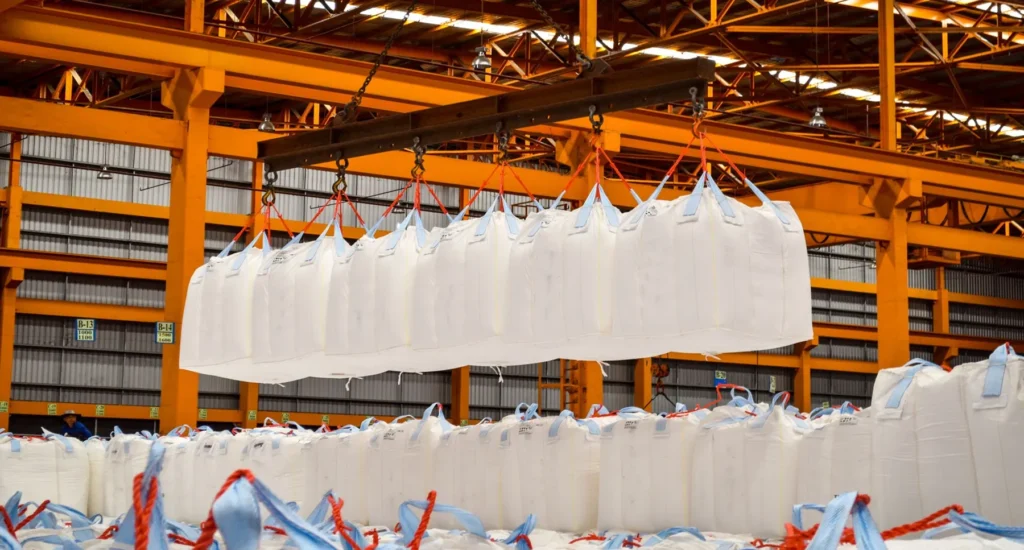
Bulk packaging looks simple only from a distance. In real production, one flexible intermediate bulk container may need to carry a dense mineral, protect a moisture-sensitive powder, fit a fixed filling head, discharge into a narrow hopper, survive forklift handling, control dust, and match the electrostatic conditions of the plant. That is why VIDEPAK treats FIBC Bags as engineered bulk-handling systems rather than as oversized sacks. The bag body, lifting system, inlet, outlet, fabric, coating, inner liner, safety factor, and electrostatic class must work together. VIDEPAK’s current product range supports open, duffle, flap, and filling-spout tops; flat, duffle, and discharge-spout bottom; U-panel, circular, four-panel, and baffle constructions; and several lifting arrangements, including four-loop, tunnel, corner-loop, and cross-corner designs.
The result is a flexible platform for powders, granules, pellets, flakes, agricultural materials, building materials, industrial minerals, chemical products, and many other dry bulk goods. For non-dangerous solids, ISO 21898:2024 covers material, construction, design, type testing, marking, selection, and safe-use requirements for flexible intermediate bulk containers. For electrostatic applications, IEC 61340-4-4:2018 defines the classification and testing framework for FIBC and their inner liners when explosive atmospheres may be present.
VIDEPAK design principle: specify the cargo first, the process second, and the bag third. A strong bag in the wrong electrostatic class is not the right bag. A moisture barrier that blocks necessary airflow is not the right barrier. A large discharge spout that does not match the receiving hopper is not the right outlet. Good packaging is not about adding every option; it is about combining the right options.
How VIDEPAK Builds the Right FIBC Bags Specification
Start with the working load, volume, and product density
Most industrial buyers begin with a target net weight, but weight alone does not define the bag. Bulk density determines how much internal volume is needed, while particle size, flow behavior, moisture sensitivity, abrasiveness, and aeration influence fabric, seam, liner, and discharge choices. VIDEPAK’s published engineering ranges place many common FIBC Bags around 500 to 2,000 kg Safe Working Load, with typical industrial sizes extending from roughly 90 × 90 × 90 cm to 120 × 120 × 120 cm depending on the project. Fabric weights commonly fall in an engineering band around 160 to 240 g/m², while final construction is selected against the certified load and handling method rather than chosen by fabric weight alone.
Safety factor is equally important. In common industry practice, single-trip designs are often specified at 5:1, while designs intended and qualified for repeated use may use 6:1. The ratio must be understood as part of a tested design system, not as a promise that any bag can be reused simply because a higher number appears on a drawing. ISO 21898:2024 provides the current international framework for type testing and marking of FIBC for non-dangerous goods.
| Specification Item | Common VIDEPAK Engineering Range / Option | Why It Matters |
|---|---|---|
| Safe Working Load | Commonly 500–2,000 kg | Matches payload, lifting, and transport conditions. |
| Safety Factor | Common 5:1 / 6:1 design families | Links rated load to validated test performance. |
| Body Construction | U-panel, circular, four-panel, baffle | Controls shape, seam layout, filling behavior, and pallet footprint. |
| Top | Open, duffle, flap, filling spout | Matches manual, gravity, or controlled filling. |
| Bottom | Flat, duffle, discharge spout | Controls emptying speed, dust, and dosing. |
| Lifting | Four loops, cross-corner, corner loops, tunnel lift | Must match forklift, hoist, frame, and operator access. |
| Barrier | PE Liner or laminated/coated fabric | Adds product containment, moisture control, and cleaner handling. |
Choose the body shape for logistics, not appearance
U-panel FIBC Bags are widely used because they combine efficient production with dependable load carrying. Circular bodies reduce the number of vertical seams and can be a practical solution for many free-flowing materials. Four-panel construction gives buyers clear panel geometry and flexible printing areas. Baffle or Q-bag designs add internal panels that limit outward bulging, helping a filled bag keep a squarer footprint for pallets, racks, trucks, and sea containers. VIDEPAK lists all four construction families as standard customization paths.
Strength
Select fabric, seam architecture, loop webbing, and safety factor as one load-bearing system.
Flow
Match filling and discharge geometry to the actual equipment, product aeration, and emptying target.
Protection
Select coating, PE Liner, electrostatic class, and seam treatment around the cargo risk.
Understanding Type A, Type B, Type C, and Type D
Electrostatic selection is one of the most important decisions in FIBC Bags. When powder or granules move during filling and emptying, charge can be generated. The correct FIBC category depends on the ignition sensitivity of the product, whether flammable vapors or gases may be present, the conductivity of the material, the surrounding equipment, the inner liner, and the site’s grounding procedures. IEC 61340-4-4:2018 covers classification, labelling, design and performance requirements, test methods, inner-liner classification, and safe-use provisions for FIBCs in hazardous explosive atmospheres.
Type A: standard non-conductive construction
Type A is the basic category. It is normally made from woven polypropylene without a dedicated electrostatic protection mechanism. It can be a practical and economical choice for non-flammable products used in non-hazardous surroundings, but it should not be treated as a static-control solution. VIDEPAK describes Type A as a non-conductive polypropylene FIBC with no static protection, and the industry safety framework separates it clearly from the controlled electrostatic functions of Type B, Type C, and Type D.
Type B: low-breakdown-voltage protection without grounding
Type B uses non-conductive fabric, but its electrical design is different from Type A. A recognized FIBC industry association describes Type B fabric as having a breakdown voltage below 6 kV. This design helps prevent energetic sparks and propagating brush discharges, yet it does not create a conductive path that continuously drains charge to earth. In other words, Type B controls a specific discharge risk; it is not a groundable bag and it is not a universal answer for every combustible material.
In practical selection, Type B is commonly considered for dry combustible powders with minimum ignition energy above 3 mJ when flammable gases or solvent vapors are not present around the bag. That limitation matters. A buyer should not upgrade from Type A to Type B and assume that all electrostatic hazards have disappeared. The material, atmosphere, liner, labels, document pockets, and operating conditions still have to be evaluated as one system.
Type C: conductive and groundable
Type C is designed with conductive elements that are interconnected so charge can be directed to a grounding point. VIDEPAK describes this construction as polypropylene fabric interwoven with conductive yarns in a grid pattern. The critical operating rule is simple and absolute in concept: Type C must be correctly grounded during filling and emptying. IEC 61340-4-4:2018 also records a maximum resistance-to-ground framework of 100 MΩ for Type C FIBCs under the current edition.
The benefit of Type C is controlled charge dissipation when the process requires a groundable bag and the site can maintain a reliable grounding procedure. The weakness is equally clear: a Type C bag that is not connected as specified should not be assumed to provide the intended electrostatic protection. This is why grounding tabs, conductive yarn continuity, operator procedures, equipment bonding, and liner compatibility belong in the purchasing specification, not in an afterthought at the filling line.
Type D: static dissipative performance without a bag grounding cable
Type D uses static-protective fabric designed to control electrostatic discharge without requiring the FIBC itself to be connected to ground. Industry guidance describes Type D as a construction with dissipative threads that control charge through low-energy dissipation mechanisms. This can simplify operations where reliable bag grounding would be difficult to maintain, but “no bag grounding cable” must never be read as “no electrostatic controls.” Conductive equipment, operators, contamination, cargo properties, and the surrounding atmosphere still matter.
For buyers comparing Type C and Type D, the choice is not “better versus worse.” It is “grounded dissipation versus dissipative fabric without direct bag grounding,” selected against the real process. Type C can be highly effective when the ground path is controlled and verified. Type D can reduce dependence on an operator making a bag-ground connection, but it must remain within its tested use conditions and must use compatible components. IEC 61340-4-4 specifically includes inner liners, labels, document pockets, qualification, certification, and safe use in the electrostatic system.
| FIBC Type | Static-Control Principle | Bag Grounding | Typical Selection Logic |
|---|---|---|---|
| Type A | No dedicated static protection | Not a groundable static-control design | Non-flammable product in non-hazardous conditions |
| Type B | Low breakdown voltage, below 6 kV | No | Dry combustible powders in suitable atmospheres; no flammable vapor around the bag |
| Type C | Interconnected conductive elements | Yes, during filling and emptying | Processes that require a validated groundable FIBC system |
| Type D | Static-dissipative fabric | No direct bag ground required | Processes needing static protection without dependence on a bag grounding cable |
Electrostatic safety callout: never select Type B, Type C, or Type D by product name alone. Confirm the cargo’s electrostatic properties, the presence or absence of flammable vapor or gas, conductive dust behavior, the liner, the filling and discharge equipment, and the site risk assessment. IEC 61340-4-4 requires type qualification and addresses the safe use of FIBCs with inner liners.
PE Liner Options: 100, 150, and 180 μm
The woven polypropylene shell of FIBC Bags provides mechanical strength, but many products need another layer between the cargo and the woven structure. That is where a PE Liner becomes valuable. A polyethylene inner bag can improve powder containment, create a cleaner contact surface, reduce moisture entry, limit product migration through the weave, and provide a more controlled interface for fine or sensitive materials. VIDEPAK’s published FIBC information identifies liners as a core customization option, while its technical content describes LDPE/LLDPE liner systems in loose, tabbed, glued, and form-fit formats.
For a practical VIDEPAK quotation, three useful PE Liner thickness levels are 100 μm, 150 μm, and 180 μm. The right gauge depends on more than “thicker is stronger.” Film thickness affects puncture margin, stiffness, folding, filling behavior, heat-seal design, liner weight, and cost. VIDEPAK’s published packaging ranges show FIBC liners commonly around 50–150 μm in many applications, while its heavy-duty PE film capability extends from about 100 μm to 300 μm or more, supporting heavier-gauge projects when the application requires them.
| VIDEPAK PE Liner Gauge | Best Starting Point | Design Consideration |
|---|---|---|
| 100 μm | General powders, granules, pellets, and moisture-sensitive dry goods where a practical liner barrier is needed. | Balances film use, flexibility, handling, and barrier performance for many standard jobs. |
| 150 μm | Heavier, sharper, denser, or more demanding cargo; projects needing more puncture margin. | Adds film mass and toughness but should still be checked for fit, folding, sealing, and discharge behavior. |
| 180 μm | Heavy-duty liner projects, abrasive contact risk, or applications where a stronger inner film is preferred. | Should be validated as a complete liner-and-bag system because more gauge can affect forming, venting, sealing, and emptying. |
Loose, tabbed, glued, or form-fit
A loose PE Liner is simple and economical, but it can move inside the bag if the filling and discharge geometry is not well matched. A tabbed or glued PE Liner adds fixing points that reduce liner migration. A form-fit PE Liner follows the shape of the FIBC body and can align more accurately with filling and discharge spouts. For baffle FIBC Bags, liner geometry becomes especially important because the inner film must not block the baffle openings or create folds that trap product. VIDEPAK’s technical guidance emphasizes that liner style, spouts, and bag geometry need to be engineered together.
Electrostatic compatibility comes before liner thickness
When Type B, Type C, or Type D is involved, the PE Liner cannot be treated as an independent accessory. IEC 61340-4-4 explicitly includes classification and safe-use requirements for inner liners, and its current edition recognizes different liner classes, including revised provisions for conductive multi-layer liners. A liner that is acceptable in a standard FIBC may change the electrical behavior of an electrostatic FIBC system. That is why VIDEPAK should confirm the bag type, liner structure, coating, labels, and intended environment together before production.
Simple rule: first choose the correct electrostatic class; then choose the compatible PE Liner; then choose the gauge. Reversing that order can create a bag that looks right on a purchase order but is wrong for the process.
When Laminated FIBC Bags Can Replace a Separate PE Liner
A separate PE Liner is not the only way to improve containment. VIDEPAK can also design laminated or coated FIBC Bags, in which a polymer layer is applied to the woven fabric. Coating can reduce sifting through the weave and limit incidental moisture entry while keeping the barrier integrated with the FIBC body. VIDEPAK’s technical material describes typical coating or lamination layers around 20–40 μm in many woven bulk-bag applications.
The key difference is structural. A PE Liner creates a separate inner film enclosure, so it can provide a more distinct product-contact layer and can be tailored as loose, fixed, or form-fit. Laminated FIBC Bags put the barrier on the woven shell itself, which simplifies the internal structure and eliminates loose-liner movement. For coarse granules, pellets, fertilizers, minerals, and many general dry goods, lamination can be a clean and efficient choice. For very fine powder, high moisture sensitivity, strict hygiene, higher sealing needs, or special chemical compatibility, a separate PE Liner may still be the stronger starting point. The final decision should be based on product tests and the actual route, not on a generic “waterproof” label.
| Decision Point | Separate PE Liner | Laminated FIBC Bags |
|---|---|---|
| Barrier layout | Independent inner film | Barrier integrated with woven fabric |
| Powder containment | Very flexible; can be form-fit and sealed | Reduces sifting through the weave; seams still matter |
| Internal movement | Must be controlled by fit, tabs, or fixing | No loose liner inside the body |
| Customization | 100 / 150 / 180 μm and different fit styles | Coating level selected with fabric and process |
| Electrostatic design | Must be compatible with Type B, Type C, or Type D requirements | Coating electrical properties must be included in FIBC qualification |
Top, Bottom, Lifting, and Body Options That Change Daily Performance
Top options: control how the product enters
An open top gives maximum access and works well when filling speed and a wide target matter more than dust containment. A duffle top adds a wide skirt that can be tied after filling. A flap top gives a simple cover. A filling spout creates a defined connection to a chute or filling head and is often preferred where dust control, repeatability, or a smaller opening is needed. VIDEPAK lists all four as standard top configurations for its FIBC Bags.
Bottom options: control how the product leaves
A flat bottom is straightforward when the bag will be cut, tipped, or otherwise emptied without a reusable outlet. A discharge spout supports controlled gravity emptying into hoppers, mixers, conveyors, or other process equipment. A duffle bottom creates a larger opening for fast discharge or materials that do not flow easily through a narrow spout. The choice should reflect particle size, bridging tendency, required discharge rate, dust collection, and the receiver below the bag. VIDEPAK’s product program includes flat, duffle, and discharge-spout bottoms.
Lifting and baffle choices: control handling and footprint
Four-loop arrangements are common because they work with many forklifts and lifting frames, while cross-corner loops can stand more naturally for fork entry on certain bag geometries. Corner-loop and tunnel-lift options can be selected around plant equipment and operator access. Baffles add internal panels to reduce bulging, helping the filled bag stay closer to a rectangular shape. That can improve pallet alignment and container-space use, but baffles, the PE Liner, and the filling pattern must be designed together so product can still spread evenly.
density · flow · moisture · MIE
fill head · hopper · forklift
body · top · bottom · loops
coating · PE Liner · static type
sample · test · marking · approval
A Practical VIDEPAK Selection Path from RFQ to Production
The fastest way to buy better FIBC Bags is to send better process information. Start with the cargo: product name, bulk density, particle size, moisture sensitivity, flow characteristics, temperature, abrasiveness, and whether the material is combustible or conductive. Then define the target fill weight, bag dimensions or pallet footprint, storage and transport route, stacking plan, and whether the bag is single-trip or intended for an approved repeated-use program. These inputs shape SWL, safety factor, fabric weight, reinforcement, and body geometry. ISO 21898:2024 makes selection, design, testing, marking, and safe use part of the same FIBC framework.
Next, describe the filling and discharge equipment. A filling-spout diameter should match the customer’s chute, not a catalog habit. A discharge spout should match the receiving hopper and the required flow rate. Loop height should match fork access and available headroom. If pallet and container utilization are important, VIDEPAK can evaluate baffle construction and a footprint that limits bulging. If dust leakage or moisture protection is the main concern, choose between laminated FIBC Bags and a separate PE Liner, then confirm the liner fit and gauge. VIDEPAK’s product pages identify these top, bottom, construction, loop, and liner options as configurable elements rather than fixed combinations.
Finally, define the electrostatic environment before approving artwork and mass production. For an ordinary non-flammable application, Type A may be sufficient. For suitable dry combustible powders without flammable vapor around the bag, Type B may be considered. When a controlled groundable system is required, Type C becomes the central option and the grounding procedure must be part of operations. Where a certified dissipative design without direct bag grounding suits the process, Type D may be appropriate. In every case, the PE Liner, coating, labels, and document pockets must preserve the intended electrostatic performance.
VIDEPAK RFQ Checklist
Send these details together: product and bulk density; target net weight; preferred dimensions; filling method; discharge method; lifting method; pallet or container limits; required SWL and safety factor; Type A / Type B / Type C / Type D; 100, 150, or 180 μm PE Liner requirement; laminated fabric requirement; baffle requirement; printing; labels; applicable food-contact, dangerous-goods, or customer-specific testing needs.
VIDEPAK’s value is the ability to connect those decisions into one manufacturable specification. The strongest FIBC Bags are not always the heaviest; they are the bags whose load path, geometry, liner, static behavior, and process interfaces have been defined together. The most protective PE Liner is not always the thickest; it is the liner whose material, gauge, fit, seal, and electrostatic behavior match the cargo. The safest electrostatic category is not automatically Type D or Type C; it is the tested category that matches the real hazard and is used exactly as intended. That is the difference between buying a bulk bag and engineering a bulk-packaging system.
From standard Type A to Type B, grounded Type C, and dissipative Type D; from an economical 100 μm PE Liner to heavier 150 or 180 μm options; from simple open-top FIBC Bags to baffle designs with controlled filling and discharge spouts, VIDEPAK can build the specification around the material, the line, and the logistics chain. One platform, many configurations. One objective: make bulk handling stronger, cleaner, safer, and easier to control from filling point to final discharge.
- VIDEPAK FIBC Bags: Configurable Bulk Packaging for Strength, Static Control, and Product Protection
- How VIDEPAK Builds the Right FIBC Bags Specification
- Understanding Type A, Type B, Type C, and Type D
- PE Liner Options: 100, 150, and 180 μm
- When Laminated FIBC Bags Can Replace a Separate PE Liner
- Top, Bottom, Lifting, and Body Options That Change Daily Performance
- A Practical VIDEPAK Selection Path from RFQ to Production
- What Are FIBC Bulk Bags?
- Why the Industry Recognizes Four Electrostatic Types (A, B, C, D)
- Systems Thinking: From Requirements to a Coherent FIBC Specification
- Type‑by‑Type: Differences, Features, and Suitable Uses
What Are FIBC Bulk Bags?
Flexible Intermediate Bulk Containers—commonly called FIBC bulk bags, big bags, jumbo sacks, or super sacks—are collapsible textile containers designed to move 500–2,000 kg of dry bulk goods with a safety factor typically rated at 5:1, 6:1, or 8:1 depending on duty and certification. The body is a woven polyolefin fabric (usually polypropylene), reinforced by lifting loops and finished with tailored filling/discharge features. In short: a fabric “container” that handles like a pallet, stacks like a cube, and folds like a tarp.
Key characteristics. High strength‑to‑weight ratio; configurable inlets/outlets (spout, duffle, cone); stack‑friendly form factors (U‑panel, 4‑panel, circular/tubular, baffle bags); optional inner liners for moisture/oxygen control; and electrostatic protection levels classified as Type A, B, C, or D for safe use around flammable powders or vapors.
How they are made—process overview. Resin → tape extrusion & stretching → weaving (flat or circular) → coating/lamination (optional) → cutting & body panel forming → loop/strap fabrication → printing/marking → liner manufacture/insertion (optional) → conversion & sewing (inlet/outlet spouts, closures, reinforcement) → finishing (inspection, metal detection, cleaning) → type tests and certification → baling and dispatch.
Where they are used. Grains and flour, sugar and salt, fertilizers and agro‑inputs, plastics and resins, cement and minerals, chemicals and catalysts, feed and pet nutrition, and pharma/food ingredients where clean manufacturing and traceability are non‑negotiable.
Why the Industry Recognizes Four Electrostatic Types (A, B, C, D)
Electrical safety is not a footnote; it is a design principle. As bulk solids flow in and out of fabric containers, charges accumulate. Discharge the wrong way in the wrong atmosphere and ignition is possible. The conversion industry therefore classifies FIBCs by the way they manage static electricity:
- Type A — Standard non‑conductive fabric with no special electrostatic features; safe only where no flammable atmospheres (dusts/vapors) are present.
- Type B — Non‑conductive fabric engineered with low breakdown voltage to prevent propagating brush discharges; suitable for combustible dusts with minimum ignition energies (MIE) ≥ 3 mJ when no flammable vapors are present.
- Type C — Conductive or interwoven groundable tapes; must be connected to earth during filling/emptying. Designed to drain charges safely even in environments where flammable vapors or low‑MIE dusts may be present.
- Type D — Static‑dissipative fabrics that safely bleed off charge without a dedicated ground connection; useful where grounding is impractical, provided contact conditions and maintenance are controlled.
FIBC Jumbo Bags Production
Complete manufacturing process guide for Type A, B, C, D FIBC bulk bags.
Check More →FIBC Bulk Bags Versatility
Styles, functions and classifications of all types of FIBC jumbo bags.
Check More →FIBC Bags Manufacturer
Professional manufacturer supplying Type A/B/C/D FIBC bulk bags worldwide.
Check More →Heavy-Duty Woven Bags Guide
Comprehensive guide including FIBC bulk bags and industrial heavy packaging solutions.
Check More →Design implication. Type selection is not merely a safety label; it drives fabric selection, seam constructions, liner choices, and the presence of grounding tabs or dissipative yarn grids. Choosing the wrong type is not just sub‑optimal—it can be dangerous.
Systems Thinking: From Requirements to a Coherent FIBC Specification
A high‑performing FIBC emerges when we treat specification as an interlocked system. We decompose the problem into sub‑questions, solve each with data, then recombine into a single, checkable document.
- Product behavior (particle size, bulk density, MIE) → informs fabric GSM, spout geometry, and type (A/B/C/D).
- Supply‑chain environment (humidity, UV, stacking height, vibration) → defines coating needs, baffles, pallet patterns, and COF targets.
- Shelf‑life & contamination risks → sets liner barrier, food‑grade hygiene, and metal detection standards.
- Regulatory path (UN or non‑UN, food contact) → dictates type tests, safety factor, and marking.
- Operational realities (fill/empty rate, plant grounding, dust control) → drives inlet/outlet design, static strategy, and housekeeping.
Type‑by‑Type: Differences, Features, and Suitable Uses
Type A — The Workhorse for Non‑flammable Environments
Features. Plain woven PP without specific electrostatic protection. Typical fabrics 160–240 GSM; SWL 500–2,000 kg with 5:1 or 6:1 safety factors depending on duty. Available in U‑panel, 4‑panel, or circular bodies with 2/4 lifting loops.
Where it fits. Dry, non‑flammable goods—e.g., mineral ores, rock salt, certain plastic pellets—in facilities without flammable vapors or explosive dust clouds.
Production notes. Standard weaving and sewing; coatings optional for dust‑tightness; liners optional for moisture protection. QA emphasizes tensile strength, seam efficiency, and dimensional stability.
Risk boundary. Not suitable where combustible dust clouds or flammable vapors may form during fill/empty.
Type B — Guarding Against Propagating Brush Discharges
Features. Non‑conductive fabric with controlled breakdown voltage (<~6 kV design intent) to prevent propagating brush discharges. No intentional conductive grid; grounding is not required but good housekeeping is essential.
Where it fits. Combustible dusts with MIE ≥ 3 mJ and no flammable vapors present—e.g., many food powders and organic fertilizers in well‑ventilated filling areas.
Production notes. Fabric recipes and coatings are tailored to achieve dielectric behavior; liners must not defeat the anti‑PB protection (avoid highly insulating liners that enable charge build‑up without appropriate specification). QA includes charge decay/BDV screens and environmental conditioning.
Risk boundary. Not for use in the presence of flammable vapors/solvents.
Type C — Groundable Conductive FIBCs for Hazardous Zones
Features. Conductive fabrics woven with carbon or metal thread grids; dedicated grounding tabs at each lifting point. Resistance to earth is engineered to allow safe charge drainage during filling/emptying.
Where it fits. Processes with flammable vapors or low‑MIE powders (e.g., pharmaceutical actives, fine organics), provided grounding is reliably maintained.
Production notes. Stitching and tape paths must maintain electrical continuity; liners must be designed as conductive or perforated/dissipative to avoid isolating the charge path. QA verifies continuity (tab‑to‑tab, tab‑to‑grid), resistance to ground, and label instructions.
Risk boundary. Unsafe if grounding is neglected or compromised (painted hooks, dirty clamps, damaged tabs).
Type D — Dissipative FIBCs Without a Ground Lead
Features. Static‑dissipative yarns and fabrics engineered to bleed charge to atmosphere through controlled corona mechanisms. No external ground wire is needed during correct use.
Where it fits. Sites where reliable grounding is impractical—mobile filling, outdoor depots—yet flammable dusts/vapors may be present.
Production notes. Fabric selection is critical; liners must be compatible (dissipative or antistatic) and not isolate the fabric. QA focuses on charge decay, ignition tests per standard, and strict handling guidance on labels.
Risk boundary. Performance depends on surface condition and environment; contaminated or wet surfaces can reduce effectiveness. Operator training is integral.