
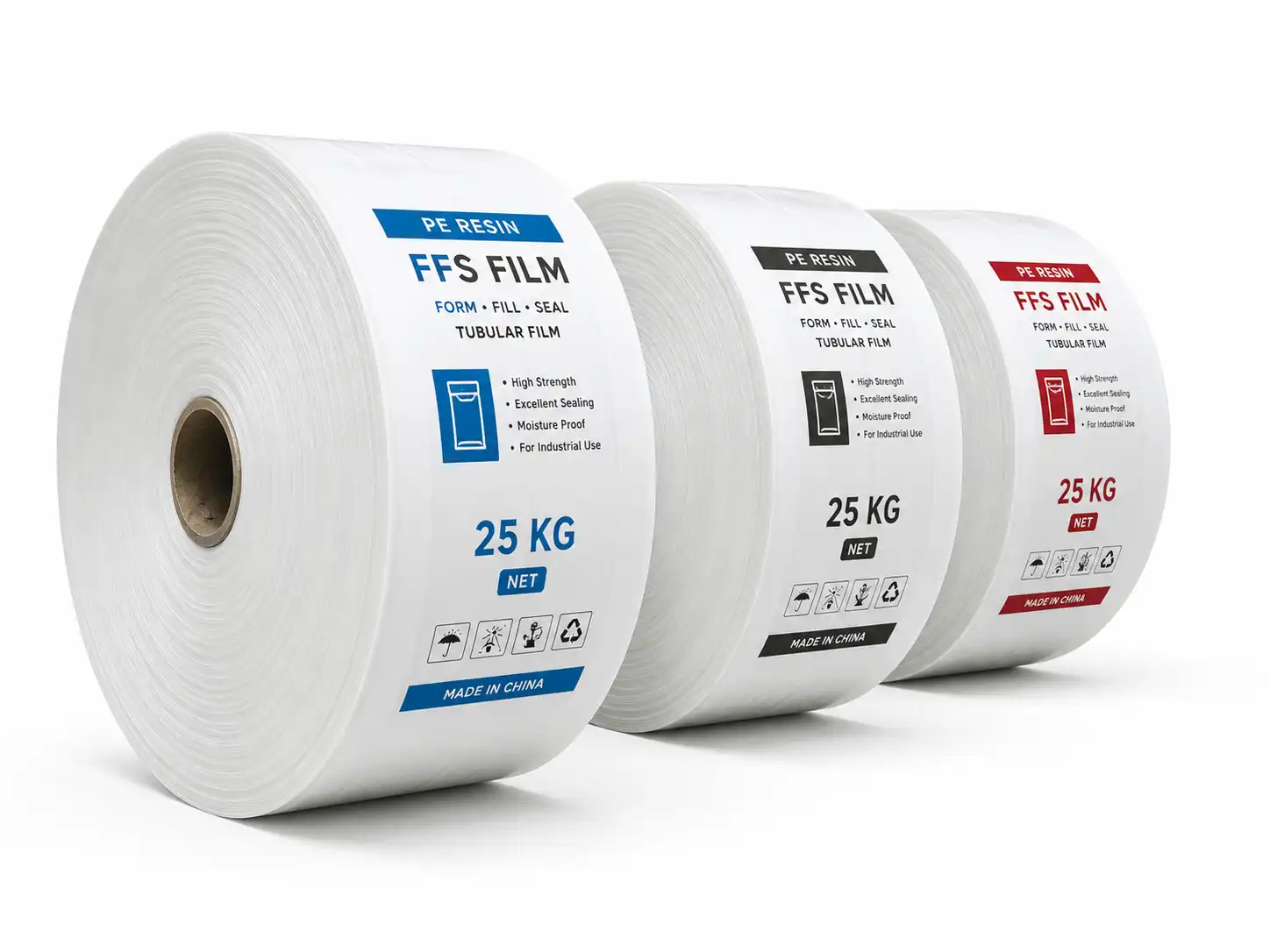
VIDEPAK Tubular FFS Films Product Analysis
For buyers searching for Tubular ffs pe films, Tubular FFS Films, and high-performance industrial PE packaging, the question is never only about film. It is about line speed, seal safety, pallet stability, print quality, storage efficiency, and total cost from extrusion to delivery. A well-designed tubular film must do many jobs at once: it must run fast, form cleanly, hold weight, resist puncture, release trapped air when needed, and still seal with confidence under plant conditions that are rarely perfect. That is why Multi-layer Co-extruded construction has become central in modern heavy-duty packaging. It combines the flexibility and sealability of one resin family with the stiffness, toughness, friction control, or processing stability of another, all inside one all-PE film structure tuned for automated Form-Fill-Seal lines.
Key view: Tubular FFS Films are continuous lay-flat tubes of PE supplied on rolls for automated bag forming, filling, and sealing. In industrial packaging, their value comes from three linked strengths: a tunable Multi-layer Co-extruded structure, precise converting options such as micro perforations and embossing strip lanes, and consistent machine behavior at high throughput. Depending on equipment and product flow, tubular FFS systems commonly operate around 2,000 bags per hour, and some suppliers cite ranges up to roughly 2,600 bags per hour.
What Tubular FFS Films really are
A tube on a roll, not a simple flat film
Tubular FFS Films are continuous, lay-flat tubes made from PE and wound on reels for automatic Form-Fill-Seal operation. Instead of feeding pre-made sacks, a packaging line unwinds the tube, forms the bag length, fills the product, and seals the mouth in one linked motion. That simple fact changes the economics of packaging: fewer bag handling steps, better line continuity, lower storage volume for empty packaging, and tighter process control on the plant floor. Because the format is tubular from the beginning, it also supports precise bag geometry, stable seal positioning, and clean integration with high-speed industrial fillers for pellets, powders, granules, salts, fertilizers, feed, and other dry bulk goods.
Why the tubular format keeps winning
The appeal of Tubular FFS Films is practical, not theoretical. They reduce manual bag feeding, support rapid changeovers, and allow a single film family to cover different bag lengths and sometimes different widths with less mechanical intervention than some shoulder-formed systems require. Several equipment references note that tubular FFS technology is especially effective for free-flowing powders and granules, while industrial suppliers position the format for fertilizers, resins, chemicals, feed, minerals, grains, and seed products. In other words, this is packaging built for factories that value rhythm: less stop-and-go, less dust escape, less wasted motion. Fast line. Clean seal. Stable bag.
In plain terms:
Tubular FFS Films are not just film stock. They are a packaging platform. The tube shape supports automatic bag making. The PE base gives moisture resistance, chemical resistance, and strong sealing behavior. The Multi-layer Co-extruded structure allows one film to carry many jobs at once. And the optional surface and vent details, such as micro perforations and an embossing strip, allow the same core format to serve very different products and line conditions.
How Multi-layer Co-extruded PE architecture creates performance
Why one resin is rarely enough
In heavy-duty packaging, a single material rarely delivers the full balance a customer needs. One layer must seal well. Another layer must resist puncture. Another may need to improve stiffness, gloss, machine handling, or antiblock behavior. That is the logic behind Multi-layer Co-extruded film. In blown-film coextrusion, multiple molten polymer streams are brought together through a circular die, inflated into a bubble, cooled, collapsed into a lay-flat tube, and wound for later bagging. Industry references describe coextruded blown film as an economical way to build uniform layers, use each resin where it brings the most value, and produce a continuous tubular format for FFS lines.
What each PE family usually contributes
In practical film design, LDPE is widely valued for flexibility, toughness, and easy processing; official resin guidance describes LDPE as highly branched and known for excellent flexibility, toughness, and processability. LLDPE is often selected when the film needs higher tensile strength, impact strength, and puncture resistance than LDPE alone can provide. HDPE, meanwhile, is used where a converter wants more stiffness and a stronger balance between processability, toughness, and rigidity. When these are fused through a Multi-layer Co-extruded design, the film can be tuned layer by layer: forgiving seals on the inside, higher stiffness in the middle, controlled friction or print handling outside. One structure, many duties. One tube, many answers.
Typical design idea for heavy-duty PE tubular film
Inner seal layer
Often richer in LDPE or seal-friendly blends for hot tack, seal initiation, and clean jaw response.
Core strength layer
Often strengthened with LLDPE and sometimes moderated HDPE/MDPE for tensile, puncture, and stiffness.
Outer handling layer
Can be tailored for printability, slip/antiblock balance, friction, or warehouse durability.
This is a design principle, not one fixed recipe; exact layer ratios vary by bag weight, filler speed, product flow, and storage conditions.
The production flow behind the tube
Process flow
This blown films route is important because it stretches the film in machine and transverse directions and supports continuous tubular production with controlled layer placement.
Sources for the material-role summary:
The common options customers ask for most
micro perforations
micro perforations are one of the most useful options in industrial tubular packaging, especially for fine powders and products that trap air during filling. The principle is simple but the execution must be precise. Tiny, engineered vent holes are added in selected film zones so air can escape after filling without turning the bag into a leak path. Packaging machine references explain the core problem clearly: fine powder can hold air, and if that air stays inside after sealing, palletizing becomes unstable or, in severe cases, not workable at all. Supplier descriptions for tubular FFS packaging therefore pair micro perforations with “deaeration,” “degassing,” and “air evacuation” because the benefit is direct: flatter bags, denser pallets, fewer swollen packs, better stack shape.
The best micro perforations are not random. They are placed where venting helps and seal integrity is protected. One technical description of tubular FFS packaging notes tiny, precisely spaced holes with equivalent diameters around 50–150 μm in low-risk areas, while equipment suppliers also mention labyrinth-style arrangements that let air leave slowly after filling and sealing. This matters because poor vent design can trade one problem for another: trapped air disappears, but sift leakage appears. Good design avoids that trap. The result is controlled breathing, not uncontrolled leaking.
When to recommend micro perforations
Use them when the product is powdery, airy, or prone to headspace retention; when pallet compactness is critical; or when faster post-fill settling improves warehouse safety. Avoid over-specifying them for dense granules that de-aerate naturally, because every added feature should serve a real process need.
embossing strip
An embossing strip is a controlled textured lane added to the bag surface to increase friction where friction is useful. The goal is not decoration. It is pallet safety. Heavy-duty sacks can slide against each other during stacking, transport, and warehousing, especially when the surface is smooth and the loads are tall. Several industrial sources describe embossed or anti-slip versions that improve outer layer friction, increase security in piling, and stabilize the pallet by adding two anti-slip stripes or embossed zones on both sides of the bag. In practical terms, the embossing strip gives grip where the stack needs it most.
This option is especially valuable for products that are packed in heavy bag weights and then shipped over long distances, moved by forklift many times, or stored in warm environments where surface slip can become more noticeable. A textured embossing strip works like a quiet insurance policy. It does not shout, but it prevents. It does not change the bag’s purpose, but it changes the bag’s behavior on the pallet. That contrast is the point. Smooth where the machine needs smoothness; grip where logistics needs grip.
Sources for the option comparison:
A deeper product reading of Tubular FFS Films
Forming and filling performance
The first test of Tubular FFS Films is not on the pallet. It is at the filler. The film must unwind evenly, hold width tolerance, feed through the machine without blocking, present a stable lay-flat profile, and respond well to the forming and sealing sequence. That is why good tubular film design pays attention not only to strength but also to coefficient of friction, antiblock level, gauge consistency, roll winding quality, and heat response. Industry pages for FFS packaging repeatedly emphasize stable filling characteristics, proper winding, easy material flow, and reliable behavior on automatic lines because machine efficiency is lost one small disruption at a time: telescoped rolls, unstable jaws, poor lay-flat, inconsistent sealing, dust contamination, or excessive line stops.
Seal confidence under real factory conditions
Seal performance is where a good film proves it deserves its cost. Resin suppliers and product guides underline the value of hot tack, sealability, and toughness in film applications because a bag does not wait politely for ideal lab conditions. In the real world, there is dust at the mouth, short dwell time at the jaw, product variation, and speed pressure from the line. A well-planned Multi-layer Co-extruded PE design gives the converter more room to manage that reality. It can widen the usable sealing window, support reliable mouth closure, and reduce the chance that a bag looks fine when it leaves the line but opens during transport. In industrial packaging, a film that seals late is expensive; a film that seals weakly is even more expensive.
Drop, puncture, and transport resistance
Heavy-duty sacks face stress from sharp granules, bag corners, conveyor transfer, warehouse drops, and compression on stacked pallets. That is why LLDPE-rich layers are so common in premium tubular films, and why HDPE is often blended in moderation to support stiffness without sacrificing too much toughness. Product literature for blown-film grades and heavy-duty FFS products repeatedly ties LLDPE to puncture resistance and tensile strength, and HDPE to a balanced combination of stiffness and toughness. In market terms, this means the film can be light enough to be economical yet strong enough to survive the trip. Not weakness hidden by thickness, but performance built by structure.
VIDEPAK market insight
Buyers rarely fail because they choose the wrong package category. They fail because they choose the wrong film balance inside the right category. For Tubular FFS Films, the winning balance usually sits at the intersection of sealability, puncture strength, de-aeration, and pallet grip. Too much stiffness can hurt sealing. Too much slip can hurt stacking. Too much venting can hurt sift resistance. The right film is therefore not “the thickest film” or “the cheapest film,” but the film whose structure matches the product’s real stress points.
Print, appearance, and shelf discipline
Industrial packaging still sells. Even in B2B channels, a bag that prints well, looks consistent, and keeps its shape sends a quality signal down the supply chain. FFS suppliers commonly offer flexographic printing from four up to eight or even ten colors, depending on structure and market. More important than the color count, however, is surface stability: a controlled outer layer, proper treatment, and predictable winding all help graphics remain clear through conversion and filling. Good print does not replace good function. But when function and appearance reinforce each other, the bag works twice—once on the line, once in the market.
Circular design and all-PE logic
Another reason interest in Tubular FFS Films remains strong is that they can be designed as all-PE structures. Several FFS suppliers describe 100% PE or mono-PE film programs as fully recyclable within the PE stream where collection and recycling systems exist, and some now combine recyclate content with industrial FFS performance. This does not make every film equal, and it does not remove the need for local recycling infrastructure. It does, however, show the strategic direction of the market: keep the structure simple where possible, keep the function high, and keep the package close to the recycling stream it is meant to enter.
Typical parameters and how customers should read them
The numbers behind common industrial programs
While exact specifications depend on bag weight, machine type, and product flow, published industrial references show a repeatable pattern. Common heavy-duty FFS programs are often positioned around 25 kg to 50 kg applications. Frequently cited film thickness ranges sit around 100–200 μm for classic heavy-duty sacks, though broader custom portfolios can extend from about 50 μm to 300 μm. Tube or roll widths vary widely by geography and machine family, from common industrial ranges like 400–695 mm or 30–65 cm to wider custom programs above 1650 mm. Gusset options are also common, because gussets help square the bag and improve final pallet geometry.
Sources for parameter ranges:
A simple selection logic by product type
Pellets and granules
Focus on puncture resistance, seal consistency, and stable lay-flat. micro perforations are often not essential unless trapped air is a clear issue.
Fine powders
Prioritize seal reliability plus controlled de-aeration. Here, micro perforations often move from optional to highly valuable.
Warehouse-intensive loads
If the bags will be stacked high, moved often, or shipped far, add an embossing strip or anti-slip surface design to improve pallet stability.
Brand-sensitive industrial goods
Use a controlled outer layer with appropriate print treatment and color capacity; function still leads, but appearance reinforces trust.
How VIDEPAK should position Tubular FFS Films in the market
Sell the system value, not only the film gauge
The strongest market story for VIDEPAK is not “we make film.” It is “we help a line run better.” Customers buying Tubular FFS Films are buying operating stability, not just rollstock. They want fewer stoppages, cleaner seals, lower dust release, stronger pallets, stable graphics, and a film structure that matches the real product—not a generic product name on a quotation sheet. This is where VIDEPAK can lead with clarity: explain how PE resin selection affects sealing, how Multi-layer Co-extruded architecture reduces trade-offs, how micro perforations solve air retention for fine powders, and how an embossing strip improves stack security once the bag leaves the line. That message is technical, but simple. Technical, but commercial. Technical, and therefore credible.
Position by application, then by film structure
The best way to market Tubular ffs pe films is to begin with the application pain point. For resin pellets, emphasize puncture resistance, seal integrity, and machine speed. For fertilizers or feed, stress moisture resistance, pallet stability, and print presence. For fine powders, put micro perforations and safe de-aeration at the center of the discussion. For logistics-heavy export loads, bring the embossing strip into the first conversation, not the last. Once the application logic is clear, VIDEPAK can recommend a fitting Multi-layer Co-extruded design, thickness window, width program, and surface option package. This turns the sales message from commodity talk into solution talk.
Positioning sentence for market use
VIDEPAK Tubular FFS Films are advanced all-PE, Multi-layer Co-extruded tubular packaging solutions built for fast filling, clean sealing, strong pallet performance, and custom options such as micro perforations and embossing strip design—so customers do not have to choose between line efficiency and bag reliability.
Final market conclusion
Tubular FFS Films remain one of the most efficient formats for industrial automatic bagging because they unite machine speed, material efficiency, and structural flexibility in one package. Their commercial power comes from their technical depth: PE chemistry that can be tuned, Multi-layer Co-extruded construction that blends properties instead of forcing compromise, and feature options such as micro perforations and embossing strip lanes that solve specific plant and logistics problems with precision. For VIDEPAK, that is the opportunity. Sell the tube, yes—but more than that, sell the confidence inside the tube. A bag that forms well. A bag that seals well. A bag that stacks well. A bag that travels well. That is why the market keeps coming back to Tubular FFS Films.
FFS Roll PE Film with Gussets
High-performance tubular FFS PE films with gusset design for automated packaging lines.
Check More →25kg Polyethylene Tubular FFS Films
Professional 25kg capacity tubular FFS PE films for industrial packaging solutions.
Check More →Polyethylene FFS Film for 50kg
Heavy-duty 50kg tubular FFS PE films with excellent strength and sealing properties.
Check More →Co-Extruded FFS HDPE Bags
Durable co-extruded tubular HDPE films optimized for form fill seal packaging systems.
Check More →- VIDEPAK Tubular FFS Films Product Analysis
- What Tubular FFS Films really are
- How Multi-layer Co-extruded PE architecture creates performance
- The common options customers ask for most
- A deeper product reading of Tubular FFS Films
- Typical parameters and how customers should read them
- How VIDEPAK should position Tubular FFS Films in the market
- Introduction — What Are Tubular FFS Films?
- Problem Framing — Why Plants Choose Tubular FFS Films
- Method — Architecture and Options of Tubular FFS Films
- Results — What Changes on the Line and the Pallet
- Discussion — Horizontal and Vertical Reasoning in Practice
- System Decomposition — Sub‑Problems, Sub‑Solutions, Integration
- Specification Table — Anchor Values for Tubular FFS Films
- Mini Case Comparisons — Pellets, Powders, and Blends with Tubular FFS Films
- Quality & Compliance — Making Tubular FFS Films Auditable
- References (selected, non‑CNC)

Introduction — What Are Tubular FFS Films?
Tubular FFS Films are continuous, lay‑flat polyethylene (PE) tubes engineered for automated Form‑Fill‑Seal packaging lines that convert a film roll directly into an industrial sack. In purchasing catalogues, you will also find Tubular FFS Films described as heavy‑duty PE tubular FFS films, co‑extruded tubular PE rolls, LDPE/LLDPE tubular packaging reels, and tubular PE FFS‑E films. A representative overview is here: Tubular FFS Films.
Features of Tubular FFS Films. High dart‑impact toughness for warehouse drops; controlled Elmendorf tear to prevent zipper‑like failures; wide hot‑tack/heat‑seal window for fast cycles; stable lay‑flat to keep bag geometry square; printability up to 6–8 colors; optional anti‑slip embossing strips; engineered micro‑perforation for de‑aeration; UV/anti‑static options; and compatibility with PCR/PIR blends while retaining heavy‑duty performance.
How Tubular FFS Films are made. PE resins (LDPE/LLDPE/HDPE in tuned ratios) are compounded with slip/anti‑block and, where relevant, recycled content; a multi‑layer blown‑film die forms a bubble that is cooled, collapsed, and wound as a lay‑flat tube. In‑line modules add textured embossing strips and pattern‑controlled micro‑perforation while keeping seal tracks pristine. Rolls are trimmed, inspected, and packed for high‑speed splicing.
Where Tubular FFS Films are used. They serve dry, flowable goods that demand strength, sealing integrity, and pallet stability: polymer pellets and powders, fertilizer, salt and minerals, cement/lime/fillers, animal feed and seeds, grains/rice/flour, and chemical granules/flake.
Problem Framing — Why Plants Choose Tubular FFS Films
Industrial logistics repeat the same story: pallets shift, bags bloat, seals fail, graphics scuff. Paper sacks dislike humidity; pre‑made bags multiply SKUs and changeovers. Tubular FFS Films answer these tensions as a single system. Horizontally, the format fuses materials science (PE layer design), graphics (print/varnish), automation (forming jaws, dosing, hot bars), and logistics (COF and stacking). Vertically, it connects resin → tape/bubble → lay‑flat → forming → pallet → route, ensuring every step inherits and reinforces the last. The guiding question is simple: how can one roll run faster, stack safer, and waste less?
Method — Architecture and Options of Tubular FFS Films
A three‑layer co‑ex (skin–core–skin) is typical. The outer skin sets COF and anchorage for inks; the core carries dart and tear; the inner skin initiates seals at practical jaw temperatures. Embossing strips add friction where bags touch each other or belts without dulling the entire panel. Micro‑perforation (laser or needle) vents entrained air so the sack compacts quickly and seals cleanly. Resin choices follow intent: LDPE for forgiving seals, LLDPE (often octene‑based) for tensile/tear, moderated HDPE for stiffness/puncture; PCR/PIR can be staged in responsibly. Print lanes avoid emboss areas; perf‑free gutters avoid seal zones. QA closes the loop with COF, dart, tear, puncture, and seal‑strength checks.
Results — What Changes on the Line and the Pallet
When the stack is tuned, Tubular FFS Films shorten fill‑to‑seal time, lower bag height after vibration, and decrease top‑seal inclusions. Pallets become columns rather than dominoes as strip COF rises and panel COF is held inside a “sweet zone.” Graphics endure because reverse prints hide ink under film; operators endure less because changeovers shrink and rework falls. The financial translation is direct: more saleable output per hour, fewer claims per shipment.
Discussion — Horizontal and Vertical Reasoning in Practice
Horizontal reasoning. Materials science explains why a 20–26 μm seal‑initiation skin can widen the hot‑tack window; printing chemistry explains why reverse‑printed films resist rub; logistics explains why a static COF ≥0.5 on an embossing strip prevents layer creep. Combine the domains and the format behaves like an instrument, not a guess.
Vertical reasoning. Start at the polymer and climb to the pallet: resin blend → bubble stability → lay‑flat → mouth geometry → seal window → pallet friction → transit behavior. Each rung constrains the next; each decision propagates downstream. Tubular FFS Films succeed when these rungs are measured, not assumed.
System Decomposition — Sub‑Problems, Sub‑Solutions, Integration
De‑aeration. Powder and flake trap air. Sub‑solution: micro‑perforation with hole diameter (~80–120 μm), density (holes/cm²), and zoning (behind the fill plume, away from seals). Integrated effect: faster compaction, cleaner seals, squarer stacks.
Pallet stability. Smooth PE can slide. Sub‑solution: twin embossing strips (10–40 mm) aligned with bag‑to‑bag contact; specify static/kinetic COF and face‑pairs (film‑to‑film, film‑to‑board). Integrated effect: lower layer shift in vibration tests and fewer returned pallets.
Seal reliability. Seals fail when inner skin chemistry mismatches bar profile. Sub‑solution: tune seal‑initiation temperature and hot‑tack; publish °C and dwell, not adjectives. Integrated effect: sift‑proof seams at speed.
Graphic durability. Scuff ruins retail‑facing sacks. Sub‑solution: reverse print; keep embossing strips outside hero art; consider matte/gloss balance. Integrated effect: billboard‑grade panels that survive material‑handling.
Circularity. Mono‑PE eases sorting; PCR adds recycled content. Sub‑solution: staged PCR ramps with recipe tuning and filtration; declare additives and inks in documentation. Integrated effect: films that run fast and bale well.
Specification Table — Anchor Values for Tubular FFS Films
| Attribute | Typical Window | Design Intention |
|---|---|---|
| Thickness (μm) | 120–220 for 15–50 kg; 80–300 on request | Balance drop/tear, seal window, and freight mass |
| Lay‑flat width (mm) | 350–650; wider by project | Match former size, dosing mass, pallet footprint |
| Gusset depth (mm) | 60–120 (M‑gusset/flat) | Build a square, robot‑friendly cross‑section |
| Roll OD / Core | 1000–1500 mm OD; 3″/6″ cores | Fit automatic splicers; manage change intervals |
| Printing | Up to 6–8 colors; matte/gloss | Protect brand panels; keep art off emboss lanes |
| Embossing strips | 1–2 lanes; 10–40 mm; diamond/cross‑hatch | Raise strip COF to ≥0.5–0.6 for pallet safety |
| Micro‑perforation | Laser/needle; ~80–120 μm; density by SKU | Shorten compaction; avoid seals and stress radii |
| COF targets | Panel μs/μk tuned; strip static ≥0.5 typical | Stabilize pallets without jamming formers |
| QA methods | D1894 COF; D1709 dart; D882 tensile; D1922 tear; F1306 puncture | Make performance measurable and comparable |
| Additives | Anti‑block, slip, anti‑static, UV | Tune handling; declare for DfR and food‑contact |
| Recycled content | 0–50% PCR/PIR (validated) | Circularity gains with recipe‑tuned toughness |
| Food contact (if relevant) | EU 10/2011; FDA 21 CFR 177.1520 | Support audits with DoCs and migration summaries |
Mini Case Comparisons — Pellets, Powders, and Blends with Tubular FFS Films
Pellets (e.g., polymer, salt). Pain point: residual air inflates bags and contaminates the top seal. Method: a sparse 100 μm micro‑perforation lane behind the fill plume; twin 20 mm embossing strips for conveyor and pallet grip. Result: shorter cycles, lower post‑vibration height, clean seals. Discussion: barrier impact is negligible for non‑hygroscopic pellets; operators appreciate the calmer line.
Powders (e.g., fertilizer, fillers). Pain point: pallet creep in summer and dust at seams. Method: widen embossing strips to 25–30 mm and set strip static COF ≥0.6; add denser micro‑perforation zones away from seals. Result: stable columns, faster compaction, fewer seal inclusions. Discussion: slight gauge increase (e.g., 180–220 μm) often pays for itself in reduced rework.
Blends (granule + fine). Pain point: mixed flow behavior confuses the line. Method: keep Tubular FFS Films at mid‑gauge with targeted perf lanes and balanced COF; validate using vibration + compression tests at hot/cold set points. Result: predictable stacking across seasons. Discussion: the hybrid SKU benefits most from numbers on the spec, not adjectives on the box.
Quality & Compliance — Making Tubular FFS Films Auditable
Publish COF targets with the test method; track dart/tear and puncture alongside seal‑window temperatures and dwell. If bags contact food or food‑adjacent goods, maintain Declarations of Compliance for EU 10/2011 and FDA 21 CFR 177.1520. Align recyclability claims with recognized guidance (APR/RecyClass) so procurement, quality, and sustainability speak the same language. When Tubular FFS Films are specified this way, audits move quickly because numbers answer questions before meetings are scheduled.
References (selected, non‑CNC)
- ASTM D1894 — Standard Test Method for Static and Kinetic Coefficients of Friction of Plastic Film and Sheeting.
- ASTM D1709 — Standard Test Methods for Impact Resistance of Plastic Film by the Free‑Falling Dart Method.
- ASTM D882 — Standard Test Method for Tensile Properties of Thin Plastic Sheeting.
- ASTM D1922 — Standard Test Method for Propagation Tear Resistance of Plastic Film and Thin Sheeting by Pendulum Method.
- ASTM F1306 — Standard Test Method for Slow Rate Penetration Resistance of Flexible Barrier Films and Laminates.
- European Commission Regulation (EU) No 10/2011 on plastic materials intended to come into contact with food; and (EC) 1935/2004.
- U.S. FDA 21 CFR 177.1520 — Olefin Polymers for food contact applications.
- APR Design® Guide for Plastics Recyclability — PE Film & Flexible Packaging.
- RecyClass Design for Recycling Guidelines — Polyethylene Flexible Packaging.
- Selected supplier datasheets and marketplace listings for heavy‑duty tubular PE FFS films (lay‑flat 350–650 mm; thickness ~120–220 μm; embossing/micro‑perforation options).