
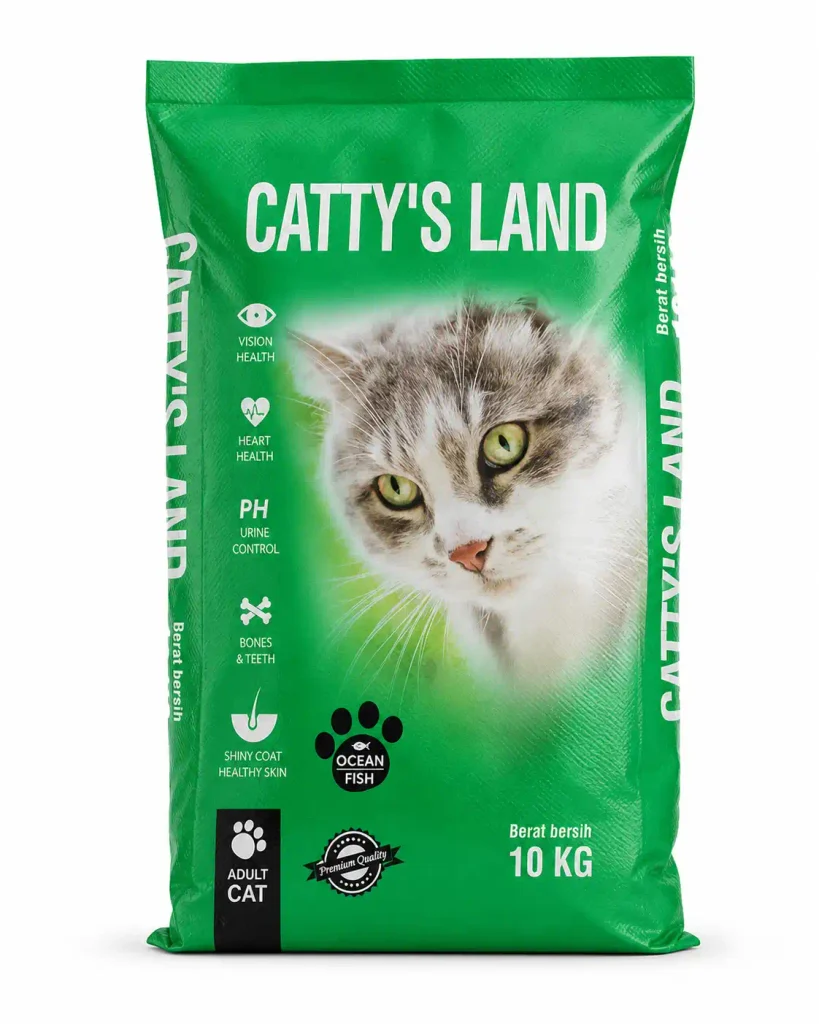
VIDEPAK Product Analysis: BOPP Laminated Woven Bags for Stronger Protection and Stronger Brands
A package should carry weight, resist damage, run well on the filling line, stack safely, and sell the product at the same time. BOPP laminated woven bags are designed to do all five. They combine a woven polypropylene load-bearing body with a printed BOPP film surface, creating industrial packaging that is tough in transit and clear in communication. The bag is not merely a container. It is protection, process equipment, and brand media in one format.
What Are BOPP Laminated Woven Bags?
BOPP laminated woven bags are flexible industrial sacks built from woven polypropylene tape fabric and an outer film made from biaxially oriented polypropylene, normally called BOPP. The woven fabric carries the load. The film provides a smooth surface for detailed graphics and adds protection against moisture, dirt, and abrasion. In a common construction, artwork is reverse printed on the inside of the clear BOPP film, then the film is bonded to the woven fabric. Because the ink sits beneath the film rather than directly on the exposed surface, the design is better protected from rubbing during bag conversion, filling, pallet handling, transport, and retail display.
The word “biaxially oriented” describes how the film is stretched in two directions during production. This orientation improves film flatness, clarity, strength, and dimensional stability. Those properties matter because high-quality printing needs a stable face: sharp text must remain sharp, barcodes must remain readable, colors must stay aligned, and product images must not look distorted. The woven base and printed film therefore have different jobs, yet they work as one system. The fabric brings muscle; the film brings message. One protects the product physically, while the other protects and promotes the brand visually.
Woven Strength
Interlaced polypropylene tapes distribute stress across the bag body, helping the package resist tearing, puncture, and repeated handling.
Print Impact
The smooth BOPP face supports photographic graphics, fine text, strong color contrast, and consistent brand presentation.
Surface Protection
The laminated exterior helps shield the woven structure and printed image from dust, stains, scuffing, and incidental moisture.
Design Flexibility
Valve, open mouth, gusset, block bottom, pinch bottom, stitched, windowed, and hemmed Bottom can be matched to the product and filling process.
Important performance point: the film surface can improve moisture resistance, but a complete bag is only as protective as its weakest detail. Stitch holes, micro-perforations, an open valve, an unsealed top, or a transparent window can change total barrier performance. For sensitive powder or food products, the specification must treat fabric, film, seams, closure, valve, vents, and optional liner as one package system—not as separate parts.
How the Material Structure Works
The Woven Load-Bearing Layer
The structural body starts with polypropylene resin processed into flat tapes. These tapes are drawn to develop strength, then woven in machine and cross directions to form a fabric tube or flat web. The weave converts many light tapes into a strong, flexible network. When a filled bag is lifted, dropped, squeezed, or stacked, stress is shared through that network rather than concentrated in one thin film. This is why woven sacks can offer a favorable strength-to-weight balance for dry bulk packaging. Official equipment information also identifies woven polypropylene sacks as a major solution for flour, rice, sugar, grain, building materials, and chemical granulates.
The Printed Film Layer
The outer BOPP film is the communication layer. It can carry multi-color artwork, product photography, handling instructions, regulatory text, QR codes, and anti-counterfeit design elements. Reverse printing places ink between the film and fabric, so the transparent film becomes a protective cover over the image. Gloss film creates bright reflection and high color energy; matte film reduces glare and can support a softer premium look. The decision is commercial as well as technical: gloss attracts attention, while matte can improve calmness and readability. Both must be evaluated against scuffing, ink adhesion, sealing temperature, and the visual expectations of the target market.
The Bonding Layer and Optional Inner Barrier
The film and woven fabric are joined through extrusion coating or another controlled bonding process. An inner coating or separate liner may be added for moisture, fine-particle, odor, or contamination control, but it can also affect air release, filling speed, recycling, and cost. The correct design uses enough barrier to protect the product without adding unnecessary material or complexity.
Typical Production and Control Flow
Control must follow the flow. Resin consistency affects tape quality; tape quality affects fabric strength; fabric geometry affects lamination; lamination affects printing and conversion; conversion affects sealing and drop performance. Quality is built forward, not inspected backward.
Reference Technical Range
For initial project discussion, VIDEPAK presents a reference range of about 90–130 microns in thickness, 100–180 GSM in total grammage, customizable dimensions, and approximately 5–40 kg filling capacity. The product page also lists vibrant multi-color graphics and options such as flat or gusset sides, fold-over stitching, taped stitching, heat-sealed closure, block bottom, micro-perforation, anti-slip treatment, glossy or matte surfaces, and a transparent window. These numbers are starting points, not universal limits; the final specification must be confirmed against product density, bag dimensions, filling speed, drop height, pallet pattern, storage time, climate, and transport route.
Detailed Configuration Options
The correct format begins with the filling system, not appearance alone. Powder, pellets, rice, and pet food flow differently; manual and pneumatic lines also need different openings, air release, and closures. The following options can be combined, but every combination should be reviewed as one system.
Valve
A valve bag is largely closed at the top and includes a filling sleeve or pocket, usually at a corner. The filling spout enters the valve, product flows into the bag, and the valve closes through the product pressure, sleeve geometry, a tuck-in action, heat sealing, or another specified method. Valve formats are well suited to fine powders and free-flowing dry materials because they support fast filling and help control dust around the packer. They are often paired with a block bottom so the empty bag can be presented accurately and the filled bag can form a stable rectangular package. Valve length, width, material, position, sealing method, and venting must match the filling nozzle and product behavior; a valve that is too tight slows filling, while one that is too loose can leak.
Gusset Option
A gusset is an inward fold along one or both sides of the bag. During filling, the folds open and create extra depth, allowing the package to take a more rectangular shape. Gussets can improve volume use, pallet presentation, and side-panel branding; they can also help the bag sit more evenly after filling. Yet a gusset is not free capacity. It changes the width of the front panel, affects how artwork wraps around corners, and can trap air if ventilation is not planned. The gusset depth should be set from product density, target fill volume, filled-bag dimensions, and pallet pattern—not selected by visual preference alone. VIDEPAK lists both flat and M-type gusset formats among its customization options.
Open Mouth Option
An open mouth bag is factory closed at the bottom and supplied with the top fully open for filling. It is one of the most flexible formats because it can run on manual, semi-automatic, or automatic gravity-filling systems. After filling, the mouth may be sewn, heat sealed, pinch sealed, tied, or fitted with an easy open system. Open mouth bags are practical for grains, pellets, feed, seeds, salt, sugar, and many granular products, especially when the product needs a generous entry area. Their main design question is the final closure: a bag that enters the line easily but closes poorly will still fail in transport. Industry definitions likewise describe open mouth bags as closed on one end and closed by sewing or sealing on the other after filling.
Block-Bottom Option
A block bottom forms a flat, squared base that lets the filled package stand more upright and use pallet space efficiently. The shape creates broad front, back, and side panels, so it can improve both stacking and visual presentation. On automated lines, a well-designed block bottom can also open predictably and receive product cleanly. It is a strong choice for retail-facing animal nutrition, premium grains, fertilizer, powders, and construction products. However, the base geometry, bonding or welding area, bag stiffness, and ventilation pattern must suit the product. A block bottom improves shape; it does not remove the need for drop testing, compression review, or proper pallet restraint. VIDEPAK identifies upright stability and space efficiency as core reasons to select this format.
Pinch-Bottom Option
A pinch-bottom construction closes an end by folding prepared flaps and activating adhesive or a compatible heat-welded structure. The result is a flat, sift-resistant closure without a line of needle holes. In a pinch bottom open mouth format, the bottom is factory closed and the top remains open for filling; after filling, the top flaps are folded and sealed on a pinch sealer. This format is attractive for flour, pet food, fertilizer, and sensitive dry products because it combines a broad filling mouth with a clean final seal. Modern equipment developments also show that pinch-bottom bags can be made from polypropylene tape fabric with reverse-printed BOPP film and closed by hot-air welding, supporting a more compatible mono-material design.
Double-Fold, Double-Stitched Bottom
In this construction, the bottom edge is folded twice and secured with two stitch lines. The double fold hides and reinforces the cut edge, while the two rows of sewing add closure security and distribute seam load. It is simple, familiar, and cost-effective for many dry goods. The limitation is equally clear: every needle creates a perforation, so the bottom is not automatically airtight or fully water-resistant. For fine powders or higher moisture exposure, a sealing tape can be applied over the sewn area, or a liner can be specified. Stitch density, thread type, fold depth, tape width, and seam position must be controlled because adding more stitches without controlling needle damage can weaken rather than strengthen the fabric. Folded and double-stitched bottoms are recognized common constructions for woven sacks.
Transparent Window Option
A transparent window lets buyers, operators, or warehouse staff see the product level and appearance without opening the bag. The feature is useful for rice, beans, seeds, pellets, resins, and other granular materials where visible proof builds trust. The window may be created through a controlled transparent zone or a selected material structure. Its size and position should avoid high-stress fold lines and critical artwork. It also changes the barrier equation: a window area may provide less opacity, UV protection, or moisture resistance than the fully laminated printed panel. The best window is large enough to inform, small enough to protect, and positioned where it supports both brand design and bag strength. VIDEPAK lists content visibility and checking as the main functions of this option.
Hemmed Open Mouth
A hemmed open mouth has its top edge folded over and fixed so the mouth is smooth, stable, and less likely to fray during handling. This makes it easier for operators or equipment to grip, open, and place the bag on a filling spout. The hem can also give the later sewing operation a more controlled edge. It is especially useful when bags are handled repeatedly before closure or when a clean top appearance matters. The trade-off is added material and conversion work, so the hem width and stitch must be justified by line handling and closure needs.
Hemmed Top
“Hemmed top” is an edge-finishing description, while “hemmed open mouth” is a bag-format description; in many specifications the two terms overlap. A hemmed top means the raw top edge is turned inward or outward and secured, reducing loose tapes and giving the opening more stiffness. It can be used on open mouth bags that will be sewn after filling, or on manually closed bags that use tying, drawstring, or another closure. Buyers should therefore define both the condition at delivery and the intended closure after filling. A purchase specification that says only “hemmed top” is incomplete unless it also states whether the top is open, pre-sewn, easy-open, heat-sealable, or fitted with another feature.
Additional Surface and Functional Options
Gloss or matte film changes visual character; anti-slip treatment improves stack friction; micro-perforations release trapped air; liners improve containment; UV stabilization supports outdoor use; and easy-open features improve access. Each option creates a trade-off: vents reduce barrier, liners can slow de-aeration, and coatings can affect surface feel. Strong design is feature coordination, not feature collection. Official woven-sack guidance lists coating, handles, easy-open closure, micro-perforation, film lamination, and inliners as application-driven options.
How to Select the Right Specification
A reliable specification begins with the product, then the filling line, distribution route, storage conditions, and market presentation. A low-density product may need a deep gusset; a dense mineral may need a smaller, stronger bag. A powder may require fast de-aeration during filling but a tight barrier after closing. Bag size alone is never enough.
Product Data
Bulk density, particle size, flow, sharpness, dust level, moisture sensitivity, odor, fat or oil content, and food-contact status.
Filling Data
Manual, gravity, auger, impeller, or pneumatic filling; nozzle dimensions; target bags per minute; required air release.
Logistics Data
Drop risk, conveyor type, pallet pattern, stack height, container route, humidity, outdoor exposure, and warehouse time.
Market Data
Shelf or industrial use, graphics, finish, transparent window, language panels, barcodes, traceability, and opening convenience.
Testing should mirror the actual risk. ASTM D5276 covers free-fall drop testing of loaded boxes, bags, and sacks and is used to compare package designs under sudden shock. ISO 23560 specifies general characteristics, requirements, and test methods for woven polypropylene sacks in 25 kg and 50 kg food applications. For film-level tensile behavior, BS EN ISO 527-3:2018 gives test conditions for plastic films and sheets below 1 mm. These standards do not replace a customer-specific protocol; they provide recognized methods that can be selected and combined with seam, peel, dimensions, grammage, print adhesion, leakage, UV, and filling-line checks.
Specification rule: write measurable requirements, not vague wishes. Replace “strong bag” with rated fill weight, test fill, drop orientation, drop height, conditioning, acceptable leakage, and pass/fail criteria. Replace “good printing” with approved artwork, color reference, registration tolerance, barcode grade, rub resistance, and viewing conditions. Clear data prevents unclear results.
VIDEPAK’s published quality approach states that production and testing are organized around ISO 9001 and relevant ASTM, EN, and JIS methods, with checks such as impact, tensile strength, and UV weather resistance. For a commercial project, the practical output should be an approved specification sheet and a signed sample that define material structure, dimensions, tolerances, print, finish, valve or mouth, bottom, perforation, liner, packing method, and test plan. This turns expectations into controls and controls into repeatability.
Applications and Commercial Value
For food and agricultural products, BOPP laminated woven bags provide a strong outer package with a clean, information-rich face. Rice, pulses, seeds, sugar, flour, and specialty grains can benefit from moisture-resistant surfaces, accurate product images, cooking instructions, origin statements, and transparent windows. Animal feed and pet food need similar communication but often add oil resistance, odor control, de-aeration, and easy opening. The structure must always be matched to applicable food-contact requirements and the product’s real shelf-life needs. ISO 23560 specifically addresses woven polypropylene sacks used for bulk packaging of cereals, sugar, and pulses at defined capacities, showing the importance of application-specific standards.
For fertilizer, chemicals, resins, minerals, and building materials, priorities shift toward containment, seam integrity, moisture control, dust management, and durable safety information. Valve bags support powder filling; open-mouth bags handle granules; anti-slip surfaces stabilize pallets; liners reduce fine-particle leakage. The package must release filling air without releasing product, close reliably, and survive rough conveyors and changing humidity.
Why Choose VIDEPAK
Seventeen Years of Industrial Bag Production Experience
VIDEPAK has 17 years of production experience in industrial bags, including BOOO PP woven bags and advanced printed woven formats. Experience matters because industrial packaging problems rarely come from one isolated parameter. A bag may look correct but fail on the filler; run well on the filler but leak in transport; survive transport but stack poorly; stack well but present weak graphics. Long-term production experience builds the ability to connect material, machinery, product behavior, closure, logistics, and market goals. VIDEPAK’s published company information highlights 17 years of production experience, broad customization, and a quality system developed through long-running industrial supply work.
Austrian Starlinger Equipment
VIDEPAK uses Austrian Starlinger equipment in the production of bopp laminated woven bags. Equipment choice is important because tape consistency, weave geometry, film bonding, and bag conversion all depend on stable process control. Starlinger’s official portfolio covers woven sack production and identifies options including BOPP lamination, micro-perforation, inliners, sewn sacks, block bottom valve bags, and pinch-bottom bags. Its newer pinch-bottom technology also demonstrates automated conversion of polypropylene tape fabric with reverse-printed BOPP film. For buyers, the value is not the machine name alone; it is the repeatability, process stability, and engineering range that the equipment can support when paired with disciplined operation and quality control.
Annual Capacity of 300 Million Pieces
VIDEPAK states an annual production capacity of 300 million pieces for its woven-bag business. Scale supports large programs, multi-market artwork families, seasonal demand, and repeat supply, but capacity only creates value when specifications remain controlled across orders. Our market approach therefore links capacity with approved samples, documented materials, process checks, and batch release. Big output without control creates big risk; big output with control creates dependable supply.
Production Based on International Standards
VIDEPAK’s published quality statement describes production and testing according to ISO 9001 and relevant ASTM and EN methods. In practice, this means selecting the correct method for the performance question: free-fall shock for loaded bags, tensile behavior for films, requirements for woven food sacks, plus project-specific tests for seams, peel strength, leakage, dimensions, print adhesion, UV exposure, and pallet performance. ASTM D5276, ISO 23560, and BS EN ISO 527-3 are examples of recognized methods that can support a structured test plan. Standards bring a common language; specifications bring project detail; records bring traceability. All three are needed.
VIDEPAK Value Proposition
We do not treat BOPP laminated woven bags as a standard shell with a new print. We treat each bag as an engineered connection between product, filling line, warehouse, transport route, retailer, and end user.
Seventeen years of industrial-bag production. Austrian Starlinger equipment. Annual capacity of 300 million pieces. ASTM- and EN-oriented standardized production. Flexible configurations from valve to open mouth, from gusset to block bottom, from stitched closure to pinch seal, from full graphics to transparent window. Strong enough to carry. Clear enough to sell. Controlled enough to repeat.
BOPP laminated woven bags unite useful contrasts: light yet strong, flexible yet stable, protective yet printable, industrial yet attractive. The best bag is not the thickest or most complex; it is the bag whose material, dimensions, opening, bottom, surface, closure, and tests match the product and process. That is the role VIDEPAK serves—from concept and sample to repeat production at scale.
Biaxially Oriented Polypropylene (BOPP) laminated PP woven bags are a high-performance packaging solution that combines the strength of woven polypropylene fabric with the printability and barrier properties of laminated films. In production, a reverse-printed BOPP film is hot-laminated onto a tubular PP woven fabric, often with a thin inner layer of LDPE to seal the weave. The result is a single-polymer bag (all PP/PE) that combines the mechanical strength of the woven fabric with the superior printability and moisture barrier of the laminated films.
Why choose this construction? Because it delivers multiple benefits at once: the woven base provides exceptional tensile and tear strength, while the BOPP film yields a glossy, stable exterior for high-resolution graphics. Indeed, BOPP film is known for its remarkable flatness and clarity, so it translates into crisp multi-color printing. The combined bag is puncture-resistant, waterproof, dirt-resistant and fully recyclable. Is it strong? Yes. Is it moisture-proof? Yes. Is it eye-catching? Absolutely. BOPP laminated PP woven bags check every box.
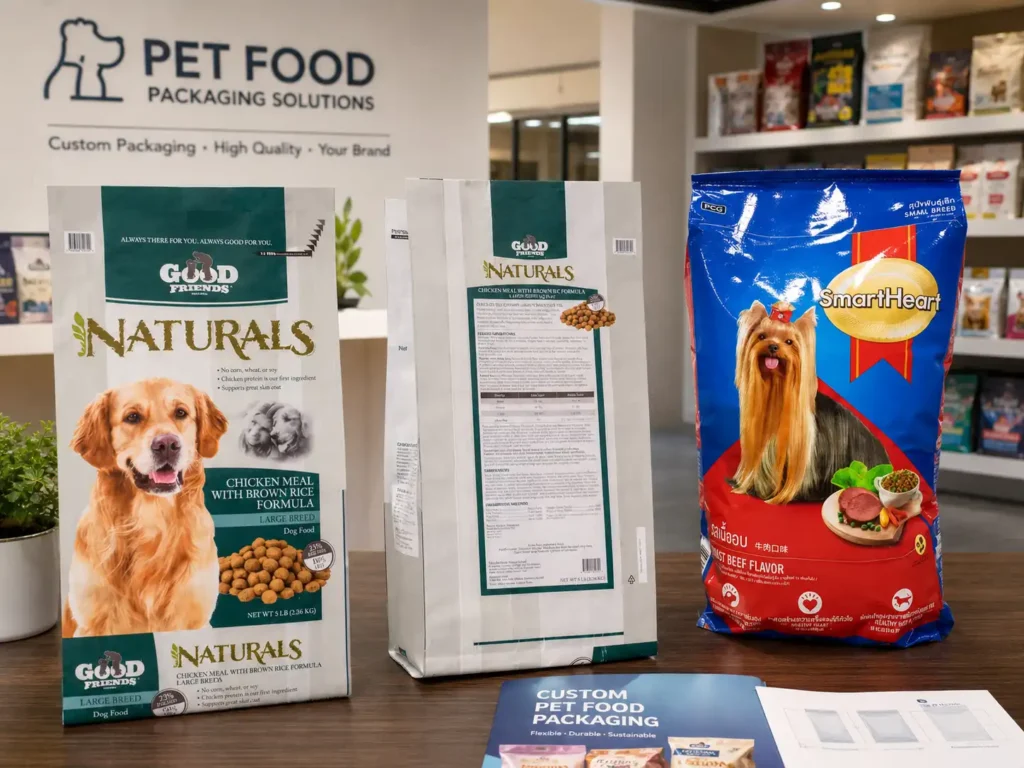
Figure: A 20kg animal feed bag made from BOPP laminated PP woven material. Its block-bottom base lets the bag stand upright when filled, and its glossy multicolor print shows the high-definition branding possible on these bags.
- VIDEPAK Product Analysis: BOPP Laminated Woven Bags for Stronger Protection and Stronger Brands
- What Are BOPP Laminated Woven Bags?
- How the Material Structure Works
- Detailed Configuration Options
- How to Select the Right Specification
- Applications and Commercial Value
- Why Choose VIDEPAK
- References:
These BOPP laminated PP woven bags are used across many industries. In food and feed, BOPP laminated PP woven bags package premium rice, flour, sugar, pulses, pet food and animal nutrition products. In agriculture, they carry fertilizers, seeds, and feed additives. In construction and industry, they hold cement, sand, tile adhesives, chemicals and plastic pellets. Unlike jute or paper sacks, BOPP laminated PP woven bags do not sag or tear under moisture. Compared to plain woven PP sacks, they look more attractive and can carry full-color logos. In short, they solve the common packaging dilemma: protecting the product while promoting the brand.
Laminated BOPP Woven Bags
High-quality laminated BOPP woven bags with glossy surface, waterproof performance and high load-bearing capacity.
Check More →BOPP Bags With Custom Printing
Customized printed BOPP laminated PP woven bags for brand promotion and product packaging needs.
Check More →BOPP PP Woven Bags Solutions
Complete packaging solutions for BOPP laminated PP woven bags with custom sizes and specifications.
Check More →BOPP Woven Bags vs PP Woven Bags
Professional comparison between BOPP laminated bags and ordinary PP woven bags in features and applications.
Check More →References:
Laminated BOPP Woven Bags – VidePak
BOPP Woven Bags – Summer Show Plastic
Multiwall Paper Bags Manufacturer: VIDEPAK – VidePak
PP & PE Laminated Woven Bags | Summer Show Plastic Corporation
Quality PP Woven & BOPP Bags Manufacturer & Supplier
Multiwall Kraft Paper Bags Factory: Bottom and Top Options – VidePak