
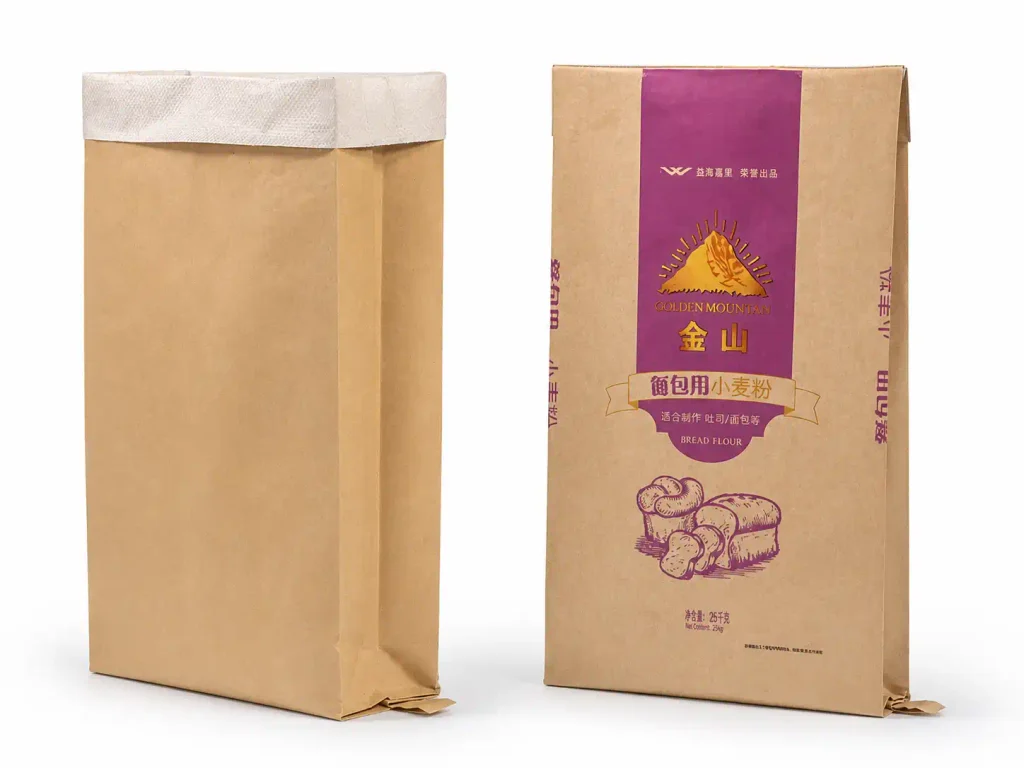
Kraft Paper Laminated Woven Bags: Where Kraft Paper, Lamination and PP Woven Fabric Work as One Packaging System
Industrial packaging has to do much more than hold a product. It has to survive filling, lifting, stacking, warehousing, container loading, trucking and final opening. It also has to communicate clearly. A bag may look strong in a sample room, yet the real test comes when it is filled with 25 kg of dry mortar, placed five layers high on a pallet, moved by forklift, exposed to changing humidity and finally carried across a construction site. This is the environment in which VIDEPAK develops kraft paper laminated woven bags: packaging that combines the visual and printing value of kraft paper, the bonding and protective role of lamination, and the structural strength of PP woven fabric.
The idea is simple, but the engineering is not. Kraft paper creates a natural, familiar and highly printable outer face. PP woven fabric acts as the load-bearing skeleton. Lamination connects these different materials so that they work together instead of acting as separate layers. The result is a family of kraft paper laminated woven bags that can be designed for powders, granules, minerals, building materials, chemicals, feed, food ingredients and other demanding dry products. For buyers, this means one packaging platform can address strength, appearance, filling behavior, pallet stability and product protection at the same time.
VIDEPAK Product Principle: Good kraft paper laminated woven bags are not made by simply adding more material. They are made by giving every layer a clear job: kraft paper communicates, PP woven fabric carries, and lamination connects and protects. More material is not automatically better. The right material in the right place is better.
Understanding the Architecture of Kraft Paper Laminated Woven Bags
At first sight, kraft paper laminated woven bags may look like paper sacks. Look closer, and the structure tells a different story. The outer surface may be brown or white kraft paper; directly behind it sits the lamination interface; underneath is PP woven fabric made from oriented polypropylene tapes woven in warp and weft directions. Depending on the packed product, the structure can also include an internal polyethylene liner, controlled perforation, anti-slip treatment, a special closure or another functional layer. VIDEPAK therefore approaches kraft paper laminated woven bags as composite packaging rather than ordinary paper packaging.
The structure can be read from outside to inside:
Outer Layer
Kraft paper
Printing, surface feel, friction and brand presentation
Bonding Layer
Lamination
Bond integrity, flatness and added moisture management
Structural Layer
PP woven fabric
Tensile strength, tear resistance and load support
Optional Inner Layer
PE liner or functional film
Extra sift control or moisture protection when required
Kraft Paper Laminated Woven Bags: The Complete Hybrid Package
The value of kraft paper laminated woven bags comes from division of labor. Traditional paper sacks can offer excellent print quality and a familiar fiber-based surface, but harsh handling, abrasion and humidity may place significant stress on paper-only structures. Plain woven polypropylene sacks are mechanically efficient and widely used for dry bulk products, but many customers also want the touch, friction, printing surface and market position associated with kraft paper. Kraft paper laminated woven bags bridge these two worlds. They look like paper where appearance matters and behave like reinforced woven packaging where mechanical performance matters. VIDEPAK describes this hybrid approach as combining an outer printable paper layer, a woven polypropylene body and a controlled bonding interface.
This combination is especially useful because packaging failures rarely have one cause. A bag can fail because the fabric is too light, because the seam receives too much stress, because the lamination separates at a fold, because trapped air makes the filled bag balloon, because the kraft paper surface absorbs too much moisture, or because the dimensions produce a poor pallet shape. With kraft paper laminated woven bags, these variables can be adjusted together. The buyer is not choosing just a bag; the buyer is choosing a material structure, closure method, barrier level, filling behavior and logistics profile.
That is why nominal filling weight alone is not enough to define kraft paper laminated woven bags. A 25 kg pack of dense mineral powder and a 25 kg pack of lightweight pellets may need different dimensions, different venting, different PP woven fabric construction and different lamination. Particle shape matters. Bulk density matters. Filling temperature matters. Drop height matters. Storage humidity matters. The pallet pattern matters. Same kilograms, different physics; same bag size, different risk.
Kraft Paper: More Than a Natural-Looking Outer Layer
In kraft paper laminated woven bags, kraft paper is the customer-facing surface, but its job goes far beyond appearance. Industrial sack grades can be engineered for strength, stretch, porosity, stiffness, printing, water response and converting behavior. Tensile energy absorption is particularly important in sack applications because a useful sheet must not only resist force; it must also absorb energy when a filled package receives an impact. High-porosity sack grades can also support faster release of filling air in suitable bag structures, an important issue for fine powders. Current sack-paper portfolios include high-strength, high-porosity, semi-extensible, non-extensible, wet-strength and print-focused grades.
For VIDEPAK kraft paper laminated woven bags, the choice between natural brown and white kraft paper also has a marketing effect. Brown kraft paper creates a direct, industrial and natural appearance that works well with strong dark colors and simple branding. White kraft paper creates a brighter base for detailed graphics, lighter inks, technical diagrams and product differentiation. Yet color is only one variable. Surface smoothness influences print definition; friction influences pallet behavior; moisture content influences dimensional stability; porosity influences air release; and grammage influences feel, stiffness and converting behavior. These are connected choices, not independent boxes on a specification sheet.
Water response deserves special attention. Paper naturally interacts with surrounding humidity, so the kraft paper grade, sizing and any coating should be matched to the storage route. ISO 535 defines a standardized method for determining water absorptiveness of suitable paper and board, commonly associated with Cobb testing, while ISO 536 provides a method for measuring grammage. For sack engineering, these measurements help turn words such as “strong paper” or “moisture resistant paper” into properties that can actually be checked.
Marketing meets engineering: The kraft paper face is where customers see the brand, but the specifications behind that face affect filling, handling and logistics. A beautiful surface that tears too easily is not premium packaging. A strong surface that prints poorly is not effective branding. VIDEPAK develops kraft paper laminated woven bags around both requirements: performance that can be handled and presentation that can be seen.
Lamination: The Interface That Makes the Hybrid Structure Work
Lamination is the bridge between kraft paper and PP woven fabric. Without reliable lamination, the paper and woven layers can move independently, create bubbles, curl, separate near folds or produce an unstable surface for printing and conversion. With well-controlled lamination, the two layers behave much more like one engineered structure. In common paper-poly constructions, a polyolefin-based extrusion layer or another compatible bonding system joins the paper surface to the woven substrate. VIDEPAK’s published product analysis describes polyethylene or polypropylene-based systems as typical approaches, with the exact coat construction adjusted to the required bond, flexibility and barrier.
The purpose of lamination is not simply to make the bag “waterproof.” That word can be misleading because complete moisture protection depends on the entire package: paper surface, lamination, perforations, seams, valve geometry, liner, closure and exposure conditions. Instead, lamination should be understood as a multifunctional interface. It creates adhesion. It stabilizes the surface. It can reduce direct moisture transfer through the laminated area. It can improve resistance to local scuffing and help the package maintain its structure. Where stronger barrier performance is needed, VIDEPAK can combine lamination with an internal film or liner rather than asking one thin bonding layer to solve every problem.
More lamination is not always better. A heavier bonding layer may increase barrier or stiffness, but it also adds material, may affect folding and changes the end-of-life profile of the composite. Too little lamination, on the other hand, can increase the risk of weak bonding or local delamination. Good kraft paper laminated woven bags therefore use enough lamination to achieve the required function, but not additional material without a reason. This is a recurring VIDEPAK design principle: protect where protection is needed, reinforce where stress occurs, simplify where extra layers do not create value.
PP Woven Fabric: The Structural Skeleton Inside the Bag
If kraft paper is the face of kraft paper laminated woven bags, PP woven fabric is the skeleton. Polypropylene resin is extruded into tapes, the tapes are drawn to orient the polymer, and these tapes are woven together in two directions to form a lightweight load-bearing textile. This woven geometry spreads force across many tapes rather than asking one continuous film to carry the whole load. Woven polypropylene sacks are consequently widely used for dry bulk products including grain, flour, sugar, building materials and chemical granules, with optional coating, perforation, liners and other features chosen for the application.
The important point is that not all PP woven fabric is the same. Fabric grammage, tape dimensions, tape orientation, weave density, fabric width, resin choice and processing control all affect the result. VIDEPAK’s current PP woven product information lists customizable woven-bag constructions in an overall fabric grammage range of about 80–150 GSM, with bag sizes and capacities adjusted by project; the company also identifies 5–50 kg as a general capacity range in its PP woven category. These figures describe a broad product family rather than a fixed specification for every kraft paper laminated woven bags order.
A heavier PP woven fabric is not automatically a better PP woven fabric. Extra weight can add cost and stiffness without correcting the real failure point. For example, if a filled bag repeatedly opens at the sewing line, the better answer may involve seam construction, stitch density, thread, fold geometry or bag dimensions rather than simply adding more PP woven fabric. If a bag deforms because air cannot escape during filling, the solution may be venting rather than heavier PP woven fabric. Engineering begins with the cause, not with the easiest material upgrade.
Technical Specification and Customization of Kraft Paper Laminated Woven Bags
VIDEPAK treats technical ranges as starting points, not automatic promises. Published company information identifies 10–50 kg as a common project range for kraft paper laminated woven bags, while the broader PP woven portfolio includes capacities of roughly 5–50 kg and customizable dimensions. Final specifications depend on the packed product, bulk density, filling equipment, distribution route and test requirements. In practical purchasing terms, customers should therefore begin with the product journey and then build the bag around it.
The outer kraft paper can be selected not only by grammage but also by how the customer wants the filled package to behave. A fast-filling powdered material may benefit from a structure designed around air release. An export product stored in humid conditions may need greater attention to sizing, lamination and an internal liner. A retail-facing construction product may place more emphasis on white kraft paper, sharp graphics and a clean block-like filled shape. The specification changes because the job changes.
Closure is equally important. Sewn open-mouth kraft paper laminated woven bags provide broad compatibility with familiar filling and sewing equipment. Valve-style kraft paper laminated woven bags can support rapid powder filling and a compact package shape when valve size, venting and filler settings are correctly matched. Pinch-bottom structures can create a clean sealed appearance when the equipment and seal system are suitable. No closure wins everywhere. The better question is: what closure creates the best balance of speed, dust control, seal integrity and user convenience on this particular line?
Before requesting a quotation for kraft paper laminated woven bags, define the journey.
Share the target net weight, bulk density, particle size, moisture sensitivity, filling temperature, filling speed, drop height, storage climate, pallet pattern, shipping route and opening method. These details help VIDEPAK determine the correct kraft paper, lamination, PP woven fabric, dimensions and closure. A quotation based only on “25 kg bag” leaves too many important questions unanswered.
Printing should also be treated as part of the engineering specification. The kraft paper face can carry logos, regulatory text, batch areas, barcodes, handling instructions and product-use graphics, but good artwork alone cannot correct an unstable printing surface. Paper formation, surface condition, ink coverage, drying, registration and movement of the underlying PP woven fabric all influence the final appearance. VIDEPAK therefore recommends confirming artwork direction, seam position, print panels and key information before mass production. The bag has to look correct when flat, when filled and when stacked.
How VIDEPAK Manufactures and Controls Kraft Paper Laminated Woven Bags
Reliable kraft paper laminated woven bags are built through a chain of controlled processes. The process begins with polypropylene resin and selected kraft paper. Polypropylene is extruded into tapes, drawn, wound and woven to form PP woven fabric. The woven structure is then combined with kraft paper through controlled lamination. Printing, cutting, tube forming, gusseting, valve making, sewing or sealing follow according to the final bag style. Quality is cumulative: unstable tapes can create uneven PP woven fabric; uneven PP woven fabric can make lamination harder to control; poor lamination can affect flatness; inaccurate converting can move stress into the wrong part of the finished bag.
VIDEPAK Production Flow
At the tape and weaving stages, process control should focus on dimensions, consistency and visible fabric defects. At the lamination stage, temperature, tension, bonding uniformity, web alignment and surface flatness become critical. Printing adds controls for artwork version, registration, color consistency and text clarity. Bag conversion then introduces another group of details: width, length, gusset depth, bottom fold, valve geometry, stitch construction, liner position and bundle count. A finished bag therefore reflects dozens of earlier decisions. The last inspection matters, but it cannot replace stable production.
Testing should be linked to actual risks. Paper grammage can be checked using recognized paper test methods, water absorption can be evaluated with the Cobb method where appropriate, and tensile testing can assess strength, strain and energy absorption of paper. Finished packages can also be evaluated through handling tests. ASTM D5276, for example, covers free-fall drop testing of loaded containers including bags and sacks, making the general principle relevant when customers need to understand how a filled package responds to impact.
VIDEPAK states that the company was founded in 2008 and operates more than 100 circular looms, 16 extrusion lines and more than 30 lamination and printing machines, with a workforce of more than 500 people and sales to customers in more than 70 countries. The company also states that its quality approach uses ISO, ASTM, EN and JIS frameworks where relevant, supported by incoming-material inspection and batch testing. For buyers of kraft paper laminated woven bags, production depth matters because repeatability is more valuable than one perfect sample: the first bag, the ten-thousandth bag and the next repeat order need to follow the same approved specification.
VIDEPAK also offers two paths for evaluation: available reference samples for an initial review and custom mock-up samples made to requested specifications for closer confirmation. Current company information lists a typical MOQ of 10,000 pieces per specification for PP woven bags and kraft paper sacks, about 10 business days for mock-up samples, and generally 15–25 business days for standard bulk orders, subject to actual design, quantity and production conditions. These are planning references rather than guarantees for every kraft paper laminated woven bags project.
Applications, Buying Logic and the VIDEPAK Value of Kraft Paper Laminated Woven Bags
Kraft paper laminated woven bags are particularly well suited to dry products that need both strong mechanical support and a clear external communication surface. In construction, this can include cement-related products, dry mortar, tile adhesive, gypsum, putty, mineral powders and other dry blends. In agriculture and industrial markets, the same architecture can be adapted for fertilizer, seed, feed, chemical granules and selected ingredients. The application name, however, never tells the whole story. Fine gypsum behaves differently from sharp mineral granules; fertilizer behaves differently from feed pellets; flour behaves differently from dense chemical powder. The structure should follow the product rather than forcing every product into one standard bag.
Building Materials
For cement blends, mortar, gypsum and mineral powders, PP woven fabric supports handling strength while kraft paper provides clear product identification. Lamination, venting and optional liners can be adjusted around dust and humidity risk.
Agriculture & Feed
Kraft paper laminated woven bags can provide the strength needed for repeated handling while keeping a familiar paper-like face for labels, instructions and product differentiation.
Chemicals & Minerals
Dense or abrasive contents can place higher stress on seams and PP woven fabric. Barrier needs should be reviewed together with lamination, liner choice and closure rather than assumed from bag appearance.
Construction materials show particularly clearly why the hybrid structure works. A dry mortar pack may need fast filling but low dust. It may need moisture protection but also controlled air release. It may need strong PP woven fabric for transport while still presenting installation instructions, mixing ratios and safety information on kraft paper. Increase barrier too far without considering venting and the bag may fill slowly; increase venting without considering powder size and the package may sift. Packaging is a balance of opposites: let air out, keep product in; build strength, control weight; create friction for stacking, maintain smooth movement on equipment.
Pallet behavior is another reason buyers select kraft paper laminated woven bags. The paper surface can provide useful friction, but actual pallet stability also depends on print coverage, coatings, dust, humidity, bag geometry and the way the product settles inside. Too little friction may allow layers to slide. Too much friction may interfere with automatic movement or scuff printed faces. A well-shaped valve bag can form a compact stack with a controlled footprint, while an open-mouth design may offer greater equipment flexibility. Again, the correct answer comes from the whole system rather than one isolated property.
Total-cost thinking: The lowest unit price is not always the lowest packaging cost. A purchasing team also pays for broken bags, leaked product, dusty filling areas, repacking, unreadable markings, unstable pallets, rejected shipments and emergency replacements. Stronger kraft paper laminated woven bags can create value when the combination of kraft paper, lamination and PP woven fabric reduces those hidden losses. Cheap at purchase and costly in use is not real economy; controlled at purchase and reliable in use often is.
Sustainability also requires a balanced view. Kraft paper is fiber based, while polypropylene is lightweight, durable and recyclable in suitable plastic streams. Once kraft paper and PP woven fabric are permanently joined by lamination, however, the package becomes a composite, so the real recycling route depends on its exact structure, separation behavior, contamination and the local collection and processing system. It is therefore better to avoid broad claims that every kraft paper laminated woven bags design has the same end-of-life outcome. Responsible design means using the barrier and material needed to protect the packed product while avoiding unnecessary complexity.
For VIDEPAK, this makes specification development a commercial service as much as a manufacturing task. A customer may arrive with an existing kraft paper laminated woven bags sample, a technical drawing, a target cost or simply a recurring packaging problem. The next step is to define the cause. Does the existing bag break? Does it absorb too much humidity? Does the kraft paper scuff? Is the lamination separating? Is the PP woven fabric too weak, or is the real issue at the seam? Does the bag fill slowly? Does the pallet move in transit? By converting each problem into a measurable specification, VIDEPAK can build a more focused solution rather than blindly copying the previous bag.
The buying sequence should therefore be straightforward: first define the product; then define the filling line; then define the storage and transport route; then define how the final customer will handle and open the package. Only after these points are clear should the final kraft paper, lamination, PP woven fabric, dimensions, closure and printing specification be frozen. Reverse that order and packaging becomes guesswork. Follow that order and kraft paper laminated woven bags become an engineered part of the supply chain.
That is ultimately the role VIDEPAK aims to play. Not simply to manufacture kraft paper laminated woven bags, but to match the layers to the work they must perform. Kraft paper should carry the message without being asked to carry every mechanical load. PP woven fabric should provide strength without adding unnecessary material. Lamination should create a stable bond and the required protection without becoming complexity for complexity’s sake. The closure should fit the filler. The surface should fit the pallet. The graphics should fit the market. The specification should fit the journey.
Strong inside. Clear outside. Controlled between the layers.
VIDEPAK kraft paper laminated woven bags bring together the printable character of kraft paper, the connecting and protective role of lamination, and the load-bearing performance of PP woven fabric. Different materials, one coordinated package. Different industries, one engineering principle: protect the product from the filling line to the final user, while keeping the specification practical, repeatable and ready for real-world logistics.