
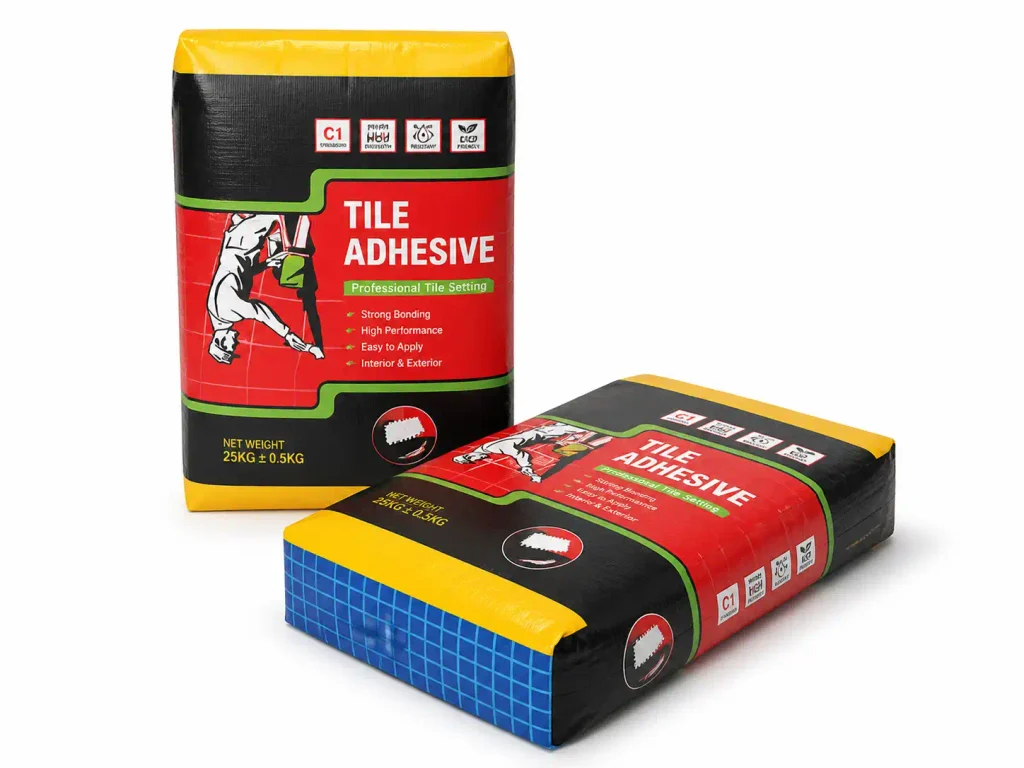
VIDEPAK kraft paper laminated woven bags: Where Paper Presentation Meets Woven Industrial Strength
Industrial packaging is rarely asked to do only one job. A bag may need to carry a dense powder, survive repeated handling, move cleanly through an automated filling line, resist moisture during ocean transport, stack neatly on a pallet, and still present a professional brand image when it reaches the customer. That is exactly the space where VIDEPAK develops kraft paper laminated woven bags and Laminated Paper Woven bags: hybrid packaging systems that combine the visual and functional qualities of kraft paper with the mechanical support of woven polypropylene.
The idea is simple, but the engineering is not. Paper does what paper does well. Woven polypropylene does what woven polypropylene does well. A carefully selected lamination layer brings them together. The outer kraft paper can provide a smooth printing area, controlled surface friction, stiffness, and a familiar paper touch, while the woven PP fabric works as a structural backbone that helps the finished package resist tearing, puncture, stretching, and difficult logistics conditions. VIDEPAK describes this hybrid structure as a practical middle ground between conventional paper sacks and conventional woven bags.
THE CORE VIDEPAK IDEA: Do not force one material to perform every task. Let kraft paper carry presentation, print, friction, and part of the structure. Let woven PP carry demanding mechanical loads. Add the barrier, closure, and bag geometry that the packed product actually needs. The result is not simply “paper plus plastic.” It is a packaging system designed layer by layer.
Within this platform, the paper choice itself matters. Natural brown unbleached Kraft paper and white Bleached Kraft paper can create very different visual identities while supporting different printing strategies. They are not simply two colors of the same bag. Surface character, brightness, print contrast, grade strength, paper weight, porosity, and end-use requirements all influence which option should be specified. Modern sack-paper portfolios accordingly include brown and white grades engineered for strength, runnability, porosity, and printing rather than treating color as the only difference.
Why VIDEPAK kraft paper laminated woven bags Matter
For many industrial buyers, packaging selection starts with a trade-off. Traditional paper sacks can offer an attractive surface, natural tactile character, useful friction, and strong print communication. Plain woven PP bags, on the other hand, are valued for mechanical strength and resistance to demanding handling. VIDEPAK kraft paper laminated woven bags are designed to reduce that trade-off by putting a paper face over a woven reinforcement structure. The customer does not have to choose presentation instead of strength or strength instead of presentation; the objective is to engineer both into the same package.
This is particularly useful when a bag has two audiences. The first audience is the supply chain: filling equipment, conveyors, warehouse workers, forklifts, pallets, containers, distributors, and transport routes. They care about strength, dimensions, closure integrity, dust control, and predictable handling. The second audience is human: purchasing teams, dealers, contractors, farmers, retailers, and final users. They notice printing, color, instructions, cleanliness, texture, and whether the package still looks professional after transport.
Paper-Led Presentation
The outer kraft paper gives VIDEPAK Laminated Paper Woven bags a broad printable surface for logos, instructions, product identification, safety information, barcodes, and market-specific graphics.
Woven Structural Backbone
Woven polypropylene carries much of the mechanical burden. In properly engineered kraft paper laminated woven bags, this layer helps the package cope with lifting, stacking, puncture risk, abrasion, and repeated movement.
Configurable Protection
Lamination, coatings, liners, valve constructions, and sealing technologies allow the final Laminated Paper Woven bags specification to be adjusted for moisture, fine powders, filling speed, pallet behavior, and route conditions.
The key word is configurable. A cementitious powder traveling through humid ports does not face the same risks as animal feed moving through a dry domestic supply chain. A premium retail-oriented agricultural product does not need the same external finish as an industrial mineral. A fast pneumatic valve filler does not ask the same things from a bag as a gravity-fed open-mouth line. VIDEPAK therefore treats the paper, PP fabric, lamination, liner, opening, bottom, venting, and closure as connected design decisions. Its published paper-faced woven references commonly place these products in industrial filling ranges around 10–50 kg, while the wider paper-sack portfolio covers approximately 2–60 kg; the actual safe filling weight is determined by dimensions, material structure, seams, product density, drop requirements, and customer handling conditions.
That last point matters. A heavier bag is not automatically a better bag. More layers are not automatically better layers. The right kraft paper grade, the right PP fabric, and the right closure can often do more for real-world performance than simply adding material everywhere. Strength should answer mechanical risk. Barrier should answer product sensitivity. Venting should answer filling behavior. Printing should answer communication needs. Simple in principle. Powerful in practice.
How kraft paper laminated woven bags Are Built
kraft paper laminated woven bags: Understanding the Layers
At their most recognizable, VIDEPAK kraft paper laminated woven bags use a printable outer kraft paper layer bonded to PP woven fabric through a controlled polymer or adhesive interface. Depending on the project, additional coating or an inner PE liner can be introduced when greater moisture or sift protection is required. The important point is functional separation: one layer communicates, another reinforces, another can control moisture, and the closure keeps the complete package working as one system. VIDEPAK’s published product descriptions specifically identify printable paper, woven polypropylene reinforcement, tie or coating layers, optional film, and multiple closure formats within this product family.
These figures should be read as engineering starting points rather than fixed catalog limits. VIDEPAK references show paper weights varying across different constructions, with approximately 70–120 gsm commonly used in laminated designs and wider project ranges appearing elsewhere in its portfolio. Woven fabric weights are likewise adjusted according to payload, bag size, transport conditions, seam design, and required stiffness.
This modular construction is why kraft paper laminated woven bags can be adapted so widely. For a dense product, more attention may go to the PP backbone and seam. For a hygroscopic product, the discussion moves toward coating, liner, and closure. For a premium brand, the surface and choice between Bleached Kraft paper and unbleached Kraft paper become central. The bag may look simple from outside, yet its performance is decided inside.
Laminated Paper Woven bags: One Platform, Multiple Formats
The market uses overlapping names for hybrid paper-and-woven packaging. VIDEPAK Laminated Paper Woven bags belong to the same broad engineering family as kraft paper laminated woven bags: a paper-led exterior is combined with woven reinforcement, while the detailed structure changes according to the application. Buyers may specify natural brown or white paper, different fabric weights, moisture-control layers, gussets, liners, printing systems, valve styles, and bottom constructions.
A valve-format Laminated Paper Woven bags project can be attractive for powders because the filling spout enters a relatively small valve sleeve, allowing the bag body and bottom to arrive at the filling plant already formed. Open-mouth designs give direct top access and can suit gravity, belt, auger, or other vertical filling systems. Pinch-style and heat-sealable designs provide another route when the customer’s closing equipment is configured around a sealable top. VIDEPAK’s published portfolio includes valve, pinch-bottom open-mouth, sewn open-mouth, pasted, and block-bottom concepts.
A USEFUL RULE: Design the bag from the product outward, not from an old bag inward.
Fill weight → bulk density → particle size → moisture sensitivity → trapped air
↓
kraft paper → woven PP → lamination → optional liner
↓
Dimensions → gusset → valve/open mouth → bottom → venting
↓
Filling trial → seal check → handling/drop test → pallet test → artwork approval
This sequence reflects an important packaging principle: dimensions cannot be chosen independently from bulk density; barrier cannot be chosen independently from venting; and valve design cannot be chosen independently from the filler. VIDEPAK’s published specification workflow similarly connects product behavior, material selection, bag architecture, filling equipment, and pre-production validation.
Choosing kraft paper: White, Brown, Surface, Strength, and Brand Position
In VIDEPAK kraft paper laminated woven bags, the paper layer is much more than decoration. The selected kraft paper influences printing, surface feel, stiffness, friction, folding behavior, lamination, and the visual position of the final product. That is why the choice between Bleached Kraft paper and unbleached Kraft paper deserves an engineering discussion, not simply a color preference.
Bleached Kraft paper and unbleached Kraft paper: Different Looks, Different Marketing Tools
Bleached Kraft paper
For customers seeking a clean, bright, premium surface, Bleached Kraft paper can be an excellent outer face for Laminated Paper Woven bags. Its white background allows printed colors to appear with less influence from the natural brown tone beneath them. That can make it particularly attractive when artwork includes bright brand colors, fine product information, clean technical graphics, or color consistency across several packaging formats.
White sack grades can still be engineered for industrial strength. Commercial white sack-paper ranges are available with high tensile properties, stiffness, extensibility, porosity, and enhanced printing characteristics, so choosing Bleached Kraft paper should not be interpreted as choosing appearance instead of performance. The precise grade still matters.
unbleached Kraft paper
unbleached Kraft paper retains the familiar natural brown appearance associated with many industrial, agricultural, building-material, and natural-positioned products. In VIDEPAK kraft paper laminated woven bags, that warm brown face can communicate simplicity and material authenticity while still offering an effective surface for bold logos, dark colors, one- or multi-color graphics, handling instructions, and product information.
High-performance brown grades can offer strong tear, burst, and tensile properties, and unbleached fresh-fiber papers are widely used where demanding mechanical performance is important. Consequently, unbleached Kraft paper should be selected by measured paper properties and application needs rather than by appearance alone. turn3search8turn3search14
The important conclusion is balance. Bleached Kraft paper should not automatically be called “better,” and unbleached Kraft paper should not automatically be called “stronger.” Paper performance is determined by the actual grade: fiber furnish, grammage, tensile energy absorption, tear resistance, stiffness, porosity, wet-strength treatment when required, and surface finishing all matter. Modern brown and white sack-paper grades are engineered for different combinations of those properties.
For VIDEPAK customers, this creates useful freedom. One product family can use unbleached Kraft paper to build a natural-looking range. Another can use Bleached Kraft paper for high-color graphics. Both can sit on a woven PP structural base. Both can become high-performance kraft paper laminated woven bags. Same engineering platform; very different shelf language.
Engineering Choices That Change Real-World Performance
A good specification for kraft paper laminated woven bags cannot stop at “brown or white” and “25 kg or 50 kg.” The performance of Laminated Paper Woven bags is shaped by the interfaces between materials: how securely the kraft paper bonds to the woven fabric, how air escapes during filling, how the mouth or valve closes, how the bag behaves after a drop, and how moisture conditions change during transport.
Lamination is the bridge. Extrusion lamination can apply a polymer layer between the paper and woven fabric so that the materials become one composite structure. Depending on the architecture, this interface can contribute to bonding, pore control, and moisture resistance. VIDEPAK references commonly discuss paper in roughly the 70–120 gsm region, woven PP in approximately the 75–110 gsm region for many projects, and lamination layers in approximately the 20–30 micron range as practical starting points, while emphasizing that specifications are adjusted for the actual application.
Barrier comes next. A laminated surface can improve resistance to external moisture compared with an untreated paper-only surface, but a moisture-sensitive powder may require more. An optional PE liner or dedicated film structure can create another level of protection. Yet barrier and filling speed must be considered together. A very closed package can trap air during fast powder filling; trapped air can make the bag inflate, slow the filling cycle, stress the valve, and produce soft pallets. Therefore, barrier must be balanced with designed venting or de-aeration. Block everything blindly, and the filler may suffer. Vent everything blindly, and product protection may suffer.
Barrier versus breathability is not a battle. It is a balance.
For VIDEPAK kraft paper laminated woven bags, the correct question is not “Can we make the bag more closed?” The better question is “How much protection does the product need, and where should displaced filling air go?” A reliable design protects the product after filling without turning the bag into an air balloon during filling.
Closure can be just as important as the laminate. For fine powders, a strong bag body means little if product escapes through a poorly controlled valve. This is where ultrasonic, or sonic-seal, technology becomes particularly useful. A sealable valve sleeve includes a compatible thermoplastic surface. After filling, a horn and anvil contact the sleeve and high-frequency vibration creates localized heating at the polymer interface, fusing the compatible surfaces. The method can create a compact positive valve closure and improve dust containment without relying on a simple self-closing paper fold alone. VIDEPAK specifically discusses sonic-seal sleeves for fine powders, hygroscopic materials, and automated filling environments.
Ultrasonic sealing is not magic, however. The valve geometry must match the filling spout; powder contamination in the sealing zone must be controlled; the thermoplastic layer must be compatible with the process; air must be released correctly before the seal is made; and the sealing energy must be validated on the customer’s line. This is why VIDEPAK treats valve design, venting, sealability, product flow, and filling speed as one system rather than five separate purchasing choices.
Quality control therefore has to follow the finished package, not one raw material. Paper strength alone cannot prove the performance of kraft paper laminated woven bags. PP fabric quality, dimensions, lamination bond, seam or pasted-bottom integrity, valve behavior, printing, and filled-bag handling all contribute to the result. VIDEPAK describes incoming-material controls and project-specific testing within its ISO 9001-based manufacturing approach.
A NOTE ON SUSTAINABILITY CLAIMS
The paper face of kraft paper laminated woven bags can come from renewable fiber sources, while polypropylene can be recyclable where suitable collection and processing systems exist. But a paper/PP laminate is a multi-material package. Its actual recyclability depends on construction, separation technology, collection infrastructure, and local rules. VIDEPAK’s own product guidance treats recyclability of the finished laminate as a design question rather than an automatic claim.
Applications, Customization, and the VIDEPAK Specification Approach
The strength of the VIDEPAK Laminated Paper Woven bags platform is not that one standard bag fits every industry. It is the opposite: the platform allows customers to adjust the package around the real behavior of the product and supply chain. kraft paper laminated woven bags are particularly relevant where a customer needs a strong industrial structure but does not want to give up the presentation and surface character of kraft paper.
For building materials and dry construction products: cement-related materials, mortars, grouts, tile adhesives, mineral powders, and similar products can place high demands on drop resistance, sift control, filling efficiency, and pallet shape. A woven reinforcement layer can help the bag endure demanding handling, while valve or block-bottom configurations can support efficient industrial filling. When powder is especially fine, venting and a more positive valve closure deserve particular attention. VIDEPAK identifies construction materials, minerals, and chemical powders among the practical application areas for paper-faced reinforced sacks.
For agriculture, feed, seed, and related products: visual communication becomes increasingly important. A bag may carry feeding instructions, crop information, handling guidance, batch codes, regulatory text, and strong brand graphics at the same time. Here, unbleached Kraft paper can provide a warm natural surface, while Bleached Kraft paper can support clean high-contrast artwork. Beneath either option, the PP woven layer gives VIDEPAK kraft paper laminated woven bags the reinforcement required for distribution and repeated manual handling.
For chemical and specialty powders: packaging must be designed around the product rather than assumptions. Particle size, hygroscopic behavior, bulk density, abrasion, filling temperature, dust generation, and regulatory requirements may all change the correct specification. Some products may require a liner. Some may need ultrasonic valve sealing. Some need carefully designed venting. Some need all three, but only after filling trials show that the structure works as a complete system.
For premium industrial and retail-facing products: the paper surface becomes a powerful communication tool. VIDEPAK Laminated Paper Woven bags can combine the tactile character associated with kraft paper and a strong woven structure beneath it. The result can look less like a basic commodity sack while still behaving like an industrial package. That contrast is valuable: soft in appearance, strong in structure; familiar at first touch, engineered underneath.
VIDEPAK’s published manufacturing profile also supports this customization strategy with 16 extrusion lines, around 100 circular looms, and more than 30 lamination and printing systems, allowing the company to manage PP tape production, weaving, lamination, printing, and bag converting across a broad industrial packaging portfolio. The company describes its production approach as combining large-scale manufacturing with project-specific material, printing, valve, liner, and format choices.
For buyers, however, manufacturing capacity is only useful when it turns into repeatable bags. This is why sample validation remains important. A drawing can show dimensions but cannot fully show how a bag settles after filling. A material sheet can show grammage but cannot prove how a finished pallet behaves after transport. A white Bleached Kraft paper sample can show artwork differently from brown unbleached Kraft paper. A laboratory seal can look perfect while a dusty filling environment creates a different challenge. Real packaging decisions become stronger when dimensions, material, printing, filling behavior, closure, drops, and palletization are evaluated together.
VIDEPAK PACKAGING PRINCIPLE
Start with what the product must survive. Then build the package around that reality.
Choose kraft paper laminated woven bags when paper presentation and woven reinforcement need to work together. Choose the right kraft paper according to print, strength, friction, and brand position. Use Bleached Kraft paper when a bright, clean printing base supports the product. Use unbleached Kraft paper when natural brown character supports the market position. Configure VIDEPAK Laminated Paper Woven bags with the barrier, liner, venting, valve, bottom, dimensions, and closure required by the customer’s filling line and supply chain.
That is the real value of the hybrid format. kraft paper does not have to carry every mechanical load by itself. Woven polypropylene does not have to define the entire appearance of the package. The laminate does not have to become a maximum barrier when a moderate barrier is enough. The valve does not have to be complicated when a simple closure works, but it can become a positively sealed system when a fine powder demands more control.
Strong where strength matters. Smooth where printing matters. Closed where moisture matters. Vented where filling air matters.
From natural unbleached Kraft paper to clean white Bleached Kraft paper, from open-mouth formats to sonic-seal valves, and from straightforward paper-faced constructions to more protected Laminated Paper Woven bags, VIDEPAK’s product platform is built around one consistent idea: the best industrial bag is not the bag with the most material. It is the bag in which every layer has a reason to be there.
For industrial customers that need a professional paper appearance without giving up a woven structural backbone, VIDEPAK kraft paper laminated woven bags offer a practical route forward: the familiarity of kraft paper, the reinforcement of woven PP, and the flexibility to engineer barrier, closure, printing, and format around the real demands of the product journey.