
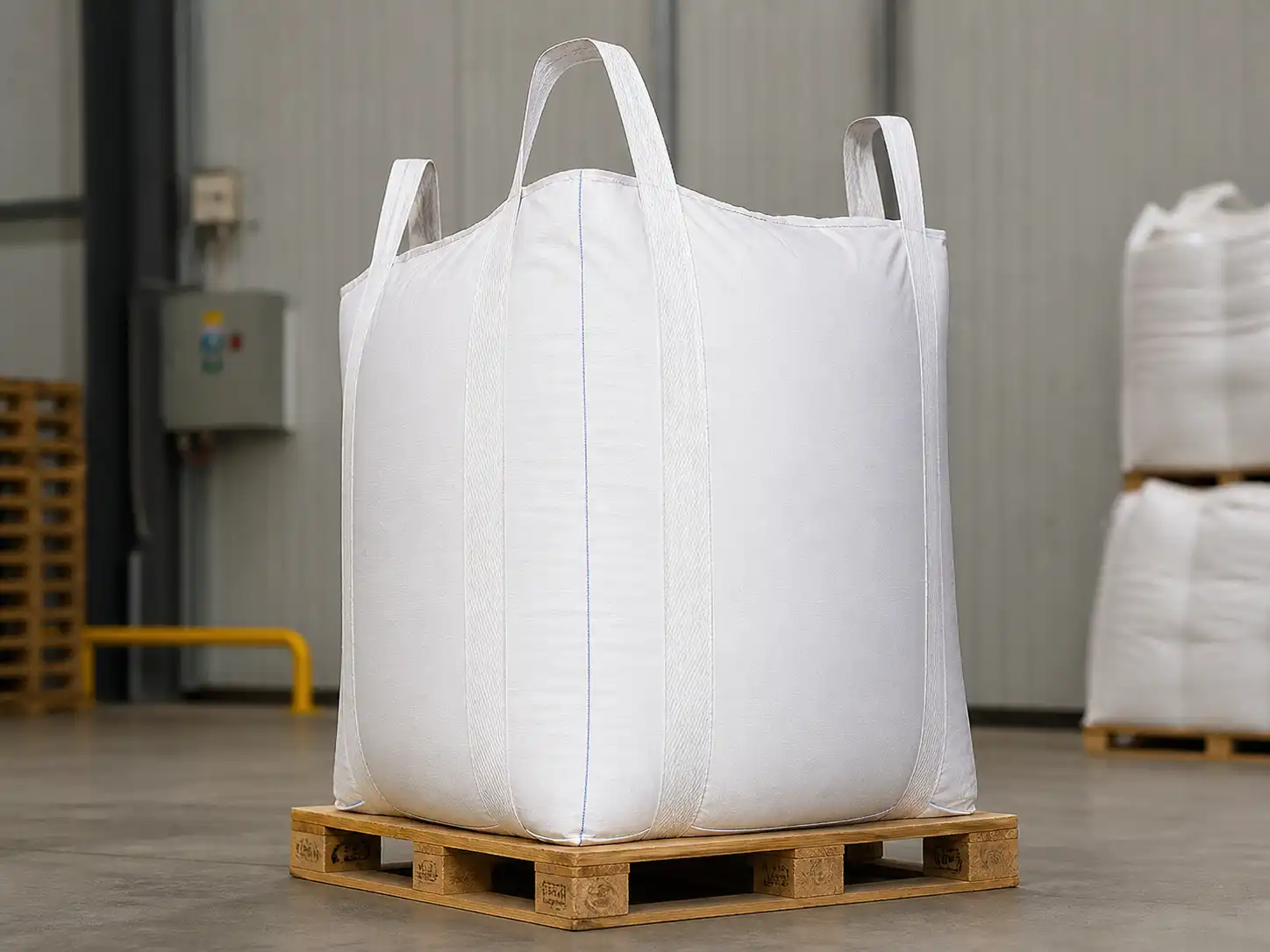
VIDEPAK Product Analysis of FIBC Jumbo Bags
In bulk logistics, the packaging is never a side issue. It is a load path, a safety barrier, a warehouse tool, and a cost lever all at once. That is why FIBC Jumbo Bags continue to win ground across chemicals, agriculture, minerals, food ingredients, and construction materials: they move large volumes with low tare weight, adapt to many filling and discharge systems, and give buyers a rare mix of flexibility, strength, and operational efficiency. For VIDEPAK, the real value of Jumbo Bags is not only that they carry product, but that they align the bag structure, the electrostatic class, the lifting method, and the production process into one coherent packaging specification.
Quick specification view. Typical market windows for VIDEPAK-style FIBC Jumbo Bags include safe working loads around 500–2,000 kg, common safety factors of 5:1 for single-trip and 6:1 for multi-trip use, woven polypropylene fabric commonly in the 145–200 gsm range, and optional PE or foil liners roughly 0.05–0.1 mm or 60–100 μm depending on product sensitivity, moisture barrier needs, and cleanliness targets. Standard customization also includes top options such as open top, duffle top, flap top, and filling spout; bottom options such as flat bottom, duffle bottom, and discharge spout; and structural choices such as U-Panel, Circular, 4 Panel, baffle, 4 loops, and tunnel lifting.
Core product positioning of FIBC Jumbo Bags
A well-designed FIBC Jumbo Bags program begins with one simple question: what must the bag do in the real world? A powder that builds static needs one answer. A dense mineral that punishes seams needs another. A food ingredient that hates moisture and contamination needs a third. In other words, the best Jumbo Bags are not generic sacks; they are engineered packaging systems built from woven PP tape yarn, shaped by panel architecture, reinforced by webbing and sewing, and completed by liners, coatings, spouts, and handling features that match the plant’s equipment and the product’s behavior.
From a marketing and product standpoint, VIDEPAK’s value is strongest when the bag is presented not as “one more bulk bag,” but as a decision platform. The customer chooses the electrostatic type first, the construction second, the handling method third, and the production controls behind all of that last. This sequence matters. Safety before shape. Shape before handling. Handling before decoration. When that order is respected, FIBC Jumbo Bags become easier to specify, easier to compare, and much harder to misuse.
Electrostatic types of FIBC Jumbo Bags
The four electrostatic classes define one of the most important buying decisions in the whole Jumbo Bags category. The logic comes from the way static electricity behaves during filling and discharging. Powders rush, particles separate, charge builds, and one wrong choice can turn a handling container into an ignition risk. The standards and industry guidance consistently classify these bags into Type A, Type B, Type C, and Type D, with each type designed for a different operating environment and level of protection.
Selection rule. If the product is non-flammable and the surrounding environment has no flammable gas or solvent vapor, Type A may be enough. If the powder is combustible and the environment is still free of gas or solvent vapor, Type B can enter the conversation. If the operation includes flammable powders and a secure grounding procedure, Type C becomes relevant. If the operation demands electrostatic protection without direct bag grounding, Type D is the premium route, though conductive particulate applications still require special review.
Type A
Type A FIBC Jumbo Bags are made from plain woven polypropylene and provide no static protection. They are the straightforward workhorse of the market: cost-effective, widely used, and suitable for non-flammable products handled in non-hazardous environments. This simplicity is their strength and also their limit. Type A is attractive when the material is inert and the plant atmosphere is clean of flammable gas, vapor, and combustible dust risk; it is the wrong choice when the material or the air around it can ignite.
Type B
Type B FIBC Jumbo Bags are also based on non-conductive fabric, but the fabric system is engineered with a lower breakdown voltage so that propagating brush discharges are suppressed. In practical terms, Type B sits between basic economy and true static-protective performance. It is commonly considered for dry combustible powders when no flammable gas or solvent vapor is present around the bag. That boundary is critical. Not “sometimes,” not “maybe,” but clearly: Type B is not the answer for areas with flammable gases or solvent vapors.
Type C
Type C FIBC Jumbo Bags, often called conductive or groundable bags, use interconnected conductive or static-dissipative threads woven into the polypropylene fabric. Their promise is powerful: they can safely handle flammable powders and can be used where flammable gases or vapors may be present, but only when the bag is properly and continuously grounded before and during filling and emptying. That “only” matters. Type C does not forgive bad grounding habits, dirty clamps, broken tabs, or interrupted connections. It rewards disciplined operations; it punishes shortcuts.
Type D
Type D FIBC Jumbo Bags are designed to dissipate charge safely without a direct grounding connection to the bag. For many buyers, this is the premium safety-and-convenience class: less dependence on operator behavior, less risk of an ungrounded event, and a cleaner operating sequence in plants that demand speed without safety compromise. Yet Type D is not a magic word. Guidance tied to IEC and NFPA practice still limits its use in certain environments, including conductive particulate situations, and the surface condition of the bag remains important because severe contamination can affect electrical behavior.
Construction systems behind shape, discharge, and handling
Once the safety type is selected, the next question is structural: how should the bag be built? Here the market often speaks in shorthand—U-Panel, Circular, 4 Panel, baffle, 4 loops, tunnel lifting—but each of these words points to a different mechanical behavior. Some constructions favor economy. Some favor square shape. Some reduce seam count. Some speed forklift entry. The right answer is not the one with the most features; it is the one whose geometry best supports the filler, the product density, the warehouse footprint, and the discharge method.
U-Panel
A balanced middle ground. Fewer body pieces than a full 4 Panel build, better shape control than many Circular designs, and strong popularity in mainstream industrial use.
Circular
Tubular body woven on a circular loom, no vertical side seams, efficient to produce, smooth for some fine-product applications, but often less cube-like when filled.
4 Panel
Four side panels plus base, more seam engineering, stronger square profile, strong stacking image, and a very clear spec for customers who care about pallet discipline.
Baffle
Internal corner control for a more cubic shape, better container fill efficiency, better stack behavior, and lower side bulging during storage and transport.
U-Panel construction
U-Panel Jumbo Bags are built with one main fabric piece that forms the bottom and two sides, plus two additional side panels. This layout gives the bag a strong, practical compromise: it keeps seam count below a full 4 Panel structure, yet creates a more defined shape than many tubular designs. For buyers, that means a package that usually performs well on pallets, handles a broad range of products, and lands in a commercially efficient space between economy and shape control. It is popular because it is sensible, and sensible often wins.
Circular construction
Circular FIBC Jumbo Bags, also called tubular bags, use fabric woven on a circular loom and cut to the required height, which removes the vertical side seams. This can be an advantage when buyers want a simpler body structure and efficient production flow. The trade-off is shape: a standard Circular bag may bulge more as it fills, so while it can be excellent for many commodities, it may not deliver the same square pallet footprint as a 4 Panel or baffled bag. In short, fewer seams, cleaner tube logic, but typically less cube discipline.
4 Panel construction
4 Panel Jumbo Bags use four separate side panels and a base panel, which creates a clearer square form under load. This is the style many buyers associate with orderly stacks, better warehouse presentation, and higher footprint efficiency in transport. More seams mean more sewing precision is required, yet the reward is a bag that tends to stand straighter and stack cleaner. For export programs, container optimization, and customers who care deeply about neat cubic loading, 4 Panel remains one of the most persuasive structural choices in the FIBC Jumbo Bags family.
Baffle construction
Baffles are internal pieces sewn into the corners of the bag to control bulging and maintain a more square profile. They can be added to U-Panel, Circular, or 4 Panel constructions, which is exactly why they are so strategic: they are not a separate body style only, but a geometry upgrade. For customers, the benefits are immediate and visual. Better stacking. Better use of warehouse and container space. Better load stability. Better external appearance. And because logistics is often won by centimeters, not slogans, a well-designed baffled bag can improve storage density in a way that buyers feel every day.
4 loops lifting
The classic handling format for FIBC Jumbo Bags is 4 loops. It is widely understood, flexible in the market, and compatible with common forklift, crane, and hoist handling methods when used correctly. Standardization is its hidden advantage: many customers already have work instructions, lifting frames, and driver habits that fit 4 loops. For a marketing team, that means faster customer acceptance. For an operations team, it means a familiar handling language. It is a conventional design because it works, and it works because the infrastructure around it already exists.
Tunnel lifting
Tunnel lifting, also called sleeve or lift tunnel loops, uses fabric sleeves that allow forklift tines to enter directly. For operations that handle bags almost entirely by forklift, this can be a highly efficient choice: quick tine insertion, less manual loop positioning, and strong practicality in repetitive warehouse movement. It is especially useful where speed and aisle discipline matter, or where vertical clearance is limited and bottom-positioned sleeves help control overall lift geometry. If 4 loops speak the language of versatility, tunnel lifting speaks the language of forklift rhythm.
Production flow of FIBC Jumbo Bags
The manufacturing story of FIBC Jumbo Bags follows a clear industrial rhythm. The original process logic is linear and disciplined: extrusion and filament production, weaving the fabric, coating where required, printing and cutting, sewing and assembly, then quality inspection and packaging. It sounds simple when listed in one line. It is not simple in execution. Every stage changes the next stage. A weak tape creates weak fabric. A fabric variation changes seam behavior. A poor cut distorts loop alignment. A poorly controlled loop changes the load path. In bulk packaging, each step argues with the next; precision is the only peace treaty.
Flow of production.
Extrusion and tape formation
The process starts with polypropylene resin together with the required additives, such as UV stabilizers, color masterbatch, or anti-static ingredients for relevant designs. The resin is melted and extruded into sheet or filament form, then slit and drawn into tape yarn. This is a foundational step. Tape uniformity, draw ratio, and molecular orientation heavily influence tensile strength, flexibility, and fabric consistency. In practical terms, good bags are born here long before they are sewn.
Weaving the body fabric
The drawn tapes are wound onto bobbins and woven into the base fabric. This weaving stage defines mesh, dimensional stability, tear resistance, and the body format itself. Tubular fabric feeds Circular production, while flat woven fabric supports cut-and-sew constructions such as U-Panel and 4 Panel. Here, engineering meets economics: tighter and stronger structures support more demanding applications, but they also require more disciplined process control and cost management.
Coating, lamination, and barrier tuning
If the end use demands sift resistance, moisture control, or cleaner dust behavior, the woven fabric can be coated or laminated. Coated fabric reduces moisture intrusion and product loss through the weave, while selected liner systems add another layer of barrier performance. This matters greatly for hygroscopic powders, food ingredients, fine chemicals, and products whose value can be lost by a little dust, a little dampness, or a little contamination. Packaging is often judged by what it prevents, not only by what it carries.
Printing and precision cutting
After weaving and any required coating, the material moves into printing and cutting. Branding, handling instructions, trace markings, and customer information are added where required. Then fabric is cut into body pieces, tops, bottoms, spouts, and reinforcement components according to the design. This stage determines dimensional accuracy. A few millimeters off in cutting can affect seam geometry, loop position, top fit, baffle symmetry, and finally the visual square profile that customers praise or question when the bag is full.
Loop preparation, sewing, and bag assembly
Once components are ready, the bag enters sewing and assembly. This is where body panels, lift belts, loop structures, spouts, skirts, duffles, and baffles come together into finished Jumbo Bags. For standard 4 loops, the sewing operation must keep the load path balanced and the loops aligned. For tunnel lifting, the sleeves must be dimensionally clean and robust enough for repeated tine entry. For Type C bags, conductive elements and grounding tabs must remain electrically continuous through the finished assembly. Sewing is not decoration; sewing is structure in visible form.
Liner insertion and finishing
If the bag uses a liner, it is inserted either loosely or secured by tabs, ties, glue, or equivalent methods. Form-fit liners can better match the internal shape of the bag and improve filling and discharge, while tube liners serve simpler barrier applications. The chosen liner must fit the product and, where relevant, the electrostatic class. A mismatch here can damage discharge performance or compromise safety expectations, which is why liner choice should be treated as a product-engineering decision, not an accessory purchase.
Inspection, testing, and packing
Before shipment, the bags move through inspection and testing. Industry guidance and VIDEPAK’s own published materials point to checks such as dimensional control, tensile and tear evaluation, seam strength, top lift and load verification, UV-related performance controls, and electrostatic compliance for static-protective bags. Finished bags are then folded, baled, or palletized for efficient transport. It is a fitting end to the process: flat in outbound form, strong in service form, economical in freight, ambitious in performance.
Commercial takeaways for sourcing teams
For customers, the strongest argument for VIDEPAK’s FIBC Jumbo Bags is not a single parameter. It is the way the parameters fit together. A buyer who chooses Type C but ignores grounding procedure has not solved the problem. A buyer who chooses a beautiful 4 Panel form for a forklift-only workflow but overlooks tunnel lifting may leave efficiency on the floor. A buyer who selects a low-cost Circular bag for a warehouse that depends on tight square stacking may save on piece price and lose on cube utilization. That is why product analysis matters: the bag is a system, not an object.
From a market-facing perspective, VIDEPAK should continue positioning FIBC Jumbo Bags around four promises. First, safety clarity through Type A, B, C, and D guidance. Second, structural flexibility through U-Panel, Circular, 4 Panel, and baffle options. Third, handling adaptability through 4 loops and tunnel lifting. Fourth, manufacturing confidence through controlled extrusion, weaving, coating, cutting, sewing, and inspection. That message is easy to understand, easy to defend, and easy for customers to translate into procurement action.
Bottom line. The best Jumbo Bags do three things at the same time: they protect the product, they protect the process, and they protect the customer’s economics. When electrostatic type, construction, lifting format, and production quality are aligned, FIBC Jumbo Bags stop being a commodity and start becoming a competitive packaging decision. That is where VIDEPAK can speak with authority—clearly, practically, and with the confidence of a manufacturer that understands both the plant floor and the market floor.
- VIDEPAK Product Analysis of FIBC Jumbo Bags
- Core product positioning of FIBC Jumbo Bags
- Electrostatic types of FIBC Jumbo Bags
- Construction systems behind shape, discharge, and handling
- Production flow of FIBC Jumbo Bags
- Commercial takeaways for sourcing teams
When it comes to industrial packaging solutions, FIBC Jumbo Bags have gained prominence for their versatility, strength, and efficiency. These Bulk bags, also known as Ton bags, are essential for transporting large quantities of products across various industries. Whether you need to store chemicals, agricultural products, or construction materials, FIBC Bags offer a durable, cost-effective solution. At VidePak, we specialize in manufacturing high-quality FIBC Jumbo Bags with advanced features that enhance performance and reliability. In this article, we will delve into the production process of Jumbo Bags, focusing on our use of cutting-edge equipment from renowned suppliers like Starlinger and W&H.
We take pride in the FIBC Jumbo Bags we produce, with each bag designed to withstand heavy loads and extreme conditions. The bags feature a reinforced X-shaped and cross-bottom design, offering extra stability and support. This unique construction ensures that our Bulk bags maintain their shape even when filled with heavy, dense materials. These reinforced Ton bags are built to last, providing both safety and efficiency during transportation and storage. You can learn more about FIBC Jumbo Bags in this detailed article.
Key Features and Technical Specifications of Our FIBC Jumbo Bags
To understand the technical excellence of our FIBC Bags, let’s look at some key product parameters. Below is a table summarizing the specifications of our Jumbo Bags, which highlight their strength and suitability for various industrial applications.
| Feature | Description |
|---|---|
| Bag Type | FIBC Jumbo Bags, Bulk bags |
| Bag Shape | X-shaped and cross-bottom reinforced |
| Material | High-quality PP (Polypropylene) |
| Capacity | 500 kg to 2000 kg |
| Dimensions | Customizable (Width, Height, Length) |
| Liner | Optional (PE, aluminum, or no liner) |
| Printing | Multi-color custom printing available |
| Bottom Type | X-shaped or cross-bottom reinforced |
| UV Protection | Available for outdoor use |
| Certification | ISO 9001, ISO 14001, REACH compliant |
The Production Process of FIBC Jumbo Bags
The production of FIBC Jumbo Bags is a meticulous process that requires state-of-the-art machinery and expertise. Each stage of the production cycle—from extrusion and weaving to coating, printing, and bag manufacturing—plays a crucial role in ensuring the bags’ high-quality standards.
1. Extrusion and Filament Production
The first stage in the production of FIBC Bags is extrusion, where polypropylene (PP) resin is melted and formed into fine filaments. These filaments are the building blocks for the fabric that will make up the bag. At VidePak, we use advanced extrusion lines provided by Starlinger, a globally recognized leader in the production of high-quality equipment. This technology ensures that the PP fibers are strong, durable, and uniform.
2. Weaving the Fabric
Once the filaments are created, they are woven together to form the fabric of the bag. The weaving process involves a series of parallel and perpendicular threads interlacing to create a durable and flexible material. For FIBC Jumbo Bags, the fabric needs to be strong enough to handle the weight of heavy materials, yet flexible enough for easy folding and storage.
Our weaving machines are sourced from Starlinger and are designed to handle the intricacies of industrial-grade fabrics. These circular looms produce a dense, high-strength weave that is key to ensuring the bag’s load-bearing capacity. The FIBC Bags produced using these looms are reinforced to support weights ranging from 500 kg to 2000 kg, making them suitable for a wide variety of applications.
3. Coating the Fabric
In many cases, the woven fabric needs to be coated to enhance its durability and protect it from external elements. This is especially true for bags intended for outdoor use or those requiring resistance to moisture and UV rays. At VidePak, we offer various coating options for our Bulk bags, including polyethylene (PE) or aluminum film coatings.
FIBC Bags Manufacturer
Professional production introduction and complete manufacturing process of high-quality FIBC jumbo bags.
Check More →FIBC Bulk Bags Versatility
Explore structural design, production craft and functional features of industrial FIBC jumbo bags.
Check More →Heavy-Duty Woven Bags Guide
Detailed manufacturing standards and processing steps for large-size FIBC jumbo woven bags.
Check More →Polypropylene Woven Bags Specifications
Raw material standards and production parameters supporting FIBC jumbo bags manufacturing process.
Check More →The coating process is managed by our high-precision W&H machines. These machines ensure that the coating is applied uniformly, providing an extra layer of protection against external factors like UV light, water, and chemicals.
4. Printing and Customization
One of the unique aspects of our FIBC Bags is the ability to customize them with high-quality printing. Whether you need logos, brand names, or instructions, our advanced printing machines ensure vibrant and durable designs. The printing process uses multi-color systems that can handle intricate designs and large-scale runs.
Our FIBC Jumbo Bags offer not only strength but also customization to enhance your brand’s presence in the market. The printing capabilities ensure that your bags are not only functional but also a promotional tool for your business.
5. Bag Manufacturing and Final Testing
Once the fabric has been woven and coated, and the printing is complete, the fabric is cut and sewn into the final Jumbo Bag shape. This step is where the bags are fitted with handles, lifting loops, and other accessories needed for safe handling.
Before the FIBC Bags are shipped out, each bag undergoes rigorous quality control testing. This includes load testing, seam strength tests, and checks for defects. At VidePak, we work closely with Starlinger to ensure that our bags meet the highest standards for safety, strength, and durability.
6. Storage and Shipping
Once the FIBC Jumbo Bags pass all tests, they are packaged and stored ready for shipment. With a capacity ranging from 500 kg to 2000 kg, these bags are typically stacked in warehouse areas or transported via trucks and containers. Whether for domestic or international shipping, our Ton bags are designed for efficient handling and long-lasting performance.
Advanced Equipment and Technology from Starlinger and W&H
At VidePak, we are committed to using the most advanced equipment available in the market to produce our FIBC Jumbo Bags. Our partnership with equipment suppliers like Starlinger and W&H is a key factor in ensuring the quality and consistency of our products.
Starlinger is a leader in the design and manufacture of woven fabric machinery, and their circular looms are renowned for their durability and precision. The high-efficiency machines help us create strong, flexible woven fabrics that meet the most demanding specifications for FIBC Bags.
W&H provides us with the advanced extrusion lines and coating systems that are critical to the durability of our Bulk bags. These machines allow us to apply coatings that offer UV protection and moisture resistance, ensuring the bags perform optimally in various conditions.
Conclusion
The production of FIBC Jumbo Bags is a complex process that requires high-quality materials, advanced machinery, and strict quality control procedures. At VidePak, we are proud to offer Bulk bags that are both strong and versatile, designed to meet the needs of industries ranging from agriculture to construction. By leveraging cutting-edge technology from Starlinger and W&H, we ensure that every Ton bag is manufactured to the highest standards, offering reliable and safe transportation solutions.
For more information on FIBC Bags, please refer to our in-depth article on FIBC Jumbo Bags. If you’re interested in learning more about the benefits of Bulk bags for your business, be sure to check out our article on Bulk bags and their versatile applications.