
Food Grade Woven Bags: Automated Precision, Food-Contact Safety, and Supply-Chain Strength
Food packaging carries two loads at the same time. The first is physical: kilograms of rice, flour, sugar, salt, starch, grain, pulses, feed, or dry ingredients must move through filling, stacking, warehousing, trucking, container shipping, and unloading without leakage or collapse. The second is invisible but even more important: the package must support hygiene, material compliance, traceability, and consumer confidence. VIDEPAK develops food grade woven bags to carry both loads. Strength without safety is incomplete; safety without stable production is unreliable; and good packaging must deliver all three—protection, consistency, and efficiency.
The VIDEPAK principle is clear: a food sack should not merely survive the journey. It should help control the journey—cleaner filling, steadier output, safer storage, clearer identification, and fewer avoidable losses.
VIDEPAK’s portfolio includes open-mouth, laminated, lined, coated, gusseted, valve-style, and retail-ready structures based on PP woven bags. Its public product information describes more than two decades of heavy-duty packaging experience and the use of virgin polypropylene in its woven product range. The product concept is therefore not a single standard sack but a configurable packaging platform: the fabric carries the load, the barrier layer protects the contents, the closure controls leakage, and the printed surface connects the package to the market.
Why Food Packaging Needs a Different Woven Bag
A woven sack becomes food grade through the whole system
The words “food grade” should never be treated as a decorative label. A suitable package depends on the intended food, contact type, storage time, temperature, destination market, filling method, closure method, and complete material structure. Resin alone does not define compliance. Inks, coatings, adhesives, masterbatch, thread, liners, and process conditions can all affect the final risk profile. For that reason, VIDEPAK approaches food grade woven bags as engineered systems rather than generic sacks with a new name.
In the United States, food-contact status is tied to authorized substances and their stated conditions of use under Title 21 rules; the U.S. Food and Drug Administration maintains an inventory for substances listed in the relevant food-contact regulations. In the European Union, Regulation (EC) No 1935/2004 establishes the general safety and traceability framework, while Regulation (EU) No 10/2011 sets composition, migration, documentation, and use requirements for plastic food-contact materials. The current EU summary, reviewed in January 2026, also reflects later amendments and emphasizes purity, migration compliance, declarations of compliance, and supporting documentation.
Material Safety
Controlled resin, additives, film, ink, adhesive, liner, and sewing components.
Hygienic Conversion
Clean handling, foreign-body control, protected work areas, and defined operating rules.
Verified Performance
Testing matched to the food, load, closure, distribution route, and legal market.
Documented Traceability
Batch identity, process records, inspection results, and controlled release.
The business cost of a weak package
A broken sack does more than lose product. It can stop a filling line, contaminate a clean area, damage nearby packs, destabilize a pallet, create dust, trigger rework, and weaken brand trust. A bag that is too slippery may shift in transport; one that is too rough may feed poorly through automated equipment. A liner that is too short may fold away from the seal; one that is too loose may block the filling spout. In other words, small packaging errors become large operational costs.
Well-designed polypropylene woven bags answer these risks through balance. Tape strength must match fabric weight. Fabric weight must match filled load. Barrier must match product sensitivity. Friction must match pallet and machine behavior. Venting must release filling air without releasing product. Closure must be easy enough for the line and strong enough for the road. Not maximum everything—correct everything.
Material Architecture Built Around the Product
The woven polypropylene load-bearing core
The structural heart of VIDEPAK PP woven bags is a fabric made from extruded and drawn polypropylene tapes. Drawing aligns the polymer structure and helps create the tensile performance needed for heavy dry goods. The tapes are woven in warp and weft directions, producing a light yet strong fabric whose weight, tape size, and weave density can be adjusted for the target load. This structure is why polypropylene woven bags can combine handling strength, puncture resistance, flexibility, and material efficiency in one package.
VIDEPAK states that its woven bag range is produced from virgin polypropylene. For food-related projects, the commercial specification can be built around documented raw-material grades and approved supporting components, subject to the destination market and intended use. Incoming checks can cover identity, melt behavior, appearance, contamination, and supplier documentation before production begins. This front-end control matters because variation introduced at the resin stage cannot be fully repaired later by printing or bag making.
Barrier layers that do different jobs
Uncoated woven fabric allows air exchange through the weave. That may be useful for selected agricultural goods, but it is not ideal for every food. Flour, starch, sugar, salt, milk-powder blends, pet food, and moisture-sensitive ingredients may need a coating, laminate, or inner liner. VIDEPAK can therefore configure food grade woven bags with a polyethylene contact liner, a polypropylene coating, a printed biaxially oriented polypropylene outer film, or a combination selected for the application.
Print is part of control, not only decoration
A food package is also an information device. High-definition laminate printing can carry product identity, ingredient panels, cooking directions, nutrition data, storage advice, allergen statements, barcodes, QR codes, batch fields, and anti-counterfeit features. Clear hierarchy matters: the consumer sees the brand; the warehouse sees the code; the operator sees the handling instruction. One surface, three audiences.
For direct and indirect food applications, print systems should be selected with attention to ink location, set-off risk, residual solvents, lamination quality, curing, and the possibility of migration through the structure. EU rules explicitly recognize that printed, coated, and adhesively bonded plastic structures require controlled composition and compliance evaluation. VIDEPAK therefore treats graphic design and material design as one project, not two unrelated services.
Automation That Converts Design into Repeatable Output
Consistency is the real purpose of automation
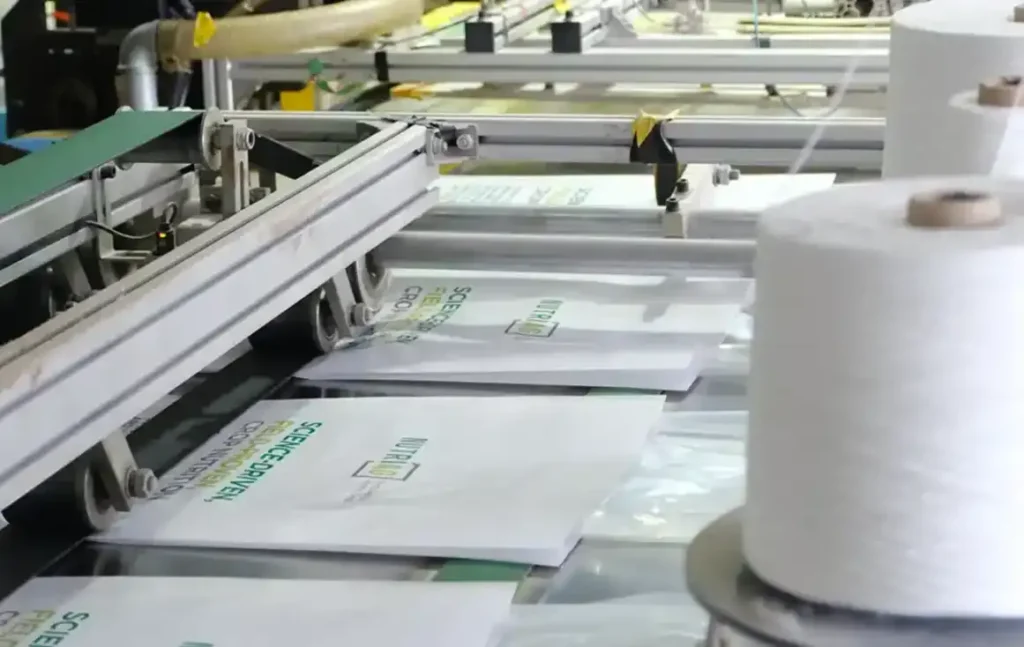
Fast machines are useful, but speed alone is not the goal. The true value of automated production is repeatability: the same tape width, the same fabric weight, the same lamination bond, the same cut length, the same seam position, and the same print registration across a large order. VIDEPAK’s manufacturing platform covers extrusion, circular weaving, lamination, printing, cutting, sewing, and converting, allowing key stages to be coordinated rather than treated as disconnected purchases. Its published company profile describes a broad manufacturing base for woven, laminated, valve, paper, polyethylene, and bulk packaging.
Automation in one sentence
Measure early, control continuously, correct quickly, verify finally.
From resin to released pallet
Resin, film, ink, liner, additive, documents
Width, draw, thickness, strength
Mesh, fabric weight, width, defect control
Coating, laminate, artwork, registration
Cut, gusset, valve, liner, seam, seal
Testing, records, pallet ID, shipment
At extrusion, stable heat, pressure, cooling, and draw conditions help keep tapes uniform. At weaving, controlled tension and online observation reduce broken tapes, uneven weave, and width variation. At lamination, web tension and coating weight influence flatness, bond quality, and barrier consistency. At conversion, accurate length, gusset depth, valve geometry, liner placement, and sewing position determine whether the finished bag works smoothly on the customer’s equipment. Every stage hands quality to the next stage—or hands forward a problem.
Designed for the customer’s filling line
Packaging performance begins before the truck moves. It begins when an empty bag is picked, opened, placed, filled, deaerated, closed, conveyed, checked, and palletized. VIDEPAK can tune bag mouth stiffness, valve dimensions, surface friction, perforation, liner position, and dimensional tolerance around manual, semi-automatic, or automatic operations. This is especially important for fine powders, where trapped air slows filling, and for high-output grain lines, where a small variation in opening behavior can repeat thousands of times per shift.
The best PP woven bags feel almost invisible on the line: they open when asked, fill without fighting, close without leaking, and stack without sliding. Quiet performance is valuable performance.
Performance Across Real Food Applications
Rice, grains, pulses, and seeds
Rice and grain packs often travel long distances and pass through many hands. They need puncture resistance, seam security, moisture management, stable pallet behavior, and strong print appeal. Laminated food grade woven bags can combine a durable fabric core with a smooth retail surface, while transparent windows, handles, easy-open features, and selected venting can be added when the product and market require them. For export programs, the design should also consider container humidity, stacking height, handling hooks, and warehouse floor conditions.
Flour, starch, sugar, salt, and dry ingredients
Fine powders and crystals place different demands on a bag. Flour and starch can escape through small pathways and generate dust. Sugar and salt can absorb moisture, cake, or lose free-flow behavior. These products often benefit from tighter construction, coated fabric, an inner liner, controlled perforation, and a closure selected for the particle size. The structure must let air leave during filling but keep product inside afterward—a simple sentence, a difficult balance.
Application Callout
Barrier is not a universal number. The right solution depends on the product’s moisture sensitivity, fat or aroma content, expected shelf life, climate, storage temperature, and closure system. VIDEPAK develops the package around those facts rather than forcing every food into one standard construction.
Pet food, feed, and nutrient blends
Pet food and feed packages need strength, resistance to oil or aroma transfer, clear feeding information, and strong shelf identity. A laminated outer layer supports detailed graphics and scuff resistance, while the woven core protects the pack through distribution. For dense pellets or mixed textures, seam design and drop resistance become central. For products with fat, odor, or vitamin sensitivity, the barrier system should be validated against the actual formulation rather than assumed from generic data.
Cold, humid, or demanding distribution
Some dry-food ingredients move through refrigerated stores, tropical ports, cold winters, or high-humidity warehouses. In these cases, condensation, low-temperature flexing, abrasion, and repeated handling may matter as much as nominal bag strength. VIDEPAK can combine the external mechanical support of polypropylene woven bags with a selected liner or coating, then review seal behavior and dimensions under the expected conditions. The objective is not laboratory beauty. The objective is shipment survival.
Technical Options and Specification Matrix
The following ranges are practical starting points drawn from VIDEPAK’s published product information and common heavy-duty food-packaging configurations. They are indicative, not automatic guarantees. Final dimensions and performance targets should be confirmed through samples, filling trials, transport needs, food-contact review, and an approved specification. VIDEPAK’s published guidance presents typical food-commodity capacities of about 5–50 kg, woven fabric around 70–120 g/m², BOPP films around 20–30 microns, and inner PE layers around 40–80 microns, while broader designs may move outside these ranges.
Choose structure by risk, not by habit
An unlaminated sack may be right for a breathable crop. A coated sack may be better when moderate dust or moisture control is needed. A BOPP-laminated sack may be the strongest choice for retail graphics and scuff resistance. A lined bag may be necessary for a fine or sensitive ingredient. A valve design may support fast powder filling; an open-mouth design may offer broader compatibility. The right answer is the one that matches the product and process with the fewest unnecessary layers.
Specification Rule
Do not buy a bag from a name alone. Buy it from a controlled specification: material structure, dimensions, tolerances, closure, artwork, tests, compliance documents, packing method, and approved sample.
Quality, Compliance, and Traceability by Design
A layered quality gate
Quality control for food grade woven bags should begin before production and continue after conversion. Incoming materials are checked and identified. Extrusion data, fabric weight, width, weave condition, and roll identity are monitored. Lamination and print are examined for bond, appearance, registration, and curing. Converted bags are checked for dimensions, liner position, seam or seal quality, valve construction, cleanliness, and count. Finished lots can then be evaluated against defined sampling and release rules.
The key is linkage. A finished pallet should connect back to the raw-material lot, production route, work order, inspection result, and approved artwork. EU food-contact law requires traceability at all stages to support control and recall, and the general framework also requires good manufacturing practice. ISO 22000 provides a wider food-safety management structure based on hazard control and applies to organizations directly or indirectly involved in the food chain, including packaging.
Testing must represent the intended use
A tensile result is useful, but it does not replace a filled-bag drop test. A migration report is useful, but it must correspond to the relevant material, food type, contact condition, time, and temperature. A seal test is useful, but the customer’s powder contamination and actual sealing jaws may change the outcome. VIDEPAK therefore recommends project-specific confirmation where the application is demanding: sample review, line trial, filled-pack testing, pallet trial, and document review before full-scale supply.
For EU-bound plastic food-contact projects, the declaration of compliance and supporting documentation are core parts of market placement, not optional sales attachments. The updated EU framework requires applicable specific and overall migration limits to be met and documentation to be renewed when relevant changes occur. For U.S. projects, authorization depends on the exact substance and intended conditions of use. “Compliant” is therefore a complete sentence only when followed by “for this structure, this food, this condition, and this market.”
Prevent
Qualified materials, controlled hygiene, approved settings, and trained operations.
Detect
Online monitoring, in-process inspection, laboratory checks, and final sampling.
Trace
Lot coding, production records, retained samples, artwork control, and pallet identity.
Improve
Complaint analysis, corrective action, trend review, and specification updates.
Sustainability Through Smarter Packaging Engineering
Use less by designing better
Sustainability is not achieved by making a package weak. Under-designed packaging can increase product loss, rework, emergency repacking, and transport waste. Over-designed packaging uses material that may not add real value. The better route is right-sizing: select the lightest structure that can reliably pass the required filling, handling, storage, and distribution tests. Because woven tapes provide high load performance at relatively low material weight, PP woven bags can support this approach when the fabric, seam, barrier, and pallet system are engineered together.
Material compatibility also matters. Structures based mainly on polypropylene and polyethylene stay within the polyolefin family, which can simplify material identification and may improve recyclability where suitable collection and recycling systems exist. Actual recycling outcomes still depend on inks, adhesives, contamination, local infrastructure, and end-market demand; therefore, recyclability claims should be market-specific, not universal. EU plastic food-contact rules also place strict conditions on materials manufactured from waste and on declarations supporting their safe use.
Protecting food is an environmental function
A package’s environmental value includes what it prevents. When food grade woven bags keep rice dry, flour contained, sugar free-flowing, feed protected, and pallets stable, they help avoid losses that have already consumed land, water, energy, labor, and transport. The best sustainability discussion therefore considers the complete system: material per bag, bags per ton, product loss rate, pallet density, transport efficiency, damage rate, recovery options, and compliance risk.
Lighter where possible. Stronger where necessary. Simpler where practical. Verified everywhere.
Why VIDEPAK Is a Practical Long-Term Packaging Partner
A broad platform, one accountable project path
VIDEPAK’s value is not limited to supplying an empty sack. Its product platform covers woven fabric structures, laminated retail sacks, valve formats, liners, coatings, custom printing, and related heavy-duty packaging, allowing buyers to compare options within one development process. The company’s public information highlights long manufacturing experience and integrated capabilities across woven and flexible industrial packaging.
For procurement teams, this means a clearer route from requirement to repeat order. The discussion can begin with food type, fill weight, bulk density, line speed, bag style, destination, shelf-life target, pallet pattern, artwork, and compliance needs. It can then move through sample structure, quotation, printed proof, trial production, performance review, approved specification, and controlled supply. Questions are answered before they become claims; risks are tested before they become losses.
What buyers should provide for a stronger first proposal
| Product Data Food name, particle size, bulk density, moisture or fat sensitivity, and intended contact. | Operational Data Filler type, spout size, target bags per minute, deaeration, closure, checkweigher, and palletizer. | Market Data Destination country, storage climate, shipping route, label text, compliance documents, and recycling claims. |
With this information, VIDEPAK can develop polypropylene woven bags that are easier to evaluate and easier to approve. The result may be a simple sewn sack, a coated high-strength bag, a lined powder package, a high-graphic BOPP structure, or a valve bag built for automated filling. The format changes. The engineering discipline does not.
The VIDEPAK Product Promise
VIDEPAK food grade woven bags are developed to unite food-contact responsibility with industrial strength, efficient conversion, clear communication, and reliable logistics. They are built for the filling line and the warehouse, for the truck and the shelf, for today’s specification and tomorrow’s growth.
Clean materials. Controlled processes. Strong bags. Clear records. Confident supply.
What is Food Grade Woven Bags? (Definition & Aliases)
Food Grade Woven Bags are polypropylene-based sacks engineered by weaving slit PP tapes into a stable fabric and, when required, laminating that fabric with PP or BOPP film to add moisture protection and a high-fidelity printable face. In purchasing conversations you will also hear: food-contact PP woven bags, BOPP-laminated food sacks, block-bottom PP woven bags for food, and—in bulk formats—FIBCs (flexible intermediate bulk containers) for ingredients. Different labels, one mission: protect rice, flour, sugar, pulses, salt, premixes, and similar commodities as they pass through automated fillers, long storage, and rough distribution while remaining recognizable to recycling streams as a mono-material PP structure.
From a field-knowledge perspective, Food Grade Woven Bags sit at the crossroads of polymer chemistry (melt-flow index, antioxidant/UV stabilization), textile mechanics (tape orientation and tenacity), print converting (corona treatment, dyne stability, lamination peel), and supply-chain physics (pallet compression, creep at temperature). Compliance threads through all of it: FDA 21 CFR §177.1520 bounds polymer composition for U.S. food contact; EU No 10/2011 codifies the overall migration limit (OML) of 10 mg/dm², substance-specific limits, and NIAS controls; EC No 2023/2006 defines Good Manufacturing Practice; hygiene programs align to BRCGS Packaging Materials (Issue 7) or ISO 22000:2018/FSSC 22000. Horizontally, these domains exchange rules: tensile thinking from textiles, surface energy from films, HACCP discipline from food plants. Vertically, causes cascade: resin → tape → fabric → laminate → bag geometry → pallet behavior.
Breathable Food-Grade PP Woven Bags
Safe and hygienic breathable woven bags designed for food-grade packaging and automated production lines.
Check More →Heat-Sealed Food Grade Woven Bags
High-safety heat sealed PP woven bags meeting food-grade standards with excellent sealing performance.
Check More →Food-Grade Woven Bag Specifications
Complete specifications of food-safe polypropylene woven bags for automated and safe food packaging.
Check More →Food Grade Open Mouth PP Bags
Food-safe sewn open mouth PP woven bags optimized for automation, safety and food packaging applications.
Check More →If you want one practical doorway into the category, explore Food Grade Woven Bags. One anchor term, many use cases.
Data reinforcement. Supplier corridors frequently listed on Made‑in‑China and Alibaba converge on real, repeatable ranges: mesh 8×8–14×14, denier 650D–1500D, fabric 55–140 g/m², lamination 20–50 μm, widths 260–750 mm, capacities 5–50 kg. These are not decorative numbers; they are operating lanes where cost, performance, and manufacturability reach truce.
Case analysis. When a Southeast Asian flour brand migrated from paper multiwall to Food Grade Woven Bags tuned to 12×12 mesh, ~900D, ~95 g/m² fabric, 25 μm BOPP, high‑speed valve filling stabilized, humidity‑driven caking declined in coastal warehouses, and shelf presence sharpened.
Comparative study. Paper wins on tactile warmth but loses to persistent moisture; heavy‑duty PE film seals hermetically but tends to creep under tall stacks. Food Grade Woven Bags balance stiffness, moisture resistance, print fidelity, and mono‑material recyclability—the rare four‑way compromise that pleases both auditors and marketers.