
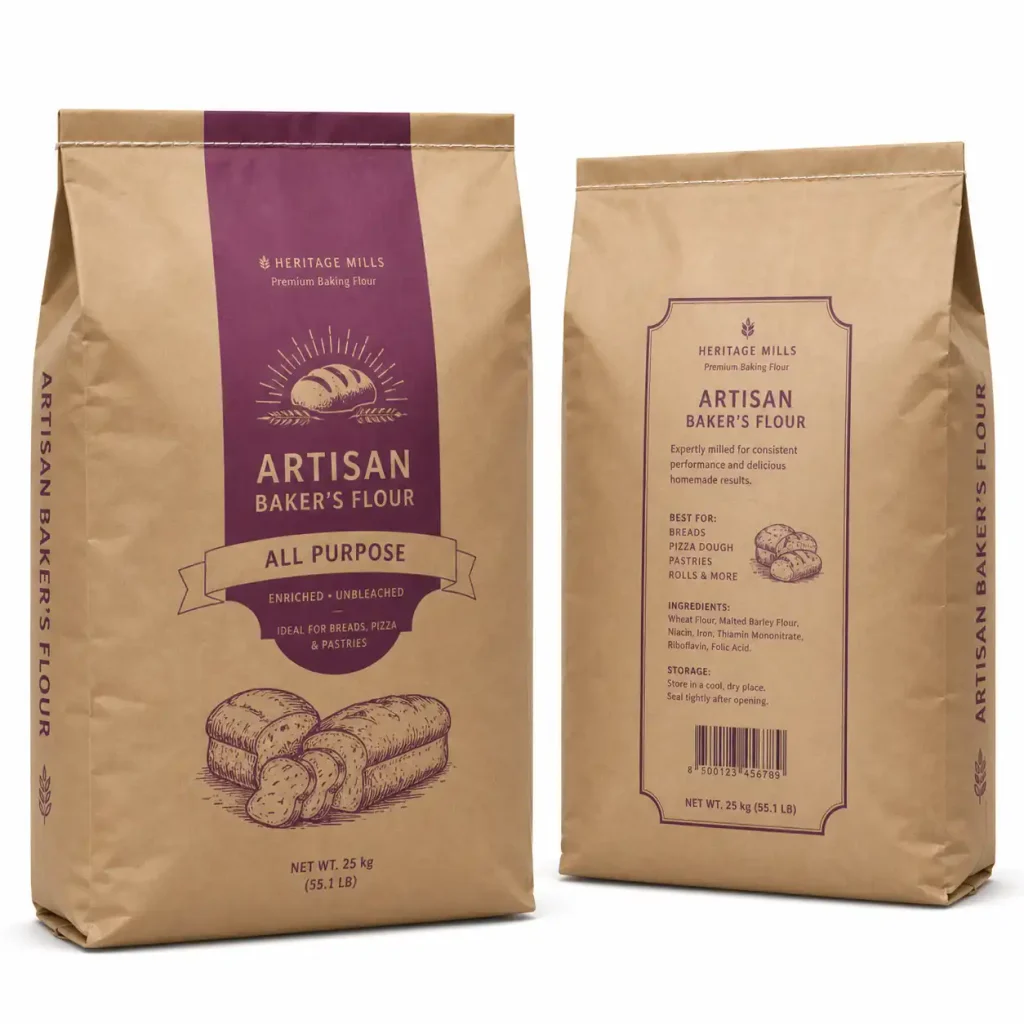
VIDEPAK Multiwall Paper Sacks: A Practical Guide to Valve, Open Mouth, Block Bottom Designs and Choosing the Right Supplier
Industrial packaging has a simple job that becomes complicated very quickly: hold the product, protect the product, move the product, and work smoothly with the customer’s filling line. For powders, granules, food ingredients, feed, minerals, chemicals, cement-based materials, and other dry bulk products, multiwall paper sacks remain a highly practical answer because one package can combine strength, controlled air release, printing, different closure systems, and optional barrier layers. Industry definitions describe multiwall sacks as flexible containers made with more than one ply of paper or other protective material, while modern sack production uses different tube, bottom, closure, and ventilation designs according to the product being packed.
At VIDEPAK, we look at multiwall paper sacks as an engineered packaging system rather than a simple paper bag. The paper matters, but so does the geometry. The number of plies matters, but so does the filling method. A good valve can increase filling efficiency; a suitable open mouth design can make one production line far more flexible; a well-built block bottom can improve the shape of the filled package and the stability of the pallet. And behind all of these choices, the right supplier must translate a customer’s powder behavior, filling equipment, transport route, target pack weight, and branding needs into one workable specification.
The central idea: do not begin by asking, “How many layers should my bag have?” Begin by asking, “How will my product be filled, sealed, stacked, transported, stored, and opened?” The answer tells us whether your multiwall paper sacks should use a valve, an open mouth, a block bottom, a barrier layer, engineered ventilation, or a combination of these features.
VIDEPAK currently offers kraft paper sacks for heavy-duty packaging across a stated 2 kg to 60 kg range, with brown or white kraft, multi-ply construction, PE-coated options, optional liners, paper-plastic composite structures, and higher-barrier constructions available according to the application. Current VIDEPAK product information also lists pasted valve, pinch-bottom open mouth, satchel-bottom open mouth, and sewn open mouth configurations among the available opening systems.
Understanding Multiwall Paper Sacks as a Complete Packaging System
The word “multiwall” explains the basic structure: several paper plies work together instead of asking one heavy sheet to perform every task. In industrial sack production, the plies are formed into a tube and then converted according to the required bag style. Depending on the design, the factory may create a sewn end, a pasted end, a stepped end, a valve, a pasted block bottom, or another functional closure. Some structures are also perforated or made with porous sack paper so that displaced air can leave the package while a powder enters it.
VIDEPAK’s current kraft paper range includes multiwall structures commonly configured with two to five paper layers depending on the required strength, stiffness, filling behavior, and protection level. Brown unbleached and white bleached kraft options are available, while liner and coating choices can be added when moisture, fine-particle leakage, oxygen, odor, or light protection becomes more important. VIDEPAK also states that its kraft paper sack range covers applications from construction and chemicals to food and agriculture.
The Layer Logic Inside Multiwall Paper Sacks
A useful way to understand multiwall paper sacks is to give every layer a job. The outer paper is normally the communication surface: it carries the brand, product name, handling instructions, batch information, and other graphics. The middle plies contribute mechanical support and help distribute stress. The inner structure works with the packed product and with any required liner or coating. When additional moisture or contamination protection is required, a PE liner, coated layer, or other barrier structure can be incorporated rather than simply adding more paper.
Outer Ply
Supports printing, appearance, handling information, surface protection, and the first line of mechanical resistance in multiwall paper sacks.
Middle Plies
Build strength, stiffness, and tear resistance while helping the filled sack hold a predictable shape during stacking and transport.
Inner Structure
Can be designed for direct product contact or combined with coatings and liners according to moisture, hygiene, leakage, and sealing requirements.
More plies do not automatically mean a better bag. This is important. Modern sack kraft development has increased both strength and porosity over time, allowing packaging engineers to reduce unnecessary material while still supporting fast filling and reliable handling. Industry data published by the European sack-kraft sector reports substantial improvements in sack-paper strength and porosity over the last two decades, illustrating why specification should focus on measured performance rather than ply count alone.
These ranges are design starting points rather than a universal specification. A dense mineral and a light food powder may both use 25 kg multiwall paper sacks, yet they can require different dimensions, paper combinations, ventilation, and closures because their bulk density and air behavior are different. That is why VIDEPAK recommends matching the sack to the actual product and actual filling line before mass production. VIDEPAK’s published product specifications and customization options confirm that dimensions, material structure, bottom pattern, liners, opening type, and related features can be configured by project.
Packaging principle: strength without filling efficiency is incomplete; barrier without reliable sealing is incomplete; good printing without transport stability is incomplete. High-performing multiwall paper sacks bring all three together: product protection, production efficiency, and market presentation.
Sustainability also depends on structure, not slogans. Paper sacks made mainly from kraft fibre can fit established paper-recycling systems in many markets, but barrier components influence the final recycling route. Independent European laboratory work on representative kraft sacks found that several common sack structures were suitable for standard mill recycling, while a structure containing a thick plastic inner tube performed less favorably; the study concluded that reducing unnecessary plastic content improves recyclability. Local collection and recycling rules still need to be checked in the destination market.
Why the Valve Matters for Fast, Clean Powder Filling
A valve sack changes the filling process by moving product through a relatively small opening formed at one corner of the bag. Traditional paper valve constructions use an internal flap or sleeve, and the filled material helps the valve close after the bag leaves the filling spout. This architecture is particularly useful for dry, flowable powders because the body of the sack is already manufactured into its final basic shape before filling.
The business benefit is easy to understand: less post-fill handling. With a suitable valve, the packer inserts or places the filling spout into the opening, fills the sack, and releases it. Depending on the design, closure may rely on self-closing geometry, a tuck-in action, heat, or ultrasonic sealing. Industry guidance also emphasizes that sack-paper porosity and controlled air evacuation are important in high-speed powder packing because the air entering with the product must escape without creating an unstable “pillow” effect.
VIDEPAK currently lists paper insert, sonic sealing, tuck-in, and poly-lock among its main valve options. It also offers micro-perforation where controlled air release is needed and block bottom construction when filled-bag geometry and pallet efficiency are priorities.
Do not choose a valve by name alone. The important variables are filling-spout dimensions, powder fineness, bulk density, trapped air, target filling rate, dust-control requirement, and the desired final closure. A technically impressive valve that does not fit the packer is the wrong valve.
For cementitious powders, minerals, fine chemicals, and similar dry materials, a valve format can therefore simplify the relationship between filling, closing, and palletizing. For especially fine or sensitive powders, however, closure integrity deserves as much attention as filling speed. Better ventilation makes filling easier; tighter sealing makes containment stronger. These two needs can pull in different directions, so they should be engineered together rather than treated as separate purchasing decisions. Industry paper-sack guidance likewise links permeability, correct sack sizing, filling productivity, sealing, and pallet stability as parts of the same system.
When Open Mouth Packaging Gives Your Filling Line More Flexibility
An open mouth sack takes the opposite approach. Instead of filling through a small corner opening, the top of the bag remains substantially open during filling and is closed afterward. This simple difference can make open mouth packaging highly flexible for products and plants that use gravity filling, auger filling, net weighers, manual filling, or other systems built around a wide bag opening. Industry sack-manufacturing references describe sewn open mouth sacks as tubes that are factory closed at one end and left open at the other for filling and later closure.
VIDEPAK’s kraft paper portfolio includes several open mouth routes. Sewn open mouth bags are filled through the full top and then stitched. Pinch-bottom open mouth designs use a preformed factory bottom and a top that can be closed after filling, often through an adhesive or heat-activated pinch process. Satchel-bottom open mouth designs combine the wide filling access of an open mouth sack with a flatter base geometry.
Sewn Open Mouth
Easy-to-understand filling format. The bag is filled from the top and stitched closed afterward. It is a practical workhorse for many powders, granules, feed ingredients, agricultural products, and industrial materials.
Best question to ask: Is sewing already part of your filling line?
Pinch-Bottom Open Mouth
The factory-prepared bottom remains closed, while the top provides wide filling access. After filling, the top can be folded and sealed to produce a cleaner, more compact closure than a basic stitched seam.
Best question to ask: Do you need a sealed top rather than stitching?
Satchel-Bottom Open Mouth
Combines broad filling access with a flat-bottom style that can improve standing shape and stacking behavior.
Best question to ask: Is filled-bag geometry almost as important as filling flexibility?
Compared with a valve, the biggest strength of an open mouth format is access. Large particles, irregular granules, flakes, blends, and products that do not flow easily through a small filling spout may be easier to manage through an open mouth. It can also be attractive when a plant already owns sewing or top-sealing equipment and wants to avoid changing its complete packing system.
The trade-off is that filling and closure are two distinct stages. A valve format is often chosen to reduce post-fill handling on automated powder lines, whereas an open mouth format normally requires deliberate closing after the target weight has been reached. Neither is automatically better. The better design is the one that creates the fewest bottlenecks between the product hopper and the finished pallet.
How a Block Bottom Improves Shape, Stacking, and Presentation
A block bottom is a geometric feature, not a filling method. This distinction matters because buyers sometimes use “block bottom bag” and “valve bag” as though they mean exactly the same thing. They do not. A sack can combine a block bottom with a valve, while some open mouth structures can also use a flat, satchel-like base. In pasted paper sack manufacturing, folded panels are opened, formed, pasted, and closed to create the flat rectangular end that gives the filled package its characteristic brick-like shape.
Why does this matter? Because pallets prefer geometry. A loosely shaped package can bulge, rotate, or create uneven contact between layers. A well-filled block bottom sack is designed to create a more regular footprint, giving the logistics team a more predictable unit to stack. VIDEPAK specifically identifies pasted block bottom construction as an option intended to support upright form, pallet stability, cleaner stacking, and efficient use of space.
Think beyond the bag: a good block bottom is really a logistics feature. It can influence the shape leaving the packer, the pattern on the pallet, the stability inside the truck or container, the appearance in the warehouse, and the way the end user handles the sack.
However, geometry only works when it is filled correctly. If the sack is too large for the target weight, even a technically good block bottom may remain soft and under-filled. If it is too small, the package can become over-tight and place unnecessary stress on seams, pasted areas, and the valve. Correct dimensions therefore need to be calculated together with target weight and bulk density. Industry guidance similarly stresses correct sack sizing because a well-sized, well-sealed paper sack supports weight accuracy, stacking, transport, and final package appearance.
A block bottom can be especially attractive for building materials, specialty powders, food ingredients, pet and animal nutrition products, and chemical products where large pallet quantities must move efficiently. Yet the decision should still begin with the filling system. If your line is designed around a valve packer, the natural discussion is often a block bottom valve structure. If your line fills through an open mouth, then a suitable satchel-bottom or other stable-base open mouth design may achieve a similar logistics goal through different construction.
Choose Block Bottom for Shape
When a regular filled footprint, neat pallet pattern, and strong shelf or warehouse presentation are important.
Choose the Right Opening for Flow
Use a valve or open mouth according to product flow and filling equipment, then engineer the bottom around the selected system.
Size for the Filled Bag
Bag dimensions should reflect target weight and bulk density, not simply copy the dimensions of a previous package.
Choosing VIDEPAK as Your Supplier: From Specification to Stable Mass Production
The final keyword is the one that connects every other keyword: supplier. Buying multiwall paper sacks is not only a material-purchasing exercise. The supplier needs to understand the relationship between product behavior, bag structure, filling equipment, closing equipment, printing, pallet layout, transport conditions, and production repeatability.
VIDEPAK was established in Shanghai in 2008 and currently reports more than 500 employees, exports to more than 70 countries, and a broader industrial-bag production capability of hundreds of millions of units per year. For kraft paper sacks specifically, VIDEPAK states an annual production capacity of more than 300 million pieces; its current valve product information separately states annual production of more than 100 million valve bags across the broader valve portfolio. VIDEPAK also states that its quality-management system follows ISO 9001 and that relevant products are produced and tested with reference to international test standards according to specification.
Scale, however, is useful only when it produces repeatability. A serious supplier should be able to move from an initial idea such as “we need a stronger 25 kg paper bag” toward a measurable specification: product bulk density, filling system, target weight, dimensions, paper structure, barrier requirement, valve or open mouth design, block bottom or other bottom style, air-release requirement, closure method, artwork, pallet pattern, and test criteria. This is the difference between ordering a bag and developing a packaging system.
From Product Data to Approved Production
Product Data
Material type, particle size, bulk density, moisture sensitivity, dust behavior.
Filling System
Decide between valve and open mouth; confirm spout or filling-head dimensions.
Bag Engineering
Select plies, barrier, ventilation, dimensions, closure, and block bottom or other bottom.
Sample & Trial
Check filling, closure, shape, print, lifting, dropping, and pallet behavior.
Mass Production
Freeze the approved specification and control repeatability batch after batch.
Sampling is particularly important when changing the valve, switching from open mouth to valve, adding a liner, changing the number of paper plies, or moving to a block bottom. A dimensional difference that looks small on a drawing can become large on a high-speed packing machine. For this reason, VIDEPAK currently offers both reference samples and specification-based mock-up samples; its published information describes approximately ten business days for mock-up sample preparation and generally 15–25 business days for standard bulk orders, depending on order requirements. The stated minimum order quantity for a single specification is currently 10,000 pieces. These commercial parameters should be reconfirmed for each order because production planning and specification complexity can affect the final schedule.
Quality control should then follow the specification, not replace it. VIDEPAK states that raw materials are batch-sampled and that industrial packaging is tested according to applicable quality plans using recognized methods for characteristics such as dimensional tolerance and mechanical performance. The purpose is consistency: the first pallet and the last pallet should behave according to the same approved design.
A Better Question for Your Next Packaging Project
Do not ask only, “What is the price of your multiwall paper sacks?” Ask, “Which structure gives us the best total packing result?”
A cheaper bag that fills slowly is expensive. A strong bag that leaks through the closure is expensive. A beautiful bag that creates unstable pallets is expensive. A complex bag with more barrier than the product needs is also expensive.
The right VIDEPAK supplier solution connects the valve to the packer, the open mouth to the closing line, the block bottom to the pallet, and every layer of the multiwall paper sacks to a clear performance requirement.
That is the VIDEPAK approach to industrial paper packaging: specify what matters, test what matters, and avoid complexity that does not add value. For one customer, the answer may be simple sewn open mouth multiwall paper sacks. For another, it may be a high-speed block bottom valve design with engineered air release. A moisture-sensitive product may require an additional liner; a more recyclable design may benefit from reducing unnecessary non-paper material wherever product protection and regulations allow. The structure changes because the job changes.
As an industrial packaging supplier, VIDEPAK combines multi-ply kraft structures, multiple valve systems, open mouth formats, pasted block bottom options, barrier choices, customized printing, sampling, and large-scale manufacturing within one product-development process. Its current published kraft paper capacity exceeds 300 million sacks annually, while the company reports exports to more than 70 countries and production under an ISO 9001 quality-management framework.
Multiwall paper sacks are not merely layers of kraft paper. A valve is not merely a hole in a corner. An open mouth is not merely an unfinished top. A block bottom is not merely a different fold. And a supplier should not merely deliver bags. When these elements are engineered as one system, packaging can fill faster, close more reliably, stack more predictably, communicate the brand more clearly, and protect the product more efficiently from the packing plant to the final user. That is what a modern industrial sack is expected to do—and that is what VIDEPAK is built to help customers achieve.