
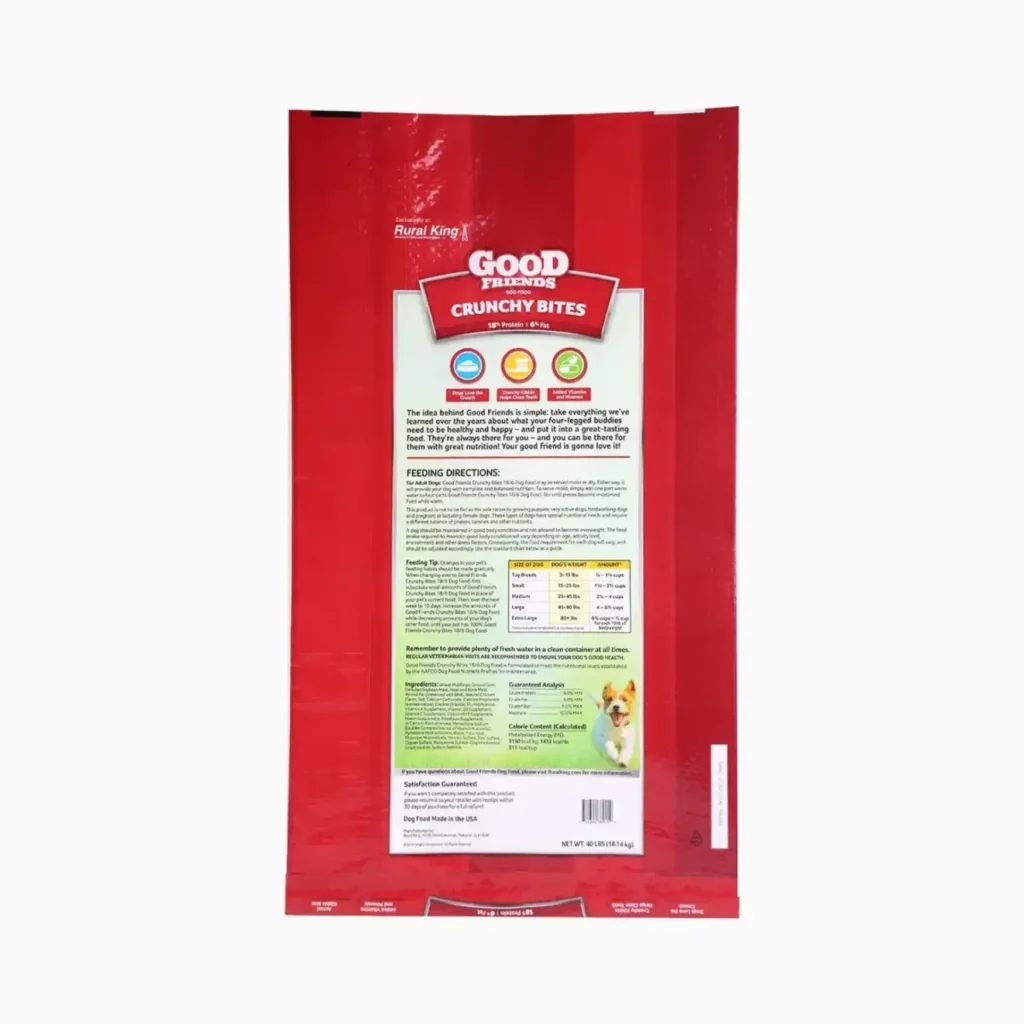
Product Guide: A Practical Packaging Partner for PP woven sacks, BOPP pp woven sacks, pp woven valve sacks, and laminated pp woven sacks
Industrial packaging has a simple job on paper: hold the product, protect the product, and move the product. In real supply chains, however, the job is much harder. A sack may have to survive high-speed filling, repeated lifting, pallet pressure, truck vibration, warehouse humidity, outdoor storage, long-distance shipping, and finally the customer’s first impression. Strength matters. Appearance matters. Filling efficiency matters. And increasingly, buyers want all three from the same packaging program.
That is why buyers evaluating PP woven sacks manufacturers should look beyond the bag itself and examine the complete packaging system: polypropylene fabric construction, fabric weight, lamination, printing, opening style, bottom structure, air release, anti-slip treatment, moisture protection, closing method, quality control, and the manufacturer’s ability to repeat the same specification from one production run to another. VIDEPAK’s PP woven sack platform is designed around this complete view of packaging rather than around a single standard bag. VIDEPAK states that its PP woven range is produced from virgin polypropylene and can be customized with different structures, coatings, liners, openings, bottoms, and functional treatments.
For customers choosing between ordinary woven packaging, BOPP pp woven sacks, automated pp woven valve sacks, and protective laminated pp woven sacks, there is no universal “best bag.” There is a best structure for a specific product, filling line, distribution environment, and brand position. A basic woven sack may place cost and strength first. A BOPP construction adds a premium printable face. A valve construction focuses on clean and efficient machine filling. Lamination adds another level of surface protection and containment. Different needs, different structures; one engineering logic.
VIDEPAK PACKAGING PRINCIPLE: Do not start with “Which bag is cheapest?” Start with “What must the bag survive?” Then define the fabric, coating, lamination, print, opening, closure, ventilation, and pallet performance around the real application. This approach helps buyers turn packaging from a commodity purchase into a controlled part of production and logistics.
What Buyers Should Expect from Professional PP woven sacks manufacturers
More Than Woven Fabric and a Sewing Line
Professional PP woven sacks manufacturers work with a material that is light but structurally efficient. Polypropylene tapes are formed and woven into fabric, creating a network that spreads load through two directions rather than relying on a single unsupported film. VIDEPAK describes its standard PP woven bags as being manufactured through extrusion, drawing, weaving, and bag-making operations, with high tensile strength, low package weight, corrosion resistance, and moisture-resistant characteristics among the key reasons woven polypropylene is widely used for industrial sacks.
Yet fabric is only the beginning. Different products behave differently during filling and transport. Rice flows differently from fertilizer. Animal feed is not handled like fine mineral powder. Granules may need fast filling but little dust control; fine powders may require controlled air evacuation and stronger sift resistance. As a result, capable PP woven sacks manufacturers need to control not only sack dimensions but also fabric weight, tape construction, coating or lamination, seams, valve geometry, perforation, gussets, surface friction, and sealing options.
VIDEPAK lists a broad working range for its standard PP woven sacks, including approximately 80–120 micron thickness, 80–150 GSM grammage, customizable dimensions with examples from 40 × 60 cm to 120 × 180 cm, and typical capacities from 5 kg to 50 kg. These figures are reference ranges rather than a rule for every project; the final construction should be matched to the packed material, target load, transport conditions, filling process, and required safety margin.
A Sack Is a System
Good PP woven sacks manufacturers coordinate four things at the same time: load performance, so the pack survives handling; product protection, so contents stay contained; filling compatibility, so the bag works with the customer’s process; and market presentation, so the package looks appropriate for the product inside. Reduce one problem without creating another. That is the goal.
Opening and Bottom Design Matter
VIDEPAK offers several opening formats, including sewn open mouth, valve opening, pinch-bottom open mouth, pasted open mouth, self-opening sack, gusseted open mouth, and other application-specific constructions. Its listed bottom options include folded and sewn bottoms, self-standing block bottoms, pinch-bottom sealed designs, and reinforced hemmed constructions. This breadth allows PP woven sacks manufacturers to move from “one sack for everything” toward packaging designed for a particular filling environment.
For example, an open-mouth sack offers simple access and works well where products are gravity filled before sewing. A block bottom improves the rectangular shape of the package, which can support cleaner pallet patterns. A valve design moves in another direction: the filling spout enters a smaller opening and the valve closes after filling, helping automate packaging operations. Neither approach is universally superior. One prioritizes flexibility; another prioritizes filling speed and cleaner closure.
The VIDEPAK PP Woven Sack Platform: Strength Before Decoration
The Fabric Carries the Product
The basic engineering idea behind woven polypropylene packaging is easy to understand: the woven fabric is the load-bearing skeleton. Printing, coating, lamination, liners, windows, valves, and special closures can be added around that skeleton according to the application. This is important when comparing PP woven sacks manufacturers, because two bags with similar dimensions can behave differently when their fabric weight, tape structure, lamination, seam design, or finishing method changes.
VIDEPAK identifies several available constructions within its PP woven range, including flat bags, gusseted bags, fold-over stitched structures, stitched structures with PE tape, heat-sealed tape structures, and block-bottom formats. It also offers anti-slip treatment, transparent windows, and different stitching arrangements. Such choices allow buyers to balance filling convenience, pallet performance, protection, visibility, and price instead of treating dimensions as the only purchasing specification.
VIDEPAK’s published specification ranges and construction options show why serious sourcing should start with a product data sheet rather than a price-per-piece comparison. A bag for 25 kg of light feed and a bag for 25 kg of dense granules carry the same printed weight but may not need the same dimensions, fabric construction, venting, or closure. The number on the sack is only one number. The packed product tells the rest of the story.
Protection Can Be Added Layer by Layer
Where basic woven fabric is sufficient, a simple woven sack can keep material use and conversion relatively straightforward. Where improved moisture control, powder containment, or surface quality is required, VIDEPAK can add coating, lamination, or an inner liner. Its range includes BOPP-laminated structures, paper-laminated constructions, waterproof configurations using PE layers, and PP woven bags incorporating PE liners. This modular approach is especially important for buyers of laminated pp woven sacks, because “laminated” is not a complete specification by itself. The laminate material, coverage, sealing method, base fabric, and end-use requirements still need to be defined.
Why BOPP pp woven sacks Combine Packaging Strength with Shelf Impact
Woven Strength Inside, Printable Film Outside
BOPP pp woven sacks begin with the mechanical support of woven polypropylene and add a biaxially oriented polypropylene film as the printable laminated face. VIDEPAK describes this construction as combining woven PP fabric with a BOPP film to achieve strong packaging performance together with improved printing, surface protection, and moisture resistance. The company lists common applications including animal feed, rice, sugar, pulses, seeds, fertilizer, sand, and cement.
This structure answers a problem that conventional industrial packaging often faces: the stronger the package looks, the more industrial it may feel; the more attractive it looks, the more buyers may worry about durability. BOPP pp woven sacks are designed to bridge that divide. The woven fabric works underneath. The printed surface works outside. One carries the load; the other carries the message.
Branding Is Not Only Decoration
For retail-facing fertilizer, premium grain, seed, animal nutrition, pet-related products, and other branded dry goods, the sack is often the largest visible communication surface around the product. BOPP pp woven sacks allow that surface to become cleaner, sharper, and more consistent while retaining the woven PP structure underneath. Protection sells reliability. Printing sells recognition. Used together, they can support both.
VIDEPAK Reference Specifications for BOPP pp woven sacks
VIDEPAK publishes a reference thickness of approximately 90–130 microns and grammage of approximately 100–180 GSM for its BOPP woven range, with customizable dimensions and target capacities generally optimized around 5–40 kg. The company also lists printing of up to 10 colors and options including flat or gusseted bodies, matte or glossy surfaces, micro-perforation, anti-slip treatment, transparent windows, different stitching formats, and block-bottom construction.
These options are not simply extras on a menu. They solve different problems. Micro-perforation can help when trapped air interferes with filling or pallet shape. Anti-slip treatment addresses package movement. A transparent window supports product visibility. A matte surface creates one visual impression; gloss creates another. The strength of BOPP pp woven sacks therefore lies not only in the BOPP layer itself, but in how the complete specification is engineered around the customer’s product. VIDEPAK lists each of these configurations within its current BOPP customization range.
How pp woven valve sacks Support Cleaner and Faster Filling
The Small Opening That Changes the Filling Process
The defining feature of pp woven valve sacks is a valve opening positioned at the corner of the package. During filling, the filling spout feeds material through this opening. After filling, the internal valve structure is designed to close under the pressure and geometry of the packed sack or to be secured by an additional sealing method, depending on the selected valve construction. VIDEPAK describes valve sacks as particularly suitable for powdered and granular materials and highlights flour, activated carbon, plastic granules, and cement among representative applications.
That difference may appear small, but on a packaging line it is fundamental. An open-mouth bag is open across most of its top before being closed. A valve bag limits filling to a controlled opening. This can reduce the need for a separate full-width sewing operation and can better support automated or semi-automated filling systems. VIDEPAK specifically positions the valve configuration for efficient filling and reduced leakage, while offering several valve constructions according to the product and filling line.
Micro-Perforation
Controlled perforation provides a route for air to escape where ventilation is required during filling. VIDEPAK lists this as an available valve-bag feature.
Block Bottom
A flat, rectangular bottom helps the filled package form a stable shape, supporting orderly stacking and efficient use of pallet space.
Valve Closure Options
VIDEPAK lists paper-insert, sonic-sealing, tuck-in, and polymer locking concepts among its valve options, allowing closure behavior to be matched with filling and distribution needs.
Choosing the Right Valve Construction
VIDEPAK describes paper-insert valves as a practical method for maintaining the valve opening during filling, while sonic-sealed structures are designed for consistent valve geometry and tighter closure. Tuck-in valves add a protective fold after filling, while a polymer-based locking structure can enhance closure under handling and movement. For purchasers comparing pp woven valve sacks, the question is therefore not simply “valve or no valve?” It is “which valve, for which powder, with which filler, at which line speed, under which dust-control requirement?”
This is where experienced PP woven sacks manufacturers add value. They translate production conditions into sack construction. Fine powder may require different air-release behavior from free-flowing granules. A fast filling line may need highly repeatable valve dimensions. A product that travels thousands of kilometers may need stronger closure security than a package moving directly from factory to a nearby warehouse. The bag has to follow the process—not fight it.
BUYER CHECKPOINT: Before requesting pp woven valve sacks, provide VIDEPAK with the packed material, bulk density, target net weight, filling-machine type, filling-spout dimensions, expected bags per hour, required air evacuation, closure preference, pallet pattern, and storage conditions. Better input creates a better specification.
VIDEPAK states that its valve-bag operations can provide paper valve, polypropylene valve, BOPP valve, and polyethylene-based alternatives, with annual valve-bag output exceeding 100 million pieces. For customers specifically sourcing pp woven valve sacks, this broader valve experience can be useful because the project can be evaluated as a filling-system problem rather than merely a fabric-conversion request.
When laminated pp woven sacks Are the Better Packaging Choice
Lamination Adds Function to the Woven Base
Ordinary woven PP fabric has tiny spaces between woven tapes. That structure is part of what makes woven packaging practical, but some applications require a more closed surface. Laminated pp woven sacks add a film or coating layer to the woven substrate, allowing buyers to improve surface continuity, moisture protection, powder containment, print quality, or a combination of these properties. VIDEPAK offers multiple laminated and lined variants, including BOPP-laminated sacks and PE-protected woven constructions.
However, laminated pp woven sacks should not automatically be specified for every product. If breathability is important, a completely closed structure may require designed perforation. If the packed material does not need a stronger moisture barrier or premium graphics, additional lamination may add cost without delivering enough value. Good packaging engineering is not about adding every feature. It is about adding the right feature and removing the unnecessary one.
Think in Layers, Not Labels
When discussing laminated pp woven sacks, define what each layer must do. The woven fabric carries load. Lamination can close the surface and improve protection. BOPP film can also become a high-quality printed face. An optional inner liner can provide another containment barrier. Each layer should have a reason to exist.
BOPP pp woven sacks Are Also a Form of laminated pp woven sacks
The terms overlap. BOPP pp woven sacks use BOPP film laminated to woven PP fabric, so they sit within the wider family of laminated pp woven sacks. The difference is specificity: “laminated” describes the addition of a layer, while “BOPP laminated” identifies the particular film and usually points toward stronger graphic presentation as well as surface protection. VIDEPAK’s product range reflects this distinction by presenting BOPP-laminated woven bags as a dedicated category while also offering other coated, lined, and laminated PP solutions.
For a fertilizer producer, the decision might be driven by moisture exposure and pallet stability. For a premium rice or animal-feed producer, the same technical requirements may sit beside another one: the package needs to look convincing at the point of sale. In such cases, BOPP pp woven sacks can combine the structural purpose of laminated pp woven sacks with a larger branding role. One structure protects the content; one surface tells the story.
Comparing BOPP pp woven sacks, pp woven valve sacks, and laminated pp woven sacks
Choose by Priority, Not by Product Name
Packaging categories can overlap. A valve sack can be laminated. A BOPP sack can use a valve. A laminated sack can have gussets, a block bottom, anti-slip treatment, or micro-perforation. This is precisely why purchasers should work with PP woven sacks manufacturers that can discuss the complete specification rather than forcing every project into a fixed catalog item. VIDEPAK lists valve openings among its woven and BOPP options and offers multiple bottom, lamination, printing, venting, and surface configurations.
The table should therefore be read as a selection guide, not as a set of rigid boundaries. VIDEPAK’s published portfolio allows several of these features to be combined, including BOPP lamination with valve openings, block bottoms, micro-perforation, anti-slip treatment, gussets, and different closure structures. The best package may belong to two or three categories at the same time.
From Product Requirement to Finished Sack
Weight, bulk density, filling method, logistics
Dimensions, weight, woven construction
Coating, BOPP, liner, ventilation
Graphics, mouth, valve, bottom, stitching
Specification and batch checks
Ready for filling, stacking, and distribution
VIDEPAK describes the core woven manufacturing route as extrusion and tape preparation followed by weaving and bag conversion, with additional lamination, printing, and finishing processes applied according to the required product. Its quality-control description includes raw-material checks and batch testing covering areas such as tensile performance, impact-related testing, and UV-weather resistance where relevant to the specification.
Specification Comes Before Quotation
This process explains why two quotations for visually similar sacks may not represent the same product. Fabric weight can differ. Lamination can differ. Printing complexity can differ. The bottom can differ. Valve technology can differ. Even perforation and anti-slip requirements can change production cost and bag performance. For purchasers comparing PP woven sacks manufacturers, price is meaningful only after the specification is aligned.
A useful request for quotation should therefore state the product, fill weight, dimensions, target fabric weight or an existing sample, coating or lamination requirement, printing artwork and color count, bag mouth, bottom construction, valve dimensions where applicable, liner requirements, perforation, anti-slip requirement, packing method, expected annual volume, and destination. With those details, the conversation becomes precise. Less guessing. Fewer revisions. Faster sampling.
Customization: Turning Standard Woven Packaging into a Product-Specific Solution
Design Around What Happens After the Bag Leaves the Factory
The true test of PP woven sacks manufacturers does not happen when an empty sack comes off the production line. It happens when the sack is filled, dropped, stacked, transported, stored, opened, and sometimes displayed. This is why VIDEPAK’s customization portfolio extends well beyond dimensions. Current options across its PP woven, BOPP, and valve ranges include gussets, several bottom structures, multiple mouth formats, micro-perforation, anti-slip treatment, windows, matte and glossy surfaces, PE protection, liners, and different valve closure concepts.
Consider pallet stability. A beautifully printed sack that slides during transport is not a successful package. Consider filling speed. A very strong sack that traps excessive air and interrupts an automated line may not be the right sack either. Consider moisture. A low-cost unlaminated construction may become expensive if the content suffers during storage. Good packaging is full of such contrasts: lighter but strong, protective but fillable, attractive but practical, economical but reliable.
For Agriculture & Animal Nutrition
Buyers can evaluate standard woven sacks, BOPP pp woven sacks, or laminated pp woven sacks according to moisture exposure, required print quality, storage time, stacking conditions, and whether consumers see the final package.
For Fertilizer & Chemicals
Containment, moisture protection, printing durability, pallet behavior, and product compatibility become major considerations. Where automated powder filling is central, pp woven valve sacks can be evaluated as part of the filling system.
For Building Materials
Rough handling and efficient filling can place greater focus on fabric construction, valve consistency, controlled air release, secure closure, and stack shape. pp woven valve sacks and reinforced laminated pp woven sacks can be configured around those priorities.
Sampling Reduces Uncertainty
VIDEPAK currently describes two sample routes: reference samples selected from existing production and custom mock-up samples manufactured according to requested dimensions, material, printing, and other specified features. The custom route is intended to replicate the planned sack more closely before mass production, while the reference route allows faster examination of general material and workmanship.
This step is especially valuable with BOPP pp woven sacks, where visual appearance matters, and with pp woven valve sacks, where the interface with filling equipment must be considered carefully. It is equally relevant to laminated pp woven sacks when buyers need to verify touch, rigidity, surface finish, closure, and overall package behavior. A drawing communicates dimensions. A sample communicates reality.
Why Buyers Choose VIDEPAK Among PP woven sacks manufacturers
One Supplier, Several Packaging Directions
For international buyers, the advantage of a broad woven packaging platform is flexibility. A company may start with simple PP woven sacks for one product, introduce laminated pp woven sacks where moisture protection becomes more important, move to BOPP pp woven sacks for a premium retail line, and specify pp woven valve sacks when a new automated filling system is installed. VIDEPAK’s published range covers each of these directions, allowing the specification to evolve without changing the basic sourcing logic.
VIDEPAK states that its PP woven manufacturing system uses virgin polypropylene, supports customized printing, size, thickness, bottom patterns, opening styles, coatings, and liners, and applies incoming-material and batch quality-control procedures. The company also reports large-scale output capability for both PP woven and valve-bag categories. These capabilities matter because dependable industrial packaging is built through repeatability: one strong bag is useful; millions of consistently specified bags are a supply solution.
A Practical Commercial Starting Point
VIDEPAK’s current product information lists a minimum order quantity of 10,000 pieces per specification for the relevant woven-bag ranges and gives a general reference lead time of approximately 15–25 business days for standard bulk orders, subject to order quantity and requirements. Custom mock-up samples are listed with a typical production lead time of around 10 business days before express transport. These are current reference terms and should be reconfirmed for each quotation, especially where printing, materials, special conversion, production scheduling, or destination requirements differ.
The VIDEPAK Difference Is in the Specification
For buyers searching for PP woven sacks manufacturers, VIDEPAK offers more than one woven sack format. The product family extends from cost-effective basic woven packaging to premium BOPP pp woven sacks, filling-oriented pp woven valve sacks, and protection-focused laminated pp woven sacks.
Strength where strength matters. Protection where protection matters. Branding where branding matters. Automation where automation matters. The objective is not to put every possible feature into every bag; it is to build the right bag around the product, the filling line, and the route to market.
When the requirement is straightforward, VIDEPAK can keep the structure straightforward. When the requirement becomes more demanding, the packaging can become more engineered: BOPP film for visual impact, lamination or liners for added protection, micro-perforation for air release, anti-slip treatment for more controlled stacking, block bottoms for package shape, valves for filling efficiency, and customized closures for the final distribution environment. These options are all represented across VIDEPAK’s current PP woven, BOPP, and valve-bag portfolio.
That is the practical standard by which professional PP woven sacks manufacturers should be judged. Not only by how a bag looks when empty, but by how it works when full. Not only by the cost of one sack, but by its contribution to filling efficiency, product protection, transport, pallet stability, and presentation. Not only by what can be produced today, but by whether the packaging platform can develop as the customer’s business develops.
From standard woven structures to high-impact BOPP pp woven sacks, from automation-ready pp woven valve sacks to application-specific laminated pp woven sacks, VIDEPAK approaches industrial packaging as a combination of material, structure, function, and market value. The sack is simple. The engineering behind the right sack is not. And when those details are controlled carefully, packaging does more than carry a product—it helps the product move safely, fill efficiently, stack confidently, and arrive ready for the next stage of its journey.
- Product Guide: A Practical Packaging Partner for PP woven sacks, BOPP pp woven sacks, pp woven valve sacks, and laminated pp woven sacks
- What Buyers Should Expect from Professional PP woven sacks manufacturers
- The VIDEPAK PP Woven Sack Platform: Strength Before Decoration
- Why BOPP pp woven sacks Combine Packaging Strength with Shelf Impact
- How pp woven valve sacks Support Cleaner and Faster Filling
- When laminated pp woven sacks Are the Better Packaging Choice
- Comparing BOPP pp woven sacks, pp woven valve sacks, and laminated pp woven sacks
- Customization: Turning Standard Woven Packaging into a Product-Specific Solution
- Why Buyers Choose VIDEPAK Among PP woven sacks manufacturers
- What are Woven Bag Manufacturers?
- References (packaging standards and domain sources)
What are Woven Bag Manufacturers?
Woven Bag Manufacturers are specialized converters that design and produce industrial sacks from polypropylene (PP) or polyethylene (PE) tapes woven into fabric and then finished into packaging for 5–50 kg (and beyond) applications. In commercial discourse they are also called PP woven bag factories, polypropylene sack producers, woven sack converters, BOPP‑laminated woven bag makers, or FIBC & small‑sack plants when they span both jumbo bags and retail‑adjacent sizes. Because procurement teams often search by capability rather than brand, Woven Bag Manufacturers are evaluated on fabric engineering, lamination/printing depth, QA systems, and logistics performance rather than on a single product SKU.
Sewn Open Mouth PP Bags
Premium sewn open mouth polypropylene woven bags manufactured with high strength and industrial-grade quality.
Check More →Laminated PP Woven Bags
Professional manufacturer of waterproof laminated PP woven bags with customizable printing and sizes.
Check More →PP Woven Valve Bags Manufacturer
Specialized manufacturing for durable PP woven valve bags ideal for automated filling systems.
Check More →Heavy-Duty Woven Bags Guide
Complete guide to heavy-duty PP woven bags produced by top manufacturers with enhanced load capacity.
Check More →Features you can reasonably expect from leading Woven Bag Manufacturers include high tensile strength (from oriented tapes), robust tear and puncture resistance, low tare weight, tunable breathability or barrier (via coatings, laminations, or inner liners), and high‑fidelity printing with finishes that change how a pack looks, runs, and stacks. A mature plant offers matte aesthetics, pearlescent (pearlized) glow, and anti‑slip surfaces; runs photo‑grade graphics; inserts EZ‑open tear tapes; and controls COF so the same bag can glide over a former yet grip its neighbor on a pallet.
How do Woven Bag Manufacturers actually make the bag? The production chain begins with resin drying and extrusion into thin films that are slit into tapes, then oriented for strength. Tapes are woven on circular or flat looms to create fabric (e.g., 70–120 g/m² for mainstream 25–50 kg sacks). If barrier and graphics are required, the fabric is laminated with PP/PE coating or with a printed BOPP film (15–25 μm). Next comes printing (flexographic or gravure up to 8–10 colors), converting (heat‑cut or hemmed mouth, single/double fold‑and‑sew bottom, optional block‑bottom), and QA (GSM, size tolerance, seam strength, COF, drop tests). Palletization, stretch‑wrap parameters, and traceability labels close the loop.
What are the bags for? The portfolios of Woven Bag Manufacturers typically cover rice & grains, flour & sugar, animal feed & pet food, fertilizers & seeds, salts & minerals, plastic resins & masterbatch, and construction materials. Where brand storytelling must coexist with forklift reality, woven sacks hold their ground—on docks, in depots, and on retail shelves.
If you’re surveying suppliers for BOPP‑laminated display quality, this overview page is a practical starting point: Woven Bag Manufacturers.
References (packaging standards and domain sources)
- FDA 21 CFR 177.1520 (Olefin Polymers); EU 10/2011 (Plastic materials and articles intended to come into contact with food).
- ISO 8295 / ASTM D1894 (Coefficient of friction—plastics film and sheet).
- ASTM D1709 (Dart impact), ASTM D882 / ISO 527 (Tensile properties of thin plastic sheeting).
- GS1 Digital Link standard and guidance on 2D barcodes for packaging; GS1 EPC Gen2 / ISO/IEC 18000‑63 for RAIN RFID.
- GB/T 8946‑2013 (General technical requirements of plastic woven sacks).
- Converter and film‑supplier technical notes on matte and pearlized BOPP, anti‑slip lacquers, and micro‑emboss textures for pallet friction.
- In‑plant QA logs correlating COF windows, varnish selection, and drop tests in high‑volume campaigns manufactured by Woven Bag Manufacturers.