
VIDEPAK PE Valve Bags: High-Performance Packaging for Clean Filling, Strong Protection, and Efficient Logistics
Industrial packaging must do more than hold a product. It must support the filling machine, protect the material, reduce dust, survive transport, stack well, display clear branding, and arrive ready for use. For powders, granules, minerals, chemicals, food ingredients, construction materials, and agricultural products, each weak point in a package can become a costly problem. A slow fill reduces output. Poor air release creates unstable bags. A weak seal causes leakage. A slippery surface creates an unsafe pallet.
VIDEPAK PE valve bags are developed to solve these connected problems as one complete packaging system. Made from engineered co-extruded PE film, each bag combines a controlled film structure with an accurately formed self-closing valve. The result is a flexible, durable, and practical package designed for high-speed filling, reliable moisture proof, effective dust control, and stable distribution.
VIDEPAK manufactures polyethylene packaging in structures of up to nine co-extruded layers. Standard production capabilities include widths from approximately 35 to 65 centimeters, film thicknesses from approximately 0.10 to 0.25 millimeters, customizable bag lengths, and printing in up to ten colors. Available design options include flat or gusseted sides, anti-slip treatment, embossing, micro-perforation, air-release features, heat sealing, and block bottom construction. Final dimensions and technical values are matched to the packed product, target weight, filling equipment, sealing method, and transport conditions.
Packaging principle: the best PE valve bags are not simply thicker bags. They are balanced bags. Film strength must support handling, the valve must match the filling spout, air must leave at the correct rate, the seal must protect the product, and the surface must support stable stacking.
What Are PE Valve Bags?
Valve-Based Filling in a Strong Polyethylene Structure
PE valve bags, also called polyethylene valve bags or PE valve sacks, are industrial bags with a valve opening positioned near one corner. During filling, the machine spout enters this opening and delivers the product directly into the bag. Once the target weight is reached and the bag leaves the spout, the internal valve sleeve folds, closes, or is sealed according to the selected design.
This arrangement makes valve sacks especially useful for controlled powder packaging. Unlike a wide open-mouth bag, the smaller valve opening limits the exposed filling area. Less open area can mean cleaner product transfer, fewer uncontrolled emissions, and a more organized working zone when the valve, filling pressure, air-release system, and machine settings are properly matched.
The valve is small, but its role is large. It guides the product. It controls the opening. It supports closure. It influences speed, cleanliness, leakage risk, and bag shape. A valve that is too narrow may restrict material flow; a valve that is too large may fit the spout poorly. A valve that closes too slowly may allow fine particles to escape, while a valve without enough internal support may deform during filling.
VIDEPAK therefore develops the self-closing valve as part of the complete bag rather than as an isolated component. Valve width, sleeve length, film stiffness, opening direction, sealing area, and compatibility with the filling nozzle can all be adjusted. Depending on the application, the closure may rely on product pressure, an internal locking structure, heat sealing, or sonic sealing. VIDEPAK also offers valve options such as polymer locking features, reinforced inserts, tuck-in structures, and sealable valve formats.
Multi-Layer Film Engineering
The performance of heavy-duty PE bags begins with the film. A single property cannot satisfy every requirement. A stiff film may travel smoothly through equipment but may not provide enough impact flexibility. A very soft film may resist impact yet lose its shape on the filling line. A high-friction outer surface may improve pallet stability but create drag inside the packaging machine. Film design is therefore an exercise in balance: stiffness and flexibility, strength and processability, grip and movement.
VIDEPAK uses multi-layer co-extrusion to combine different PE grades and functional layers in one continuous film structure. HDPE can contribute stiffness and dimensional support. LDPE can support flexibility, sealing, and processing. LLDPE can improve toughness, puncture performance, and resistance to sudden impact. The exact blend is selected according to bag size, fill weight, product density, drop conditions, valve design, and required sealing behavior.
Because the layers are created together during co-extrusion, the film can be engineered from the inside outward. The inner surface can be optimized for product contact and sealing. Core layers can support mechanical strength. The outside can be adjusted for printing, machine movement, pallet grip, or scuff resistance. VIDEPAK’s polyethylene packaging range uses up to nine-layer co-extrusion and is designed for heavy-duty loads above five kilograms.
Core Performance Advantages
Moisture, Impact, and Containment Performance
For many industrial products, water is not a small concern. It is the enemy. Cement-based powders may form lumps. fertilizers may cake. salts may absorb moisture. food ingredients may lose flowability. mineral powders may become difficult to discharge. In these applications, the low water absorption and water-resistant nature of polyethylene make polyethylene valve bags a practical foundation for moisture proof.
The continuous film body creates a strong external barrier against rain, humidity, splashes, and warehouse moisture when seams, valves, and perforations are correctly designed. This does not mean every configuration has the same barrier value. Perforation quantity, valve construction, film thickness, sealing quality, and package damage can all affect the final result. VIDEPAK therefore considers moisture proof at the system level: film body, side structure, bottom seal, valve, and optional ventilation pattern.
Toughness matters just as much as barrier performance. Bags may drop from conveyors, strike metal guides, rub against pallet edges, experience vibration in trucks, and carry concentrated loads when lifted by workers. Multi-layer film can distribute these stresses across complementary layers. The film does not need to be rigid like a box; it needs to bend without failing, stretch without opening, and absorb impact without losing containment.
For product qualification, tensile properties of thin plastic film can be evaluated with recognized film-test methods such as ASTM D882. The standard explains that tensile results are useful for material identification, characterization, and specification control, while also noting that specimen thickness, preparation, speed, and test conditions influence results. This is why VIDEPAK evaluates performance against the approved specification and intended use rather than promoting one isolated laboratory number.
Protect the Product
Moisture proof, strong seals, and puncture-resistant film help preserve product quality from filling to final use.
Protect the Process
High-speed filling, controlled deaeration, and a correctly sized valve help reduce interruptions and manual handling.
Protect the Workplace
Dust control and secure closure can support cleaner equipment, cleaner pallets, and more organized production areas.
Controlled Air Release for Fast, Stable Filling
When dry powder enters a bag quickly, it often carries air with it. That air must escape. If it remains trapped, the package can become inflated, unstable, slow to settle, and difficult to stack. Yet uncontrolled openings can release valuable product and create dust. Effective powder packaging must therefore allow air to leave while encouraging the product to remain inside.
VIDEPAK can add precisely distributed micro-perforation to selected PE valve bags. The holes are small, but their total number and position have a major effect. Too little venting may reduce filling speed and leave the bag swollen. Too much venting may weaken the barrier, increase leakage of very fine particles, or reduce moisture proof. The correct pattern depends on particle size, bulk density, moisture sensitivity, filling pressure, spout design, target rate, and dust-management equipment.
Air-release performance can also be supported through an engineered valve path or a dedicated air valve. VIDEPAK lists both micro-perforation and air-valve options for its polyethylene packaging. These functions can help the package settle faster after filling and form a flatter, more stable shape before palletizing.
The goal is not maximum ventilation. The goal is controlled ventilation. Fast enough for the line, limited enough for the product; open enough for air, closed enough for protection. This balance allows high-speed filling and dust control to work together rather than compete with each other.
Important: the final perforation design should be validated with the actual product and filling machine. Two powders with the same bag weight may behave very differently because particle size, trapped air, temperature, and bulk density are different.
Custom Structures and Functional Options
Bag Shape, Gussets, and Block Bottom Design
A successful package must fit the product before it can fit the pallet. VIDEPAK supplies both flat and M-gusseted constructions. A flat bag offers a simple format for products that settle evenly and do not require significant side expansion. A gusseted bag opens into a deeper three-dimensional shape, creating additional internal volume and helping the filled package develop more defined sides.
Correct geometry improves more than appearance. It affects fill weight, headspace, valve position, deaeration, pallet dimensions, and pressure on the seals. A bag that is too wide may become soft and rounded. A bag that is too narrow may become overfilled and hard. Excess length can create loose material at the ends; insufficient length can place unnecessary stress on the valve and bottom.
For customers seeking a squared presentation, VIDEPAK can produce a block bottom structure. A well-designed block bottom valve bag can stand more securely during handling and create a compact, brick-like package after the product settles. The flatter top and bottom can support orderly pallet layers, more efficient use of storage space, and improved presentation in warehouses or distribution centers. VIDEPAK identifies block bottom construction as an available option for polyethylene bags and as a method of improving upright stability and space efficiency.
Surface, Opening, Venting, and Sealing Options
The outside surface of industrial packaging bags must perform two opposite jobs. It must move through filling and converting equipment without excessive drag, yet it must also resist uncontrolled movement after palletizing. VIDEPAK can adjust surface treatment through embossing strips, anti-slip features, and other application-specific methods.
Anti-slip areas increase contact between adjacent bags and can reduce layer movement during internal transport or shipping. The treatment should still be matched to conveyor surfaces and automatic palletizing systems. Too little grip may create unstable loads; too much grip may interfere with bag separation or machine feeding. Once again, the best specification is not the strongest possible treatment. It is the treatment that works with the complete line.
Closure options are equally important. A standard self-closing valve may use the internal pressure of the packed product to flatten and close the sleeve. A polymer locking feature can strengthen this closing action. A tuck-in format protects the valve opening by folding it inward after filling. For fine powders, sensitive contents, demanding distribution, or customers seeking tighter containment, a sealable valve can be closed by heat sealing or sonic energy.
Heat sealing creates a fused closure without sewing holes. Seal temperature, pressure, contact time, contamination at the seal area, and film structure all influence seal quality. A strong seal begins before the sealing jaw closes: the valve dimensions must be correct, the sealing surface must remain clean, and the film must have an appropriate sealing window.
Applications Across Industrial Markets
Construction Materials, Minerals, and Chemicals
Construction products are among the most demanding applications for PE valve bags. Cement additives, dry mortar, grout, gypsum compounds, tile adhesive, putty powder, and similar materials may be dense, abrasive, fine, and sensitive to moisture. The package must fill quickly, release displaced air, resist puncture, contain dust, and stay stable after palletizing.
For these products, VIDEPAK can combine a tough co-extruded PE film with a precisely sized self-closing valve, selected micro-perforation, anti-slip surface treatment, and a stable bottom structure. Where outdoor loading or humid storage is possible, the configuration can place greater emphasis on moisture proof. Where the powder is extremely fine, the valve and perforation design can place greater emphasis on dust control.
Mineral products such as calcium carbonate, silica-based materials, pigments, clay, and other processed powders present similar challenges. Abrasive particles can stress the internal film surface, while high bulk density can place concentrated loads on the bottom and valve area. Material choice, bag dimensions, film orientation, seal strength, and drop performance should therefore be considered together.
Chemical powders and plastic granules may require clean containment, clear batch information, controlled static behavior, or special regulatory review. VIDEPAK can customize dimensions, film structure, printing, and closure according to the product data supplied by the customer. Compatibility must be evaluated for the specific chemical because polyethylene resistance varies with the substance, concentration, temperature, storage time, and mechanical stress.
Fertilizers, Food Ingredients, and Plastic Resins
Fertilizers often travel through humid ports, open loading zones, and long distribution networks. Many fertilizer grades can cake when exposed to moisture, while dense granules can challenge seals during drops and pallet movement. Moisture-resistant packaging, puncture performance, anti-slip treatment, and secure valve closure can therefore protect both product flow and commercial value.
For flour, starch, sugar-based ingredients, salt, feed additives, and other dry food-related products, cleanliness and product suitability are essential. Polyethylene valve bags can provide a smooth internal film surface and controlled closure, but food applications require more than a general bag description. Resin formulation, additives, inks, migration requirements, manufacturing hygiene, and local food-contact rules must be reviewed for the destination market. VIDEPAK develops the specification from the customer’s declared product and compliance requirements rather than assuming that one standard construction is suitable for every food use.
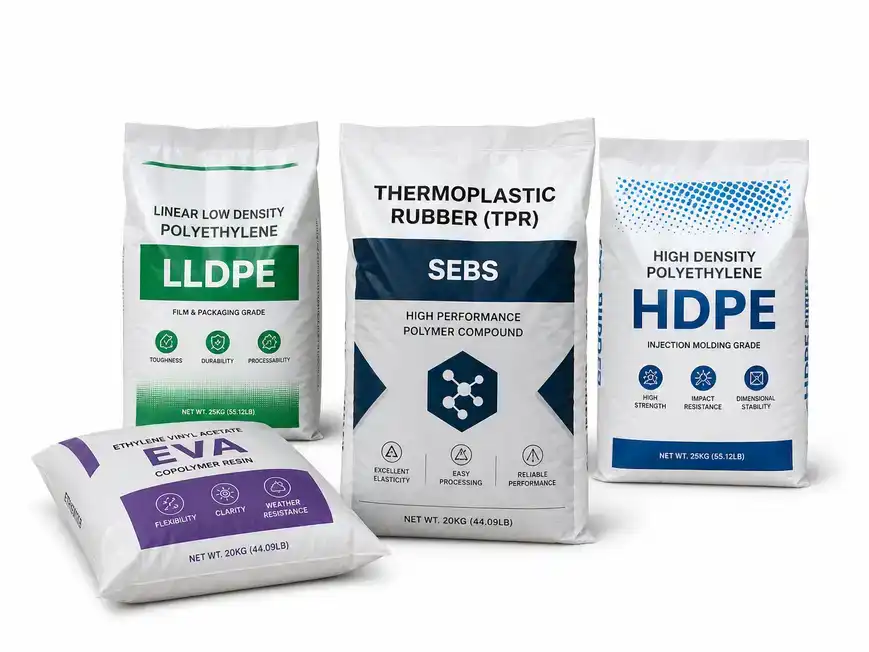
Plastic pellets and masterbatch materials benefit from fast filling, resistance to moisture, strong branding, and protection from contamination. Pellets generally release air more easily than fine powder, so the required perforation pattern may be reduced or removed. A tighter film structure can then improve barrier performance. For valuable masterbatch, specialty compounds, or light-sensitive materials, color, opacity, surface printing, and closure design can be adjusted.
This application-based approach is central to custom PE valve bags. VIDEPAK does not treat every 25-kilogram package as the same package. A 25-kilogram fine mineral, a 25-kilogram fertilizer, and a 25-kilogram resin pellet may have the same net weight, but they do not flow alike, release air alike, settle alike, or stress the film alike.
From Product Data to a Qualified Packaging System
A Practical Development and Filling Workflow
The performance of custom PE valve bags is decided before mass production begins. A technically useful inquiry should include the product name, particle form, bulk density, target net weight, filling temperature, filling speed, spout dimensions, current bag size, pallet pattern, storage conditions, transport route, and known problems with the existing package.
Bulk density is especially important because it converts weight into volume. Two products may both be packed at 20 kilograms, yet the lighter product may require much greater bag volume. Particle behavior also changes the process. Fine powder may retain air and leak through unsuitable perforations. Coarse granules may settle quickly but produce sharp pressure points. Warm products may change the film’s stiffness or sealing response.
Product Data
Weight, density, particle size, temperature
Line Review
Spout, output, valve position, sealing unit
Bag Design
Film, dimensions, valve, venting, surface
Sample Trial
Fill, seal, drop, stack, inspect
Mass Production
Approved specification and batch control
After the initial design, a sample trial connects laboratory planning with real production. The bag should be tested on the intended filler whenever possible. Operators should observe spout insertion, filling time, air release, bag inflation, weight control, valve closing, seal cleanliness, conveyor movement, pallet shape, and leakage after handling.
VIDEPAK offers reference samples for an early review of material and printing quality, as well as custom mock-up samples produced to the buyer’s requested dimensions, structure, and artwork. A custom sample is more suitable for functional trials because valve fit and package volume depend on the exact specification.
Quality Control That Connects Data with Real Use
Reliable industrial packaging requires repeatability. A successful trial is not enough if later production changes in width, thickness, valve position, sealing behavior, or surface friction. VIDEPAK states that its quality system uses virgin raw materials, incoming material inspection, defined production controls, and testing aligned with relevant ISO, ASTM, EN, and JIS requirements. Its published capabilities also include impact, tensile, and weather-resistance testing according to project needs.
ISO 9001:2015 remains the current published edition in August 2026, with a revised edition expected later in 2026. The standard provides a framework for establishing, maintaining, evaluating, and continually improving a quality-management system, with emphasis on controlled processes, customer requirements, performance evaluation, and corrective improvement.
For PE valve bags, practical inspection may include film thickness, bag width and length, valve dimensions, printing position, visual defects, seal appearance, tensile behavior, impact performance, leakage, drop resistance, and pallet trials. Not every project requires the same test plan. A bag for lightweight pellets may prioritize seal quality and contamination control, while a bag for dense minerals may require greater focus on impact, puncture, and bottom strength.
Commercial Value, Sustainability, and the VIDEPAK Advantage
Lower Total Packaging Cost Through Better Performance
The lowest bag price is not always the lowest packaging cost. A package influences product loss, filling-line output, cleaning time, labor, pallet stability, warehouse damage, transport claims, customer complaints, and brand confidence. A cheaper bag that leaks or slows the line may cost far more than its purchase-price saving.
VIDEPAK PE valve bags are designed around total performance. A correctly fitted valve can support fast spout engagement. Controlled venting can shorten settling time. A stable geometry can improve pallet formation. Strong film can reduce breakage. A reliable closure can reduce product loss. Clear printing can reduce identification errors. Each benefit may appear small by itself, but together they influence every filled bag, every pallet, and every shipment.
Material optimization can also reduce unnecessary packaging weight. The objective is not to make the thinnest possible bag; it is to develop the lightest structure that still satisfies filling, handling, drop, barrier, and transport requirements with an appropriate safety margin. Multi-layer co-extrusion supports this approach because different layers can perform different functions instead of asking one uniform material to do everything.
Responsible Design for Polyethylene Packaging
A polyethylene-based structure can support recycling-oriented design when the total package remains compatible with an accepted PE flexible-film stream. Current guidance from the Association of Plastic Recyclers treats PE film grades such as HDPE, MDPE, LDPE, and LLDPE as preferred components in PE mono-material flexible-film designs, while emphasizing that the whole package—including inks, adhesives, closures, and other features—must be evaluated. Its guidance uses more than 90 percent PE by weight as an important threshold for a PE mono-material flexible package.
Recyclability, however, is never created by material name alone. Local collection systems differ. Industrial bags may contain product residue. Dark colors, heavy ink coverage, incompatible attachments, and contamination may affect sorting or reprocessing. For this reason, environmental claims should be based on the final construction and the actual recovery system in the destination market.
VIDEPAK can support responsible packaging development through right-sized dimensions, optimized film thickness, PE-focused structures, controlled printing, and designs that avoid unnecessary components. The practical sequence is simple: protect the product first, reduce preventable damage second, optimize material third, and verify the available recovery route. A bag that saves a small amount of film but allows valuable product to be lost is not an effective sustainability solution.
Why Buyers Choose VIDEPAK
VIDEPAK was established in Shanghai in 2008 and produces a broad range of heavy-duty industrial packaging. The company reports more than 500 employees, exports to over 70 countries, operates extensive extrusion, weaving, lamination, and printing capacity, and manufactures polyethylene bags through advanced multi-layer film equipment. Its published polyethylene capability exceeds 500 million bags annually, while its broader industrial-bag capacity is designed to serve high-volume international programs.
Capacity is important, but technical communication is equally important. VIDEPAK combines specification development, sample preparation, printing control, film production, bag conversion, inspection, and export coordination. Customers receive more than an empty package. They receive a packaging solution developed around the product, machine, pallet, market, and supply chain.
For buyers who need cleaner powder packaging, dependable high-speed filling, stronger moisture proof, controlled dust control, stable pallet formation, and flexible branding, VIDEPAK PE valve bags provide a powerful platform. They are strong without being rigid, protective without being complex, and customizable without losing production efficiency.
The right bag is not simply a film tube with a valve. It is a measured relationship between material and machine, air and powder, seal and pressure, package and pallet. VIDEPAK develops that relationship through engineered co-extruded PE film, carefully designed self-closing valve systems, application-specific micro-perforation, dependable heat sealing, stable block bottom options, and disciplined quality control.
VIDEPAK PE valve bags help industrial products move faster, stay cleaner, travel safer, and arrive stronger. Better filling. Better protection. Better pallets. Better packaging performance from the first bag to the final shipment.
- VIDEPAK PE Valve Bags: High-Performance Packaging for Clean Filling, Strong Protection, and Efficient Logistics
- What Are PE Valve Bags?
- Core Performance Advantages
- Custom Structures and Functional Options
- Applications Across Industrial Markets
- From Product Data to a Qualified Packaging System
- Commercial Value, Sustainability, and the VIDEPAK Advantage
- What Are PE Valve Bags?
- Why Material Choice Matters: The Engineering Logic Behind PE Valve Bags
- Frequently Asked Questions About PE Valve Bags
What Are PE Valve Bags?
Definition & Aliases.
PE valve bags are industrial sacks manufactured from polyethylene films and designed with a self‑closing valve that enables rapid, dust‑controlled filling. In different markets you will also hear them called valve sacks, poly valve sacks, poly film valve bags, or simply poly valve packaging. The defining feature is the corner‑mounted valve sleeve—internal or external—that admits product under air or mechanical assistance and then seals by product pressure, heat, or ultrasonic weld, minimizing spillage and improving line hygiene.
Key Features.
Because the substrate is polyethylene (LDPE, LLDPE, or blends with MDPE/HDPE), PE valve bags combine high toughness with low water‑vapor permeability relative to uncoated paper. Typical benefits include moisture resistance, puncture and tear resistance, printability for high‑coverage branding, and compatibility with automated high‑speed filling lines. With appropriate film architecture (mono‑layer or co‑extruded), PE valve bags can be engineered for target metrics such as WVTR, dart impact, COF, and seal strength—critical properties for powders and granulates that degrade or cake when exposed to humidity.
Manufacturing Process.
The core process for PE valve bags is film extrusion followed by conversion. Resins specified by melt flow rate (ISO 1133‑1) are blended and extruded—either as blown film or cast film—into mono‑ or multi‑layer webs. Performance layers can include slip/anti‑block, puncture‑resistant cores, and sealing layers. After conditioning and corona treatment, webs are cut, folded, and side‑welded; a valve sleeve (often of compatible PE fabric or film) is inserted; and the bag is bottom‑welded or gusseted. Seal integrity is verified per ASTM F88, film tensile per ASTM D882, and dart impact per ASTM D1709; moisture barrier is characterized via ASTM F1249 or ISO 15106. Where customers require documented traceability, batches are marked with line, date, and reel identifiers for full genealogy.
Applications.
PE valve bags are used for cement and dry mortar, calcium carbonate and mineral fillers, fertilizer blends, plastic masterbatch, salt and sugar, seed and animal nutrition, powdered food ingredients, and diverse chemicals. In humid climates or in maritime logistics, the low WVTR of PE valve bags protects hygroscopic contents, reducing clumping and specification drift while enabling longer storage and fewer warranty claims.
Quick Link
Curious about formats, sizes, and form‑fill‑seal compatibility? See our product overview for PE valve bags.
China Leading PE Valve Bags Manufacturer
Professional manufacturer of high-performance PE valve bags for industrial packaging.
Check More →PE Valve Bags
Premium PE valve bags with reliable sealing and excellent durability for bulk packaging.
Check More →Heavy Duty Polyethylene Bags
Heavy-duty PE valve bags designed for heavy load industrial packaging applications.
Check More →Polyethylene FFS Film for 50kg
High-quality PE FFS film used for manufacturing durable PE valve bags.
Check More →Why Material Choice Matters: The Engineering Logic Behind PE Valve Bags
A bag is never just a bag. It is an engineered system that must balance handling strength, filling speed, powder containment, shelf appeal, and end‑of‑life pathways. PE valve bags excel when moisture control, impact robustness, and automated sealing are non‑negotiable. Consider three pillars of performance:
- Barrier and Stability. For hygroscopic products—cement, tile adhesive, milk powder premixes—WVTR is destiny. Multi‑layer PE valve bags commonly achieve sub‑1 g/m²·24h WVTR (ASTM F1249, test‑condition dependent), which reduces caking and preserves workability. Paper sacks need coatings or liners to approach similar performance; those laminations complicate recycling.
- Mechanical Safety Margin. With tensile testing to ASTM D882 and free‑fall dart impact to ASTM D1709, PE valve bags can be tuned for drop‑resilience through the distribution chain. That margin matters not only for obvious hazards—forklift tines, sharp pallet corners—but for micro‑impacts during automated palletization.
- Process Efficiency. The valve architecture, when matched to the product’s aeration behavior, supports higher fill rates with lower dust emission. Smooth internal surfaces, engineered COF per ASTM D1894, and hermetic heat sealing keep lines clean and reduce post‑fill housekeeping.
Frequently Asked Questions About PE Valve Bags
Are PE valve bags food‑safe?
Food‑adjacent applications require compliant resins, inks, and process controls. Suppliers should furnish migration and compliance statements where applicable and demonstrate GMP.
Can PE valve bags be anti‑slip without chalky exteriors?
Yes. COF can be tuned through masterbatch and layer design while maintaining a clean, printable surface finish.
What about static in dusty environments?
Anti‑stat packages and grounding protocols reduce ignition risks; consult site EHS for combustible dust management.
Do PE valve bags work on my existing paper‑bag line?
Most valve fillers handle both with minor change parts. Validate with a factory trial; operators typically appreciate lower dust and easier sealing.
References
- ISO 527: Plastics — Determination of tensile properties.
- EN 13430: Packaging — Requirements for packaging recoverable by material recycling.
- ASTM D882: Standard Test Method for Tensile Properties of Thin Plastic Sheeting.
- ASTM F1249: Standard Test Method for Water Vapor Transmission Rate Through Plastic Film.
- Ellen MacArthur Foundation, “The New Plastics Economy.”