
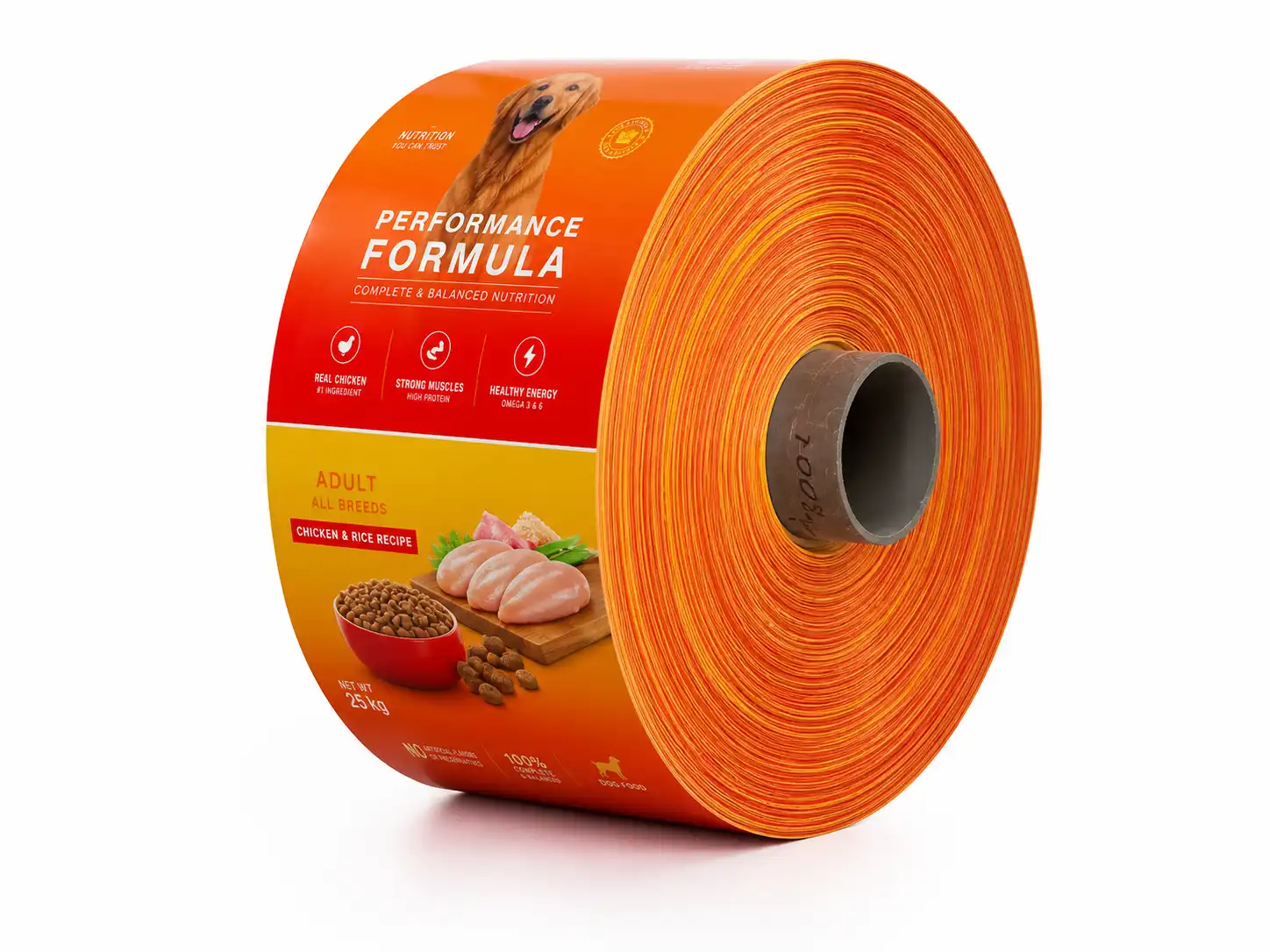
VIDEPAK Tubular Form Fill Seal Films: A Complete Packaging System for Fast, Clean, and Reliable Filling
Industrial packaging is judged twice: first on the filling line, and again after the bag has crossed warehouses, trucks, ports, and customer sites. A package that looks strong but runs poorly creates stoppages; a package that runs quickly but leaks, slides, or absorbs moisture creates claims. VIDEPAK tubular form fill seal films connect these two realities by bringing forming, filling, and sealing into one process while giving buyers control over structure, venting, friction, print, and pallet performance.
The central idea: the roll is not simply a supply of plastic. It is a working component of the packaging line. Well-designed tubular FFS films help the machine form a bag accurately, release trapped air, create a dependable seal, carry clear graphics, and build a stable pallet. One material, many jobs. One roll, one continuous rhythm.
VIDEPAK produces heavy-duty PE packaging through multi-layer co-extrusion and offers customized widths, thicknesses, roll formats, printing, gussets, surface treatments, and sealing options. Published VIDEPAK product information lists typical widths of 35–65 cm, thicknesses of 0.10–0.25 mm, roll diameters of 100–150 cm, printing up to 10 colors, and constructions of up to nine co-extruded layers; the final specification is selected for the product, bagging machine, filling speed, and transport route rather than copied from a generic catalogue.
Understanding Tubular Form Fill Seal Films
What the Film Does from Roll to Bag
Tubular form fill seal films are continuous tubes of polyethylene film supplied in roll form for automatic form-fill-seal equipment. The machine draws a measured length from the roll, closes the bottom, fills the product, seals the top, and cuts the finished bag. The next cycle begins immediately. This format reduces the need to handle stacks of empty pre-made sacks and can support a cleaner, more orderly filling area, especially for dusty powders and fast-moving granules. The operating logic follows the same core sequence described in VIDEPAK’s technical overview: form, fill, seal, repeat.
The word “tubular” matters. Because the web arrives as a tube, the package already has continuous sides or folds, depending on its geometry. The equipment creates cross seals rather than building every seam from separate sheets. Side gussets can add volume or produce a more rectangular filled shape, while machine settings can adjust bag length within print-repeat and equipment limits, allowing one approved polyethylene film platform to support related pack sizes.
This is why buyers should compare tubular FFS films as systems, not as price-per-kilogram commodities. Gauge matters, yet gauge alone does not describe toughness. Resin matters, yet resin alone does not describe sealing. Friction matters, yet one average friction value does not describe both machine travel and pallet grip. Good tubular form fill seal films balance these linked demands: smooth enough to move, strong enough to survive; open enough to vent, closed enough to protect; attractive enough to sell, practical enough to run.
Engineering Performance into Every Layer
Layer Structure, Toughness, and Seal Control
The performance of polyethylene film begins with its layer structure. A mono-layer design can be suitable for straightforward duties, while a co-extruded design allows different layers to perform different tasks. In a practical multi-layer structure, the outer surface may be tuned for print treatment, surface slip, and handling; the core may carry much of the puncture, impact, and stiffness requirement; and the inner surface may be tuned for heat sealing. The layers work together. The outside meets the machine and the market. The inside meets the product and the seal bar.
VIDEPAK can manufacture up to nine-layer co-extruded PE constructions, but more layers are not automatically better. The correct number is the number that solves the customer’s real problems without adding needless cost or complexity. For one product, the priority may be puncture resistance against angular granules. For another, it may be seal reliability when fine powder reaches the seal area. For a third, it may be stiffness and shape on the pallet. The value of multi-layer polyethylene film lies in placing performance where it is needed, not in chasing a layer count. VIDEPAK’s published product range confirms the availability of multi-layer co-extrusion, heavy-duty formats, gussets, heat sealing, and customized surface options.
Outer Layer
Supports print treatment, rub resistance, controlled slip, and a clean visual surface.
Core Layers
Carry toughness, puncture resistance, stiffness balance, and thickness stability.
Inner Layer
Supports seal initiation, hot-seal behavior, product contact needs, and leak control.
Seal design deserves special attention because the seal is made in real production, not in a perfect laboratory. Product dust may enter the top area. Line speed may change. Seal bars age. Ambient temperature can move. A useful seal layer therefore needs a practical operating window rather than one narrow “best” setting. ASTM F88 is widely used to evaluate seal strength in flexible barrier materials, while tensile, impact, tear, and friction behavior are covered by established film test methods such as ASTM D882, ASTM D1709, ASTM D1922, and ASTM D1894. These methods do not replace filled-bag trials, but they create a common language for specification and comparison.
Thickness should also be treated as a distribution, not only as an average. A nominal 140-micron polyethylene film is useful only when the profile across the web remains controlled and the weakest zones still meet the job. Uneven thickness can affect tracking, seal energy, print appearance, and drop performance. VIDEPAK’s typical heavy-duty range of 0.10–0.25 mm provides a broad starting window, but the final gauge should come from the filled weight, product shape, drop height, pallet pattern, route, climate, and acceptable failure risk.
Surface Design, Print, and Machine Interaction
A film surface carries two identities. It is a machine surface before filling and a brand surface after filling. For the machine, the web must unwind, guide, register, and seal without uncontrolled sticking or slipping. For the customer, the finished bag must present clear information, strong color, readable codes, and a professional appearance. VIDEPAK tubular FFS films can be printed in up to 10 colors according to the company’s published specification, giving industrial products room for brand blocks, handling icons, multilingual instructions, safety information, traceability fields, and product differentiation.
Print quality starts before ink touches the web. Surface treatment, flatness, thickness profile, artwork, and registration all matter. A smooth panel supports sharper graphics, correct treatment supports ink anchorage, and protected artwork reduces scuffing. The best-looking bag is not the one with the most ink; it is the one that remains clear after filling, stacking, shipping, and unloading. Strong blocks. Clean contrast. Useful information.
Design rule: separate functions whenever possible. Keep the main artwork panel smooth. Place high-friction features where bags contact one another. Place venting where trapped air can leave with the lowest product-loss risk. Give the seal area enough clean space. Functional zoning turns polyethylene film from a uniform tube into a planned packaging tool.
Controlling Friction and Air with Targeted Features
Embossing Strips and Micro-Perforation solve different problems, but both follow the same principle: modify only the area that needs modification. Instead of changing the entire surface, targeted features create zones of performance. This protects machine speed, print quality, moisture control, and cost while addressing the exact point where the package needs help.
Placed Friction
Embossing Strips add texture in selected lanes so filled bags can grip one another while the remaining web stays smoother for machine travel.
Placed Venting
Micro-Perforation adds controlled vent points in selected panels so trapped air can escape without turning the whole package into an open structure.
Embossing Strips are narrow textured bands formed on the film surface. Their purpose is not simply to make the bag feel rough. Their purpose is to create more grip where filled bags meet on the pallet. This distinction is important. If the entire polyethylene film surface has high friction, the roll may resist movement over machine parts, creating drag, wrinkles, or unstable feeding. If the entire surface is very slippery, the web may run well but finished bags may shift during palletizing or transport. Embossing Strips offer a middle path: glide on the line, grip in the stack.
The position and width of Embossing Strips should follow the pallet pattern and artwork plan. They are often placed away from the main print field so the graphics remain smooth and bright. One or more lanes can be considered depending on bag width, filled shape, stacking direction, and contact area. Their effectiveness should be checked through coefficient-of-friction testing and, more importantly, through filled-pallet trials. ASTM D1894 covers static and kinetic coefficients of friction for plastic film and sheeting, providing a recognized method for describing starting and sliding resistance under specified test conditions.
Micro-Perforation addresses trapped air. Powders and small particles can carry air into the package during filling. If that air cannot leave, the bag may balloon, settle slowly, push product toward the seal, or create an unstable shape. The first response should not be “add more holes.” The better response is to study how much air enters, how quickly it must leave, how sensitive the product is to humidity, how much dust can escape, and where the bag has a low-risk vent zone.
Properly planned Micro-Perforation uses small openings controlled by pattern, density, and position. Free-flowing granules may accept more venting than fine, dusty, moisture-sensitive powders; high-speed filling may require faster air release; humid storage may require less vent area or machine-side deaeration. VIDEPAK offers customized Micro-Perforation, while its technical analysis stresses matching vent design to product behavior rather than applying one pattern to every line.
Barrier performance can be measured rather than guessed. ISO 15106-3 describes an instrumental method for water-vapour transmission through plastic film, sheeting, and multilayer structures. Such testing is valuable when comparing unperforated structures or controlled vent designs, but the real decision must also include packaged-product trials because moisture pickup depends on the product, climate, storage time, pallet cover, and total package system.
From Resin Selection to a Stable Pallet
The quality of tubular form fill seal films is created through a chain of controlled decisions. Resin flow behavior affects extrusion. Extrusion affects layer balance and thickness. Thickness affects strength and sealing. Surface treatment affects print. Rewinding affects how the roll unwinds. Machine settings affect the final bag. No stage works alone. The process is a relay: each step must hand a stable result to the next.
| Product & Line Data | → | Film Recipe | → | Co-Extrusion |
| Printing & Features | → | Roll Conversion | → | Line & Pallet Validation |
The first input is not film. It is information. VIDEPAK needs product form, bulk density, target weight, filling temperature and speed, air and dust levels, moisture sensitivity, seal cleanliness, bag dimensions, gusset need, print repeat, machine configuration, roll limits, pallet pattern, climate, shipping method, and drop risk. A complete request leads to a complete polyethylene film specification.
Next comes resin and structure selection. Melt mass-flow rate is one established way to describe thermoplastic flow under specified temperature and load conditions; ISO 1133-1 defines procedures for determining melt mass-flow rate and melt volume-flow rate. This does not tell the whole performance story, but it helps control raw-material and process consistency. The selected blend is then extruded into a tubular web, with layer ratios, cooling, lay-flat width, and thickness profile monitored against the approved target.
After extrusion, the web can receive surface treatment, printing, gussets, Embossing Strips, Micro-Perforation, or other agreed features. It is then rewound to the required roll diameter and core format. Rewinding quality matters because a roll that is too loose, too hard, telescoped, or uneven can undermine an otherwise strong film. The finished roll must be easy to load, stable to store, and predictable to unwind.
Testing connects design to evidence. ASTM D882 addresses tensile properties of thin plastic sheeting; ASTM D1709 measures impact failure under a falling dart; ASTM D1922 provides a controlled index of tear propagation; ASTM D1894 measures static and kinetic friction; ISO 15106-3 addresses water-vapour transmission; and seal testing should be matched to the actual package and customer requirement. These tests are useful because they separate important properties, but the final judgment belongs to the complete pack. A film sample can pass a tensile test and still fail at a dusty seal. A strong seal can still sit on a weak corner. Laboratory data guides the trial; the trial confirms the system.
Validation principle: test the filled bag, not only the empty film. Run the real product at the real speed. Check seal contamination, venting, bag shape, weight control, drop survival, pallet stability, print rub, and roll change behavior. The strongest specification is the one proven under the customer’s own conditions.
Matching the Film to the Product and Market
Different products create different failure modes. Cement-like powders create dust and trapped air. Fertilizer granules can be dense, angular, and moisture-sensitive. Plastic resins flow freely but may require clean handling and clear identification. Mineral fillers can be fine and abrasive. Animal nutrition products may need strong hygiene controls and accurate declarations. A single standard polyethylene film cannot serve every duty equally well, which is why VIDEPAK develops tubular FFS films around application data.
For dusty powders, the design conversation starts with air and seals. Does the product fluidize? How long does it settle? Does dust reach the top seal? Could Micro-Perforation release air safely, or would it release dust and weaken moisture protection? The answer may be a selective vent zone, lower perforation density, an unperforated design using tubular form fill seal films with machine deaeration, or improved fill-spout control. The goal is not maximum venting. It is sufficient venting.
For dense granules, the priority often shifts toward impact, puncture, and pallet stability. Angular product can press against the bag during drops and vibration. A tougher core, balanced thickness, strong cross seals, and well-positioned Embossing Strips can work together. Here again, contrast creates performance: the polyethylene film should yield enough to absorb impact, yet hold enough shape to stack; it should grip neighboring bags, yet move freely through the bagger.
For branded industrial products, print becomes part of risk control as well as marketing. Clear product codes reduce picking errors. Clear handling marks support safer movement. Strong color blocks help operators distinguish similar grades. Scannable areas support traceability. VIDEPAK’s up-to-10-color capability gives buyers room to combine brand identity with practical communication, while careful placement keeps Embossing Strips and Micro-Perforation away from sensitive artwork or code zones where necessary.
Pack weight also changes the design. VIDEPAK positions its heavy-duty PE products for packages above 5 kg and reports large-scale annual PE bag output, but the suitable film for a 10 kg free-flowing pellet is not automatically suitable for a 25 kg abrasive powder. Greater weight may call for greater impact resistance, but simply adding gauge is not always the most efficient answer. A better layer balance, stronger seal design, improved bag geometry, or a reduced stress concentration may deliver more value than extra material alone.
VIDEPAK Specifications, Quality Logic, and Customer Value
VIDEPAK’s standard published range gives buyers a clear starting point: 35–65 cm width, 0.10–0.25 mm thickness, customizable length, 100–150 cm roll diameter, up to 10-color printing, flat or M-gusset formats, heat sealing, multi-layer co-extrusion, optional Embossing Strips, optional Micro-Perforation, and block-bottom-related options for selected finished bag formats. These are capability ranges, not a promise that every combination fits every line. The commercial advantage comes from choosing the right combination and locking it into a controlled specification.
A strong purchasing specification states more than dimensions. It identifies structure, tolerances, roll build, core, winding direction, print repeat, treatment, splice rules, gusset geometry, seal expectations, friction zones, Embossing Strips position, Micro-Perforation pattern, roll identification, sampling, test methods, and line-acceptance rules. Without these points, the buyer receives film. With them, the buyer receives a repeatable process input.
Quality management is the discipline that keeps this input stable across orders. VIDEPAK states that it works under ISO 9001:2015 and applies ASTM, JIS, EN, and ISO-related production and testing practices. ISO describes ISO 9001 as a framework for establishing, maintaining, and continually improving a quality management system, with emphasis on meeting customer expectations and controlling processes. For tubular FFS films, that logic translates into approved raw materials, defined production parameters, in-process checks, roll traceability, documented inspection, controlled changes, and feedback from trials and claims.
Why buyers choose a developed film instead of a generic roll
The purpose is not to buy more material. It is to remove uncertainty: uncertainty at the unwind, uncertainty at the seal, uncertainty in the stack, uncertainty in transit. VIDEPAK tubular form fill seal films are designed to turn product data and line data into a controlled package—measured where possible, tested where necessary, and refined where experience matters.
The commercial case is straightforward. Faster operation has little value if rejects rise. Lower gauge has little value if drop failures rise. More venting has little value if moisture enters. Higher friction has little value if the web stops. Better graphics have little value if the seal area becomes unstable. Effective tubular FFS films do not maximize one property; they balance the full set. That balance is the difference between a roll that merely fits the machine and a packaging system that supports the business.
For new projects, VIDEPAK can use product and equipment data to propose a structure, feature layout, samples, and line-validation plan. Existing projects can begin with the current problem: slipping pallets, ballooning, contaminated seals, punctures, poor print, unstable rolls, or excessive material. The problem defines the test. The test defines the change. The change defines the next trial.
In the end, tubular form fill seal films succeed through precision that customers can see and precision they never need to notice. They see sharp print, square stacks, clean seals, and intact deliveries. They do not see the layer ratios, friction balance, vent map, treatment level, thickness profile, and winding control working behind the result. That is as it should be. Good packaging is visible on the shelf and almost invisible on the line: no drama, no delay, no wasteful surprise.
VIDEPAK combines multi-layer polyethylene film engineering, customized Embossing Strips, calibrated Micro-Perforation, high-color printing, roll-format control, and application-based validation to create tubular FFS films for demanding industrial supply chains. Strong when dropped. Stable when stacked. Clean when sealed. Efficient when run. This is not simply film on a roll; it is a practical route from raw product to protected, branded, transport-ready package.
- VIDEPAK Tubular Form Fill Seal Films: A Complete Packaging System for Fast, Clean, and Reliable Filling
- Understanding Tubular Form Fill Seal Films
- Engineering Performance into Every Layer
- Controlling Friction and Air with Targeted Features
- From Resin Selection to a Stable Pallet
- Matching the Film to the Product and Market
- VIDEPAK Specifications, Quality Logic, and Customer Value
- Why Tubular FFS Films Matter to Modern Operations
- Engineering the Film: Anatomy and Options
- References for the Two Articles
Tubular FFS Films are continuous polyethylene film tubes supplied on rolls for automated form‑fill‑seal packaging lines. In day‑to‑day plant language they are also called tubular PE FFS rolls, heavy‑duty PE film sleeves, or simply FFS tubes. The defining idea is deceptively simple: the bag is formed, the product is filled, and the mouth is sealed in one uninterrupted motion from a single roll. Fewer touchpoints, fewer pre‑made sacks, fewer chances for dust or spillage—more control.
Features in plain terms. Because the substrate is polyethylene (LDPE/LLDPE/MDPE blends), Tubular FFS Films pair high toughness with low water‑vapor transmission. They can be engineered for puncture and tear resistance, tuned for surface friction, and printed in high coverage. Options such as localized embossing strips and calibrated micro‑perforations allow the web to run fast on rollers yet sit still on pallets, vent quickly during fill yet protect contents during storage.
How they are made. Resin grades specified by melt flow (ISO 1133‑1) are blended and extruded as blown film—mono‑layer or co‑extruded multi‑layer—then conditioned by corona treatment for print and seal performance. The film is folded into a lay‑flat tube, edge‑welded or left as seamless tubular, and rewound to customer widths. Where downstream equipment needs it, side gussets are introduced; valve‑ready headers or block‑bottom pre‑creases can be cut during conversion. Quality gates typically include tensile/elongation (ASTM D882), dart impact (ASTM D1709), tear (ASTM D1922), seal strength (ASTM F88), coefficient of friction (ASTM D1894), and moisture barrier (ASTM E96 or ISO 15106).
Where they are used. Tubular FFS Films serve powders and granulates across building materials (cement, dry mortar, tile adhesive), fertilizers and salts, plastic resins and masterbatch, mineral fillers, animal nutrition, and selected food ingredients. If the product is dusty, hygroscopic, abrasive—or all three—Tubular FFS Films are strong candidates because the package is created in‑line without manual handling of empty sacks.
Quick Link
Looking for sizes, options, and compatible machinery? See our overview of Tubular FFS Films.
Why Tubular FFS Films Matter to Modern Operations
Packaging is not merely a wrapper; it is a system. Tubular FFS Films sit at the heart of that system when throughput, hygiene, and consistency are non‑negotiable. What makes them compelling?
- A closed path from roll to sealed bag reduces airborne dust and off‑spec seals.
- On‑the‑fly bag length adjustment lets one roll address multiple SKU sizes.
- Mono‑material designs support recyclability targets while preserving performance.
The result is a calmer line, predictable OEE, and pallets that travel further with fewer claims.
Engineering the Film: Anatomy and Options
1) Layer Architecture
At the core of Tubular FFS Films is the layer stack. A common three‑layer design places a printable, low‑slip outer; a tough, puncture‑resistant core; and a seal‑friendly inner with a low seal‑initiation temperature. Metallocene‑LLDPE is frequently used for the seal layer; LLDPE/MDPE blends are popular for the core. By manipulating thickness distribution and resin chemistry, engineers can meet specific targets for dart impact, WVTR, and COF without overspending on raw material.
Rhetorical question. Do you design for rare accidents or daily wear? With Tubular FFS Films, the answer can be both: a robust core for drops and a forgiving inner for clean seals.
2) Embossing Strips (Friction Where You Want It)
Embossing is a localized, mechanical way to control friction. Narrow textured lanes—often 5–8 cm wide—are pressed into selected regions of Tubular FFS Films during conversion. The raised micro‑texture increases contact area exactly where pallets need stability, while the rest of the web remains smooth for low‑drag travel across rollers and forming shoulders. When placed outside the main artwork, embossing preserves print gloss and color fidelity.
Co-Extruded FFS HDPE Bags
High-quality co-extruded HDPE bags designed for tubular FFS packaging systems.
Check More →FFS Roll PE Film With Gussets
Premium PE roll films with gussets for efficient form fill seal packaging processes.
Check More →25kg Polyethylene Tubular FFS Films
Durable 25kg capacity tubular FFS films for industrial packaging applications.
Check More →Heavy Duty HDPE Bags With Venting
Heavy-duty vented HDPE bags compatible with automatic FFS film systems.
Check More →References for the Two Articles
- ISO 527 — Plastics: Determination of tensile properties.
- ASTM D882 — Tensile properties of thin plastic sheeting.
- ASTM D1709 — Standard test method for impact resistance of plastic film by the free‑falling dart method.
- ASTM D1922 — Propagation tear resistance of plastic film and sheeting (Elmendorf method).
- ASTM F88 — Seal strength of flexible barrier materials.
- ASTM D1894 — Static and kinetic coefficients of friction of plastic film and sheeting.
- ASTM E96 / ISO 15106 — Water vapor transmission rate through plastic films.
- ISO 1133‑1 — Plastics: Determination of melt mass‑flow rate (MFR).
- EN 13430 — Packaging: Requirements for packaging recoverable by material recycling.
- ISO 1183‑1 — Plastics: Methods for determining density.
- Ellen MacArthur Foundation — “The New Plastics Economy” (circular design principles for plastic packaging).
- Supplier and converter technical datasheets for heavy‑duty PE Tubular FFS Films (layer architecture, COF targets, and perforation/embossing options, accessible via industry platforms).