
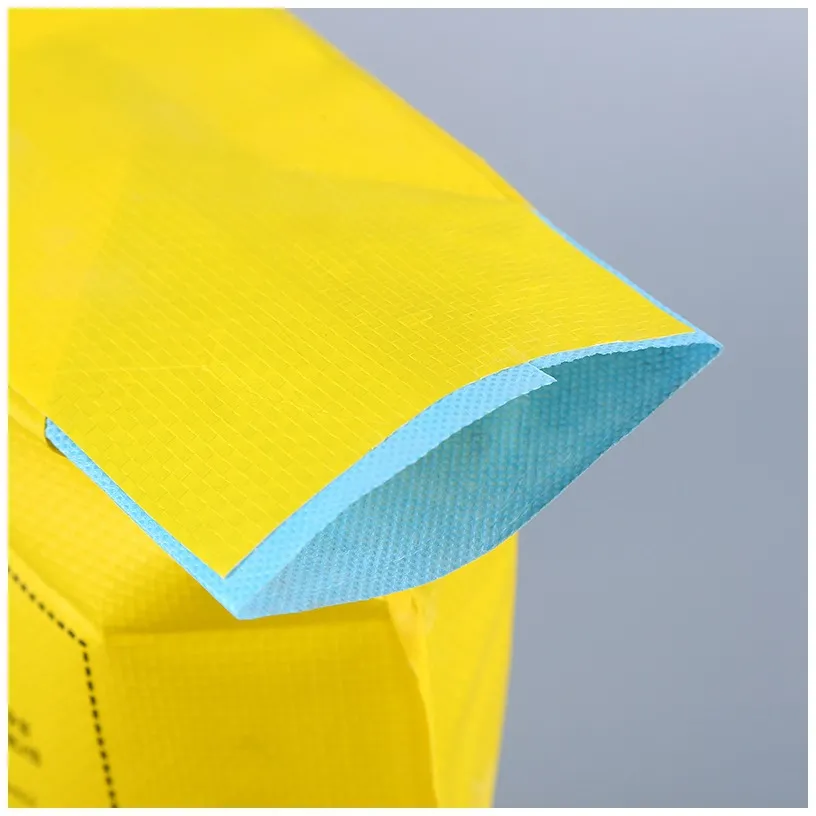
VIDEPAK Kraft Paper Laminated Woven Valve Bags: Strength, Clean Filling, and a Natural Paper Finish in One Industrial Package
Industrial packaging has to do more than hold a product. It has to survive filling pressure, control dust, move through conveyors, resist rough handling, stack well on a pallet, carry clear product information, and arrive in a condition that protects both the product and the brand. This is exactly where VIDEPAK kraft paper laminated woven valve bags create value: they combine the visual and handling qualities of kraft paper with the mechanical strength of woven polypropylene, then add an engineered valve system for efficient filling and controlled closure. VIDEPAK describes this product family as a composite structure built around a printable paper surface, a woven PP core, a laminated bond, and a purpose-designed filling opening.
The idea is simple, but the engineering is not. The outer surface must print well without losing its natural look. The woven core must carry the load without adding unnecessary weight. The laminate must keep the layers together through folding, filling, transport, and storage. The valve must accept the filling spout quickly, allow the product to enter with minimum interruption, support controlled air release, and close in a way that suits the customer’s actual equipment. In other words: paper for presentation, weave for strength, valve for speed. Each element has a different job, yet all of them must work as one system.
VIDEPAK PRODUCT IDEA: Kraft Paper Laminated Woven Valve Bags are designed for customers who do not want to choose between a strong industrial sack and a professional paper appearance. The woven structure carries. The kraft paper communicates. The valve keeps the filling process moving.
Why VIDEPAK Kraft Paper Laminated Woven Valve Bags Fit Modern Industrial Packaging
The market for dry powders, granules, minerals, construction materials, agricultural products, feed ingredients, salts, resins, and similar bulk products places several demands on a bag at the same time. A package may need a strong body but also a smooth filling cycle; moisture control but also enough air release during packing; a clear print surface but also enough friction for stable pallets. A single property is rarely enough. The useful package is the package that balances these properties. VIDEPAK’s approach to kraft paper laminated woven valve bags is therefore system-based rather than material-based: product behavior, particle size, bulk density, filling equipment, spout geometry, air release, transport conditions, storage climate, printing needs, and closure method should be considered together.
This is an important distinction. A heavier bag is not automatically a better bag. A stronger barrier is not automatically a better barrier. A larger valve is not automatically a faster valve. For example, increasing coating or liner performance may reduce air movement through the package; if venting is not adjusted at the same time, powder filling may slow and the filled bag may remain soft or swollen. Likewise, an opening that does not match the customer’s filling spout can create leakage, unstable docking, slower bag placement, or inconsistent closure. VIDEPAK’s own technical guidance therefore emphasizes matching the complete bag specification to the complete filling and distribution system.
Compared with conventional paper-only industrial sacks, kraft paper laminated woven bags add a woven polypropylene backbone that improves resistance to tearing and puncture during rough logistics. Compared with a standard woven sack without a paper face, the laminated kraft paper layer provides a different surface character: natural-looking, relatively low in glare, easy to identify, and well suited to clear industrial graphics and coding. Add a properly engineered valve, and kraft paper laminated woven valve bags move from being simply a strong sack to becoming part of the filling process itself.
Strength Layer
Oriented PP tapes are woven into the structural core of kraft paper laminated woven bags, helping the finished sack handle demanding industrial loads and rough distribution.
Brand Layer
The kraft paper face gives the bag a matte, industrial appearance while providing a useful surface for product names, instructions, barcodes, safety information, and brand graphics.
Filling Layer
A correctly specified valve connects the bag to the filling process, with internal, extended, reduced, tuck-in, self-closing, or sealable concepts selected according to the filling line.
The result is balance rather than excess. Strong, but not needlessly heavy. Protective, but still designed around filling speed. Natural in appearance, but supported by a technical woven structure underneath. For customers comparing industrial packaging formats, this balance is the central reason to consider VIDEPAK kraft paper laminated woven valve bags.
Inside the Product: Kraft Paper, Woven Structure, Lamination, and the Valve
The performance of kraft paper laminated woven valve bags is easier to understand when the package is separated into functional layers. The paper surface handles appearance, print, feel, and part of the sack stiffness. The woven PP fabric handles much of the mechanical load. The laminating layer bonds those two different materials together. The valve manages entry of the product and, depending on the chosen construction, contributes to sift control and final closure. Block-bottom geometry can then create a flatter, more rectangular package for pallet building. VIDEPAK’s published product guidance lists typical constructions using kraft paper in the approximately 70–120 g/m² range and woven PP fabric in roughly the 65–120 g/m² range, with actual values selected according to product weight and duty.
The Kraft Paper Face: More Than a Brown Surface
In kraft paper laminated woven bags, the kraft paper layer has an important commercial role. Natural brown kraft paper can create a direct, practical, material-led appearance, while white kraft paper can provide a cleaner background where color accuracy and contrast are more important. Smooth grades are useful where smaller text and fine graphics need clarity; more textured or ribbed grades can support a stronger industrial look and different handling characteristics. VIDEPAK’s published range for the paper layer is typically about 70–120 g/m², subject to the final bag design.
Printing is another reason customers choose kraft paper. Flexographic printing can place product names, logos, handling symbols, batch information, barcodes, instructions, and compliance text directly onto the paper face. VIDEPAK’s product guidance describes one- to six-color flexographic printing on the paper surface, while higher-detail film-faced variants can use reverse printing when a different graphic result is required. The main point is choice: kraft paper can deliver a simple industrial identity, a premium natural identity, or a controlled base for a more complex branded design.
Important material point: a kraft paper surface does not make a composite sack an all-paper package. Kraft paper laminated woven bags normally contain both fiber and polymer layers, so recycling, recovery, and disposal claims should be based on the complete construction and the real collection system in the customer’s market. VIDEPAK’s own technical guidance recommends evaluating the actual structure and local recovery route rather than treating appearance as proof of recyclability.
The Woven PP Core: The Hidden Load-Bearing Structure
If the paper is what customers see, the woven layer is what carries much of the mechanical work. Polypropylene resin is converted into tapes; the tapes are stretched to develop strength and then woven into fabric. The resulting network distributes stress in two directions and gives kraft paper laminated woven bags a structural character that is different from paper-only sacks. VIDEPAK lists typical woven fabric values of about 65–120 g/m², mesh ranges of approximately 7 × 7 to 14 × 14, and commonly referenced tape deniers around 700–1000D for demanding 25–50 kg applications. These are practical design ranges rather than universal fixed specifications.
This woven core is especially useful when bags face repeated lifting, conveyor contact, pallet edges, vibration, drops, and long distribution routes. A cut or local impact does not interact with a woven structure in the same way it interacts with a simple sheet. Yet woven strength must still be matched to coating, fold design, bottom construction, and filling conditions. A very strong fabric with a poor corner fold can still fail. A strong wall with an incorrectly positioned valve can still leak. Strength must travel through the whole structure, not stop at the fabric.
The bond between kraft paper and woven fabric is therefore critical. VIDEPAK describes extrusion lamination using a polyethylene-based tie layer as one common route, while adhesive lamination can also be used for selected structures. Published product ranges include PE extrusion coating or bonding weights around 18–30 g/m². During production, web tension, temperature, nip conditions, surface preparation, and alignment affect whether the two materials behave like one laminate through later cutting and folding.
The Valve: A Small Component with a Large Operational Role
The valve is the point where package design and filling equipment meet. In a typical industrial filling process, a horizontal filling spout enters the valve and transfers powder or granules into the bag. Depending on product behavior and machine type, filling can involve pneumatic pressure, impeller action, auger feeding, gravity assistance, or another controlled method. Once filling is complete, the valve must allow the bag to leave the machine cleanly and then close either through internal product pressure, manual action, or a dedicated sealing step.
For VIDEPAK kraft paper laminated woven valve bags, possible valve designs include internal sleeves, extended sleeves, reduced-length designs, tuck-in concepts, and sleeves prepared for ultrasonic or hot-air sealing. Internal designs can help control fine powders because the opening sits largely inside the body. Extended designs can make docking easier on some existing filling machines. Reduced designs can help control residual air when the body of the bag provides the required venting. Sealable sleeves can be used when the customer wants a more positive closure after filling. The correct valve is not the one with the longest list of features; it is the one that matches the product and filling line.
Fine powders make this particularly clear. During fast filling, product can carry significant entrained air. That air must leave. If it leaves too slowly, the pack may stay soft and filling time may rise; if the venting path is too open, fine material can escape. Micro-perforation patterns, material porosity, the valve structure, coating level, and product particle size therefore have to be tuned together. It is a deliberate contradiction: let air out, keep product in.
Technical Specification Choices for Kraft Paper Laminated Woven Bags and Valve Formats
A useful specification for kraft paper laminated woven bags starts with the product to be packed, not with an empty bag sample. What is the target net weight? What is the bulk density? Is the product a fine powder, a free-flowing granule, an abrasive mineral, or a moisture-sensitive ingredient? Does it carry much air during filling? Will the filled package travel through a humid coastal route, remain in covered domestic storage, or sit temporarily in an outdoor yard? Those questions determine more than the nominal dimensions. They influence fabric weight, kraft paper grade, coating, perforation, liner, valve design, surface friction, and closure method.
VIDEPAK publishes a broad working envelope for kraft paper laminated woven valve bags: nominal capacities commonly around 20–50 kg, body widths of roughly 350–610 mm, bag lengths of approximately 440–920 mm, and block-bottom widths around 90–180 mm. These figures should be treated as starting points, not as a universal size chart. Two products with the same net weight can have very different bulk densities; therefore, a 25 kg bag for one powder may require a very different volume and valve arrangement from a 25 kg bag for another product.
The same logic applies to barrier design. A customer should not add layers simply because more layers sound safer. For a relatively forgiving product moving through a short, dry route, the laminated body may provide the required balance without a separate inner liner. A hygroscopic material shipped through humid conditions may justify an additional PE liner or other controlled barrier solution. More sensitive products can require a higher-barrier construction. But higher barrier can change stiffness, venting, sealing, cost, and end-of-life options. Every added protection layer solves one problem while potentially creating another design question.
A BETTER RFQ STARTS WITH OPERATING DATA. For VIDEPAK kraft paper laminated woven valve bags, useful customer inputs include product name, net weight, bulk density, particle size, moisture sensitivity, filling method, filling spout dimensions, target speed, preferred valve closure, pallet pattern, storage climate, transport route, artwork requirement, and any applicable performance or compliance standard.
Printing durability deserves particular attention because kraft paper laminated woven bags are often handled many times before reaching the final user. ASTM D5264 provides a standardized approach for evaluating abrasion resistance of printed materials, while dimensional, visual, registration, and color controls can be defined within the approved artwork specification. In practical terms, the customer should identify the zones that face conveyors, pallet contact, or frequent manual handling, then specify print protection according to the real risk.
Mechanical validation should also match the final filled package rather than relying only on individual material numbers. ISO 23560:2015 specifies general characteristics, requirements, and test methods for woven polypropylene sacks used for 25 kg and 50 kg foodstuff applications, while ASTM D5276-19(2023) covers free-fall drop testing of loaded containers including bags and sacks. For paper-sack impact evaluation, ISO 7965-1:2024 defines a vertical impact test by dropping a filled paper sack. These standards illustrate an important procurement principle: test methods create a common language, but acceptance conditions still need to be agreed for the actual product, bag construction, fill weight, and distribution route.
Where a sealable valve or flexible liner is used, closure strength can also become a measurable process parameter. ASTM F88/F88M-23 addresses measurement of seal strength in flexible barrier materials and notes its use in process validation and control. Barrier-sensitive designs can use methods such as ASTM F1249 to measure water-vapor transmission through flexible barrier materials. These methods are valuable because they turn vague phrases such as “strong seal” or “good moisture resistance” into testable performance objectives.
From Resin and Kraft Paper to Filled Pallet: How the System Works
VIDEPAK kraft paper laminated woven valve bags begin long before the finished bag reaches a filling line. Polypropylene resin is first converted into flat tapes and stretched to develop the properties needed for weaving. Those tapes are then woven to the target fabric weight and mesh. Separately, the selected kraft paper is prepared as the outer face. The two webs are bonded through a controlled lamination process, printed according to the artwork plan, cut and folded, fitted with the required valve, converted into the chosen bag geometry, inspected, counted, and prepared for shipment. VIDEPAK describes this sequence as a controlled chain in which tape production, weaving, lamination, printing, conversion, valve integration, and quality checks all influence final performance.
| PP Resin Extrude and orient tapes | → | Weaving Create load-bearing fabric | → | Lamination Bond woven fabric to kraft paper |
| Printing Add brand and product information | → | Conversion Cut, fold and form the bag | → | Valve Integration Fit the selected valve system |
| Inspection Check dimensions, bond, print and closure | → | Customer Filling Dock, fill and release air | → | Closure & Pallet Close the valve, stack and ship |
At the customer’s plant, the process reverses the design logic. The empty bag is presented to the filler. The spout enters the valve. Product flows in while displaced air finds its engineered path out. The bag reaches target weight, leaves the filling station, and the valve either closes through its own internal action or receives the chosen manual or automated sealing step. The bag then needs to settle into a predictable shape for palletizing. Every upstream design decision now becomes visible: a few millimeters of valve mismatch can affect docking; inadequate air release can affect cycle time; excess residual air can affect pallet shape; inadequate surface friction can affect stack stability.
This is why VIDEPAK recommends trial-based specification development for demanding applications. The customer supplies product and filling-line information; the material stack and valve route are selected; samples are tested on the intended equipment; filling, closure, drop behavior, stacking, and transport conditions are reviewed; then the approved design becomes the repeatable control specification. “Same size” does not always mean same line behavior. “Same GSM” does not guarantee the same tape strength. “Same kraft paper color” does not guarantee the same print result. A good trial turns those uncertainties into defined parameters.
THE CORE ENGINEERING RULE: do not optimize the fabric, the kraft paper, the coating, the valve, or the pallet separately. Optimize the journey. Product in. Air out. Valve closed. Bag square. Print clear. Pallet stable.
Quality control follows the same system logic. Incoming materials can be checked for identity and relevant physical properties; in-process checks can cover fabric weight, dimensions, lamination condition, print registration, perforation position, bottom geometry, and valve placement; functional verification can include filling trials, closure checks, drop tests, abrasion checks, and barrier testing where needed. The objective is not to produce the largest possible inspection list. It is to control the characteristics that could stop the filling line, lose product, weaken the pallet, or damage customer confidence.
Where Kraft Paper Laminated Woven Valve Bags Deliver Value — and Why VIDEPAK
The strongest case for kraft paper laminated woven valve bags appears in products that combine demanding logistics with a need for efficient filling and professional presentation. Building materials are a clear example. Cement-like powders, dry mortar, gypsum, lime, tile-related dry mixes, mineral fillers, and similar products can be dense, dusty, abrasive, or air-laden during filling. Here, the woven structure supports mechanical durability, the laminated surface helps control the package environment, micro-perforation can be tuned for air release, and a properly matched internal or sealable valve can support a cleaner filling process.
Fertilizers, salts, soil amendments, and other granular products bring a different balance. They may flow more freely than fine construction powders but can require good moisture management and stable pallet behavior. An extended or appropriately dimensioned valve may suit certain filling systems, while a textured kraft paper surface or designed anti-slip treatment can help manage movement between bags. For long routes, the coating and optional liner should be selected according to actual humidity exposure rather than assumed from product category alone.
Feed ingredients, flour-type products, grains, sugar, and other dry food or agricultural materials can also be candidates for kraft paper laminated woven bags, but suitability depends on the complete contact structure, hygiene system, legal market, and product requirement. A package intended for a food-contact application should never be described as suitable merely because it uses PP or kraft paper; relevant contact layers, additives, inks, adhesives, production controls, and applicable declarations must be reviewed for the intended use. ISO 23560:2015 provides characteristics and test methods for woven PP sacks intended for 25 kg and 50 kg bulk foodstuffs such as cereals, sugar, and pulses, offering one technical reference point for woven-sack evaluation.
Engineering plastics, masterbatches, pigments, calcium carbonate, and other industrial powders illustrate another advantage of specification flexibility. Some products need mechanical protection above all else. Others are sensitive to moisture. Some require fast deaeration. Others need low dust escape. For these applications, VIDEPAK kraft paper laminated woven valve bags can be configured with different woven weights, coating levels, valve formats, perforation strategies, surface finishes, and optional inner barriers. One body, many possible specifications.
Behind these product options is VIDEPAK’s manufacturing platform. The company states that it was established in Shanghai in 2008, employs more than 500 people, supplies products to more than 70 countries, and operates more than 100 circular looms, 16 extrusion lines, and over 30 lamination and printing machines. VIDEPAK also states that its quality-management system follows ISO 9001:2015. For customers purchasing kraft paper laminated woven bags, that manufacturing depth matters because tape extrusion, weaving, lamination, printing, bag conversion, and multiple industrial sack formats can be evaluated within a broad packaging capability rather than viewed as isolated processes.
More importantly, manufacturing scale should support repeatability, not replace it. Buyers of kraft paper laminated woven valve bags need the approved kraft paper grade to remain controlled, the woven fabric to stay within the agreed construction, the lamination to remain stable, dimensions and artwork to match the approved drawing, and the valve position to remain compatible with the filling machine from batch to batch. That is why dimensional checks, material records, approved artwork, test results, retained samples, and traceability can matter as much as headline production capacity. VIDEPAK’s published quality approach places checks at incoming material, conversion, functional testing, distribution testing, and final release stages.
When should a buyer choose VIDEPAK kraft paper laminated woven valve bags?
Choose this product family when the packaging brief asks for several things at once: the mechanical confidence of woven PP, the natural presentation and print surface of kraft paper, the process efficiency of a properly engineered valve, configurable moisture and barrier performance, and a bag shape designed around filling, stacking, transport, and brand communication.
Kraft paper laminated woven bags solve one side of the equation: they combine a paper-facing layer with a woven core to balance appearance and physical durability. Add the filling system, and kraft paper laminated woven valve bags solve a larger problem. They become an interface between product and machine, machine and pallet, pallet and warehouse, warehouse and customer. The kraft paper gives the pack a face. The woven layer gives it a backbone. The valve gives it a controlled point of entry. The laminate makes those parts work together.
For VIDEPAK, this is the product’s real value proposition. Not one material against another. Not paper against plastic. Not appearance against performance. Instead: paper and weave, strength and presentation, filling speed and closure control. Properly specified kraft paper laminated woven valve bags are designed to fill efficiently, close cleanly, withstand demanding handling, form orderly pallets, and carry clear information through the supply chain. The best specification is therefore not the specification with the most layers or the highest individual number. It is the one in which the kraft paper, woven fabric, laminate, perforation, dimensions, valve, closure, print, and pallet behavior are matched to the customer’s real operating conditions.
VIDEPAK Kraft Paper Laminated Woven Valve Bags: a paper face for communication, a woven core for strength, a tuned valve for filling, and a specification built around the journey from packing line to final delivery.
- VIDEPAK Kraft Paper Laminated Woven Valve Bags: Strength, Clean Filling, and a Natural Paper Finish in One Industrial Package
- Why VIDEPAK Kraft Paper Laminated Woven Valve Bags Fit Modern Industrial Packaging
- Inside the Product: Kraft Paper, Woven Structure, Lamination, and the Valve
- Technical Specification Choices for Kraft Paper Laminated Woven Bags and Valve Formats
- From Resin and Kraft Paper to Filled Pallet: How the System Works
- Where Kraft Paper Laminated Woven Valve Bags Deliver Value — and Why VIDEPAK
- What Are Kraft Paper Laminated Woven Valve Bags?
- References
What Are Kraft Paper Laminated Woven Valve Bags?
What exactly are Kraft Paper Laminated Woven Valve Bags? In plain terms, they are heavy‑duty sacks that bond a printable kraft paper face to a woven polypropylene (PP) fabric core and integrate a purpose‑built valve for fast, clean filling. In trade catalogs and RFQs you will also see aliases like paper‑laminated woven valve sacks, kraft‑poly composite valve bags, paper‑laminated PP woven bags, block‑bottom valve sacks, and paper‑poly valve bags. Different labels, one platform: a paper exterior for matte optics and crisp coding, a woven backbone for tear strength, and a valve mouth engineered for speed.
The signature features of Kraft Paper Laminated Woven Valve Bags read like a checklist for plant managers and brand teams alike: high tensile‑to‑weight ratio; puncture and tear resistance that multi‑wall paper struggles to match; block‑bottom geometry that stacks like bricks; line‑ready valve configurations (internal, extended, reduced) that match ultrasonic or hot‑air closures; tunable barrier via PE extrusion coats, BOPP/VMPET film faces, or optional inner liners; anti‑slip outer textures for pallet stability; UV stabilizers for yard storage; and a kraft face that accepts flexographic or offset inks without glare.
How are Kraft Paper Laminated Woven Valve Bags made? The manufacturing process follows a disciplined sequence: PP resin is extruded into tapes and oriented for strength; tapes are woven into flat or circular fabric; kraft paper is bonded to the fabric by extrusion lamination (molten LDPE/LLDPE tie) or solventless PU adhesive; printing is applied on kraft (flexo/offset) or, when a film face is used, via reverse gravure beneath the film; the web is converted into block‑bottom form with hot‑air welded corners; the valve sleeve—heat‑sealed or co‑extruded to the mouth—is inserted; QA (seam strength, valve pull‑out, color, drop resistance) closes the loop.
Where do these bags work best? The uses are broad and practical: cement and dry mortar, gypsum and lime, fertilizers and soil amendments, salt, grains and flour, animal feed and pet food, sugar, engineering plastics and masterbatches, minerals, pigments, calcium carbonate, and construction chemicals. Whenever the product is free‑flowing, the route is rough, and the brand needs to be read at a glance, Kraft Paper Laminated Woven Valve Bags earn their place. For a quick overview of styles and sizes, see Kraft Paper Laminated Woven Valve Bags.
Kraft Paper Woven Bags Producer
Professional manufacturer of kraft paper laminated woven valve bags for industrial use.
Check More →PP Woven Valve Bags Manufacturer
Specialized in producing kraft paper laminated PP woven valve packaging bags.
Check More →Laminated Kraft Paper Sacks
High-strength laminated kraft paper woven valve bags with premium barrier properties.
Check More →Valve Bags & Valve Types
Complete guide to valve structures used in kraft paper laminated woven valve bags.
Check More →References
ISO 23560:2015 — Woven polypropylene sacks — Characteristics and test methods.
ISO 7965 / ASTM D5276 — Drop testing for filled sacks ≤50 kg.
ASTM D882 / ASTM D1709 — Tensile and dart impact for films used in valves/laminates.
ASTM D5264 — Sutherland Rub for print durability.
ASTM D3985 / ASTM F1249 — Oxygen and water‑vapor transmission for barrier liners.
ISO 12647 — Process control for CMYK printing (flexo/gravure variants).
TAPPI T 410 — Basis weight (grammage) of paper and paperboard.