
VIDEPAK Jumbo Bags: A Practical Guide to FIBC Types, Tops, Bottoms, Constructions, and Lifting Loops
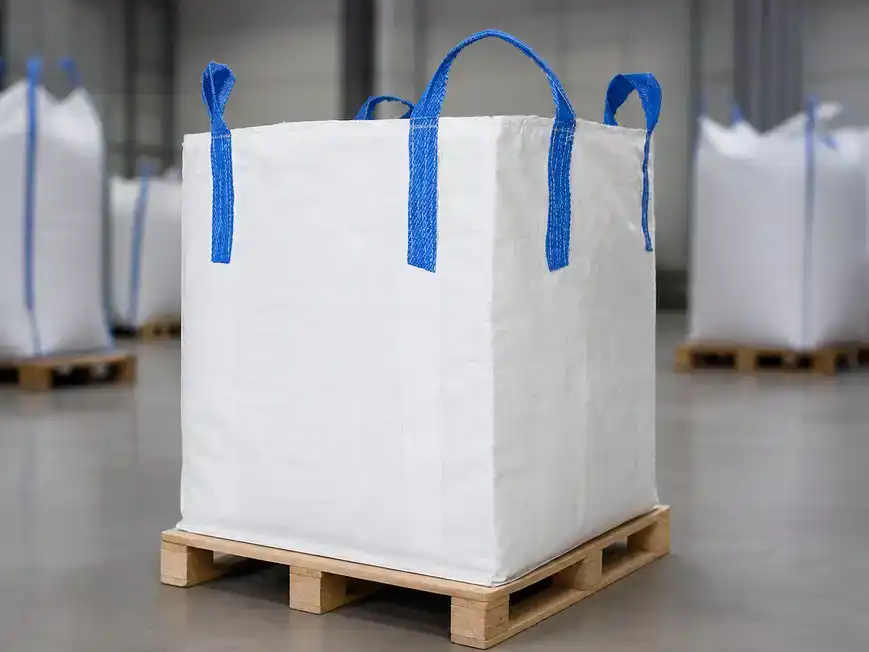
Bulk packaging looks simple until the material starts moving. A powder that flows easily during filling may create dust during discharge; a dense mineral may demand stronger lift geometry; a fine chemical may introduce electrostatic risk; and a bag that performs well on the filling line may still waste container space if its body expands too far after loading. This is why VIDEPAK approaches Jumbo Bags, also known as Flexible Intermediate Bulk Containers or FIBCs, as configurable material-handling systems rather than oversized sacks. The fabric carries the load, the top controls filling, the bottom controls discharge, the body controls shape, and the lifting loops connect the package to handling equipment. VIDEPAK’s public product information identifies Type A, Type B, Type C, and Type D electrostatic classes together with open, duffel, and Spout Top designs, multiple discharge systems, U-Panel, 4-Panel, Circular and Baffle constructions, and several lifting-loop configurations.
For project planning, VIDEPAK publishes FIBC working ranges that commonly cover approximately 500–2,000 kg of product, while other published VIDEPAK engineering references show fabric weights around 160–240 g/m² and customizable dimensions rather than one fixed universal specification. ISO 21898:2024 separately defines construction, design, type-testing and marking requirements for FIBCs intended for non-dangerous solid materials. The practical lesson is important: capacity, fabric weight, loop design, liner, inlet and outlet must be engineered as one package. Bigger is not automatically stronger; heavier is not automatically safer. Correctly matched is better.
VIDEPAK DESIGN PRINCIPLE: Specify Jumbo Bags from the process outward. Start with the material and its hazards, then select the electrostatic class, filling top, discharge bottom, body construction, liner and lifting system. One bag carries the product; a well-designed bag also controls the process.
Understanding Type A, Type B, Type C, and Type D
The letters A, B, C and D describe electrostatic behavior, not simply different strength grades. IEC 61340-4-4:2018 classifies FIBCs according to their construction, intended operation and electrostatic performance, because filling and emptying insulating powders can generate substantial electrical charge. The correct class therefore depends not only on what is inside the bag but also on whether combustible dust, gas or vapor may exist around the operation.
Type A — Straightforward Packaging for Non-Hazardous Electrostatic Conditions
Type A is the basic FIBC class. It is normally made from woven polypropylene without measures intended to control static-electricity build-up. That makes Type A practical for non-flammable solids handled in environments where an explosive atmosphere is not present. Typical examples may include many aggregates, minerals and other dry non-hazardous products. Type A should not be treated as an electrostatic-protective bag simply because polypropylene fabric is strong or because a liner has been added; IEC guidance states that a Type A FIBC remains Type A even when an inner liner is installed.
Type B — Low Breakdown Voltage Without Grounding
Type B uses a different safety principle. Like Type A, the fabric is not designed to continuously dissipate accumulated charge to earth. Instead, IEC 61340-4-4 defines Type B FIBCs as bags designed to prevent sparks and propagating brush discharges. For relevant combustible-dust applications, the standard specifies material breakdown voltage of no more than 6 kV; importantly, conductive material must not simply be added to a Type B structure because isolated conductive components can themselves produce an ignition hazard.
The operating boundary matters. IEC labeling for compliant Type B FIBCs states that they are permitted in dust Zones 21–22 where the minimum ignition energy, or MIE, is greater than 3 mJ. Type B is therefore useful for appropriately assessed dry combustible powders, but it is not the choice for a flammable gas or vapor atmosphere. It should never be selected by the shortcut “flammable product equals Type B.” The material, surrounding atmosphere, liner and full process risk need to be considered together.
Type C — Conductive and Groundable FIBC Design
Type C FIBCs are built around controlled grounding. Conductive threads, tapes or other conductive elements are incorporated into the bag structure and interconnected so that electrostatic charge can be transferred to earth. IEC 61340-4-4 requires a Type C FIBC to be connected to earth before filling or emptying starts and to remain properly earthed throughout these operations. For relevant applications, the resistance to the designated groundable point must be below 1.0 × 10⁸ ohms under the specified test method.
That grounding requirement is not optional housekeeping; it is part of the operating principle of Type C. IEC labeling permits compliant Type C FIBCs in dust Zones 21–22 and gas Zones 1–2 for applicable explosion groups IIA/IIB, subject to the standard and the complete risk assessment. Where Type C is specified, VIDEPAK can integrate conductive elements into the bag system, including appropriate lift-loop construction when required. IEC also requires lift loops attached to a Type C FIBC to be conductive or to contain conductive threads or tapes at specified spacing.
Type D — Static-Protective Performance Without FIBC Grounding
Type D takes another route. IEC defines Type D FIBCs as being made from static-protective fabric designed to prevent incendiary sparks, brush discharges and propagating brush discharges without requiring an earth connection from the FIBC itself. This can simplify operations where reliable bag grounding would be difficult, but “no bag grounding” does not mean “no electrostatic controls.” Conductive equipment and personnel still require appropriate earthing, and contamination can change electrical behavior.
IEC labeling specifies Type D use in dust Zones 21–22 and gas Zones 1–2, for explosion groups IIA/IIB where MIE is at least 0.14 mJ and charging current does not exceed 3 μA. In other words, Type C and Type D are not “good and better” versions of the same technology. They are different electrostatic strategies with different operating conditions. The correct choice begins with the actual plant environment.
| FIBC Type | Electrostatic Concept | Ground the FIBC? | Practical Selection Point |
|---|---|---|---|
| Type A | No electrostatic protection measures | No | Non-flammable material in non-explosive conditions |
| Type B | Prevents sparks and propagating brush discharges through low-breakdown-voltage construction | Normally no | Applicable combustible dust environments with MIE > 3 mJ; not flammable gas/vapor atmospheres |
| Type C | Interconnected conductive system transfers charge to earth | Yes | Hazardous powder handling where verified grounding can be maintained |
| Type D | Static-protective fabric controls incendiary discharge without bag earthing | No FIBC earthing | Qualified hazardous applications where the IEC operating envelope is satisfied |
STATIC-SAFETY CALLOUT: Never select Type A, Type B, Type C, or Type D from the product name alone. Inner liners, conductive contents, dust MIE, gas or vapor hazards, plant zoning, contamination and equipment grounding can all affect the safe-use decision. IEC 61340-4-4 explicitly states that compliance does not replace a full risk assessment.
Top Options: Controlling How Jumbo Bags Are Filled
The top is the first interface between the production line and the FIBC. VIDEPAK offers several top geometries because loader buckets, gravity chutes, screw feeders and enclosed powder-filling systems do not need the same opening. Open designs favor access and speed; spouted designs favor control and containment.
Open Top
Open Top is the simplest arrangement: the upper body remains open without a dedicated filling tube. It provides maximum access and works well where material is loaded by bucket, conveyor or broad chute and where a sealed top is not required. Coarse aggregates, recycling materials and other low-dust bulk solids are natural candidates. The advantage is simplicity. The trade-off is equally clear: an Open Top offers less control over airborne dust and outside contamination than a closed filling interface.
Duffel Top
A Duffel Top, sometimes called a duffle or skirt top, adds a large tubular fabric skirt around the upper opening. During filling it behaves almost like an Open Top, giving broad access; after filling, the skirt can be gathered and tied. This balance makes the design useful for grains, feed, granules and other products that need easy filling plus a practical closure, but do not require the tighter machine connection offered by a Spout Top.
Spout Top
A Spout Top places a cylindrical filling tube in the top panel. The tube can be matched to the customer’s filling chute, creating a more controlled product path and reducing open exposure around the filling point. For fine powders, pellets, cementitious materials, food ingredients and many chemical products, a Spout Top can improve housekeeping while providing a repeatable filling connection. After filling, the Spout Top is normally closed with its integrated tie or closure arrangement.
Spout Top with Flap
A Spout Top with Flap adds a protective fabric cover over the closed filling spout. Think of it as two stages: first control the fill through the Spout Top; then cover the closed inlet. The flap can add another physical barrier against dirt and handling exposure and can be useful where customers prefer an extra layer over the filling opening. The flap itself does not automatically make the bag moisture-proof or hermetic; coating, liner structure and closure design must also be specified when barrier performance is required.
Conical Spout Top
A Conical Spout Top changes the upper geometry from a flat top panel toward a funnel-like form. The cone guides incoming material toward the body and can support smoother filling when flow behavior, filling-head arrangement or usable top volume makes a conventional flat Spout Top less suitable. VIDEPAK can engineer the cone, inlet diameter and inlet length around the filling equipment rather than forcing the customer’s line to adapt to one catalog dimension.
FAST TOP-SELECTION RULE: Maximum access → Open Top. Broad access plus tie closure → Duffel Top. Controlled machine filling → Spout Top. Controlled filling plus an additional cover → Spout Top with Flap. Funnel-shaped entry geometry → Conical Spout Top.
Bottom Options: Designing the Discharge, Not Just the Container
A good FIBC must do two jobs well: hold the product securely and release it in the way the receiving process expects. VIDEPAK therefore treats the bottom as an operating component. A sealed base may be perfect for one-way dumping; a Discharge Spout Bottom can meter free-flowing product; a conical outlet can support more complete flow; and a full-opening bottom can release coarse material rapidly.
Flat Bottom
Flat Bottom is the simplest closed-base configuration. There is no integral discharge outlet. It is suitable when the FIBC is intended to remain closed until one-time emptying, when the bag will be tipped, or when an approved operation cuts the bottom for final discharge. Flat Bottom reduces closure complexity and can be economical, but it gives the operator little flow control once destructive opening begins. For repeated, metered or enclosed discharge, another bottom style is usually more practical.
Discharge Spout Bottom
The Discharge Spout Bottom is one of the most versatile choices for powders, grains, pellets and granules. A cylindrical outlet is sewn into the bottom center and secured during storage and transportation. At the receiving station, the outlet can be positioned over the hopper, untied and opened to establish a controlled product stream. Compared with cutting a Flat Bottom, a Discharge Spout Bottom offers better direction, less uncontrolled dumping and easier integration with industrial discharge frames. VIDEPAK’s published guidance cites a commonly used starting format around 14 inches in outlet diameter and roughly 18 inches in spout length, while broader VIDEPAK engineering guidance shows discharge outlets can be customized over much wider dimensional ranges.
The right Discharge Spout Bottom size depends strongly on product flow. A small outlet can improve dosing but may slow coarse granules; an oversized outlet may empty rapidly but provide less control. Density matters. Particle size matters. Cohesion matters. Receiving-equipment diameter matters. Therefore, the most effective Discharge Spout Bottom is not necessarily the largest outlet—it is the outlet matched to the product and the downstream machine.
Conical Discharge Spout
A Conical Discharge Spout introduces funnel-shaped bottom geometry that directs product toward the outlet. This is valuable where residual product in lower corners is undesirable or where the material does not naturally migrate toward a flat-bottom center outlet. Fine powders, products with moderate cohesion and applications that place a premium on more complete emptying can benefit from the conical geometry. The cone is not a cure for every flow problem, however; severe bridging or caking must also be addressed through outlet size, liner, vibration, conditioning and process design. VIDEPAK lists conical discharge among the options for difficult-flow applications.
Spout with Flap
Spout with Flap combines the controlled outlet concept with a secondary fabric panel. The flap remains closed over the discharge area during handling and is opened before the spout itself is released. This staged opening can add protection against accidental exposure of the tied discharge spout and creates a more deliberate unloading sequence. It is especially useful when buyers want the control of a Discharge Spout Bottom together with an additional external closure layer.
Duffle Bottom
Duffle Bottom, or fully open bottom, is designed for speed rather than fine metering. Instead of sending material through a relatively narrow outlet, a major portion of the base opens, allowing coarse or irregular product to leave quickly. This makes Duffle Bottom suitable for bulky, clumpy or large-particle materials that could discharge slowly through a conventional Discharge Spout Bottom. The contrast is simple: a spout controls the stream; a duffle bottom releases the load. Because the release can be rapid, the unloading station and operating procedure must be prepared for the flow rate.
Flap Bottom
Flap Bottom, often called a diaper-style bottom in the FIBC industry, uses an opening panel that can be untied or released to expose the base. It sits conceptually between a fixed Flat Bottom and a full Duffle Bottom: it allows quick access to a larger discharge area while retaining a defined closing panel. For some coarse materials and fast-discharge operations, this can reduce unloading time without requiring the narrow flow path of a standard Discharge Spout Bottom.
| Bottom Style | Flow Control | Discharge Speed | Best-Fit Logic |
|---|---|---|---|
| Flat Bottom | Low | Process dependent | Simple closed base and one-way discharge |
| Discharge Spout Bottom | High | Controlled | Powders, granules and pellets entering hoppers or process equipment |
| Conical Discharge Spout | High | Controlled | Reduce corner retention and guide difficult-flow material toward outlet |
| Spout with Flap | High | Controlled | Controlled outlet plus secondary exterior cover |
| Duffle Bottom | Low | Very fast | Coarse, bulky and irregular solids |
| Flap Bottom | Moderate | Fast | Large-area release using a defined opening panel |
Construction Styles: 4-Panel, U-Panel, Circular, and Baffle
The construction style determines how fabric panels transmit stress and how the bag behaves after filling. VIDEPAK offers 4-Panel, U-Panel, Circular and Baffle structures because freight efficiency, seam count, filled shape and product behavior are different from application to application.
4-Panel Construction
A 4-Panel FIBC uses four individual side panels joined together, plus a separate bottom. The four-sided geometry supports a relatively square filled footprint and provides broad printable faces. Because more vertical seams are involved than in a tubular body, seam engineering becomes an important part of the load path. For customers prioritizing predictable dimensions, stable presentation and conventional rectangular geometry, 4-Panel construction remains a versatile starting point.
U-Panel Construction
U-Panel construction uses one continuous piece of fabric to create the bottom and two opposite sides, while two additional panels complete the remaining sides. Fewer primary body pieces create a useful balance between shape retention, seam architecture and production efficiency. VIDEPAK identifies U-Panel as one of its standard customizable body styles, and it is well suited to many industrial powder and granule projects where buyers want a square-style bag without four separate side panels.
Circular Construction
Circular construction begins with tubular woven fabric forming the sidewall, minimizing vertical body seams. “Circular” describes the woven tube, not necessarily a perfectly round filled package. Once filled, the bag can still develop a roughly square footprint, although tubular bodies generally have more freedom to bulge than form-stabilized designs. Circular construction is attractive where low seam count, straightforward conversion and cost efficiency are more important than maximum cube retention.
Baffle Construction
Baffle construction adds internal fabric elements that connect the inner walls and restrain outward expansion. These internal baffles allow product to move through openings while holding the external body closer to a cube. The result can be better dimensional control, neater pallet geometry and more effective use of warehouse, truck and container space. A baffle is therefore not merely “extra fabric”; it changes the geometry of loaded Jumbo Bags. VIDEPAK can apply baffle concepts to suitable base constructions according to the application.
CONSTRUCTION IN ONE LINE: 4-Panel for defined panel geometry; U-Panel for a strong balance of shape and seam efficiency; Circular for tubular simplicity; Baffle for stronger cube retention and logistics-space control.
Lifting Loops: Where Bag Design Meets the Forklift or Crane
Lifting loops are structural load paths, not accessories added after the bag has been designed. They transmit the entire suspended payload from woven body to forklift, hook or lifting frame. VIDEPAK publicly offers four-loop, corner-loop, cross-corner and tunnel-style handling configurations, while its broader FIBC engineering guidance includes webbing widths around 50 mm for selected designs. In commercial FIBC procurement, approximately 30 cm of free loop height and 5 cm of webbing width is a widely encountered starting configuration, but it should not be treated as a universal standard dimension. Published patent literature specifically notes that conventional PP FIBC transport loops do not have one mandatory standardized length and width; attachment geometry must be adjusted to load requirements.
4 Corner Loops
4 Corner Loops place one lifting loop at each upper corner, usually connecting the webbing into reinforced seam or panel areas. This is the familiar four-point lifting arrangement for many Jumbo Bags. With suitable equipment, the four pickup points create balanced support and make the design easy to understand on the production floor. A reference specification of roughly 30 cm free height × 5 cm width is often practical, but loop length, webbing strength, sewn length and reinforcement must ultimately match SWL, bag height and lifting equipment. VIDEPAK identifies four corner loops as a standard handling option.
Cross-Corner Loops
Cross-Corner Loops are sewn across the corners rather than simply rising vertically from the corner seam. Their geometry makes the loop opening easier to present toward forklift tines and distributes the lifting connection over the adjacent body structure. They are particularly common with circular and other FIBC constructions where loop orientation and operator access are important. The specification should account for fork width, tine spacing and lifting angle; a loop that is structurally adequate but difficult for an operator to engage is not operationally optimized. VIDEPAK lists cross-corner construction within its lifting options.
Single Stevedore Strap
A Single Stevedore arrangement connects the primary loops through one larger secondary lifting strap. Instead of individually engaging all four primary loops, handling equipment can pick up the central stevedore strap. This can simplify particular crane, port or forklift workflows and allows a different lifting interface without changing the fundamental FIBC body. The strap, its connections and the primary loops still work as one structural system, so the complete assembly must be qualified for the intended load.
Double Stevedore Straps
Double Stevedore construction uses two secondary straps, commonly arranged through opposite primary loops. It creates two larger pickup interfaces and can help operators engage a loaded FIBC without individually positioning equipment through every corner loop. The choice between single and double stevedore arrangements should reflect handling direction, lifting frame, forklift access and loading sequence—not simply preference. VIDEPAK includes both stevedore concepts within its published overview of FIBC lifting configurations.
Sleeve or Tunnel Lift
A Sleeve or Tunnel Lift provides broad fabric channels or sleeves into which forklift tines can enter. This changes the handling experience substantially: instead of searching for individual flexible loops, the operator aims the forks toward defined tunnel openings. Tunnel systems can support fast repetitive handling where the forklift configuration is known in advance. The sleeve dimensions, spacing and reinforcement must therefore be matched carefully to actual fork geometry. VIDEPAK identifies tunnel lifting among its customizable options for Jumbo Bags.
| Loop Option | Handling Character | Key Specification Question |
|---|---|---|
| 4 Corner Loops | Conventional four-point lift | Can the operator easily engage all four loops? |
| Cross-Corner Loops | Accessible loop presentation across corners | Are loop angle and fork spacing compatible? |
| Single Stevedore | One secondary pickup interface | Is single-point-style engagement useful for the handling system? |
| Double Stevedore | Two secondary pickup interfaces | Does the equipment benefit from two broad engagement points? |
| Sleeve / Tunnel Lift | Forks enter defined channels | Are sleeve width and spacing engineered for the actual forklift? |
How to Build the Right VIDEPAK Jumbo Bags Specification
The strongest FIBC specification is built in sequence. First define what the bag carries. Then define where it operates. Then define how it fills, moves and empties. This sequence prevents a common procurement problem: choosing individual features that look correct on a datasheet but do not work together in the real process.
Material + Bulk Density + Flow
↓
Electrostatic Environment: A / Type B / Type C / Type D
↓
Top: Open / Duffel / Spout Top / Flap / Conical
↓
Bottom: Flat / Discharge Spout Bottom / Conical / Duffle / Flap
↓
Construction + Liner + Lifting System
↓
Confirm SWL, Safety, Dimensions, Testing and Handling
Reference Engineering Window
| Parameter | Useful VIDEPAK Project Reference | What Ultimately Determines It |
|---|---|---|
| Safe Working Load | Approximately 500–2,000 kg across published project ranges | Product density, construction, handling and validated design |
| Fabric Weight | Approximately 160–240 g/m² in published working ranges | SWL, dimensions, weave, coating and test performance |
| Body Construction | 4-Panel / U-Panel / Circular / Baffle | Filled shape, freight efficiency and process requirements |
| Loop Starting Point | About 30 cm free height × 5 cm width is a common commercial configuration | SWL, fork geometry, lift angle, webbing and sewn attachment |
| Top and Bottom | Spout Top, open, duffel and conical options; Flat Bottom, Discharge Spout Bottom, conical and full-opening options | Filling head, discharge station and product flow |
These figures should be treated as engineering starting points rather than a promise that every bag should use the same values. VIDEPAK’s published FIBC information repeatedly presents customization as central to the product family, while ISO 21898:2024 requires FIBC design and performance to be evaluated as a complete container.
Why VIDEPAK Jumbo Bags Are Built Around Manufacturing Control
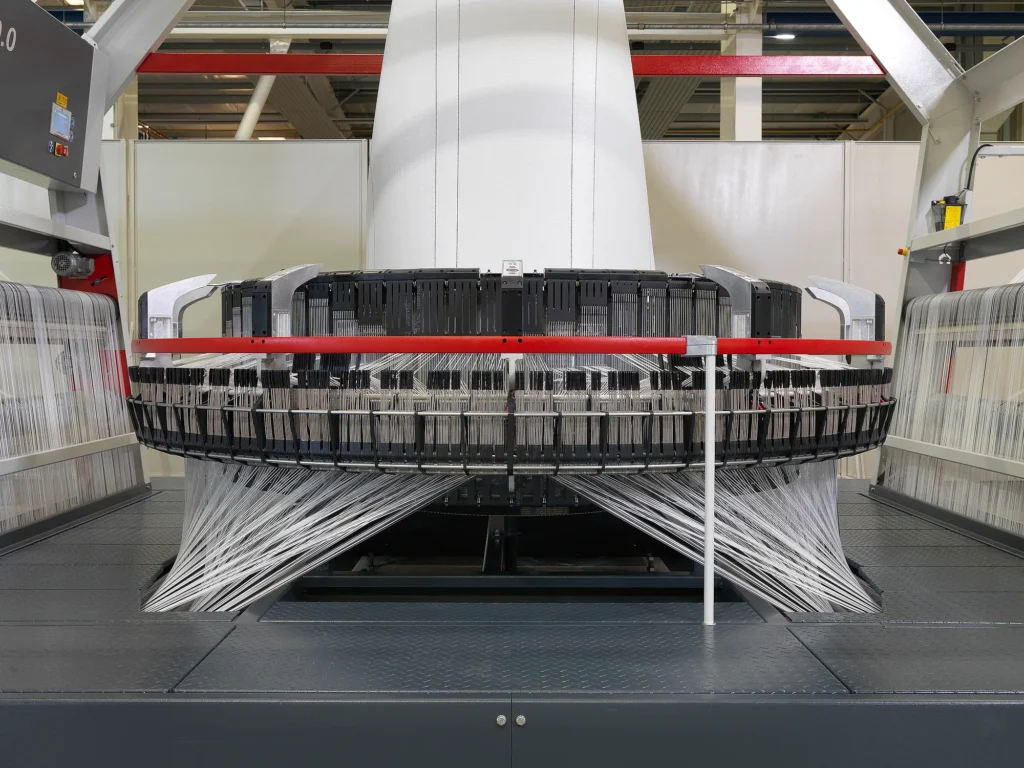
A detailed specification only creates value when production can repeat it. VIDEPAK reports more than 25 years of industrial-bag experience within its team, exports to more than 70 countries, and operates manufacturing infrastructure including more than 100 circular looms, 16 extrusion lines and more than 30 lamination and printing machines. Its current company information states that production uses high-quality virgin material and operates within an ISO 9001:2015 quality-management framework while referencing ASTM, JIS, EN and ISO requirements across its industrial-bag programs.
For VIDEPAK Jumbo Bags, that manufacturing base supports a modular approach. A customer can start with Type A and Open Top for a straightforward non-hazardous application, or move toward Type B for qualified combustible-dust conditions, properly grounded Type C for relevant hazardous operations, or Type D where qualified static-protective performance without FIBC earthing is needed. The same project can then be matched with a Spout Top for cleaner filling, a Discharge Spout Bottom for controlled emptying, a Baffle body for improved cube retention, and loop geometry designed around the customer’s forklift. The parts change, but the design logic remains consistent.
THE VIDEPAK VALUE: Fill cleanly. Carry safely. Lift confidently. Discharge predictably. Pack space efficiently. The best Jumbo Bags do not force operations to work around the package; they are engineered so the package works with the operation.
From One FIBC to a Complete Bulk-Handling Solution
For buyers, the most productive question is not “Which FIBC is the best?” There is no single best configuration. The better question is “Which combination fits our product, filling system, transport route, storage method, electrostatic environment and discharge process?” A free-flowing polymer pellet may pair naturally with a machine-connected Spout Top and Discharge Spout Bottom. A coarse aggregate may favor Open Top and Duffle Bottom. A space-sensitive export program may justify Baffle construction. A combustible powder may move the discussion immediately toward Type B, Type C or Type D, but only after its complete electrostatic risk is understood.
This is the central strength of the VIDEPAK Jumbo Bags platform: one woven polypropylene technology can be configured into very different working tools. Open or enclosed. Simple or form-stable. Groundable or static-protective. Fast-dumping or carefully metered. Four-corner lift or cross-corner handling. The customer does not have to choose between flexibility and engineering discipline; the purpose of customization is to bring the two together.
And that is where a professional FIBC specification should finish: not with a list of options, but with a coherent system. Select the correct electrostatic type. Match the Spout Top or alternative inlet to the filler. Match the Discharge Spout Bottom or alternative outlet to the receiver. Choose the construction that controls the required footprint. Set loop geometry around real lifting equipment. Validate the final design against the intended SWL, applicable standards and actual operating conditions. When every part has a reason, VIDEPAK Jumbo Bags become more than bulk packaging—they become a dependable link between production, logistics and the next process.
- VIDEPAK Jumbo Bags: A Practical Guide to FIBC Types, Tops, Bottoms, Constructions, and Lifting Loops
- Understanding Type A, Type B, Type C, and Type D
- Top Options: Controlling How Jumbo Bags Are Filled
- Bottom Options: Designing the Discharge, Not Just the Container
- Construction Styles: 4-Panel, U-Panel, Circular, and Baffle
- Lifting Loops: Where Bag Design Meets the Forklift or Crane
- How to Build the Right VIDEPAK Jumbo Bags Specification
- Why VIDEPAK Jumbo Bags Are Built Around Manufacturing Control
- FIBC Fabric Types: Type A & Type B & Type C & Type D
- FIBC Jumbo Bag Top Styles
- FIBC Jumbo Bag Bottom Styles
- FIBC Jumbo Bag Constructions
- Lifting Loops and Accessories
- Tables of Key Features
- Reference
FIBC Fabric Types: Type A & Type B & Type C & Type D
FIBCs are classified into four safety types (A, B, C, D) based on their electrostatic properties. This classification guides safe use in different environments:
FIBC Bulk Bags Versatility
Explore the versatile styles and functional advantages of FIBC jumbo bags for various industrial applications.
Check More →FIBC Bags Manufacturer
Professional FIBC jumbo bags manufacturer providing custom solutions and high-quality bulk packaging products.
Check More →FIBC Bags With Reinforced Bottom
High-durability FIBC jumbo bags featuring reinforced bottom structures for heavy-duty bulk transportation.
Check More →FIBC Bulk Bags Global Market
Comprehensive analysis of FIBC jumbo bags market dynamics, strengths and competitive packaging advantages.
Check More →- Type A bags are the most basic. Made from plain woven polypropylene, they offer no static protection. When contents rub against the bag, static can build up, so Type A FIBC Jumbo bags are suitable only for non-flammable, non-hazardous products. Common uses include storing sand, gravel, minerals or other inert materials. They should never be used with flammable powders or in explosive atmospheres.
- Type B bags are similar to Type A in basic materials but use fabric with a lower breakdown voltage. This means energetic sparks (propagating brush discharges) are less likely, though they do not dissipate static charge. Thus, Type B FIBCs can carry dry, flammable powders where strict grounding isn’t required. However, they should not be used in environments with combustible dust or where ignition energies exceed safety thresholds.
- Type C FIBC (Groundable) incorporate conductive yarns woven into the fabric (usually in a grid pattern). This allows the bag to be electrically grounded during filling/discharge to safely remove static charge. Type C bags are ideal for handling flammable powders, vapors or dusts in hazardous environments. Critical: they must be grounded at all times; failure to ground negates their safety feature. These bags are widely used in chemical, mining, and pharmaceutical applications where reliable grounding and static protection are needed.
- Type D (Anti-Static) FIBCs use special static-dissipative fabric that prevents sparks without external grounding. The fabric contains quasi-conductive yarns that emit any charge safely into the atmosphere (low-energy corona discharge). Type D FIBC bags can be used for flammable powders and combustible dusts in hazardous areas without the complexity of grounding. They are suited for chemicals and fine powders where any spark could be dangerous. However, if the bag surface becomes contaminated (e.g. with conductive grease), their anti-static effectiveness is reduced.
The table below summarizes these FIBC types:
| FIBC Type | Fabric/Protection | Typical Uses |
| Type A | Plain woven PP; no static protection | Non-flammable materials (e.g. sand, aggregate); general storage in non-hazardous areas. |
| Type B | Plain PP with low breakdown voltage (no static dissipation) | Dry flammable powders in dust-free areas (ignition energy <3mJ). Avoid when any combustible gas or solvent is present. |
| Type C | PP woven with conductive threads (ground-able) | Flammable powders or dusts in hazardous environments (must connect to ground during use). Common in chemical and mining industries. |
| Type D | Antistatic (dissipative) fabric, no grounding needed | High-risk flammable/combustible powders. Suitable for volatile chemicals or where grounding is impractical. Ensure bag is clean (no conductive contamination). |
Using the correct type is crucial. For instance, a Type A FIBC bag is cost-effective but unsafe for flammable materials, whereas Type D FIBC offers maximum static protection with ease of use. Always match bag type to the material and environment: non-hazardous loads can use basic Type A, flammable powders require groundable Type C FIBC or self-dissipative Type D FIBC.
FIBC Jumbo Bag Top Styles
The top design of an FIBC bag affects how it is filled and closed. Common top styles include:
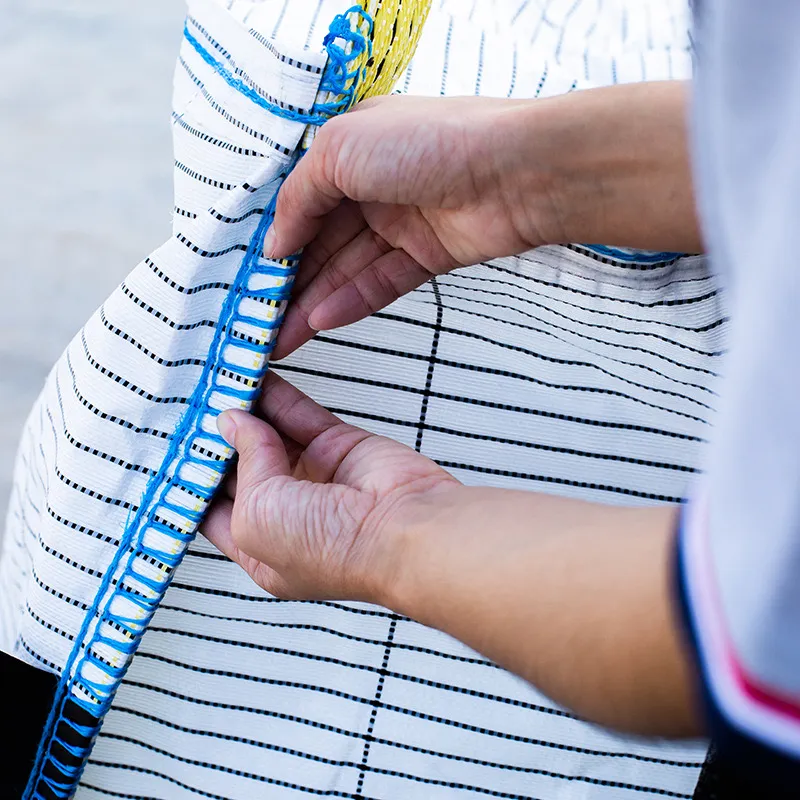
- Open Top: A completely open bag top (no closure). It allows full access, ideal for bulky or oversized materials. After filling, the skirt can be gathered and tied. Open tops are simple and cost-effective, used for things like soil, gravel, scrap, or other materials not requiring a sealed closure.
- Duffle (Duffel) Top: Features a large tubular skirt sewn onto the top. This design lets operators completely fill the bag (like open-top) and then tie off the skirt. It combines easy filling with a secure closure. Duffle tops are widely used for aggregates, animal feed, grains, beans, and granular materials. Because the skirt is substantial, it does not connect to filling equipment; the material drops from above. They are excellent when you need full access and a closure after filling.
- Spout Top (Filling Spout): A cylindrical spout (filler tube) is sewn into the center of the top panel. During filling, this spout connects to the filling chute or equipment, enabling a controlled, dust-tight fill. Afterward, the spout is tied off with a built-in drawstring. Spout tops are ideal for fine powders and dust-prone products (chemicals, cement, flour, food ingredients) because they minimize spillage and airborne dust.
- Spout Top with Flap: This is a spout top with an additional fabric flap over it. The flap covers the closed spout, providing extra containment against moisture or contamination. It combines the sealed filling of a spout with added security. Useful for materials that need both dust control and a bit of extra closure protection.
- Conical Spout Top: A variation of spout top with a built-in funnel (high filling cone). The internal conical spout top shape promotes complete filling (reducing trapped material) and can speed up filling. It’s used in specialized applications where the bag must fill quickly with fine or damp powders.
The following table summarizes these top styles, their structure, and typical uses:
| Top Style | Structure & Features | Applications |
| Open Top | No closure; the bag is entirely open. After filling, edges are tied. | Bulk items (soil, rock, scrap, debris) where dust/sealing isn’t critical. Cost-effective. |
| Duffle Top | Large tubular skirt sewn on top. Fully open for filling, then tied off with drawstring. | Granules, seeds, animal feed, chemicals, beans – materials needing easy fill and closure. Not ideal for dust control. |
| Spout (Filling Spout) | Cylindrical tube sewn into center of top. Connects to fill spout equipment; closeable with tie. | Fine powders, chemicals, cement, food ingredients – any dusty material needing contained fill (e.g. cement, salt, flour). |
| Spout + Flap | Spout top with extra fabric flap covering it. Offers additional coverage over the closed spout. | Sensitive powders or moisture-sensitive products requiring an extra layer of protection. |
| Conical Spout Top | Spout top with an internal funnel-shaped filler. Ensures rapid, complete filling. | Specialized use with difficult-to-flow powders (damp or clumpy) where full discharge is needed. |
In practice, open and duffle tops offer simplicity and lower cost but less dust control, while spout-based tops (especially with flaps) provide closed filling to keep material contained. VidePak Jumbo Bags can be customized with any of these top styles to fit the material and filling method required.
FIBC Jumbo Bag Bottom Styles
Just as tops differ, the bottom design (discharge style) determines how the bag’s contents are emptied. Key bottom styles include:
- Plain (Flat) Bottom: A sealed bottom with no discharge opening. This is the simplest, most economical option. To empty, workers must cut or pull the bag open. Plain bottoms are used when the bag will be emptied one-time by cutting, or when discharging is handled by tipping/pouring (for very coarse or rock-like materials).
- Discharge Spout Bottom: A closing spout at the bottom center. Often 14″×18″ diameter, it allows controlled emptying. The spout is opened (untied) and contents flow out in a stream. This style is common for granular or powdered products, as it speeds unloading and minimizes waste. Variations include:
- Conical Discharge Spout: Features an internal funnel (conical) insert so that almost all powder flows out without blockage. Useful for sticky or moist powders.
- Spout with Flap: A discharge spout plus an extra fabric flap over it. The flap is untied first, then the spout for an added safety enclosure. This double layer can help prevent spillage or contamination at discharge.
- Duffle Bottom: A bottom with a large openable pane (also called a “fully open bottom”). One or more seams can be untied to let the entire base open like a flap, dumping all contents at once. Duffle bottoms are excellent for coarse or clumpy loads (e.g. gravel, shells) where a quick, full empty is desired. They do not allow controlled flow (everything empties suddenly), so they require careful handling.
- Flap (Diaper) Bottom: A type of bottom with a single tied panel that is untied and opened sideways (like a diaper). This allows faster unloading than a plain bottom but is still reusable. (Not shown in table below; it is similar to duffle but typically opens only one side.)
Below is a summary table of common bottom styles:
| Bottom Style | Structure & Features | Applications |
| Plain (Flat) Bottom | Sealed bottom; no spout or opening. | Cheapest; used for single-use bags emptied by cutting or for dumping bulky materials (e.g. scrap, debris). |
| Discharge Spout Bottom | Cylindrical spout sewn into base. Tied closed; untie to discharge material. | Powders and granular products needing controlled discharge (chemicals, grains, cement, plastic pellets). Spout diameters are often 14″×18″. |
| Conical Spout Bottom | Discharge spout with an internal conical insert. Ensures full flow. | Sticky or fine powders (sugar, chemicals) where trapped material must be minimized. |
| Discharge Spout + Flap | Spout plus an extra fabric flap over it. Flap untied first, then spout. | Situations needing extra barrier at the bottom before spout opening (sensitive powders or dusty loads). |
| Duffle Bottom | Bottom panel (a “flap”) that fully opens. Can dump all contents quickly. | Coarse, bulky or irregular materials (rocks, shells, feed) requiring rapid release. Not for powders that need controlled flow. |
Selecting the right bottom style depends on unloading needs: spouts provide controlled, dust-reduced discharge, whereas duffle bottoms give full, rapid emptying. VidePak Jumbo Bags can be tailored with any of these bottom options during manufacturing.
FIBC Jumbo Bag Constructions
The bag construction (fabric panel design) determines the bag’s shape and stability when filled. The most common FIBC constructions are:
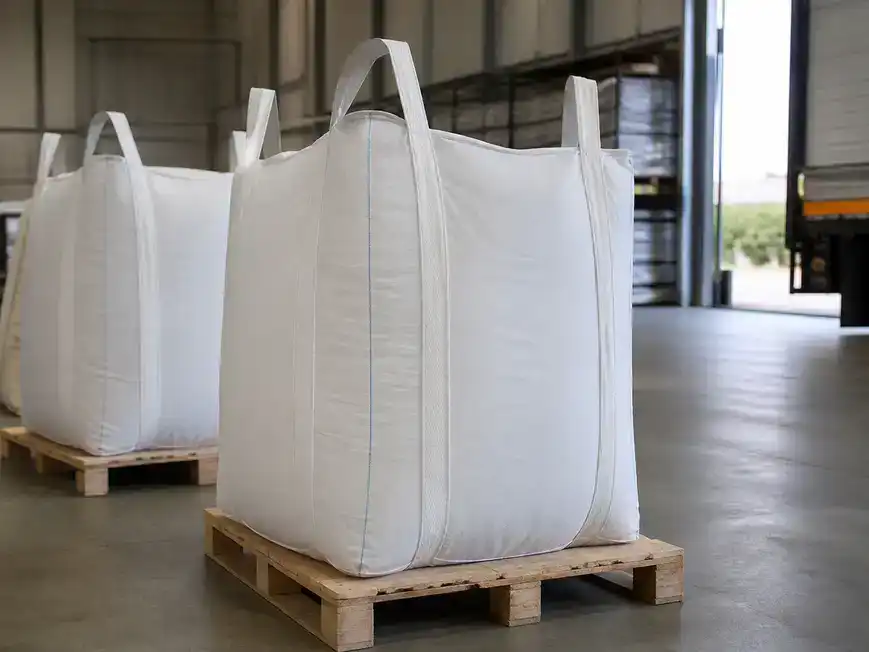
- 4-Panel FIBC: This industry-standard design consists of five separate pieces: four vertical side panels sewn together and one bottom panel. The result is a square/rectangular bag that maintains its shape well. However, the numerous seams can be points of weakness. 4-panel FIBC bags generally fill and stack uniformly, making them suitable for stable storage.
- U-Panel FIBC: Constructed from three main pieces: one large U-shaped tube forming the bottom and two opposite sides, plus two smaller fabric pieces sewn in for the other two side panels. U-panel FIBC bags also form a square shape when filled and are the most popular style due to fewer seams (one big piece + two small pieces). They balance shape retention and cost-effectiveness.
- Circular FIBC Bags (Tubular): Made from one continuous tube of fabric for all four sides, with separate pieces for top and bottom. Despite the name, a “circular” FIBC looks square-ish when filled, but it has minimal sewing (only at top and bottom). This construction is very economical but holds its shape the least, often bulging more under load. It is suited for applications where cost is critical and perfect squareness is not required.
- Baffle FIBC Bags (Q-Bag): A baffle bag is any of the above (4-panel, U-panel, or circular) with additional square panels sewn into each of the four internal corners. These internal baffles force the bag to retain a cube shape when filled, preventing bulging and increasing volume (often by ~30% vs. unbaffled). Baffled bags are ideal when space efficiency and stackability are important – for example, when maximizing storage or shipping efficiency. The most common is a 4-panel bag with corner baffles.
The table below compares these constructions:
| Construction | Structure | Features & Uses |
| 4-Panel | Four side panels + separate bottom piece. | Strong, retains square shape; industry standard. More seams (slightly lower burst strength at seams). Good for stable loads and easy stacking. |
| U-Panel | U-shaped fabric forms 3 sides + bottom; two additional side panels sewn in. | Popular design; fewer seams than 4-panel. Holds shape well. Cost-efficient. |
| Circular | Tubular fabric forms all four sides; top and bottom sewn on. | Minimal seams (only top/bottom). Least expensive. Bag tends to bulge; less squareness. Used when bag shape is less critical. |
| Baffle | Internal square baffle panels in each corner. Can be U-panel, 4-panel, or circular bag with baffles. | Locks the bag into a cubical shape. Increases volume (up to +30%) and stability for stacking. Ideal for space optimization. |
In summary, 4-panel and U-panel constructions will keep a squarish shape (U-panel being slightly cheaper), circular is lowest cost but more rounded, and baffled bags excel at maximizing volume and stack strength. VidePak offers all these constructions to match storage needs and stability requirements.
Lifting Loops and Accessories
All Jumbo Bags have lifting loops that allow cranes or forklifts to move them. The loop style can vary:
- 4 Corner Loops (Standard): Four loops, one at each corner, sewn into the bag seams. This is the most common. Cranes or forklifts pick up each loop to lift the bag. It provides good stability and easy handling for cranes.
- Cross-Corner Loops (Tunnel): Also four loops, but each loop extends across the bag from one side to the adjacent side (through the bag’s top, forming a ‘staple’ shape). These tunnel loops pass over the top and down the side, distributing weight along the fabric. They can reduce stress on seams and make the loops easier to locate for equipment.
- Stevedore Straps: In some systems, flat heavy straps are threaded through the bag’s loops:
- Double Stevedore: Two straps, each threaded through two loops on opposite sides. Forklift forks slide under these straps to lift the bag. This spreads the load and allows forklift handling without hooking loops.
- Single Stevedore: One strap goes through all four loops. Allows lifting from any forklift direction using one big strap.
- Sleeve (Tunnel) Lift: A separate strong fabric sleeve (tube) is fixed around the bag’s mid-section. Forklift forks slide directly under or through this sleeve. This approach avoids using loops entirely, securing the bag for forklift lifting.
These loop styles affect handling: corner loops work for cranes or hooks, while stevedore straps and sleeves facilitate forklift use. VidePak bags typically include four corner loops as standard, and can be paired with forklift straps or sleeves as needed for the customer’s equipment.
Tables of Key Features
Table 1: FIBC Bag Electrostatic Types (Type A–D):
| Type | Fabric/Protection | Use Case |
| Type A | Plain PP; no static control | Non-flammable solids in safe areas. |
| Type B | Plain PP; low breakdown voltage | Dry powders (flammable); no grounding, no combustible dust. |
| Type C | PP with conductive yarns (groundable) | Flammable powders/dust; must be grounded for safe use. |
| Type D | Antistatic PP (dissipative) | Flammable/combustible products in hazardous areas; no grounding needed. |
Table 2: Top Fill Styles for FIBC:
| Top Style | Structure & Operation | Typical Uses & Remarks |
| Open Top | Fully open mouth; material dumped/loaded in bulk. Close by gathering skirt. | Soil, rock, waste, scrap (non-dusty). Lowest cost; less containment. |
| Duffle Top | Large tubular skirt sewn on top. Fully open during fill; tie off after. | Grains, seeds, feed, aggregates; need full access & closure. Not sealed against dust. |
| Spout Top | Cylindrical filler tube in top. Attaches to hopper; tie when filled. | Powders, fine chemicals, cement, food ingredients (dusty loads). Contained filling. |
| Spout + Flap | Spout + extra fabric flap over it. Spout ties off; flap covers it. | Sensitive or hygroscopic powders needing dust control + added moisture barrier. |
| Conical Spout Top | Spout with built-in funnel (cone). Promotes complete filling. | Sticky/damp powders; ensures nearly complete emptying (no residue). |
Table 3: Bottom Discharge Styles for FIBC:
| Bottom Style | Structure & Operation | Typical Uses |
| Flat Bottom | Sealed base; no discharge opening. | Single-use or open dumping (e.g. scrap, rubble). Low-cost. |
| Discharge Spout Bottom | Cylindrical outlet in base. Untie to release. | General powders and granules (chemicals, grains, plastic pellets). Controlled flow. |
| Discharge Spout + Flap | Spout + additional bottom flap. Untie flap first. | Fine or hazardous powders needing extra containment. |
| Conical Spout Bottom | Spout with inner funnel. Facilitates full discharge. | Sticky/powdery materials (cement, sugar) that can cling. |
| Duffle (Fully Open) | Bottom panel opens fully (like a hatch). | Coarse solids or large lumps (mining ore, nutshells) for rapid emptying. |
Table 4: FIBC Bag Constructions:
| Construction | Description | Characteristics |
| 4-Panel | Four side panels + separate bottom piece. | Maintains square shape; many seams (standard design). Good for stacking. |
| U-Panel | One U-shaped piece (bottom + 2 opposite sides) + 2 side panels. | Popular; fewer seams; holds shape well. Balance of cost and strength. |
| Circular | One continuous tube for all sides. | Least seams (only top/bottom sewing). Bag is more round; cheapest. |
| Baffle | Any above style + corner baffles. | Enforces square shape; +30% volume. Highly stable and stackable. |
Table 5: FIBC Lifting Loop Configurations:
Reference
Types of FIBC Bags, FIBC Bags Specification & FIBC Bags Uses