
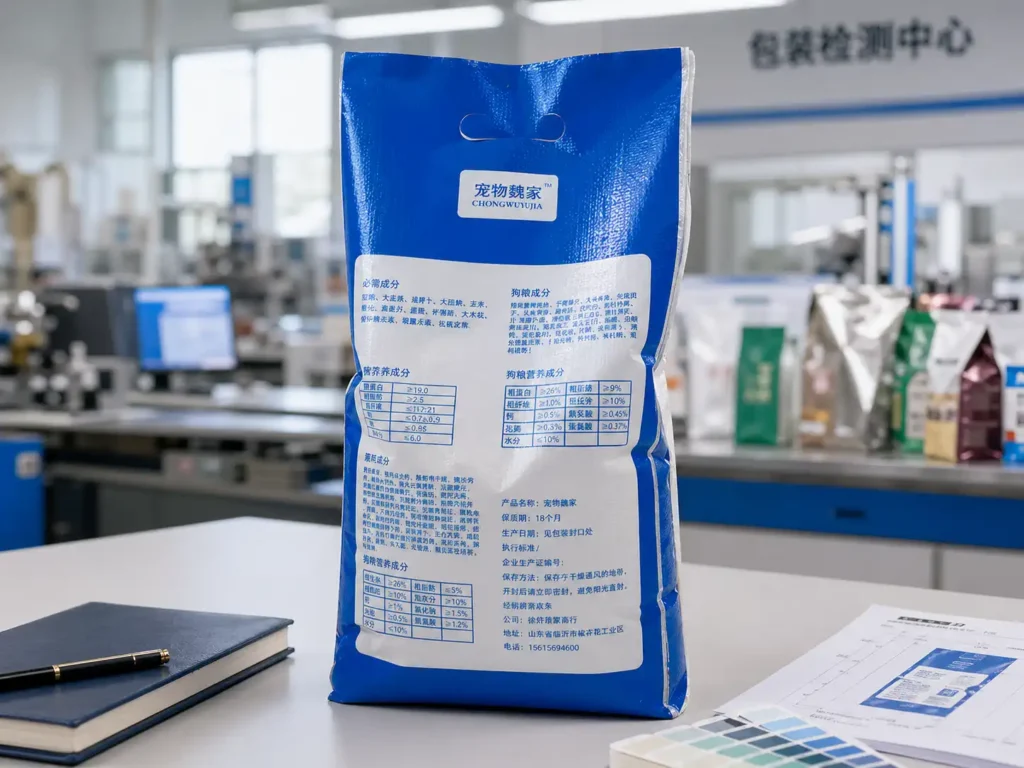
VIDEPAK Product Analysis of BOPP PP Woven Bags
For dry bulk packaging, retail-forward agricultural packs, pet food sacks, fertilizer bags, feed bags, rice bags, and many industrial outer packs, the real question is no longer whether packaging should be strong. It must be strong. The real question is whether that strength can also look clean on the shelf, run smoothly on the filling line, resist moisture in transit, and still help the customer trust what is inside at first sight. That is exactly where BOPP PP Woven Bags and Bopp Woven Bags continue to stand out. They combine woven polypropylene strength with laminated BOPP film print quality, and they do so in a mono-material PP structure that is widely valued for printability, stiffness, barrier performance, and easier recycling alignment versus mixed-material formats.
From a market department perspective, this category wins because it solves two problems at once. It protects the product, and it sells the product. The woven base carries weight and resists puncture. The BOPP layer delivers sharper graphics, stronger shelf presence, and a smoother exterior. Optional structures such as sewn open mouth, valve mouth, pinch bottom, block bottom, gusset sidewalls, Matt Surface, Glossy Surface, Micro-Perforation, Anti-Slip Treatment, and Transparent Window turn one packaging family into many market-ready solutions. That range is why this format can move from warehouse to pallet, from pallet to shelf, and from shelf to purchase without changing its basic material logic.
Key market message: BOPP PP Woven Bags are not only protective packs. They are visible packs, stackable packs, printable packs, and highly customizable packs. That is why they are useful in both industrial channels and retail channels.
Commercial Value and Market Position
Why BOPP PP Woven Bags continue to matter
The commercial strength of BOPP PP Woven Bags begins with their layered structure. A woven PP fabric gives the pack its load-bearing backbone. A laminated BOPP outer film adds smoothness, weather resistance, vivid reverse printing, and a cleaner premium look than plain woven sacks. In practice, this means one package can answer several buyer needs at once: mechanical strength for transport, moisture and dirt resistance for storage, and better graphic performance for branding. That combination is one reason BOPP laminated woven bags are used across grains, rice, seeds, feed, fertilizers, chemicals, and pet products.
For marketing teams, the advantage is even clearer. Plain bulk sacks talk only about function. Bopp Woven Bags talk about function and image together. They can carry fine color printing, high-contrast layout, cleaner logos, clearer product stories, and easier shelf recognition. They can look tough and premium; practical and attractive; industrial in structure, but retail in presence. That contrast is powerful. It allows one packaging platform to support private label programs, distributor packs, export packs, and value-added consumer-facing lines.
Strength
Woven PP fabric provides high tensile support and dependable puncture resistance for dry bulk filling and transport.
Shelf Appeal
Laminated BOPP supports sharper print, stronger color presentation, and a smoother visual finish than plain woven packaging.
Barrier
Lamination improves moisture and dust protection, helping packaged goods stay cleaner and drier across storage and transit.
Recycling Logic
PP-based mono-material structures are valued because PP films offer stiffness, barrier, heat, and optical performance within one polymer family.
This is why the value story of BOPP PP Woven Bags is simple but strong: they help products travel better, stack better, print better, and sell better. Not every buyer says that in one sentence, but most buyers want exactly that.
Materials and Construction Behind the Performance
The structure that gives Bopp Woven Bags their balance
The original logic of this packaging family starts with material construction, and that is still the right place to begin. BOPP PP Woven Bags are typically built from woven PP fabric plus a laminated BOPP film layer. The woven part provides structural strength. The BOPP film adds optical clarity, print support, a smoother touch, and better moisture resistance. Official PP film sources describe OPP and BOPP films as offering an effective balance of stiffness, heat resistance, barrier, heat-seal support, and optical properties, while commercial BOPP woven bag suppliers describe these packs as puncture-resistant, waterproof, dirt-resistant, and suitable for automatic packaging lines.
Commercially published ranges also show why this structure is highly flexible. One woven bag supplier lists single-sided and double-sided BOPP laminated woven bags in width ranges of about 40 to 60 cm, length ranges of about 50 to 110 cm, printing up to six colors, and loading capacities up to about 40 kg. At the film level, commercial BOPP grades are commonly offered in thin gauges such as 13, 15, 18, and 20 microns, with one high-gloss transparent BOPP grade showing 20-micron thickness, gloss of 140 gloss units on the treated side, haze of 2.0%, and water vapor transmission data of 6.8 g/m²/24 hr at 38°C and 90% RH. Those figures matter because they show the industry logic behind high clarity, vivid appearance, and moisture control in BOPP PP Woven Bags.
In simple terms, the woven fabric carries the load, while the film carries the image. The fabric is the muscle. The film is the face. And the market needs both. Without the woven layer, the bag loses structural advantage. Without the film, the package loses brand power and a meaningful part of its moisture and dirt resistance. Together, they create one of the most practical and market-friendly dry goods packaging formats available today.
Why finish options begin at the film level
When buyers ask about Matt Surface and Glossy Surface, the answer is not decorative alone. It is material, visual, and strategic. Matte BOPP grades are commercially available in one-side matte and one-side glossy structures, often in 13, 15, and 18 micron ranges. Glossy transparent grades emphasize high transparency and high gloss with low haze. This matters because the outer appearance of Bopp Woven Bags can be tuned by film choice before printing is even discussed. A matte face absorbs light and reduces glare. A glossy face reflects light, makes colors look brighter, and increases shelf sparkle. The finish, in other words, is not a small aesthetic detail. It is a first-message decision.
For VIDEPAK, this is where product analysis becomes market analysis. Material configuration is not only about protection. It is about price positioning, shelf language, product identity, and buyer expectation. A premium pet food panel, a staple rice bag, a fertilizer export sack, and a feed bag for distributor channels may all use the same packaging family, yet each can look and perform differently because the surface system is customizable at the film stage.
Bag Architecture That Shapes Filling, Stacking, and Display
Opening style is not a small detail
The source article makes a useful point: structure begins with the opening style. Sewn open-mouth bags remain simple, strong, and cost-conscious. Valve bags improve automatic filling and dust control. Pinch bottom open mouth formats add stronger shelf posture. Pasted or special top closures can support specific packing conditions. For dry powders and automated plants, valve structures are often the logical choice. For lower-speed lines and wider SKU variation, sewn formats remain effective and economical. That means the right top opening depends not only on product type, but on plant reality, labor setup, dust level, and desired closure speed.
Bottom style changes both logistics and perception
Bottom construction matters just as much. Folded seam bottoms support simple general-purpose filling. Hemmed bottoms with tape improve leak resistance. Pinch bottom and block bottom formats improve standing performance, pallet shape, and shelf presence. Industry equipment sources also show that PP woven sacks with BOPP lamination can move into more attractive consumer-facing formats, especially when block bottom or premium pinch bottom geometry is involved. In other words, bottom design affects more than stability. It affects how the bag photographs, how it faces forward, how it stacks cleanly, and how premium it appears in the customer’s hand.
The table above follows the same structural logic as the original article while translating that logic into buyer language: packing method, shelf effect, and logistics effect should be evaluated together, not separately.
Flat body versus gusseted body
Flat bags save material and keep a more compact profile. Gusset bags expand better, create a boxier silhouette, improve pallet efficiency, and give designers more real estate for copy and graphics around the side. Here again, structure becomes communication. A flat bag says simple and direct. A gusset bag says organized and premium. Neither is always better. The better choice is the one that matches filling volume, retail expectation, and shipping density.
Customization Options That Change Real Market Performance
This is the heart of any serious product analysis, because buyers do not purchase a bag family in theory. They purchase a specification. And in BOPP PP Woven Bags, the specification is where market performance is won or lost.
Matt Surface
A Matt Surface reduces glare and creates a calm, premium, tactile look. Commercial BOPP matte grades are available in one-side matte / one-side glossy constructions, often in 13–18 micron ranges, and are chosen when the brand tone should feel refined, natural, muted, or high-end rather than flashy. On crowded shelves, a Matt Surface often signals confidence through restraint.
Glossy Surface
A Glossy Surface works differently. It amplifies color, increases shine, and usually makes graphics more vivid and more immediate. One commercial transparent BOPP film grade shows excellent transparency, 140 gloss units, and 2.0% haze at 20 microns, which helps explain why a Glossy Surface is so useful for polished shelf graphics and premium, high-clarity presentation.
Micro-Perforation
Micro Perforation introduces tiny holes that allow ventilation, gas exchange, humidity control, and lower condensation risk. Packaging sources and academic work both note that micro perforation can tailor oxygen transmission and is especially useful for products that need breathability rather than a fully closed moisture barrier. That makes Micro-Perforation suitable for selected produce, coffee-related, or air-sensitive goods, but less suitable for moisture-sensitive powders.
Anti-Slip Treatment
Anti-Slip Treatment is a logistics feature with clear market value. Commercial woven bag specifications show anti slip treatment targets such as static friction coefficients above 0.5 or above 0.6, while anti slip product pages describe the function as enhancing coefficient of friction and pallet stability. This matters in real life, because cleaner stacks mean safer transport, tidier displays, lower slippage loss, and less complaint from warehouses and distributors.
Seen one by one, these options look technical. Seen together, they become a market toolkit. Matt Surface shapes visual tone. Glossy Surface shapes visual impact. Micro-Perforation shapes product breathing. Anti-Slip Treatment shapes pallet control. And when those are paired with structure choices such as gussets, opening type, bottom style, and print density, Bopp Woven Bags become highly specific packaging programs rather than generic sacks.
For VIDEPAK, the strongest commercial approach is not to overspecify every option. It is to link each option to a real buyer problem. That keeps the bag honest, competitive, and easier to sell.
Deep Analysis of Transparent Window as a Sales and Trust Feature
Why the Transparent Window matters more than it first seems
Among all customization options in BOPP PP Woven Bags, the Transparent Window deserves special attention because it works at the intersection of product truth, shopper trust, and purchase speed. A customer does not need to imagine the rice grain, pet kibble, seed size, mineral texture, or pellet consistency. The customer can see it. Packaging sources describe transparent-window woven bags as helping buyers inspect contents without opening the pack, while product pages note that a transparent section combined with high-transparency fabric can display the contents clearly through the bag. That simple visual proof often reduces hesitation, especially in categories where product appearance is tied directly to perceived quality.
The most practical VIDEPAK-style logic for a Transparent Window
For a strong and cost-effective design route, the Transparent Window can be created by using a transparent PP fabric base and intentionally leaving the window zone unprinted during the graphic process. In other words, the clear effect does not need to come from a different decorative layer. It comes from material transparency plus print omission in the selected window area. Packaging sources describe both one-side transparent laminated woven bags and “knock-out” window approaches in which a part of the printed film is left unprinted so the underlying visual transparency can show through. This route is efficient because it keeps the design simple, preserves the visual honesty of the content, and supports a clean front-panel story: print where branding is needed, leave clear where product proof is needed.
VIDEPAK market reading of the Transparent Window
The Transparent Window is not decoration. It is evidence. It lets the pack say, “Look before you buy.” That message is short, direct, and very strong in grain, feed, pet food, and seed packaging.
Why this structure works so well in the market
A good Transparent Window does several jobs at the same time. First, it lets buyers check product condition, color, granule uniformity, and fill state without tearing the bag. Second, it reduces the need for destructive inspection during distribution and handling. Third, it gives the design a smart contrast: opaque printed branding around a clear visual center. That contrast is effective because it combines promise and proof. The printed area says what the product is. The clear area shows that the printed claim is real. In shelf competition, few messages are stronger than that.
Still, the Transparent Window should be engineered with care. Window size, window placement, seal distance, and front-panel layout all matter. A window that is too small may not reveal enough product character. A window that is too large may weaken visual balance or reduce the space available for printed claims. A window placed too close to fold lines, seam areas, or stress zones can complicate converting or reduce the clean look of the front. The best designs usually place the Transparent Window where the product is visually meaningful and mechanically calm: centered or slightly lower-front for grain-like goods, or in a shaped side or front section for retail-forward feed and pet applications.
From a merchandising perspective, the Transparent Window works particularly well with both Matt Surface and Glossy Surface, but in different ways. With a Matt Surface, the clear zone becomes a striking visual accent because the non-glare printed field makes the transparent zone stand out more quietly and more elegantly. With a Glossy Surface, the window can blend into a brighter, more energetic package style, creating a more dynamic retail look. One route feels premium and composed. The other feels vivid and immediate. Both can work; the better choice depends on brand tone and target channel.
In short, the Transparent Window is one of the highest-value features available in Bopp Woven Bags because it goes beyond appearance. It improves product visibility, supports easier selection, raises buyer confidence, and strengthens the perceived honesty of the pack. In categories where customers want to judge what is inside, this feature can turn packaging from a cover into a conversion tool.
VIDEPAK Specification Framework for Product Development
A product report should help customers act, not only understand. That is why VIDEPAK should present BOPP PP Woven Bags as a specification framework: size range, load range, surface choice, structure choice, and feature choice. Commercial product pages show common ranges such as widths around 40–60 cm, lengths around 50–110 cm, printing up to six colors, and loading capacities around 40 kg for BOPP laminated woven bags. They also show common customization routes such as flat type, gusseted type, plain fold-over stitching, fold-over stitching with PE tape, over-tape seam sealing, anti-slip treatment, and transparent-window design. These are exactly the anchor points that customers use when moving from inquiry to confirmed bag structure.
The values above reflect common published product ranges and customization paths in the category, and they are useful as RFQ anchors rather than rigid limits.
Simple selection flow for customers
That flow matters because it keeps decision-making practical. Choose the product. Choose the line style. Choose the visual tone. Then add only the functions that solve real problems. If the product is sensitive to appearance and retail trust, prioritize Transparent Window. If it is a bright shelf product, consider Glossy Surface. If it should look refined and premium, consider Matt Surface. If pallet stability matters, specify Anti-Slip Treatment. If the product needs air release or breathability, assess Micro-Perforation. This approach keeps the offer clear and the quotation easier to close.
For VIDEPAK, this framework also supports better sales communication. The conversation becomes structured: What do you pack? How do you fill? Where do you sell? What do you need the customer to see? That sequence turns a technical inquiry into a guided product-development process.
Conclusion for Market Use
The strongest way to position VIDEPAK’s BOPP PP Woven Bags is to show that they are engineered for both protection and presentation. That dual value is the real center of the category. The woven PP body gives the bag strength. The laminated BOPP surface gives the bag image. The architecture options adapt the bag to filling speed and stacking needs. The finish options adapt the bag to brand tone. The functional add-ons adapt the bag to real logistics and product behavior. And the Transparent Window, when built on transparent PP fabric and combined with a non-printed window area, gives the pack one of the most persuasive advantages in modern dry-goods packaging: visible proof of product quality before opening.
That is why Bopp Woven Bags remain commercially powerful. They are strong without looking crude. They are printable without becoming fragile. They are customizable without losing the efficiency of a proven PP structure. They can speak loudly through a Glossy Surface, speak calmly through a Matt Surface, breathe through Micro-Perforation, stack more safely through Anti-Slip Treatment, and build trust through a Transparent Window. Few packaging families can do all of that with such a clear product logic.
For customers choosing a packaging partner, the message is straightforward: VIDEPAK’s BOPP PP Woven Bags are not one bag. They are a flexible product system. And a flexible product system, when designed well, is exactly what the market rewards.
BOPP-laminated polypropylene woven bags are engineered heavy-duty sacks that pair a high-strength PP fabric core with a biaxially oriented PP film lamination. This mono-polymer construction yields a durable, moisture‑barrier package with a smooth, printable exterior. Unlike plain PP sacks, laminated BOPP bags combine toughness with vibrant reverse‑printed graphics locked under a clear polymer surface. In practice, these bags resist punctures, UV, and moisture, keeping contents dry and intact during stacking and transit. Typical formats include sewn and valve open-mouth bags, pinch-bottom and block-bottom (SOS) designs, and specialty types like “easy‑open” tear-strip sacks, each tailored to fill-line and product needs. Additional features (flat vs gusseted sides, matte vs glossy finishes, micro‑perforation, anti-slip coatings, transparent windows, etc.) let buyers fine-tune performance vs. cost.
VidePak’s production exemplifies this engineering: only 100% virgin PP (from BASF, Sinopec, etc.) is used to extrude and weave tapes, which are then extrusion‑laminated with a high-clarity BOPP film on Starlinger lines and printed on W&H presses. Stringent QA follows ASTM/ISO protocols – e.g. melt flow (ISO 1133/ASTM D1238), tensile and tear tests, friction tests (ISO 8295) and AQL sampling (ISO 2859) – ensuring consistency. In this report, we systematically dissect bag options (openings, bottoms, add-ons), detail VidePak’s supply chain and capacity (state‑of‑the‑art equipment and hundreds of millions of bags/year), and tabulate attributes for easy comparison. A conclusion offers guidance on selecting the right BOPP/PP woven bag based on product, line speed, and branding needs.
- VIDEPAK Product Analysis of BOPP PP Woven Bags
- Commercial Value and Market Position
- Materials and Construction Behind the Performance
- Bag Architecture That Shapes Filling, Stacking, and Display
- Customization Options That Change Real Market Performance
- Deep Analysis of Transparent Window as a Sales and Trust Feature
- VIDEPAK Specification Framework for Product Development
- Conclusion for Market Use
- Materials & Construction of BOPP‑Woven Bags
- Reference:
Materials & Construction of BOPP‑Woven Bags
BOPP (biaxially oriented polypropylene) woven bags are mono‑material sacks: they use 100% polypropylene in both the woven fabric and the lamination. The core fabric is woven from extruded PP tapes (strips), providing the tensile backbone. A thin BOPP film (typically 15–35 μm thick) is laminated on one or both sides, often with a PP tie layer to bond film to fabric. This makes the entire bag recyclable as a single stream. Typical PP fabric thickness is on the order of 80–120 μm (roughly 80–150 gsm by weight), with flexibility to customize heavier weights for higher loads. The laminated film adds moisture- and UV-barrier, yielding a watertight yet lightweight sack. During production, both sides of the film may be reverse-printed with inks (under the clear lamination) so that colors are vivid and scratch‑resistant.
Key material details include strict control of polymer grade: VidePak uses virgin homopolymer PP resin with a narrow melt‑flow index (~6–8 g/10 min). This consistency allows uniform tape extrusion and fabric strength. All layers – inner fabric, outer film, and interlayer – are polypropylene for compatibility and recyclability. Additives such as UV stabilizers or color masterbatches can be incorporated into the polymer before extrusion. After lamination, sacks undergo finishing (cutting, sewing or thermal sealing) and any post-treatments (e.g. matte coating, anti-slip coating).
VidePak’s process (extrusion → weaving → lamination → printing → converting) uses premium machinery: Austrian Starlinger extruders/looms for fabric and lamination, and German W&H presses and bag-converting lines for high-resolution printing and precise stitching. This “all‑Starlinger & W&H” lineup ensures, for example, uniform lamination coating, correct pre-heating of films, tight print registration, and stitch accuracy. In practice, a typical BOPP woven bag from VidePak can endure heavy loads, UV exposure, and rough handling far beyond minimum requirements.
BOPP Woven Bags
Premium BOPP woven bags with glossy finish, high-definition printing and durable industrial packaging performance.
Check More →BOPP Laminated PP Woven Bags Analysis
Comprehensive analysis of BOPP laminated polypropylene woven bags including materials and application advantages.
Check More →Printed BOPP Woven Bags
Custom printed BOPP woven bags with vibrant colors, perfect for brand display and product packaging solutions.
Check More →Laminated BOPP Woven Bags
High-quality laminated BOPP woven bags with waterproof, tear-resistant and strong load-bearing properties.
Check More →