
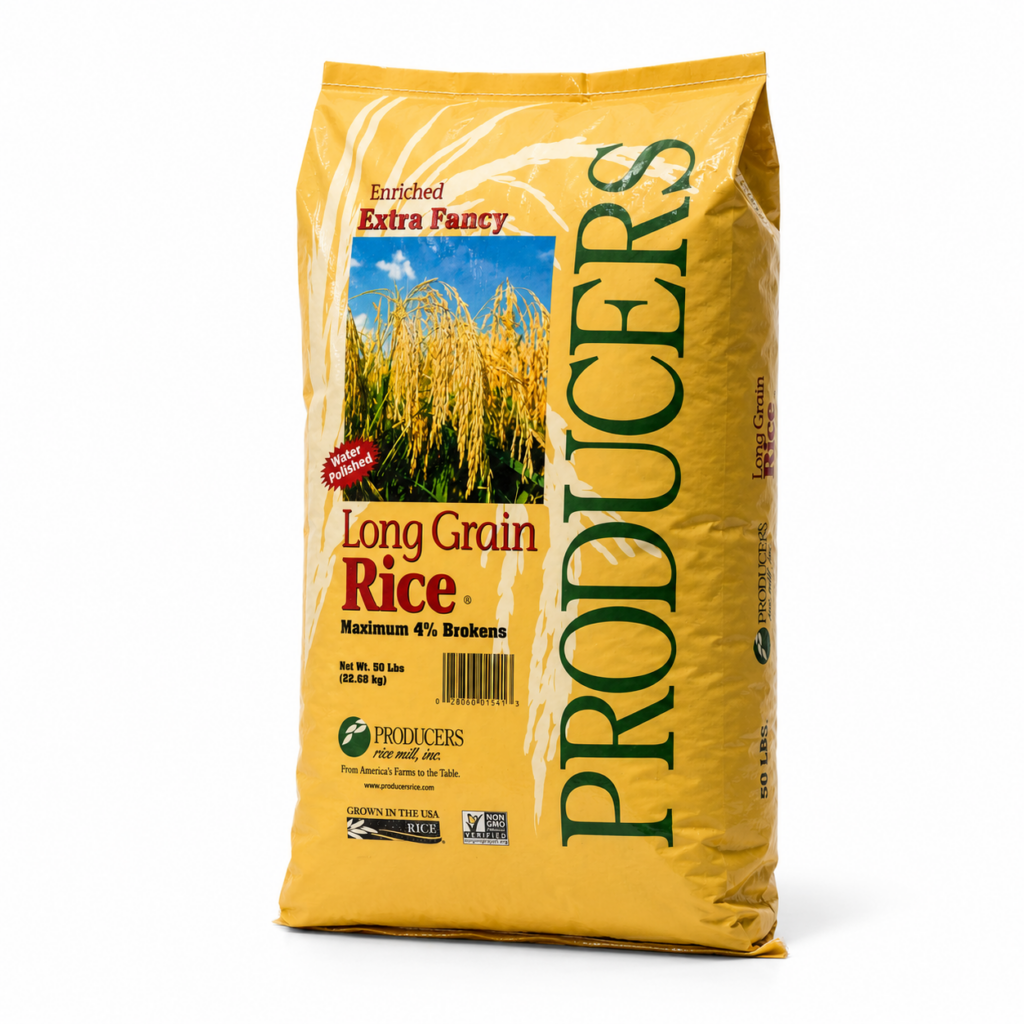
VIDEPAK Food Grade Woven Bags: Stronger Polypropylene Packaging, Smarter Protection, Better Brand Presentation
Food packaging has one simple job that quickly becomes complex: protect what is inside. A bag may travel from a mill to a warehouse, from a warehouse to a port, from a port to another country, and finally from a distributor to a customer. During that journey, it can face humidity, dust, repeated lifting, stacking pressure, vibration, abrasion, and changing temperatures. For rice, flour, sugar, grains, pulses, seeds, feed ingredients, and other dry products, packaging must therefore do more than look good. It must carry weight, help control contamination, reduce product loss, support efficient filling, and communicate the brand clearly.
This is where VIDEPAK Food Grade Woven Bags bring together several proven packaging elements: a strong woven Polypropylene body, optional PE Inner Bags for an additional product-facing barrier, and optional BOPP Laminated Woven Bags construction for premium printing and enhanced exterior protection. VIDEPAK publishes a broad woven-bag range built around virgin PP materials, with customizable bag structures, dimensions, closures, liners, coatings, and printing options for different filling and distribution needs.
One packaging system, several layers of value. The woven structure carries the load. PE Inner Bags can strengthen the internal barrier. BOPP Laminated Woven Bags can turn the outside surface into a durable branding platform. And a carefully controlled Food Grade specification connects materials, hygiene, production, documentation, and the intended food-contact conditions.
That last point matters. Food Grade should never be treated as a decorative label. For the U.S. market, olefin polymers used in food-contact articles are governed by specific conditions and limitations under regulations including 21 CFR 177.1520. In the European Union, Commission Regulation (EU) No 10/2011 sets specific requirements for plastic materials and articles intended to contact food. In other words, suitability depends on the complete formulation, intended use, contact conditions, and supporting documentation—not simply on calling a plastic “safe.”
For VIDEPAK, the practical goal is clear: engineer Food Grade Woven Bags around the product and its journey rather than forcing every customer into one standard sack. Strong where strength matters. Protective where protection matters. Attractive where branding matters. Simple in concept, detailed in execution.
Understanding VIDEPAK Food Grade Woven Bags
What makes woven packaging different?
The foundation of VIDEPAK Food Grade Woven Bags is woven PP fabric. Instead of relying on a single thin sheet to carry the load, stretched PP tapes are interlaced to form a flexible fabric. This woven architecture is widely used for dry bulk packaging because it combines relatively low package weight with useful tensile strength, tear resistance, handling durability, and the ability to be converted into many sack formats. Woven sacks can also be combined with coating, lamination, micro-perforation, liners, different closures, and other application-specific features.
VIDEPAK’s published general PP woven range includes reference specifications around 80–150 GSM, customizable sizes approximately from 40 × 60 cm to 120 × 180 cm, and nominal filling capacities from about 5 kg to 50 kg, although the actual specification must be matched to the packed product, bag dimensions, seam design, fabric construction, filling equipment, and logistics conditions.
Marketing promise must follow engineering reality: a 25 kg rice pack, a 10 kg flour pack, and a 50 kg agricultural ingredient pack may all use Food Grade Woven Bags, but they should not automatically use the same GSM, liner, dimensions, seam, coating, or air-release design. The best bag is not the bag with the most features. It is the bag with the right features.
VIDEPAK reference specification window
Reference ranges above are drawn from VIDEPAK’s published product and technical materials; final parameters should be confirmed against the actual order specification.
Strength is only the beginning
A successful sack must survive more than static weight. It may be dropped during loading, compressed in a pallet, rubbed against adjacent bags, exposed to vibration inside a truck, or moved repeatedly by workers and automated equipment. For this reason, the performance of Food Grade Woven Bags comes from a system: tape quality, weave density, fabric weight, lamination, liner design, seam construction, bag geometry, and quality control all work together.
This system view also explains why VIDEPAK offers choices rather than a single universal structure. An unlaminated woven sack can make sense where breathability and economy are priorities. PE Inner Bags make sense when the contents need more separation from humidity, outside contamination, or powder leakage. BOPP Laminated Woven Bags make sense when the customer needs both physical performance and high-impact visual presentation. One foundation; several solutions.
Why Polypropylene Is the Structural Heart of the Bag
From resin to stretched tape
Polypropylene is particularly well suited to woven sack construction because the material can be extruded into tapes, stretched to orient the polymer structure, and woven into a fabric. The stretching step increases tape strength, while the woven arrangement distributes load through warp and weft directions. The result is not simply “plastic in bag shape.” It is a textile-like load-bearing structure engineered from polymer tapes.
VIDEPAK’s published food-packaging references describe the use of virgin PP for its woven structures. For customers purchasing Food Grade Woven Bags, this provides a controlled material starting point from which the resin, additives, inks, coatings, liners, and other components can then be evaluated against the intended market and application.
Carry More Confidently
The woven Polypropylene network creates the mechanical backbone needed for stacking, lifting and repeated handling.
Configure More Precisely
Fabric weight, dimensions, weave, gussets, coating, liner and closure can be adjusted around real packaging conditions.
Present More Clearly
The woven base can support printed, coated or BOPP-laminated structures when visual communication is as important as transport strength.
Virgin material does not replace compliance control
It is important to make a careful distinction. “Virgin” describes the material source; Food Grade describes suitability within a specific food-contact system. Using virgin Polypropylene is therefore a starting point, not the complete compliance argument. In the United States, applicable olefin polymers and additives must meet the relevant provisions and conditions of use. In the EU, the finished plastic material or article is subject to applicable composition, migration, documentation, and use requirements under the food-contact framework.
For buyers, this is good news because it turns a vague marketing claim into a practical purchasing process. Define the food. Define whether the product directly contacts the bag or an inner liner. Define temperature and storage conditions. Define the target country. Then define the correct Food Grade material and documentation package.
What should a buyer specify?
Rather than asking only, “What GSM is the bag?”, a serious specification should connect several questions. What is the filling weight? How sharp or abrasive is the product? Is the product dusty? Does it absorb moisture? How high will pallets be stacked? Will the bag travel through humid sea freight? Will it be filled automatically? Will customers see it in retail stores?
These questions are connected. A heavier woven fabric without the right seam can still fail. An excellent PE Inner Bags specification without correct insertion can create filling problems. Beautiful BOPP Laminated Woven Bags without sufficient base strength may look impressive but underperform in logistics. Packaging works when every layer agrees with every other layer.
How PE Inner Bags Add a Second Line of Protection
Strong outside, protective inside
Woven fabric is excellent at carrying mechanical load, but its interlaced construction is not the same as a continuous film wall. That is why PE Inner Bags play such an important role in many Food Grade Woven Bags. VIDEPAK describes lined woven packaging as a two-part system: the woven PP shell provides load-bearing strength, while the PE liner helps reduce moisture contact, dust escape, and exposure to outside contamination.
This division of work is easy to understand. Let the woven shell carry the weight. Let PE Inner Bags manage the internal environment. Neither layer needs to do everything, because together they can do more.
The functional comparison follows VIDEPAK’s published liner guidance and the established use of flexible polyethylene materials in packaging applications requiring moisture control, sealability and toughness.
Why moisture control matters
Many dry foods do not need liquid water to suffer quality problems. Water vapor in humid air can be enough to affect products that readily absorb moisture. Powders may cake. Sugar may harden. Free-flowing material may become less free-flowing. Packaging therefore needs to be selected not only for visible water exposure but also for the storage climate and duration.
Polyethylene films are widely used in packaging because appropriate grades can combine flexibility, toughness, sealability, and moisture-barrier performance. In VIDEPAK lined structures, PE Inner Bags use those film characteristics inside the mechanically stronger woven shell.
Think in terms of risk, not extras. If humidity, powder leakage, cleanliness, or product-contact control is important, PE Inner Bags are not simply an accessory. They are part of the protection strategy. If breathability is the main goal, however, an unlined or specially vented configuration may make more sense.
Different products need different liners
VIDEPAK technical references show that inner liners can be produced and integrated in different ways depending on the application. A liner may be loose-inserted, attached at selected points, or coordinated with the mouth or valve structure. Published VIDEPAK references commonly place PE liner thicknesses within a broad range from roughly 20 or 25 μm up to about 80 μm for many woven-bag applications, rather than defining one thickness as universally correct.
A thinner liner may serve a lighter-duty dry product. A thicker liner may be considered when stronger puncture resistance, more robust handling, or greater barrier performance is needed. But thickness alone is not the answer. Liner dimensions, sealing, attachment, resin type, filling speed, air release, and bag closure all affect actual performance.
Why BOPP Laminated Woven Bags Turn Industrial Strength into Shelf Appeal
The structure behind the appearance
BOPP Laminated Woven Bags combine a woven PP structural base with a biaxially oriented PP film laminated to the outside. BOPP film is oriented in two directions, producing a smooth film suitable for clear graphics and stable surface presentation. In many designs, artwork can be reverse-printed before lamination so the print sits beneath the outer film and receives additional protection from rubbing and handling.
That combination changes what a woven sack can be. The woven Polypropylene fabric remains the muscle. The BOPP surface becomes the face. The result is a format suited to customers who do not want to choose between logistics performance and marketing performance.
Premium Graphics
BOPP Laminated Woven Bags provide a smoother print surface for detailed artwork, product photography, brand colors, barcodes and information panels.
Surface Protection
The laminated face helps shield printed graphics from normal rubbing, dirt and handling while adding another exterior layer between the environment and woven fabric.
Brand Consistency
For products displayed at wholesale or retail, stronger color reproduction and a cleaner surface help the package continue selling after the logistics journey is over.
A multilayer system with clear roles
VIDEPAK’s published technical guidance emphasizes that layer terminology varies in the market, so buyers should define actual fabric GSM, BOPP film gauge, liner presence and closure instead of relying only on a product name.
Retail packaging that still works like an industrial sack
This is the commercial strength of BOPP Laminated Woven Bags. Rice, grains, pulses, feed products, seeds, and other packaged goods often need to survive industrial logistics and still look presentable when they reach the point of sale. A damaged print can make an undamaged product look old. A weak bag can make beautiful artwork irrelevant. BOPP Laminated Woven Bags address both sides of the equation.
VIDEPAK’s published references describe multi-color printing and glossy or matte BOPP presentation across its laminated woven range. Exact artwork method, number of colors, film thickness and finish should be finalized according to the customer’s design and production specification.
For brand owners, the value is wider than appearance. The large printable surface can organize product identity, handling instructions, batch information, barcodes, QR codes, multilingual text, and regulatory information into one visible communication platform. The bag protects the product; the graphics protect the message.
What Food Grade Should Mean in a Real Packaging Program
It is a system, not a sticker
A true Food Grade packaging program begins before the bag is made. The resin must be selected correctly. Additives must be controlled. Product-contact components must match applicable requirements. Production areas and handling practices must manage contamination risks. Finished bags must be protected during storage and shipment. Documentation must connect the final product to the agreed specification.
This systems approach is consistent with modern food-safety frameworks. ISO 22000 defines requirements for food-safety management systems across organizations involved directly or indirectly in the food chain, while the current ISO food-safety portfolio specifically includes prerequisite-program requirements relevant to food and feed packaging manufacturing. BRCGS Packaging Materials likewise provides a framework focused on safe packaging, quality, legal compliance and operational control.
A useful purchasing rule: never ask only, “Is this Food Grade?” Ask, “What is the intended food-contact condition, which layer contacts the product, what materials are used in that layer, what destination-market requirements apply, and what documents support the specification?” Better questions produce better bags.
The U.S. and EU perspective
For U.S. food-contact applications, 21 CFR 177.1520 covers specified olefin polymers—including relevant PP and PE materials—subject to defined compositions, extractive limits, food types, and conditions of use. FDA’s food-contact inventory also emphasizes that authorization is tied to the specific intended use and conditions stated in the applicable regulation.
For the EU market, Regulation (EU) No 10/2011 is a specific measure covering plastic materials and articles intended for food contact. Its framework addresses authorized substances, restrictions, migration requirements and documentation, and it operates alongside the general EU food-contact framework. Because regulatory texts are amended over time, customers should define the destination market when approving a Food Grade specification.
VIDEPAK’s own published Food Grade Woven Bags materials identify virgin PP, BOPP/PE structures, customization and food-contact compliance programs as key parts of this product family. The right commercial approach is therefore not to make one universal compliance promise for every possible bag, food and country, but to build and document the chosen construction for the customer’s actual application.
Hygiene continues after production
Even the right polymer loses value if finished packaging is poorly handled. Clean manufacturing, inspection, controlled storage, protected bundling, and traceability are therefore part of the practical meaning of Food Grade. This is also why packaging safety standards focus on operational control rather than material selection alone.
For customers, that broader view reduces uncertainty. Material control helps address chemical suitability. Hygiene control helps address contamination. Dimensional and mechanical checks support filling and transport. Traceability supports investigation when something goes wrong. Each control is useful alone; together they create confidence.
From Polypropylene Resin to Finished VIDEPAK Food Grade Woven Bags
A packaging flow where every stage affects the next
Performance is created step by step. VIDEPAK’s published production descriptions start with PP material control, followed by tape extrusion and stretching, weaving, optional coating or lamination, printing, conversion, liner insertion where required, sewing or sealing, and final inspection. Published VIDEPAK references also describe checks on parameters such as fabric GSM, dimensions, liner thickness, lamination, seams and finished-bag performance.
Material selection
Stretch and orient
Create strong fabric
Build barrier and brand
Shape the final bag
Confirm specification
Tape extrusion: strength begins before weaving
The first structural transformation takes Polypropylene from resin to tape. The polymer is melted, formed, cut into tapes, and stretched. Orientation during stretching is important because it increases the tensile strength that the woven fabric will later depend on. A stable tape creates a better foundation for stable fabric.
Weaving: many tapes become one structure
The tapes are then interlaced into woven fabric. VIDEPAK’s technical material describes control of weave density and fabric GSM as part of building sacks for different load requirements. This is a critical stage because small differences in tape or weaving consistency can appear later as differences in bag dimensions, tensile performance, seam behavior, and pallet stability.
Adding PE Inner Bags: protection moves inside
Where the specification requires an inner liner, flexible PE film is formed separately and inserted or integrated into the woven shell. The liner must be dimensioned for the bag, the filling process, and the closure method. Too small can create stress. Too loose can interfere with filling. Poor attachment can allow movement. Correctly designed PE Inner Bags, by contrast, create the inner protective layer the product needs without taking away the strength of the woven outer structure.
Building BOPP Laminated Woven Bags: protection meets communication
For premium BOPP Laminated Woven Bags, the printed BOPP film is bonded to woven fabric. This creates a smoother external face, protects reverse-printed graphics, and makes it possible to combine industrial woven performance with high-resolution branding. The process is not merely decorative: film thickness, adhesion, substrate condition, printing and conversion accuracy must work as a system.
Conversion and closure: where fabric becomes a usable package
After printing and lamination, the material must become the correct bag geometry. Open-mouth, gusseted, sewn, lined and other formats each interact differently with filling and closing equipment. VIDEPAK’s woven-bag references include a range of converted configurations and seam options, with the appropriate design determined by load, product behavior and customer process.
This is where small choices have large effects. A good bottom seam supports rough transport. The correct mouth dimensions improve filling. A suitable liner arrangement controls powder without blocking air release. A stable bag geometry improves pallet appearance. Manufacturing is a chain, and a chain performs only when its links cooperate.
Choosing the Right VIDEPAK Food Grade Woven Bags for Your Product
Start with the product, not the bag
Good packaging selection begins with what customers are trying to protect. Rice and grains need strong handling performance and may benefit from attractive BOPP branding. Flour and fine powders often place more emphasis on dust control and internal cleanliness. Sugar can be sensitive to moisture. Seeds may require both strength and clear product identification. Feed ingredients may prioritize economical heavy-duty logistics. The same Polypropylene technology can serve all of these markets, but the final design should change with the risk.
Five questions that define a better specification
First, what does the product fear? Moisture, dust loss, puncture, contamination, sunlight, rough handling and long storage create different packaging priorities. A bag should solve the biggest risk first.
Second, how will it be filled? Manual filling and automated filling can need different bag-mouth tolerances, air-release behavior, liner positioning and closures. A package that performs beautifully in transport but slows the packing line is not a complete solution.
Third, where will it travel? Local truck distribution and long-distance container shipping create different levels of humidity exposure, vibration, stacking time and handling. For difficult routes, the combination of woven Polypropylene, lamination and PE Inner Bags may provide useful layers of protection.
Fourth, how will it be sold? For industrial ingredients, simple identification may be enough. For consumer-visible rice, grains, pet food or specialty products, BOPP Laminated Woven Bags can turn the shipping package into a marketing surface. Strength moves the product. Design moves the customer.
Fifth, which Food Grade requirements apply? The destination market, food type, direct or indirect contact, storage conditions, resin formulation, liner, ink, adhesive and other relevant components should be considered together. Regulatory suitability is application-specific.
The VIDEPAK Packaging Principle
A strong bag protects the product. A well-designed bag protects the process. A clean Food Grade system protects confidence. A beautiful bag protects brand value.
VIDEPAK brings these needs together through customizable Food Grade Woven Bags, structural Polypropylene, protective PE Inner Bags, and visually powerful BOPP Laminated Woven Bags. Not more packaging for the sake of more packaging—but the right layers, the right construction, and the right specification for the journey ahead.
For procurement teams, mill operators and food brands, the decision therefore becomes easier when the bag is viewed as an engineered system rather than a commodity. Start with the product. Map the risks. Match the fabric. Add PE Inner Bags when internal protection is needed. Select BOPP Laminated Woven Bags when visual performance must travel together with physical performance. Build the Food Grade requirements around the actual food-contact application. Then confirm dimensions, weight, printing, closure, filling-line fit and logistics performance before production.
That is the value VIDEPAK aims to deliver through modern Food Grade Woven Bags: Polypropylene strength without unnecessary weight, PE Inner Bags protection without sacrificing the benefits of a woven outer shell, BOPP Laminated Woven Bags branding without giving up industrial durability, and a Food Grade approach built around materials, process control and customer requirements.
Because packaging is the final manufacturing step before a product begins its journey—and the first thing a customer sees when that journey ends.
- VIDEPAK Food Grade Woven Bags: Stronger Polypropylene Packaging, Smarter Protection, Better Brand Presentation
- Understanding VIDEPAK Food Grade Woven Bags
- Why Polypropylene Is the Structural Heart of the Bag
- How PE Inner Bags Add a Second Line of Protection
- Why BOPP Laminated Woven Bags Turn Industrial Strength into Shelf Appeal
- What Food Grade Should Mean in a Real Packaging Program
- From Polypropylene Resin to Finished VIDEPAK Food Grade Woven Bags
- A packaging flow where every stage affects the next
- Tape extrusion: strength begins before weaving
- Weaving: many tapes become one structure
- Adding PE Inner Bags: protection moves inside
- Building BOPP Laminated Woven Bags: protection meets communication
- Conversion and closure: where fabric becomes a usable package
- Choosing the Right VIDEPAK Food Grade Woven Bags for Your Product
- Start with the product, not the bag
- Five questions that define a better specification
- The VIDEPAK Packaging Principle
- 1. The Science Behind Food Grade Woven Fabric Bags
- 2. Manufacturing Process: Precision at Every Stage
- 3. Why VidePak Stands Out
- 4. Product Specifications & FAQs
- 5. Partnering for Success
- References
VidePak’s food grade woven fabric bags combine cutting-edge technology with rigorous quality control to deliver products that meet global safety standards. With over 30 years of industry expertise, 568 skilled employees, and a fleet of 100+ Starlinger circular looms, 16 extrusion lines, and 30+ lamination/printing machines, we produce 50 million bags annually, achieving a defect rate of <0.5%—a benchmark in the packaging industry.
1. The Science Behind Food Grade Woven Fabric Bags
Food grade woven bags must comply with stringent regulations, including FDA (U.S.) and EU No. 10/2011 standards, to ensure chemical inertness, tensile strength (>35 N/cm²), and resistance to microbial contamination. At VidePak, we use 100% virgin polypropylene (PP) resin, free from recycled materials or additives that could compromise food safety. Our bags undergo third-party lab testing for heavy metals, migration limits, and biodegradability, aligning with ISO 22000 and BRCGS packaging certifications.
For example, our BOPP laminated woven bags feature a 20–30 μm bi-axially oriented polypropylene layer, enhancing moisture resistance (<0.1% water vapor transmission) and print clarity. This is critical for products like rice or flour, where prolonged storage demands barrier protection against pests and humidity.
2. Manufacturing Process: Precision at Every Stage
2.1 Extrusion & Tape Production
Using Starlinger’s high-speed extruders, PP granules are melted at 200–250°C and extruded into flat tapes. Our proprietary cooling system ensures uniform thickness (0.045–0.055 mm) and tensile strength. Quality Control: Infrared sensors detect thickness deviations (±0.005 mm), while DSC (Differential Scanning Calorimetry) verifies polymer crystallinity to prevent brittleness.
2.2 Weaving
Tapes are woven into fabric on circular looms at 120–150 rpm. VidePak’s looms adjust warp/weft density (10×10 to 14×14 strands per inch) to optimize load capacity (up to 50 kg). Quality Control: Real-time tension monitors prevent slack or breakage, ensuring fabric GSM (grams per square meter) stays within 70–120 g/m² specifications.
2.3 Lamination & Coating
For applications requiring waterproofing, a 15–25 μm BOPP film is thermally bonded to the fabric using W&H laminators. Alternatively, polyethylene (PE) coating (15–20 g/m²) is applied for chemical resistance. Quality Control: Peel strength tests (>3 N/15mm) and SEM microscopy validate adhesion integrity.
2.4 Printing & Customization
Our 8-color CI flexo printers achieve 120 dpi resolution, compatible with Pantone guides. Food-safe inks (EU 94/62/EC compliant) are cured via UV-LED systems to eliminate solvent residues. Quality Control: Spectrophotometers ensure color accuracy (ΔE < 2), while rub tests (500+ cycles) confirm durability.
2.5 Bag Making
Automated sewing machines stitch bags with reinforced gussets and anti-leak valves. For valve bags, pneumatic filling tests (up to 2 bar pressure) guarantee seal integrity. Quality Control: Each batch undergoes random weight checks (±2% tolerance) and drop tests (1.5 m height, 10 cycles).
3. Why VidePak Stands Out
- Global Compliance: Our bags meet FDA, EU, and JIS Z 1707 standards for direct food contact.
- Scalability: With 100+ production lines, we deliver 10,000–500,000 units per order within 15–30 days.
- Sustainability: Recyclable PP and water-based adhesives reduce carbon footprint by 30% vs. conventional methods.
4. Product Specifications & FAQs
Technical Parameters of VidePak’s Food Grade Woven Bags
| Parameter | Specification |
|---|---|
| Material | 100% Virgin PP + BOPP/PE Lamination |
| Bag Size | Customizable (20–100 cm height/width) |
| Load Capacity | 10–50 kg |
| Printing Colors | Up to 8 colors with UV resistance |
| MOQ | 10,000 units |
| Certifications | ISO 22000, BRCGS, FDA, EU 10/2011 |
FAQs
Q1: How do you ensure chemical safety in food contact applications?
A: We use FDA-approved PP resin and conduct GC-MS testing to detect <1 ppm volatile organic compounds (VOCs).
Breathable PP Woven Bags
Food-safe woven fabric bags with breathable design, meeting food-grade safety and quality standards.
Check More →Heat-Sealed PP Woven Bags
Food-grade sealed woven bags with hygienic production for safe food storage and packaging.
Check More →PP Woven Bags Specifications
Standardized specifications and quality requirements for food-grade woven fabric packaging bags.
Check More →Laminated BOPP Woven Bags
Food-grade laminated woven bags with safe composite materials for food industry packaging needs.
Check More →Q2: Can bags withstand freezing temperatures?
A: Yes, our PE-coated bags retain flexibility at -30°C, ideal for frozen seafood or vegetables.
Q3: What’s the lead time for custom designs?
A: 7–10 days for artwork approval, followed by 15–20 days production.
5. Partnering for Success
Founded in 2008 by CEO Ray, VidePak has served clients in 60+ countries, including multinationals like Cargill and Unilever. Our R&D team collaborates with clients to develop anti-static bags for spices or UV-blocking designs for outdoor storage.
References
- Food Packaging: Ensuring the Safety and Quality of Foods (Gilbert & López De Sá, 2002).
- Unlocking Food Safety: A Review of South Africa’s Food Control Systems (Springer, 2024).
- VidePak Case Study: BOPP Laminated Woven Bags.
- Technical Guidelines: FIBC Manufacturing Processes.
Contact Us:
Website: https://www.pp-wovenbags.com/
Email: info@pp-wovenbags.com
This article integrates insights from food safety research, industrial manufacturing standards, and VidePak’s operational data to provide a trustworthy resource for procurement professionals.